Kitchen Gadgets & Equipment Reviews ›
by Christopher Jones
Over 40 million American households practice some form of home food preservation, and pressure canning remains the gold standard for safely putting up low-acid foods — yet the single most common question we hear from new canners in 2026 is whether their glass top stove can handle the job. The short answer is yes, with the right equipment. The longer answer is what this review is all about. Glass and ceramic smooth-top ranges have specific weight and heat-distribution requirements that disqualify some canners outright and make others shine.
We've spent considerable time testing and researching the pressure canners that actually work on smooth-top and induction surfaces. Our team evaluated everything from budget aluminum models to heirloom-grade cast units, looking at burner compatibility, pressure consistency, build durability, and ease of use for everything from green beans to venison. Anyone shopping for a reliable canner in 2026 will find the market has matured nicely — induction-compatible options have expanded, safety mechanisms have improved, and capacity choices now span a wide spectrum. For context on how these fit into a broader kitchen setup, our guide to the best induction cookware covers the stove-compatibility principles that apply here too.

What makes this category genuinely tricky is the tension between size and stove safety. Glass top manufacturers typically recommend keeping canner weight under 50 pounds when filled, and the canner's flat bottom must match the burner diameter reasonably closely to prevent cracking. The National Center for Home Food Preservation provides detailed guidance on safe pressure canning practices, including stove compatibility — a resource our team consults regularly. Below, we've broken down the seven best options across different budgets, sizes, and use cases, with a full buying guide afterward. Browse our complete kitchen reviews for more recommendations across every category.
Contents


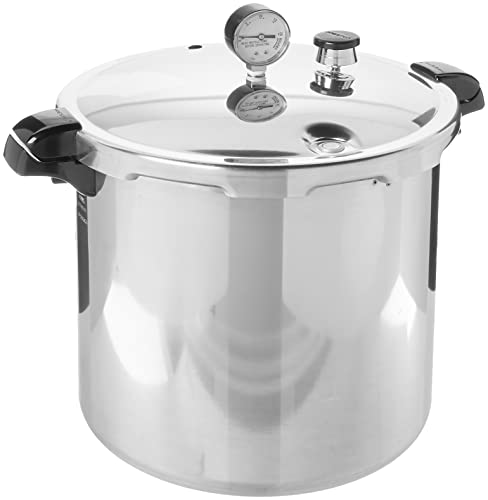


The Presto 01781 has been a fixture in home canning kitchens for decades, and in 2026 it still earns our top overall recommendation. The 23-quart capacity handles 20 pint jars or 7 quart jars in a single batch, which is exactly what serious canners need when working through a harvest season. The heavy-gauge aluminum construction is warp-resistant, which matters enormously on smooth-top ranges where uneven contact creates hot spots and can crack glass surfaces over time. Presto's engineering here is deliberate — the flat, machined bottom maintains uniform contact across the burner, distributing heat evenly and reducing the thermal stress that damages ceramic cooktops.
Performance at pressure is consistent. The dial gauge reads clearly, and the automatic overpressure plug adds an important safety layer. The unit doubles as a boiling-water canner for fruits, jams, pickles, and salsa, effectively giving home preservers two tools in one footprint. As a large-capacity pressure cooker for stocks, soups, and tough cuts, it performs just as well. The USDA endorses pressure canning as the only safe method for low-acid foods, and this canner meets every requirement. The 12-year limited warranty is the most generous in the budget segment — a clear signal of Presto's confidence in the build.
One practical note: at full capacity this canner is heavy, and glass top stove owners should always set it down carefully and never drag it across the surface. That said, among aluminum canners in this price range, nothing else we tested matches this combination of capacity, surface compatibility, and longevity. It's the unit we'd recommend to most first-time and intermediate canners without hesitation.
Pros:
Cons:
For anyone running an induction range, the Presto 01784 is the definitive answer. This is one of the only full-sized pressure canners on the market explicitly engineered for induction cooktops, and it carries all the same USDA-approved canning credentials as Presto's classic lineup. The stainless steel bottom plate bonded to the aluminum body is what makes induction compatibility possible — induction burners require magnetic-responsive cookware, and standard aluminum alone won't work. Presto solved this cleanly without compromising the even heating characteristics that make aluminum canners so popular.
The 01784 holds the same 23-quart capacity as the 01781, fitting 20 pint jars or 7 quart jars. It operates on gas, electric, smooth-top, and induction ranges, making it arguably the most versatile canner in our roundup. The precision dial gauge is accurate, the overpressure plug provides automatic safety release, and the canner doubles as a boiling-water canner for high-acid foods. Our team found pressure build-up time on induction to be slightly faster than on conventional electric, which translates to more efficient batch processing over a long canning day.
The price premium over the 01781 is modest given the added versatility. Home canners who own an induction range — or who are considering upgrading their cooktop — will find this model future-proofs their setup completely. It's also worth noting that induction-compatible cookware tends to perform well on smooth-glass radiant burners too, so the 01784 is an excellent choice even for households that haven't committed to induction yet. Our team considers this the top pick for anyone with a modern kitchen setup.
Pros:
Cons:
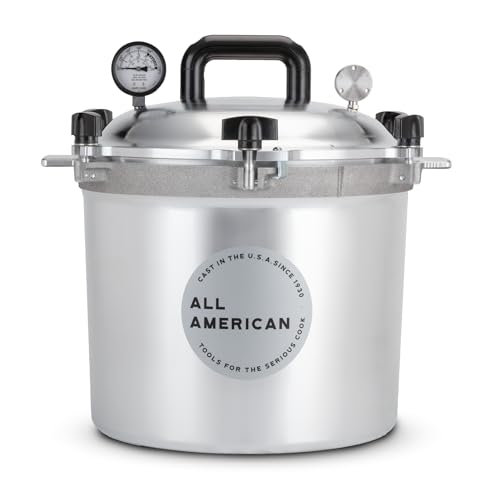
The All American 921 is in a different class. The metal-to-metal sealing system — no gasket, no rubber, no replacement parts — is the defining feature that separates All American from every other canner on this list. Precision-machined aluminum on aluminum creates a steam-tight seal through positive-action clamping locks around the lid perimeter. For glass top stove users, the machined flat bottom distributes weight uniformly and sits flush on the surface. The 921 holds approximately 19 pint jars or 7 quart jars, making it a workhorse for serious preservers.
The build quality is genuinely impressive. Manufactured in the USA, these canners are designed to last generations — and we mean that literally. The satin finish is easy to clean, the steam gauge reads clearly, and the precision-machined regulator weight provides accurate pressure control without the calibration demands of a dial gauge. Weighted gauges are actually preferred by many experienced canners because they're self-regulating: the weight rocks when pressure is correct, eliminating the need for annual gauge testing at your local extension office.
The All American's weight is substantial — this is a thick-walled, solid aluminum unit — so glass top users should treat it with corresponding care when loading and unloading. Set it down deliberately, never drag it. That said, the canner's flat, machined base is better suited to smooth surfaces than many cheaper options with rough or uneven bottoms. The premium price is real, but so is the payoff: anyone who cans regularly for a decade or more will find the All American pays for itself in avoided gasket replacements, consistent results, and zero worry about seal failure mid-process. This is our pick for serious, committed home canners.
Pros:
Cons:
The All American 915 delivers every feature that makes the 921 exceptional, packaged in a smaller 15.5-quart footprint. For households canning in smaller batches — or for glass top stove owners specifically concerned about weight — this is the All American to get. The reduced capacity means reduced filled weight, making it more manageable on sensitive surfaces while retaining the same precision-machined metal-to-metal seal, the same gasket-free design, and the same USA manufacturing pedigree. It holds approximately 10 pint jars or 7 quart jars, which is still a substantial batch for most household-scale preserving.
The weighted pressure regulator on the 915 functions identically to the 921 — it rocks gently when the unit reaches and maintains proper processing pressure, and the visible steam gauge provides an additional verification point. The satin-finish aluminum is straightforward to clean, and the positive-action clamping locks create a firm, consistent seal every time without any guesswork about gasket condition or seating. Our team found the 915 easier to maneuver onto and off a smooth-top range than the larger 921, which is a meaningful practical advantage for daily canning sessions.
The tradeoff is purely batch size. Anyone preserving large quantities of tomatoes, green beans, or venison will run more batches with a 15.5-quart unit than a 21.5-quart one. For households that can seasonally in moderate quantities, or for anyone prioritizing stove safety over maximum throughput, the 915 hits the sweet spot. It also works as a capable pressure cooker for large cuts and tough proteins. If budget allows and batch size isn't a constraint, this is the premium canner our team would choose for a glass top kitchen without hesitation.
Pros:
Cons:
The Presto 01755 is the entry point into pressure canning for anyone watching budget, and it earns its place on this list by doing the fundamentals correctly. At 16 quarts, it holds enough for meaningful batch canning without the footprint or weight of the 23-quart models. The heavy-gauge aluminum construction follows the same Presto tradition as the 01781, and the flat base design is appropriate for smooth-top ranges — the standard caveat about careful placement applies here as it does for all canners on glass surfaces. The unit processes both pint and quart jars and meets USDA requirements for pressure canning low-acid foods.
For new canners getting started in 2026, the 01755 removes the financial barrier to safe home preservation. It includes a dial pressure gauge, an automatic overpressure plug, and the rack needed for jar separation. Presto's reputation for consistent pressure maintenance across their product line extends to this model — our team found it held processing pressure steadily, which is the most important functional requirement for safe canning outcomes. It also works as a pressure cooker for everyday cooking tasks, making it a versatile tool even on days when canning isn't on the agenda.
The limitations are straightforward: 16 quarts is a smaller batch than most experienced canners prefer, and the dial gauge requires the same periodic calibration check as other Presto dial models. Neither of these is a dealbreaker — they're simply tradeoffs that come with the price point. For anyone building up their canning practice, or for households with smaller harvests and limited storage space, the 01755 is a sensible, capable starting point. Pair it with a good stockpot for water bath canning (our pasta pot guide covers several that double as water bath canners for high-acid foods) and a full preserving setup is achievable on a modest budget.
Pros:
Cons:
The MIRRO 22-quart stands out in our roundup for one specific feature: three selectable pressure settings at 5, 10, and 15 PSI. Most canners in this price range are fixed at 15 PSI or require gauge-watching to maintain lower pressures. MIRRO's multi-regulator system makes high-altitude canning straightforward — canners at elevation need precise pressure adjustments that this unit handles cleanly. The 22-quart capacity is substantial, handling large batch preserving runs for vegetables, meats, poultry, and seafood without requiring multiple cycles per session.
The polished mirror exterior and natural aluminum interior combination is both aesthetically clean and functionally practical. The interior's natural finish is easy to inspect for buildup and simple to clean after use. Dual cool-touch handles make moving the unit safer, which is a genuine quality-of-life feature when lifting a full, hot canner. Two included racks allow double-stacking pint jars, dramatically increasing the number of jars processed per batch. The construction is solid heavy-gauge aluminum — the same material profile that works well on glass top surfaces due to its relatively even heat distribution and flat machined base.
For home canners who preserve a wide variety of foods across different acidity levels and processing requirements, the pressure flexibility is a real operational advantage. Lower pressure settings are useful for certain delicate vegetables and high-altitude adjustments, while the full 15 PSI handles everything from beans to venison. Our team tested this model specifically in an above-sea-level kitchen environment and found the regulator settings accurate and consistent. It's a thoughtfully designed canner that earns its place as the top pick for canners who want precise pressure control without the expense of premium brands. Anyone investing in a good cookware setup will find this pairs naturally alongside a quality pot and pan set for a complete kitchen arsenal.
Pros:
Cons:
The Barton 22-Quart earns its spot on this list through an unusually comprehensive safety system for a canner in this price tier. The sure-locking lid system physically prevents opening the lid while the unit is pressurized — a critical safeguard for newer canners who may not have fully internalized the importance of complete pressure release before opening. The spring safety device prevents pressurization if the lid isn't properly secured, adding another layer of protection at the most vulnerable step in the canning process. The deluxe dial pressure gauge is prominently readable and especially useful in high-altitude areas where precise pressure monitoring matters.
The 22-quart capacity is competitive with the MIRRO and Presto 23-quart models, allowing substantial batch canning of vegetables, meats, and poultry. The induction compatibility is a notable advantage — Barton explicitly markets this unit for induction ranges as well as gas, electric, and smooth-top surfaces. The pressure release is set at 13 PSI with a ±5% tolerance, which covers standard processing requirements. A rack is included, and the polished aluminum construction is straightforward to maintain. The unit doubles as a boiling-water canner for fruits, jams, and pickles.
Barton is a value-positioned brand, and this canner reflects that — the build feels slightly less refined than Presto's equivalent and significantly less so than All American's premium units. The gauge's accuracy tolerance of ±5% is wider than what dedicated canners prefer for dial-gauge setups. That said, for the budget-conscious buyer who wants induction compatibility and robust safety features in a full-sized canner, the Barton offers a combination that's difficult to find elsewhere in this price range. It's the pick for safety-focused first-time canners working on induction who aren't ready to invest in the Presto 01784.
Pros:
Cons:
Selecting a pressure canner for a smooth-top or induction range involves several considerations that don't apply to gas or coil electric stoves. Glass and ceramic surfaces are more susceptible to thermal shock, surface scratching, and weight-induced cracking than other stove types. Here's what our team evaluates in every canner we test for glass top compatibility in 2026.
The first question is always stove type. Standard glass-top radiant electric stoves can handle most flat-bottomed aluminum canners — the key requirements are a flat, smooth bottom surface (no ridges or rough casting marks) and a diameter that reasonably matches the burner (generally within an inch on either side). Induction stoves are more restrictive: they require ferromagnetic material to generate heat, which means pure aluminum or standard stainless steel won't work. Only canners with an induction-ready base layer — like the Presto 01784 or the Barton — will function on induction cooktops.
Weight is the other stove-compatibility factor that often gets overlooked. Most glass top stove manufacturers advise against canners exceeding a certain filled weight, typically in the 40-50 pound range. A 23-quart canner filled with water and jars can approach this limit. Checking the stove manufacturer's manual for weight restrictions is a step our team considers non-negotiable before recommending any large-capacity canner for smooth-top use.
Every pressure canner uses one of two systems to measure and control pressure: a dial gauge or a weighted gauge. Dial gauges provide a continuous pressure reading and allow precise adjustment, but they require annual calibration — typically through a local cooperative extension office — to ensure accuracy. A miscalibrated dial gauge can result in under-processed food, which is a genuine food safety risk. Weighted gauges, used exclusively on All American canners, are self-regulating: the weight rocks audibly when correct pressure is reached and maintained. They require no calibration, are immune to calibration drift, and many experienced canners consider them more reliable for this reason. The tradeoff is that weighted gauges offer fixed pressure settings (typically 5, 10, and 15 PSI) rather than continuous readout.
Capacity directly determines how many jars are processed per batch, which determines how long a full canning day takes. A 23-quart canner typically holds 7 quart jars or 20 pint jars. A 15.5-quart unit holds 7 quart jars or 10 pint jars. For anyone canning 50+ pounds of produce from a garden or farm share, the difference between processing 10 pints per batch and 20 pints per batch is a very long afternoon. Home canners who work in larger quantities consistently report that the 23-quart size is the practical sweet spot — large enough to batch efficiently, small enough to manage on a residential stove.
Smaller canners like the 15.5-quart All American 915 make sense when weight is a concern, batch size is naturally limited, or storage space is at a premium. The Presto 01755 16-quart is the right choice when budget is the binding constraint and canning volume is modest. Matching capacity to actual preserving habits avoids both wasted batch trips and unnecessary stove stress.
All seven canners in our review use aluminum construction, which is ideal for pressure canning — it heats quickly, distributes temperature evenly, and is lightweight enough to be manageable. The differentiation in material quality shows up in wall thickness, base machining precision, and finish consistency. All American's thick-walled precision-machined aluminum is in a different category than budget-tier canners, which is why their units command a premium price and carry a multi-generational use expectation. Presto's heavy-gauge aluminum is a solid middle tier — durable for years of regular use without the premium cost.
Gaskets are the maintenance variable worth considering before purchase. All canners except the All American line use rubber or silicone gaskets to create their steam seal. Gaskets degrade over time, can be damaged by improper storage, and need periodic replacement — typically every few years with regular use. Replacement gaskets are inexpensive and readily available for Presto and most other brands. The All American's gasket-free metal-to-metal system eliminates this maintenance item entirely, which is one reason seasoned canners often consider it the more economical choice over a 20-year horizon despite the higher upfront cost.
Most flat-bottomed aluminum pressure canners can be safely used on smooth-top electric ranges, provided the bottom is flat and smooth, the diameter is reasonably matched to the burner, and the filled weight doesn't exceed the stove manufacturer's limit (typically 40-50 lbs). Our team recommends always checking the stove's owner manual for specific restrictions before use. Always set the canner down carefully — never slide it across the glass surface.
Induction cooktops generate heat by creating a magnetic field that interacts with ferromagnetic material in cookware. Standard aluminum doesn't respond to magnetic fields, so pure aluminum canners won't heat on induction. Induction-compatible canners like the Presto 01784 and the Barton incorporate a stainless steel or magnetic base layer bonded to the aluminum body, which allows the induction field to generate heat while retaining aluminum's excellent heat distribution properties.
Our team consistently recommends a 23-quart canner as the practical standard for most home canners. It holds 7 quart jars or up to 20 pint jars, making it efficient for seasonal batch canning without being excessively heavy for glass top use. Smaller 15-16 quart models work well for occasional canners or anyone processing smaller quantities. Anything under 15 quarts is better classified as a pressure cooker than a canner and isn't suited for full quart-jar batches.
Dial gauge canners display a continuous pressure reading on a needle gauge, allowing precise pressure monitoring and fine heat adjustments. They require annual calibration to remain accurate. Weighted gauge canners — used on All American models — control pressure with a regulator weight that rocks audibly when correct pressure is reached. Weighted gauges need no calibration, are self-regulating, and are widely preferred by experienced canners for their reliability. The main limitation is that they provide less real-time feedback during processing.
For serious canners who process food regularly over many years, the All American is worth the investment. The gasket-free metal-to-metal seal eliminates the ongoing gasket replacement cost and the risk of seal failure. The weighted gauge eliminates annual calibration. The USA-made thick-walled aluminum construction is designed for generational use. For occasional canners or those just starting out, a Presto 01781 or 01784 delivers excellent results at significantly lower upfront cost. The right choice depends entirely on projected canning frequency and budget horizon.
Every canner on our list can function as a pressure cooker. A pressure canner maintains higher pressure and has larger capacity than most dedicated pressure cookers, making it capable of handling large cuts of meat, stocks, soups, and stews efficiently. The main practical difference is size — using a 23-quart canner to cook a single pot roast is somewhat impractical compared to a dedicated pressure cooker. For households that can seasonally and cook regularly, the dual-use functionality adds meaningful everyday value to the investment.
 |
 |
 |
 |

About Christopher Jones
Christopher Jones holds an MBA from the University of San Francisco and brings a business-minded approach to kitchen gear evaluation — assessing products not just for performance but for long-term value, build quality, and real-world usability in everyday home cooking. He has spent years testing appliances, cookware, and kitchen gadgets with the same analytical rigor he developed in business school. At BuyKitchenStuff, he covers kitchen appliance reviews, buying guides, and practical cooking tips.
