Kitchen Gadgets & Equipment Reviews ›
by Rick Goldman
Which food mill should you actually buy in 2026 — the trusted OXO classic, the powerful Weston electric, or something built for commercial kitchens? If you've stood in the kitchen staring at a pot of tomatoes and wished you had a faster, cleaner way to strip seeds and skins, you already know why a food mill matters. It's one of those tools that sounds old-fashioned until you use one, and then you wonder how you ever got along without it. Whether you're making homemade tomato sauce, silky applesauce, lump-free mashed potatoes, or smooth baby food, a good food mill saves you serious time and effort compared to pushing food through a sieve by hand.
A food mill (essentially a hand-cranked or electric strainer that forces soft food through a perforated disc) has been a kitchen staple for generations — and for good reason. The right one gives you complete control over texture, separates seeds and skins automatically, and handles everything from berries to root vegetables. But with so many options on the market, picking the right one comes down to knowing exactly what you need: batch size, power source, disc fineness, and build quality. If you're also looking for other kitchen essentials, check out our guides to the best countertop blenders and the best electric pasta makers for more tools that make cooking from scratch a real pleasure.
We tested and researched the top-selling food mills of 2026 to bring you honest, practical reviews. Whether you're a home cook preserving a garden harvest or a professional chef processing large batches, there's a pick on this list for you. Browse our full kitchen product reviews for even more expert recommendations. Here's everything you need to know before you buy.
Contents
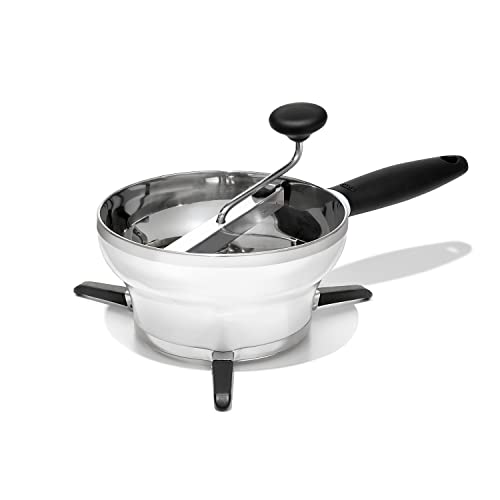


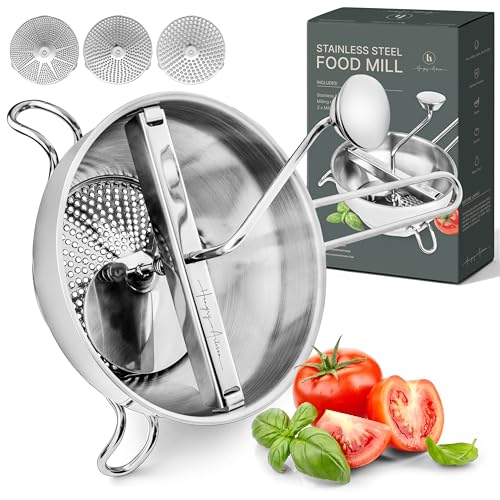

The OXO Good Grips Stainless Steel Food Mill has been a go-to recommendation for home cooks for years, and in 2026 it still holds up. The stainless steel bowl is completely nonreactive, which means you can run hot tomatoes, acidic fruits, and pigment-heavy vegetables through it without worrying about staining or off-flavors. That matters more than you'd think — some cheaper mills will pick up tomato stains within a season of use. The OXO stays clean and professional-looking no matter how hard you push it.
What really sets this mill apart is the spring-loaded disc exchange system. You get three stainless steel grinding discs — fine, medium, and coarse — and swapping between them takes seconds rather than the fiddly unscrewing that plagues older designs. If you're making raspberry coulis (fine disc) and then mashed potatoes (coarse disc) in the same session, that convenience adds up fast. The feet lock over the rim of most standard pots and bowls, keeping the mill stable while you crank. Build quality is solid throughout, with no plastic parts in the food path.
If you're an everyday home cook who wants one food mill that handles everything from baby food to holiday applesauce, the OXO is the easiest recommendation on this list. It isn't the biggest or the fastest, but it balances capacity, ease of use, and durability in a way that most cooks will appreciate for years. The only real limitation is size — for large-scale preserving sessions with bushels of tomatoes, you'll want to look at the Weston electric or the Louis Tellier commercial option instead.
Pros:
Cons:
Cuisinart's food mill brings the brand's reliable build quality to a 2.3-quart stainless steel package that handles most weeknight and weekend cooking tasks without breaking the bank. You get the same three-disc setup — fine, medium, coarse — that you'll find on premium mills, which means you're not giving up versatility for the lower price. The all-stainless construction feels durable and appropriately heavy without being cumbersome to lift or store in a cabinet.
The 2.3-quart capacity is a genuine sweet spot for household cooking. It's large enough to process a full pot of stewed tomatoes in a reasonable number of batches, but compact enough that it doesn't dominate your storage space. Cleanup is straightforward — the parts disassemble cleanly and most users find it easy to rinse under running water or load into the dishwasher. For making tomato sauce, applesauce, or smooth vegetable soups, this mill performs consistently well.
Where you might notice the mid-range positioning is in the crank action. Under heavy loads — particularly dense root vegetables — the turning resistance is higher than on the OXO. It's still very manageable, but if you have wrist or grip concerns, that's worth factoring into your decision. Overall, the Cuisinart is a smart buy if you want a name-brand product with solid everyday performance at a price that doesn't hurt.
Pros:
Cons:
If you're preserving garden harvests, processing bushels of tomatoes at a time, or simply don't want to crank by hand for extended sessions, the Weston Deluxe Electric Tomato Strainer is in a different league from everything else on this list. The 250-watt motor drives the strainer at two speeds, and the one-gallon hopper means you can continuously load fruit or vegetables without stopping to empty and reload. For people who do serious canning, this machine pays for itself in time and effort within the first season of use.
The two-speed operation is genuinely useful in practice. Forward speed handles normal straining — removing skins and seeds from tomatoes, soft fruits, and vegetables efficiently without requiring any coring beforehand. The reverse speed prevents jamming, which is a real quality-of-life feature when you're processing large quantities and don't want to stop and disassemble the machine every time something gets stuck. Processing speed is impressively fast: you can work through a large pot of cooked tomatoes in a matter of minutes rather than the extended cranking a manual mill requires.
The trade-off is that this is a specialized appliance rather than a general-purpose kitchen tool. It takes up more storage space than a manual mill, and it needs to be near an outlet. If you're making occasional small batches of tomato sauce or applesauce, a manual mill is probably the better fit. But for anyone who grows their own produce and spends time each summer or fall preserving food in bulk, the Weston electric removes what would otherwise be the most tedious step in the process. It's also worth noting that this pairs naturally with a good straining workflow — if you're interested in making tomato juice recipes, this machine will dramatically speed up that process too.
Pros:
Cons:
The RSVP International Endurance Food Mill is a straightforward, no-frills stainless steel mill that earns its place on this list through sheer value. At 7.75 inches in diameter and 4.25 inches tall, it's compact enough to store easily but large enough to handle a meaningful batch of food. The 18/8 stainless steel construction (meaning 18% chromium, 8% nickel — the industry standard for food-safe, corrosion-resistant steel) makes it nonreactive and hygienic, which is the kind of material quality you want when processing acidic foods like tomatoes or citrus.
This is the mill to recommend to someone who wants to try food milling for the first time without a large upfront investment. It handles classic food mill tasks — applesauce, tomato sauce, mashed potatoes, strained carrots, peach puree, and raspberry coulis — competently and without fuss. The basic crank mechanism is intuitive, and the simple design means fewer parts to lose or break over time.
The limitations are the flip side of the simplicity. There's no disc-change system as sophisticated as the OXO, and the single included disc (or limited disc options depending on the package) means less texture control compared to three-disc mills. For everyday cooking where you're not chasing precision texture control, that's a reasonable trade-off at the price point. If budget is your primary concern and you want a durable stainless steel mill that will last, the RSVP International is a solid choice in 2026.
Pros:
Cons:
The Mirro Foley is one of the more classic designs you'll find on this list, and that's not necessarily a bad thing. The Foley name has been associated with food mills for decades, and the 2-quart stainless steel version carries on that tradition with durable construction and a practical size that suits households cooking for two to four people. If you're making a small jar of applesauce, processing a handful of roasted tomatoes, or ricing a couple of potatoes for a weeknight dinner, this mill is genuinely well-suited to the task.
The 2-quart capacity is the defining characteristic here — it's purposefully sized for moderate quantities rather than large-scale preserving. The milling discs handle the standard range of tasks (mashing, straining, grating, ricing) with the consistency you'd expect from a basic stainless steel construction. Cleanup is easy, and the elegant design means it doesn't look out of place sitting on a countertop or hanging in a well-organized kitchen.
Where the Mirro Foley falls short is in disc variety and feature refinement. Compared to the OXO's spring-loaded exchange system or the Cuisinart's clean disc mechanism, the Foley's design is more utilitarian. For cooks who want simplicity above all else and aren't processing large volumes, that's perfectly fine. If you need more capacity or more texture control, step up to one of the larger three-disc options. But for light, regular use in a smaller household, this mill gets the job done without unnecessary complication.
Pros:
Cons:
This stainless steel food mill with three discs and an ergonomic rotary hand crank occupies an interesting spot in the market — it's designed specifically around reducing hand fatigue during extended use. The rotary crank mechanism is shaped and positioned to feel more natural in your hand compared to the straight-handle cranks on many competitors. If you've ever cranked a food mill for twenty minutes straight and felt it in your wrist afterward, you'll appreciate why that design choice matters in practice.
You get the full three-disc range — fine, medium, and coarse — in durable stainless steel, which means you can work through smooth purees, standard sauces, and chunkier preparations without swapping to a different tool. The mill handles the classic food mill repertoire: tomato sauce, applesauce, baby food, mashed potatoes, and canning prep. Dishwasher-safe construction simplifies cleanup, which is a practical plus when you're in the middle of a batch cooking session and don't want to hand-wash between uses.
The ergonomic focus is the real differentiator here. If you or someone you cook for has arthritis, repetitive strain concerns, or simply cranks large quantities regularly, this design reduces the effort required per revolution compared to standard-handle mills. It's also a good option for teaching kids or older family members to use a food mill, since the motion feels more intuitive. Build quality is solid throughout — the stainless steel holds up to regular use and doesn't show the wear marks that cheaper alloy mills develop over time. A well-designed food mill like this pairs nicely with a good countertop blender when you want to handle both smooth and chunky textures in your cooking.
Pros:
Cons:
The Louis Tellier X5 is not a kitchen gadget — it's a piece of professional equipment. If every other mill on this list is built for the home cook, the Louis Tellier is built for the chef. The 8-quart capacity is enormous compared to everything else here, and the flow rate of 11 pounds per minute means you can process a truly industrial quantity of food in a short window. Professional kitchens, catering operations, and serious home preservers who put up large quantities of sauce, soup, or puree each season will find this machine performs at a completely different level.
The X5 comes with a 2mm grid (the disc that controls how finely the food is processed), and the overall construction is robust — the kind of heavy-duty stainless steel build that's meant to last through years of commercial use. It handles the full range of food mill applications: purees, stewed fruit, fish soup, tomatoes, apples, carrots, potatoes. Given its service volume of 10 to 50 portions per batch, this is the right tool when you're feeding a crowd or preserving a large harvest in a single session rather than spreading it across multiple days.
The honest caveat is that the Louis Tellier X5 is simply too much mill for most home cooks. It's expensive, it's large, and its capacity far exceeds what a household of four needs even for ambitious preserving. But if you know you need a professional-grade food mill — whether you're running a small restaurant, catering events, or genuinely preserving hundreds of pounds of produce a year — this is the option that won't let you down. It's the kind of investment that pays off over years of heavy use. Pair this kind of high-output kitchen setup with equipment like the best electric pasta makers if you're building out a serious food production workflow at home or in a small commercial kitchen.
Pros:
Cons:
Shopping for a food mill is simpler than it looks once you know which factors actually matter for your cooking habits. Here are the key things to think through before you buy.
Most food mills on the market are manual — you turn a hand crank to force food through the disc. Manual mills are compact, affordable, require no electricity, and give you tactile control over the process. They're the right choice for most home cooks making sauces, purees, and applesauce in typical household quantities. Electric food mills (like the Weston on this list) are in a different category: they're faster, require less physical effort, and can handle large volumes continuously. If you're canning dozens of quarts of tomato sauce each summer or preserving bulk fruit from your garden, an electric strainer pays for itself in time savings. If you're making a pot of soup or a jar of applesauce once a week, a manual mill is more practical.
Think honestly about how much food you process at a time. A 2-quart mill like the Mirro Foley is perfect for a household of two to four people making weekly sauces. A 2.3-quart mill like the Cuisinart handles a bit more. The OXO sits in a similar range. If you regularly cook for larger groups, host dinner parties, or preserve food seasonally, you'll want to look at larger options. The Louis Tellier X5's 8-quart capacity is designed for true professional-scale output — serving 10 to 50 portions per batch — which is overkill for most kitchens but exactly right for some. Matching capacity to your actual cooking habits is one of the most important decisions you'll make when choosing a food mill.
The disc (also called a grid or plate) is the perforated surface that food is forced through, determining the final texture of your output. Fine discs produce silky smooth purees and are ideal for baby food, tomato sauce, and fruit coulis (a smooth fruit sauce). Medium discs give you a slightly textured result that works well for applesauce or chunky soups. Coarse discs produce a rougher output suited for mashed potatoes or rustic vegetable preparations. Mills that include all three discs give you the most flexibility. If a mill only comes with one disc, make sure it's the texture you need most — or confirm that additional discs are available to purchase separately.
Stainless steel is the material you want for any food mill you plan to use long-term. It's nonreactive (won't pick up flavors from acidic foods like tomatoes), easy to clean, resistant to staining, and durable enough to handle heat from hot foods. Look specifically for 18/8 stainless steel (sometimes labeled 304 stainless) — this is the food industry standard. Avoid mills with plastic parts in the food path if you're processing hot foods regularly, as plastic can absorb flavors and degrade over time. The handle, crank, and leg mechanism can be plastic or metal without significantly affecting performance, but the bowl, disc, and blade should be stainless.
A food mill is a kitchen tool that forces cooked soft foods through a perforated disc to produce a smooth or textured puree while automatically removing skins, seeds, and fibers. Common uses include making tomato sauce, applesauce, mashed potatoes, baby food, fruit coulis, vegetable soups, and jams. It does the work of both straining and pureeing in a single step, which is why many cooks prefer it over a blender for certain tasks — particularly when you want to remove seeds and skins without blending them in.
Yes, and many cooks consider it the best method. Forcing cooked potatoes through a food mill produces exceptionally smooth, lump-free mashed potatoes without the gluey texture that can result from over-processing in a blender or food processor. The coarse disc is typically the right choice for potatoes. You can also rice (process into small, rice-like pieces) potatoes through a food mill with a coarse disc, which produces a fluffy, airy texture ideal for certain recipes.
No — that's one of the main advantages of a food mill for tomato processing. The food mill separates the tomato flesh and juice from the skins and seeds automatically as you crank. You simply cook the tomatoes until soft and then run them through the mill. This saves a significant amount of prep time compared to blanching and peeling tomatoes by hand before cooking. The same applies to many other fruits and vegetables: food mills handle the separation step so you don't have to.
A food processor chops, slices, or purees food by running it through rotating blades, but it doesn't separate skins and seeds — it blends everything together. A food mill forces food through a perforated disc, straining out seeds and skins in the process. For tomato sauce, applesauce, or raspberry coulis where you want smooth texture without seeds and skins, a food mill produces a cleaner result. For tasks like chopping onions, shredding cheese, or making dough, a food processor is the right tool. Many home cooks own both for different purposes.
It depends on the model. Most stainless steel food mills are dishwasher safe, but you should always check the manufacturer's instructions for the specific product you own. Some mills have parts (particularly the crank mechanism or rubber feet) that are labeled hand-wash only. Even dishwasher-safe mills often last longer with occasional hand washing, as the high heat and detergents in dishwashers can cause cosmetic wear over time. The discs, bowl, and blade are the parts that benefit most from thorough cleaning after each use.
For most home cooks, three discs — fine, medium, and coarse — give you all the texture control you'll ever need. Fine is best for baby food, smooth sauces, and fruit coulis. Medium works well for applesauce and chunky soups. Coarse suits mashed potatoes and rustic vegetable preparations. If you're primarily making tomato sauce and nothing else, a single medium disc may be sufficient. But if you cook a wide variety of foods, a three-disc set gives you the flexibility to match the texture to the recipe without compromise.
A food mill is one of those kitchen investments that quietly makes a big difference in the quality of your homemade sauces, soups, and preserves — once you start using one, going back to pushing food through a sieve by hand feels like a chore you'll never want to repeat. Take a look at the options above, match the capacity and features to how you actually cook, and pick the one that fits your kitchen and your habits best. Whether you go for the everyday versatility of the OXO, the hands-free power of the Weston electric, or the professional output of the Louis Tellier, you're making a choice that will serve you well through many cooking seasons in 2026 and beyond.
 |
 |
 |
 |

About Rick Goldman
Rick Goldman grew up traveling the Pacific Coast and developed an early appreciation for regional and international cuisines through exposure to diverse food cultures from a young age. That culinary curiosity shaped his approach to kitchen gear — he evaluates tools based on how well they perform across different cooking styles, ingredient types, and meal occasions. At BuyKitchenStuff, he covers kitchen equipment reviews, recipe guides, and food-focused buying advice.
