by Christopher Jones
Have you ever wondered exactly how long your turkey needs to cook in a convection oven — and whether you're doing it right? The answer might surprise you: a convection oven can cut your turkey cooking time convection oven roasting by roughly 25% compared to a conventional setup. That means a bird that normally takes four hours could be done in about three. But shaving off time only works if you know the correct temperatures, prep steps, and timing adjustments. This guide covers everything you need to roast a perfect turkey using convection heat, from basic timing charts to advanced techniques. If you enjoy cooking guides like this, you'll find plenty more tips across our site.

Convection ovens use a fan to circulate hot air evenly around your food. This consistent airflow eliminates hot spots and promotes even browning — two things that make a massive difference when you're roasting a large bird. The result is crispier skin, juicier meat, and a shorter cook time.
Whether you're a first-time turkey roaster or someone who's cooked dozens, understanding how convection changes the game will help you nail it every time. Let's break it down section by section.
Contents
The standard guideline for turkey cooking time in a convection oven is about 11 to 13 minutes per pound at 325°F (163°C). Compare that to 15 to 17 minutes per pound in a conventional oven and the time savings become clear. The circulating air does the heavy lifting — it transfers heat more efficiently, which means the outer layers of the turkey cook faster without drying out the interior.
Keep in mind that every oven is slightly different. Your convection fan speed, oven calibration, and even altitude can shift cook times by a few minutes per pound. That's why a meat thermometer is non-negotiable.
For an unstuffed turkey at 325°F in convection mode, here's what you can generally expect:
These are estimates. Always verify doneness with an instant-read thermometer inserted into the thickest part of the thigh. You're looking for 165°F (74°C) as recommended by the USDA food safety guidelines.

A wet or dry brine adds moisture to the meat before it ever hits the oven. Since convection ovens cook faster, there's slightly less time for the turkey to dry out — but brining provides an extra insurance policy. A simple dry brine of kosher salt rubbed under and over the skin, applied 12 to 24 hours before roasting, works wonders.
For a wet brine, dissolve one cup of salt per gallon of water and submerge the turkey overnight. Rinse and pat completely dry before roasting. Dry skin equals crispy skin.
Here's a question that divides home cooks: should you baste a convection turkey? The short answer is that you don't need to. Every time you open the oven door, you lose heat and disrupt the airflow that makes convection cooking effective. If you want extra flavor on the skin, brush the turkey with butter or oil before roasting and leave it alone.
Some cooks baste once or twice during the last hour. That's fine — just don't overdo it. The convection fan is already doing the work of distributing heat evenly, so constant basting creates more problems than it solves.
Pro tip: If the skin is browning too quickly, tent the breast loosely with aluminum foil during the last third of cooking rather than reducing the oven temperature.
If this is your first time roasting a turkey in a convection oven, keep it simple. Season your bird with salt, pepper, and a little butter. Place it on a rack inside a roasting pan, set the oven to 325°F convection, and let it cook. Check the internal temperature about 45 minutes before your estimated finish time.
That's it. You don't need a complicated herb crust, injection marinade, or rotisserie attachment. A straightforward approach will give you a bird that's better than what most people pull off in a conventional oven. If you enjoy straightforward cooking methods, you might also like our guide to making honey garlic pork tenderloin in an Instant Pot — another easy recipe with impressive results.
Experienced cooks can take things further with a two-temperature approach:
This method gives you deeply golden, crispy skin while keeping the interior moist. The higher initial temperature also helps render fat from under the skin more effectively. Just watch carefully during that first 30 minutes — convection at 425°F moves fast.
Another advanced technique is spatchcocking (butterflying) the turkey. Removing the backbone and pressing the bird flat reduces cooking time even further — sometimes by another 30%. A spatchcocked turkey in a convection oven can cook in under two hours for a 14-pounder.
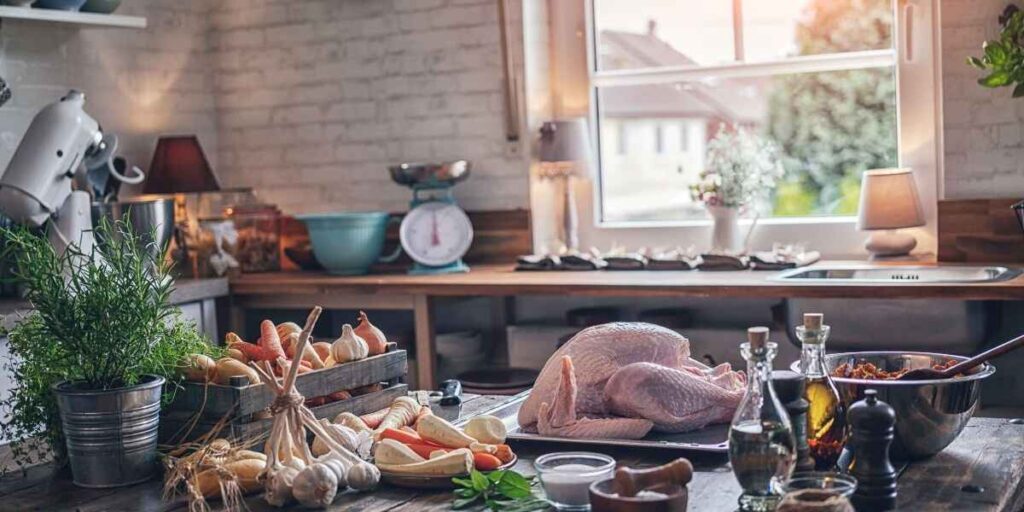
Proper prep is half the battle. Follow these steps before the turkey goes into the oven:
That room-temperature rest matters. A cold turkey straight from the fridge will cook unevenly — the outer meat overcooks while the center struggles to reach a safe temperature.
Once your turkey is prepped, here's how to manage the cook:
You've heard it already in this guide, and you'll hear it again: a reliable meat thermometer is the single most important tool for roasting turkey. Digital probe thermometers that stay in the bird during cooking are ideal. They let you monitor the internal temperature without opening the oven door and disrupting the convection airflow.
Instant-read thermometers work too, but you'll need to open the oven to check. Either way, don't rely on pop-up timers — they're unreliable and often trigger late, resulting in dry meat.
A sturdy roasting pan with a wire rack elevates the turkey so hot air circulates underneath. This is especially important in a convection oven where even airflow is the whole point. Disposable aluminum pans can work in a pinch, but they're flimsy and harder to handle when full of hot drippings.
Other useful tools include:
Speaking of kitchen upkeep, once you've finished the big cook, you'll want to clean up properly. Check out our tips on how to clean the outside of a stainless steel kettle — the same principles apply to scrubbing roasting pans.
Below is a comprehensive turkey cooking time convection oven chart for both stuffed and unstuffed birds at 325°F. Use this as your planning reference, but always verify with a thermometer.
| Turkey Weight | Unstuffed (Convection) | Stuffed (Convection) | Conventional (Unstuffed) |
|---|---|---|---|
| 8–10 lbs | 1.5–2 hours | 2–2.5 hours | 2.5–3 hours |
| 10–12 lbs | 1.75–2.5 hours | 2.25–3 hours | 3–3.25 hours |
| 12–14 lbs | 2.25–2.75 hours | 2.75–3.25 hours | 3.25–3.75 hours |
| 14–18 lbs | 2.75–3.25 hours | 3.25–3.75 hours | 3.75–4.25 hours |
| 18–22 lbs | 3.25–3.75 hours | 3.75–4.5 hours | 4.25–4.75 hours |
| 22–24 lbs | 3.75–4.25 hours | 4.25–5 hours | 4.75–5.25 hours |
As you can see, the convection advantage grows with turkey size. On a 22-pound bird, you could save up to an hour compared to conventional roasting. That's significant when you're juggling side dishes and dessert prep.
Stuffing a turkey adds 30 to 60 minutes to the total cook time, even in a convection oven. The stuffing acts as insulation, slowing heat penetration to the center of the bird. You must check the stuffing temperature separately — it needs to reach 165°F in the center to be safe.
Many food safety experts recommend cooking stuffing in a separate dish. You'll get a crispier top on the dressing and eliminate the risk of undercooked stuffing inside the bird. If you do stuff the turkey, pack it loosely — about three-quarters of a cup of stuffing per pound of turkey.
The most common mistake is setting the temperature too high. Some recipes suggest roasting at 350°F or even 375°F in convection mode. Unless you're doing a deliberate high-heat sear at the beginning, these temperatures will overcook the outside before the inside catches up on larger birds.
Other temperature-related errors include:
Cutting into a turkey immediately after removing it from the oven is a guarantee of dry meat. Those juices you see pooling on the cutting board? They should be inside the turkey. A minimum 20-minute rest — loosely tented with foil — lets the muscle fibers relax and reabsorb moisture.
Don't worry about the turkey getting cold during resting. A large bird retains heat remarkably well. Internal temperature will actually continue rising 5 to 10 degrees after you remove it from the oven (this is called carryover cooking). That's why you can safely pull the turkey at 160°F and let it coast up to 165°F.
Other common mistakes to avoid:
Most manufacturers recommend reducing the temperature by 25°F compared to conventional recipes. So if a recipe calls for 350°F conventional, set your convection oven to 325°F. Many modern convection ovens make this adjustment automatically — check your owner's manual to see if yours does.
It's not recommended. Roasting a frozen turkey — even in a convection oven — leads to uneven cooking. The outside overcooks while the center remains dangerously undercooked. Always thaw your turkey fully in the refrigerator before roasting. Allow 24 hours per 4 to 5 pounds for safe thawing.
Brine the turkey beforehand (dry or wet brine both work), start with a well-dried skin coated in butter or oil, avoid opening the oven door frequently, and most importantly pull the turkey when the thigh reaches 160–165°F. Resting for at least 20 minutes after cooking allows juices to redistribute and keeps the meat moist.
Now that you know the turkey cooking time convection oven basics — from prep and timing to temperature targets and common pitfalls — it's time to put this knowledge to work. Pick up a reliable digital probe thermometer if you don't have one, plan your timeline using the size chart above, and give your next turkey the convection treatment. You'll wonder why you ever roasted any other way.
 |
 |
 |
 |

About Christopher Jones
Christopher Jones holds an MBA from the University of San Francisco and brings a business-minded approach to kitchen gear evaluation — assessing products not just for performance but for long-term value, build quality, and real-world usability in everyday home cooking. He has spent years testing appliances, cookware, and kitchen gadgets with the same analytical rigor he developed in business school. At BuyKitchenStuff, he covers kitchen appliance reviews, buying guides, and practical cooking tips.
Check for FREE Gifts. Or get our Free Cookbooks right now.
Disable the Ad Block to reveal all the recipes. Once done that, click on any button below
|
|
|
|
