Kitchen Gadgets & Equipment Reviews ›
by Rick Goldman
Picture this: it's a sweltering July afternoon, the family is home, and someone decides it's finally time to stop buying overpriced pints from the grocery store. So the search begins — and within ten minutes, there are seventeen tabs open and zero clarity. Ice cream makers range from under $30 to over $400, and the specs don't make it obvious which ones actually deliver creamy, scoopable results versus icy disappointment.
Our team has tested and compared the leading machines across every price tier to cut through the noise. Whether the goal is a quick single-serving treat or enough frozen yogurt to feed a crowd, the 2026 market has strong options at every budget. We evaluated consistency, ease of use, cleanup time, and overall value — and the seven picks below represent the best ice cream makers for the money right now.

From the innovative Ninja CREAMi to the classic Nostalgia bucket-style machine, each of these picks earned its spot on our list for a concrete reason. We've also included a full buying guide in our reviews section and a practical FAQ to help anyone choose the right model with confidence. For frozen dessert lovers who also enjoy hot drinks on the other end of the spectrum, our roundup of the best hot chocolate makers is worth a look as well.
Contents


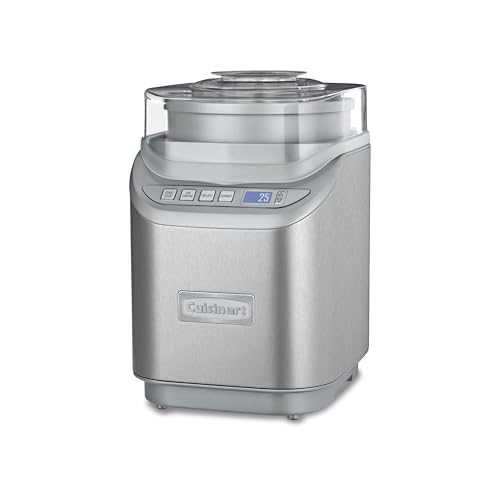


The Ninja CREAMi has become one of the most talked-about kitchen appliances of the last few years — and after putting it through its paces, we understand why. This machine works differently from traditional ice cream makers. Instead of churning while freezing, the CREAMi processes a pre-frozen pint by driving a blade down through the solid block, shaving and blending it into a smooth, creamy texture. The result is genuinely impressive: gelato-style creaminess from a $200 machine.
The 800-watt motor handles seven one-touch programs — Ice Cream, Sorbet, Gelato, Milkshake, Mix-In, Smoothie Bowl, and Lite Ice Cream. The compact footprint is a real advantage in a crowded kitchen. Two pint containers with lids are included, which means batches can be prepped and frozen in advance, then processed on demand. For anyone managing dietary restrictions, the ingredient-control angle is genuinely useful: keto, dairy-free, low-sugar, and vegan bases all work without modification.
One thing to factor in: pints need at least 24 hours in the freezer before processing. That means some planning ahead is required, which doesn't suit last-minute cravings. Still, for consistent texture and impressive customization, the CREAMi earns our top overall pick for 2026. It dominated its category in U.S. dollar sales across multiple years ending January 2025, and the community around recipe development has grown substantially.
Pros:
Cons:
The Breville Smart Scoop is the machine for people who want a true appliance-grade experience — brushed stainless steel construction, a built-in compressor (meaning no pre-freezing required), and a proprietary feature that no other model on this list has: automatic hardness sensing. The machine reads the consistency of the mixture during churning and adjusts processing to hit one of 12 hardness settings, from soft sorbet to firm gelato. Pour ingredients in, select hardness, press start.
Beyond that headline feature, the Smart Scoop delivers on the details. The pre-cool function chills the bowl to optimal temperature before churning begins, which matters for achieving uniform texture without ice crystals (tiny frozen water particles that make ice cream grainy). A keep-cool mode then holds the finished product at serving temperature for up to three hours — a genuinely practical touch for entertaining. The brushed stainless finish holds up to regular use without showing wear.
The price is the main barrier. This is a serious investment, and most buyers who go this route are committed ice cream enthusiasts. But for those who want a machine that does the thinking for them and produces consistent results batch after batch without any canister prep, the Breville Smart Scoop is the premium benchmark in 2026.
Pros:
Cons:
Tech Gear Lab's "Best Overall Ice Cream Maker" award is printed right on the box, and after testing this machine, the recognition holds up. The Whynter ICM-200LS brings compressor-based self-freezing technology to a more accessible price point than the Breville, making it a strong contender for buyers who want on-demand production without the premium outlay. No pre-freezing a canister, no planning 24 hours ahead — add ingredients, start the machine, scoop in about 30–40 minutes.
The 2.1-quart stainless steel bowl handles a meaningful batch size, and the LCD display with built-in timer makes tracking progress simple. The BPA-free churn blade is included and contributes to both texture quality and peace of mind for health-conscious households. Continuous use is genuinely supported by the compressor design — back-to-back batches are possible without waiting for anything to re-freeze, which makes this the right pick for gatherings or large households that go through multiple batches in a session.
Gelato, sorbet, and ice cream all performed well in our testing. Texture consistency was high across batches, and the machine ran quietly relative to other compressor units. For the buyer who wants a true compressor machine without paying Breville prices, the Whynter is our pick.
Pros:
Cons:
Cuisinart has been making reliable kitchen appliances for decades, and the ICE-70P1 represents the brand at its practical best. This 2-quart machine churns out a full batch of ice cream, frozen yogurt, gelato, or sorbet in as little as 20 minutes — a speed that impresses first-time buyers. The canister-style design (meaning the bowl must be pre-frozen before use, typically 16–24 hours) keeps the price reasonable while delivering genuinely good results.
The LCD screen and built-in countdown timer with auto-shutoff are features usually reserved for higher-end machines, and their inclusion at this price point is one of the reasons this model stands out. Three settings with multiple speeds give operators fine control over the churn without making things complicated. Stainless steel construction looks sharp on the counter and cleans up easily. The 2-quart capacity is the right size for most family households — enough for four to six generous servings per batch.
The 20-minute churn time is accurate under ideal conditions (cold mix, properly frozen canister). Real-world results are consistently strong. For buyers who want a feature-rich canister machine at a mid-range price, the ICE-70P1 is a smart choice in 2026. Anyone interested in other dessert appliances might also enjoy our look at the best electric milk frothers — a natural companion for ice cream floats and coffee-based frozen drinks.
Pros:
Cons:
The Cuisinart ICE-21P1 is the machine we recommend when someone wants to try homemade ice cream without committing serious money. At its price point, it overdelivers.strong> The double-insulated freezer bowl (a bowl with gel sealed between two walls that locks in cold once frozen) eliminates the need for ice or salt, which simplifies cleanup considerably compared to old-fashioned bucket machines. The result: clean, fuss-free production in 20 minutes or less.
Capacity is 1.5 quarts — slightly smaller than the ICE-70P1, but completely adequate for most households making a single flavor at a time. The mixing paddle is straightforward and effective. Controls are simple: one button, one speed. There's no LCD screen or timer here, which is a trade-off that keeps the price low and also means one less thing to break. The machine is light enough to pull out and put away easily, which encourages more frequent use.
The pre-freeze requirement (plan ahead 16–24 hours) is the same caveat as with any canister machine. But for first-time ice cream makers or budget-focused buyers, the ICE-21P1 delivers excellent value and consistent results — it's been a best-seller in this category for years and continues to earn strong reviews in 2026.
Pros:
Cons:
The Dash My Pint solves a specific problem: making a single serving of ice cream without dedicating counter space or cabinet real estate to a full-size machine. This is the right machine for small kitchens, dorm rooms, studio apartments, or anyone who lives alone and doesn't need a 2-quart batch. The 1.6-cup capacity (just under a standard pint) is intentionally small and intentionally convenient.
Operation is as simple as it gets: one-touch churning with no settings to navigate. The machine disassembles easily for cleaning, and the accessories store inside the unit itself — a thoughtful design detail that means no loose parts scattered in a drawer. It makes gelato, sorbet, and frozen yogurt in addition to ice cream, so the small size doesn't limit flavor variety. The aqua color option is appealing in a market full of stainless and white.
The limitations are real: this is not a machine for families, parties, or anyone who wants more than a personal portion at a time. But within its intended use case, the Dash My Pint delivers consistently and earns its place on this list as the most space-efficient option available in 2026.
Pros:
Cons:
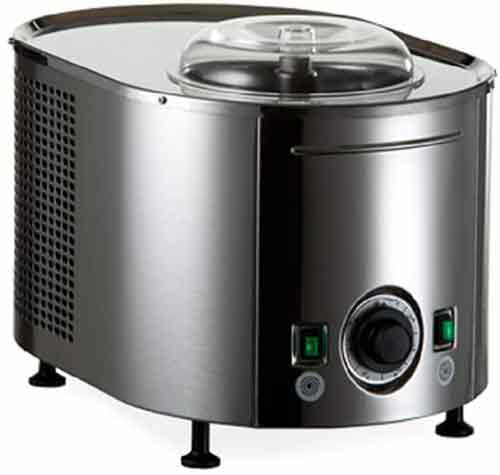
The Nostalgia machine brings back the visual style of old-fashioned ice cream socials — wooden bucket exterior, aluminum canister, classic electric churn — and it does so while delivering a genuinely practical 4-quart batch capacity. No other machine on this list makes as much ice cream at once. For large households, summer cookouts, birthday parties, or family gatherings, that capacity is the deciding factor. Four quarts means twelve to sixteen generous servings per batch.
The electric motor handles the churning automatically, so there's no hand-cranking involved despite the nostalgic aesthetic. The process involves surrounding the canister with ice and salt (rock salt accelerates freezing by lowering the temperature of the ice — this is the traditional method), which delivers the old-fashioned creamy texture that many purists prefer. It also means slightly more setup and cleanup than canister machines. The machine is safe for kids to participate in, and that interaction — watching the process, adding ingredients, scooping the finished product — makes it genuinely engaging for family use.
Beyond ice cream, the machine handles gelato and frozen yogurt as well. For buyers who prioritize batch size and the social experience of making ice cream the traditional way, the Nostalgia 4-quart is the right call. It's also a conversation piece that most countertop compressor machines simply aren't. According to Wikipedia's overview of ice cream maker history, the ice-and-salt bucket method is the original home production technique — and it still works beautifully.
Pros:
Cons:
With seven strong options on the list, the right choice comes down to a few practical factors. Here's what our team focuses on when evaluating any ice cream maker.
This is the biggest functional difference between machines. Compressor machines (Breville, Whynter) have a built-in refrigeration unit — no prep required, just pour and churn. They're the most convenient but also the most expensive and bulkiest. Canister machines (both Cuisinarts, Ninja CREAMi) require the bowl or pint to be frozen solid before use, which means planning 16–24 hours ahead. They're lighter, cheaper, and compact. Ice-and-salt machines (Nostalgia) use the traditional method — surround the canister with a mixture of ice and rock salt to create sub-zero temperatures. This method produces excellent texture but demands the most prep work. Most home buyers land in the canister camp for the balance of cost and convenience.
Capacity ranges from 1.6 cups (Dash My Pint) to 4 quarts (Nostalgia) on this list. For a household of two to four people, a 1.5 to 2-quart machine is the right fit. Single-person households or those with limited freezer space benefit from the smaller pint-format machines. Anyone hosting parties or large family events should look at the 4-quart Nostalgia or consider a compressor machine that supports continuous back-to-back batches. The Ninja CREAMi processes one pint at a time but extra pint containers can be purchased separately to batch prep.
Controls range from single-button operation (Dash, Nostalgia) to seven one-touch programs (Ninja CREAMi) to automatic hardness sensing (Breville). For most home users, simpler is better — complexity doesn't translate to better ice cream unless the user actively engages with settings. Cleanup matters: machines with dishwasher-safe bowls and minimal parts save time. The Dash My Pint specifically scores well here, with accessories that store inside the unit and an easy-disassembly design. Canister machines generally have fewer parts than compressor units.
Ice cream makers span a wide price range, and the most expensive option isn't always the best for a given buyer's situation. Our framework: under $50 is the entry point for reliable canister machines (ICE-21P1); $50–$150 covers mid-range canister options with more features (ICE-70P1, Ninja CREAMi); $150–$300 gets into quality compressor territory (Whynter); $300+ is the premium compressor segment (Breville). Factor in how often the machine will realistically be used — a family that makes ice cream weekly will recoup the cost of a compressor machine over time, while an occasional user is better served by a $40 canister model. Home cooks who enjoy other dessert appliances might also want to check out the best crepe pans — another easy way to level up homemade dessert night.
Only traditional ice-and-salt machines like the Nostalgia require rock salt. Salt lowers the freezing point of ice, which drops the temperature around the canister below 32°F and allows the mix to freeze while churning. Canister machines and compressor machines use entirely different freezing methods and need no salt at all.
Active churn time is typically 20–40 minutes for most machines. However, canister machines require 16–24 hours of pre-freezing before that timer even starts. Compressor machines eliminate the wait — total time from ingredients to finished ice cream is roughly 30–45 minutes. The Ninja CREAMi is the exception: pints need 24 hours to freeze solid before the 2-minute processing cycle.
Yes. Every machine on this list can process dairy-free bases — coconut milk, oat milk, almond milk, and cashew cream all work well. The Ninja CREAMi specifically markets dairy-free and vegan options as core use cases, and its processing method handles non-dairy bases consistently. Results vary by recipe, but the machines themselves are compatible with any frozen-dessert base.
Gelato (a denser, lower-fat Italian frozen dessert) is churned at a slower speed and served at a slightly warmer temperature than traditional American ice cream. Many machines on this list have dedicated gelato settings. The Breville Smart Scoop handles this automatically via hardness sensing. The Cuisinart ICE-70P1's multiple speed settings also accommodate gelato. The Ninja CREAMi has a dedicated Gelato program. Basic single-speed machines can produce a gelato-style result, but texture won't be as precisely controlled.
Transfer freshly churned ice cream into an airtight, freezer-safe container and press a layer of plastic wrap directly onto the surface before sealing. This prevents ice crystals from forming on top. Homemade ice cream is best consumed within one to two weeks — it lacks the commercial stabilizers that extend shelf life in store-bought products. For best texture, remove from the freezer 5–10 minutes before serving to allow it to soften slightly.
It depends on frequency of use and priorities. For occasional use — a few times per season — a canister machine under $100 delivers strong results at a fraction of the cost of a compressor unit. For weekly or more frequent production, a compressor machine's convenience (no pre-freeze required, back-to-back batches possible) justifies the higher price over time. The Breville Smart Scoop's automatic hardness sensing is a genuine luxury feature worth paying for if consistency and hands-off operation matter most.
 |
 |
 |
 |

About Rick Goldman
Rick Goldman grew up traveling the Pacific Coast and developed an early appreciation for regional and international cuisines through exposure to diverse food cultures from a young age. That culinary curiosity shaped his approach to kitchen gear — he evaluates tools based on how well they perform across different cooking styles, ingredient types, and meal occasions. At BuyKitchenStuff, he covers kitchen equipment reviews, recipe guides, and food-focused buying advice.
