Kitchen Gadgets & Equipment Reviews ›
by Rick Goldman
Picture this: you've just committed to eating more vegetables, you've watched a dozen recipe videos, and now you're standing in the kitchen aisle — or scrolling Amazon at midnight — completely overwhelmed by the sheer number of spiralizers staring back at you. You want zucchini noodles, sweet potato ribbons, maybe some curly carrot fries, but you have no idea whether to get a countertop model, a handheld gadget, or an electric machine. The good news is that we did the research so you don't have to, and this guide breaks down the seven best veggie noodle makers of 2026 in plain, honest language.
A veggie noodle maker — also called a spiralizer or vegetable slicer — turns whole vegetables into long, noodle-like strands by pushing them against a rotating blade. The result is a low-carb (fewer digestible carbohydrates) substitute for pasta that works with zucchini, carrots, beets, sweet potatoes, cucumbers, and much more. According to the CDC's nutrition resources, increasing your vegetable intake is one of the single most effective dietary changes you can make for long-term health, and spiralizing makes that change genuinely enjoyable. Whether you are following a keto, paleo, gluten-free, or simply plant-forward lifestyle, the right spiralizer removes friction from healthy cooking.
This review covers everything from compact handheld cutters to full-sized tabletop units and even an electric model, so you can match the tool to your actual kitchen habits. If you want a broader look at the category before diving into individual products, check out our complete guide to the best vegetable spiralizers of 2026 for even more context. We also compare blade counts, suction strength, storage, and cleanup time in the buying guide at the end of this post, so read through before you click "add to cart."

Contents
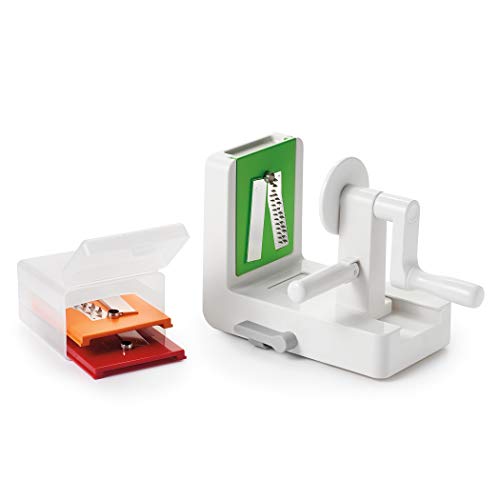


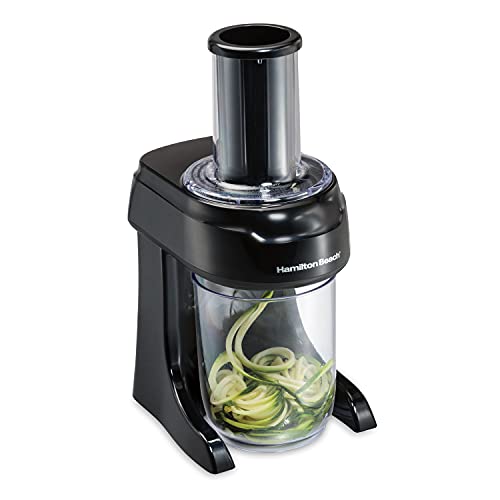


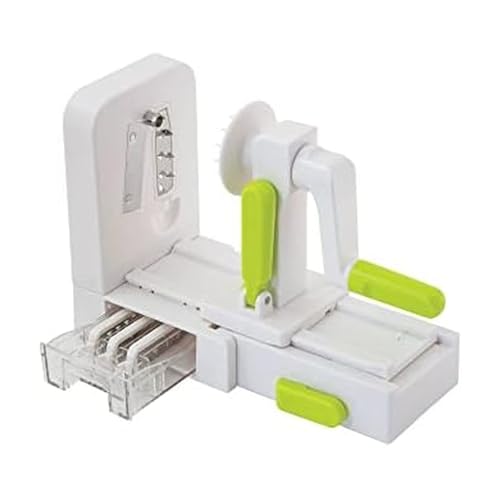
The OXO Good Grips 3-Blade Tabletop Spiralizer has earned its reputation as the go-to recommendation for most home cooks, and in 2026 it remains one of the most reliable spiralizers you can buy. The StrongHold suction cup base locks onto your countertop with a single lever press, giving you a stable platform that does not slip or shimmy even when you are pushing a firm sweet potato through the blades. That stability matters more than you might think — a wobbly spiralizer turns meal prep into a frustration workout.
OXO includes three stainless steel blades that cover the three cuts most people actually use: a spaghetti cut at 1/8 inch, a fettuccine cut at 1/4 inch, and a wide ribbon cut for dishes like salads and stir-fries. Swapping blades takes only a few seconds because they all snap in and out of the same housing. The removable blade box (a small covered caddy that slides into the body of the unit) keeps sharp edges covered and all three blades together in one place, so you never end up rifling through a drawer hunting for the right one. Cleanup is straightforward, with all removable parts going into the dishwasher top rack without complaint.
Where OXO falls short is blade variety — three options is plenty for everyday cooking, but if you have specific cuts in mind like angel hair or crinkle chips, you will need to look elsewhere. The unit also requires a small amount of counter space even when stored because the suction base adds some bulk underneath. That said, for the combination of build quality, stability, and ease of use, this is the spiralizer we recommend to most first-time buyers who want something that simply works without a learning curve.
Pros:
Cons:
If you want to do everything a spiralizer can possibly do, the Brieftons 10-Blade Vegetable Spiralizer is the answer. Ten 420-grade hardened Japanese stainless steel blades give you angel hair, spaghetti, tagliatelle, linguine, pappardelle, ribbons, curly fries, fine ridged pasta, crinkle chips, and lasagne-width flat cuts — essentially every cut shape the category offers. All blades are labeled clearly so you never have to guess which one you grabbed, and the steel itself is hardened enough to stay sharp through months of daily use without rusting.
One of the genuinely clever design features here is the integrated catch container that snaps directly under the blade exit point. Most tabletop spiralizers dump noodles onto your cutting board or counter, which means you transfer them into a bowl before seasoning or refrigerating. The Brieftons unit spiralizes directly into the catch container, and you snap a keep-fresh lid onto that same container and put it straight into the fridge for batch prep — fewer dishes, less mess, smarter workflow for people who cook in large quantities ahead of the week. The storage system is equally thoughtful: three blades sit in a built-in compartment on the unit itself, and the remaining seven slot into a dedicated blade caddy that keeps everything together as one compact bundle.
The trade-off is size — ten blades and a catch container mean a larger footprint than simpler units, and the whole assembly takes a bit more time to set up and break down compared to a three-blade model. If you are cooking for one and doing it infrequently, the OXO above is probably all you need. But if you meal prep, cook for a family, or enjoy experimenting with different textures and noodle shapes, the Brieftons 10-blade is the most complete spiralizer package on this list at its price point. You can browse our full spiralizers category if you want to compare even more models side by side.
Pros:
Cons:
Every other spiralizer on this list requires you to crank a handle, which works fine for occasional use but gets tiring when you are processing five or six zucchinis for a big family dinner. The Hamilton Beach 3-in-1 Electric Vegetable Spiralizer solves that problem entirely by doing the cranking for you with an electric motor, and the result is noticeably faster, more consistent noodles with zero hand strain. You simply set the vegetable against the cone, press the food holder down, and let the machine run — the whole process takes seconds per vegetable.
The 2.5-inch round chute (the opening where you load the vegetable) is wide enough to accept whole zucchini, squash, and cucumbers without any pre-cutting, which eliminates one of the more annoying prep steps that manual spiralizers sometimes require. The integrated bowl holds up to six cups of vegetable noodles, which is a generous capacity for family-sized servings. Three cutting cones produce spaghetti, linguine, and ribbon cuts — the everyday shapes that cover most pasta recipes — and swapping cones is a simple pull-and-push operation.
The main consideration with any electric kitchen appliance is counter space and cord management, and this unit is larger than the manual options on this list. It is not something you tuck in a drawer; it lives on the counter or takes up meaningful shelf space in a cabinet. Cleanup is also slightly more involved because the motor unit cannot be submerged, so you wipe that portion down separately while the bowl and cones go in the dishwasher. But if you have the space and you cook vegetables in volume regularly, the electric convenience is worth every inch of counter real estate. This is particularly valuable for anyone with arthritis or limited hand strength, where cranking a manual unit becomes genuinely difficult.
Pros:
Cons:
The brand simply called Spiralizer has been around long enough to appear on Ellen, The Doctors, and The Food Network, and this third-generation 7-blade model reflects years of iterative improvement based on real user feedback. The most important upgrade in this generation is the reinforced ABS (acrylonitrile butadiene styrene — a tough engineering-grade plastic) body and 420 high-carbon cutlery-grade stainless steel blades, which the company claims are 30 to 35 percent stronger than competing models. That claim is practically demonstrated when you run a raw sweet potato or turnip through it — harder root vegetables that snap lesser spiralizers right at the handle glide through this unit without any drama.
Seven blades put this model between the three-blade OXO and the ten-blade Brieftons in terms of versatility, and the selection covers the most useful cuts across the range. The suction base holds firm on smooth countertops, and the body has enough weight behind it to feel solid during heavy-duty processing. The package includes four recipe e-books focused on keto, paleo, raw vegan, and gluten-free cooking, which is a practical bonus if you are new to cooking with veggie noodles and need inspiration beyond basic zucchini pasta.
The tradeoff compared to the OXO is that blade storage is slightly less elegant — you do get a storage container, but switching between the seven blades requires a moment of attention to make sure you have oriented the blade correctly in the holder. That is a minor complaint given the performance. If your goal is to spiralize a broad range of vegetables including the dense, starchy roots that challenge other spiralizers, this is the most capable manual unit in the mid-price range. It pairs well with our article on the best spiral slicers of 2026 if you want to compare specific blade geometries.
Pros:
Cons:
If counter space is tight, storage is limited, or you simply want the least complicated tool possible, a handheld spiralizer is the answer — and this 4-in-1 model is one of the more capable ones you will find in 2026. The body is made from BPA-free ABS plastic with 304 food-grade stainless steel blades, which is a notably higher steel grade (304 is the same alloy used in kitchen sinks and surgical equipment) than the 420-grade steel found in most budget handheld spiralizers. The compact design fits comfortably in your palm, and the whole unit stores in a kitchen drawer without taking up meaningful space.
What sets this particular handheld apart from single-blade alternatives is the three-button mode system that gives you four distinct cut shapes without swapping blades. Press button one for a julienne cut (thin matchstick strips), press button two for a narrow spiral, press both buttons simultaneously for a spaghetti-width spiral, and press the reset key for a wide spiral. It works across a surprisingly broad range of vegetables — zucchini, onion, carrot, cucumber, cabbage, beet, turnip, rutabaga, radish, potato, and squash are all listed as compatible. For single-serving meals or small households, this is the fastest and least fussy option on the entire list.
The honest limitation of any handheld spiralizer is output speed. You are moving the vegetable by hand rather than cranking or motorizing it, which means processing a full pound of zucchini takes more time and a bit more hand effort than a tabletop unit. This also means the noodle length per strand tends to be shorter and less uniform than what you get from a crank mechanism. If you cook veggie noodles daily in large batches, step up to a tabletop model. But for weeknight single servings or apartment kitchens where every drawer inch is precious, this handheld delivers real value and performance. You might also find our review of the best electric vegetable choppers useful if you are building out a complete vegetable prep toolkit.
Pros:
Cons:
Mueller makes a point of distinguishing its Pro spiralizer from competitors with a specific claim: this is the only model that produces round veggie pasta strands rather than flat julienne cuts. That distinction matters if you are specifically trying to replicate the mouthfeel of round spaghetti or linguine — flat-cut noodles cook and sauce differently than round ones, and round strands hold sauce more evenly across the surface. If sauce cling and texture are priorities for you, the Mueller Pro's round-strand geometry is a meaningful advantage over most of the field.
The unit arrives with four 420-grade stainless steel blades housed in a body built from heavy-duty professional-grade ABS plastic. Mueller's reputation was established in the UK and European markets before expanding to the US, and the build reflects a design philosophy that prioritizes durability over minimum viable construction. The blades feel substantially thick compared to budget competitors, and the body does not flex under pressure even when you are pushing firmer vegetables through the mechanism. The four blade options do cover a practical range of everyday cuts without becoming overwhelming to manage.
The Mueller Pro is a solid mid-range choice for anyone who specifically wants round noodles and does not need the ten-blade variety of the Brieftons or the extreme rigidity of the Spiralizer 7-blade for very hard roots. The four-blade lineup is intentionally curated rather than comprehensive, which keeps the setup and cleaning process simple while still giving you meaningful cut variety. For everyday low-carb pasta substitutes where texture truly matters, this model earns its place on this list through the quality of its output rather than its spec count.
Pros:
Cons:
The Farberware Professional Foldable Spiralizer takes a clever engineering approach to the perennial kitchen problem of where to put things when you are not using them. The unit folds flat via a fold-and-lock hinge mechanism, collapsing from a full-sized tabletop spiralizer to a compact, flat profile that slides into a kitchen drawer or tucks neatly on a shelf without wasted airspace. If you have looked at tabletop spiralizers and hesitated because of the storage bulk, Farberware's foldable design removes the single biggest practical objection to this class of product.
The five-blade lineup covers a 2mm thin cut, a 3mm thin cut, a 5mm thick cut, a 7mm thick cut, and a ribbon cut — five meaningfully different sizes that cover the full range from fine angel-hair style to wide flat ribbons. All five blades store in a built-in blade caddy that stays with the unit, so you never have a loose blade floating around a drawer unsafely. The operation is straightforward: choose a blade, lock it into the holder, place your vegetable against the spike, and crank. Farberware's name and Walmart-shelf presence means quality control is consistent and replacement parts or customer service are not difficult to access if something goes wrong.
The foldable joint is the most structurally complex part of this unit, and while it is well-engineered, it does add a flex point that is not present in a solid-body spiralizer. Under normal use this is not an issue, but if you habitually force very dense vegetables through without proper technique, the hinge area will feel less confidence-inspiring than the rigid body of the Spiralizer 7-blade or Mueller Pro. For the home cook who wants a full-featured tabletop spiralizer that actually fits in a normal kitchen cabinet, the Farberware is the most thoughtfully designed storage solution on this list.
Pros:
Cons:
Shopping for a spiralizer in 2026 means choosing between a genuinely wide range of price points, designs, and feature sets. The questions below cut through the marketing language and help you match the right tool to the way you actually cook.
Manual spiralizers — the kind you crank by hand — are more affordable, easier to clean, and take up less counter space than electric models. They work well for anyone who spiralizes vegetables two or three times per week in normal serving quantities. The tradeoff is hand effort, which accumulates noticeably when you are processing a large batch for meal prep or cooking for a family of four or more. Electric models like the Hamilton Beach eliminate that fatigue entirely and produce faster, more consistent output, but they demand counter real estate, a power outlet, and a more involved cleanup process. If you cook veggie noodles more than four or five times per week or have any hand or wrist limitations, electric is worth the investment. For casual or light use, manual delivers everything you need at a fraction of the size and cost.
The honest answer for most home cooks is three to four blades. Spaghetti-width, fettuccine-width, and ribbon cuts cover roughly 90 percent of recipes that call for veggie noodles, which means a three-blade unit like the OXO handles the vast majority of use cases cleanly. More blades become genuinely useful when you cook a diverse range of dishes — if you want curly fries, crinkle chips, and angel hair alongside standard noodle cuts, a seven- or ten-blade model like the Brieftons or Spiralizer 7-blade pays off. Do not pay for ten blades if you will only ever reach for two of them, but do not limit yourself to three if your cooking style genuinely uses more variety. Be realistic about what you will actually cook in the next six months, and choose accordingly.
Stability is the single most underrated factor in spiralizer performance. A unit that slips or shifts during cranking produces uneven noodles, risks your fingers, and turns a pleasant cooking task into an aggravating one. Suction cup bases like those on the OXO and Brieftons lock onto smooth surfaces like tile, sealed granite, and laminate countertops with real holding power, but they do not work on porous, textured, or unsealed stone surfaces. If your countertop is rough or textured, look for a model with a clamp-style base or a very heavy body that resists movement through mass alone. Handheld spiralizers bypass the countertop issue entirely by design, but they transfer all stability responsibility to your grip. The Farberware's foldable joint introduces a small amount of flex at the hinge, which is a reasonable engineering compromise for the storage benefit it delivers.
A spiralizer you cannot store conveniently is a spiralizer you will stop using. Assess your actual drawer and cabinet space before you buy and choose a form factor that fits without forcing other items out. The Farberware's fold-flat design and the compact handheld spiralizer are the two best options for tight spaces. For cleanup, look for fully dishwasher-safe blade assemblies and food-contact parts — hand-washing sharp blades is a small but real injury risk that accumulates over time. Most tabletop models on this list are dishwasher safe on the top rack, but always verify the specific model's care instructions before assuming. A catch container like the one on the Brieftons also dramatically reduces the number of bowls and surfaces you need to wash after a spiralizing session.
Zucchini is the most popular choice because it has a firm but not rock-hard texture, mild flavor, and high water content that mimics pasta well when cooked briefly. Carrots, beets, cucumbers, sweet potatoes, butternut squash, turnips, and parsnips all spiralize successfully in most tabletop models. Very soft vegetables like ripe tomatoes or eggplant do not hold up well to the blade mechanism and tend to fall apart rather than forming clean strands. For hard root vegetables like raw sweet potato or beet, look for a model with reinforced blades and a solid body, such as the Spiralizer 7-Blade reviewed above.
The main cause of watery zucchini noodles is excess moisture releasing during cooking. You can reduce this significantly by salting your noodles and letting them sit in a colander for 15 to 20 minutes before cooking, then patting them dry with paper towels. Another technique is to cook them briefly — just 1 to 2 minutes in a hot pan — rather than boiling or steaming, which draws out far more water. Some cooks skip cooking entirely and serve zucchini noodles raw, tossed in warm sauce, which preserves texture completely. Whichever method you use, avoid covering the pan during cooking, which traps steam and makes the noodle texture soggy.
Most tabletop spiralizers have removable, dishwasher-safe parts that make cleanup genuinely simple. The blades, food holder, and body all detach and go on the top rack of your dishwasher, and a quick rinse under the tap before loading prevents vegetable residue from drying on. The one caution is the blades themselves — they are sharp, and reaching into a parts bin or dishwasher basket without looking first is how small cuts happen. Use the blade caddy or storage box that comes with your spiralizer to keep blades covered during transport to the dishwasher. Electric models like the Hamilton Beach require hand-wiping the motor unit, but the bowl and cones are dishwasher safe.
Yes — most spiralizers handle firm fruits very well. Apples, pears, and beets (technically a root vegetable but often grouped with fruits in spiralizer marketing) produce beautiful spirals for salads, desserts, and garnishes. Apples spiralized and tossed with cinnamon and a touch of maple syrup make a quick healthy dessert that requires almost no cooking. Softer fruits like peaches, bananas, or ripe mangoes do not spiralize cleanly and will clog or crush against the blades rather than forming strands. Stick to firm, relatively dense fruits for best results, and make sure the fruit is fresh and not overripe.
A julienne peeler (a flat tool with serrated edges that you drag along a vegetable surface) produces short, irregular strips rather than long continuous noodle strands. A spiralizer pushes the vegetable through a rotating blade mechanism that produces long, unbroken spirals — the continuous length is what makes the result feel more convincingly like pasta on the plate. Julienne peelers are cheaper and take up essentially no storage space, but the output is fundamentally different in texture, length, and visual presentation. If you want the full noodle experience, a spiralizer is the right tool; a julienne peeler is useful for adding thin strips to salads or stir-fries but does not replicate pasta effectively.
Zucchini noodles contain roughly 20 calories and 4 grams of carbohydrates per cup, compared to approximately 220 calories and 43 grams of carbohydrates per cup of cooked white pasta. That is a dramatic reduction in both calories and carbs, which is why spiralized vegetables have become central to keto, paleo, and low-carb diets. The trade-off is that pasta provides more protein per serving and is more calorie-dense for people who need sustained energy for physical activity. Veggie noodles are also higher in fiber, vitamins, and micronutrients than refined white pasta. For most people pursuing weight management or blood sugar control, replacing pasta with vegetable noodles two or three times per week delivers meaningful dietary benefits without requiring a dramatic lifestyle overhaul.
 |
 |
 |
 |

About Rick Goldman
Rick Goldman grew up traveling the Pacific Coast and developed an early appreciation for regional and international cuisines through exposure to diverse food cultures from a young age. That culinary curiosity shaped his approach to kitchen gear — he evaluates tools based on how well they perform across different cooking styles, ingredient types, and meal occasions. At BuyKitchenStuff, he covers kitchen equipment reviews, recipe guides, and food-focused buying advice.
