Kitchen Gadgets & Equipment Reviews ›
by Daisy Dao
You're standing in the kitchen aisle, looking at a wall of spiral slicers that all promise to turn your zucchini into restaurant-worthy noodles, and you have absolutely no idea which one is worth your money. Some are barely bigger than a pencil sharpener, others look like they belong in a professional kitchen, and the price range spans from under $10 to well over $50. The good news is that after testing and researching the top models available in 2026, the choice is far clearer than that crowded shelf makes it seem.
Spiral slicers — sometimes called spiralizers or vegetable noodle makers — have become a genuine kitchen staple for anyone eating low-carb, paleo, gluten-free, or simply trying to get more vegetables onto the plate. According to the CDC's dietary guidelines, increasing vegetable intake is one of the most impactful changes you can make to your diet, and a good spiralizer makes that transition significantly easier by transforming raw vegetables into satisfying, pasta-like dishes that actually hold sauce. Whether you're making zucchini noodles for a weeknight dinner or curly sweet potato fries on the weekend, the right spiral slicer makes the difference between a frustrating chore and a two-minute prep task. If you love making vegetable-based meals, you might also want to check out our guide on the best smoothie recipes for weight loss for more healthy eating inspiration.
This guide covers seven of the best spiral slicers on the market right now, ranging from compact handheld options to full-featured countertop units and even an electric model for maximum convenience. We've evaluated each one on blade quality, stability, ease of use, cleanup, and overall value. You'll find our full reviews below, followed by a buying guide that breaks down exactly what to look for when you're making your decision. For all our kitchen equipment recommendations in one place, browse our complete reviews section.

Contents
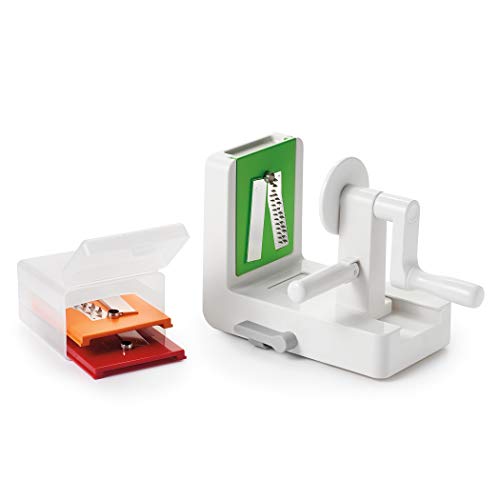




The OXO Good Grips Tabletop Spiralizer earns its place at the top of this list through a combination of thoughtful design, serious build quality, and the kind of stability that makes spiral cutting feel effortless rather than stressful. The StrongHold suction base is genuinely one of the best in the category — it locks onto your countertop with a lever mechanism that doesn't budge even when you're pushing through a dense butternut squash or a firm beet. OXO has long been trusted for ergonomic kitchen tools, and this spiralizer reflects that reputation in every detail, from the comfortable food holder that keeps your fingers away from the blades to the clean lines of the overall design.
Three stainless steel blades cover the cuts you'll use most often: a fine spaghetti cut at 1/8th inch, a wider fettuccine cut at 1/4th inch, and a broad ribbon cut for sheets of vegetable that work beautifully in salads or as lasagne-style layers. The removable blade box is a standout feature that solves a real problem — those sharp blades stay clean, organized, and safely tucked away when the unit isn't in use, and the box stores directly on the unit so you'll never lose a blade. Cleanup is quick because the entire unit disassembles with minimal effort and all parts are dishwasher safe. If you're building a complete vegetable-focused kitchen and you want one reliable countertop spiralizer that handles everything from zucchini to kohlrabi, the OXO is where you start.
The one genuine limitation is blade count — three blades will satisfy most home cooks, but if you're after crinkle cuts, curly fries specifically, or ultra-fine angel hair, you'll want to look at the Brieftons models reviewed below. That said, for everyday spiralizing of the most common cuts, three well-made blades beat seven mediocre ones every time, and OXO's blades stay sharp through serious use.
Pros:
Cons:
Brieftons has built a strong reputation in the spiralizer market by focusing on blade quality and completeness, and the 7-Blade model delivers exactly that. All seven blades are 420-grade hardened Japanese stainless steel, which is the same material used in professional kitchen cutlery — they're ultra-sharp out of the box, rust-resistant through years of use, and each blade is clearly labeled so you never have to guess which cut you're grabbing. The seven cuts cover angel hair, spaghetti, fettuccine, pappardelle, ribbons, crinkle chips, and true curly fries, which means you have a complete range of shapes for everything from light salad garnishes to satisfying air-fryer snacks.
The integrated catch container is one of the most practical features in this price range. While most countertop spiralizers drop noodles onto the counter or into a separate bowl you have to place beneath them, the Brieftons 7-Blade spiralizes directly into its own container, which snaps a keep-fresh lid on for refrigerator storage. If you batch-prep a week of zucchini noodles on Sunday afternoon, that means you go directly from spiralizing to fridge without transferring anything to a separate container. The storage system is equally well thought-out: three blades sit in a built-in self-storage compartment on the unit, and the remaining four blades go into a dedicated blade caddy, so the entire system packs away as a single organized unit.
The suction cup base is rated strongly, and in practice it performs well on smooth countertops, though it's worth noting that the lever-style suction on the OXO provides a slightly more secure lock on certain surfaces. For most kitchens, however, the Brieftons suction is more than adequate for continuous use. This is the spiralizer to choose if blade variety is your top priority and you want the convenience of a built-in catch container included at a competitive price point.
Pros:
Cons:
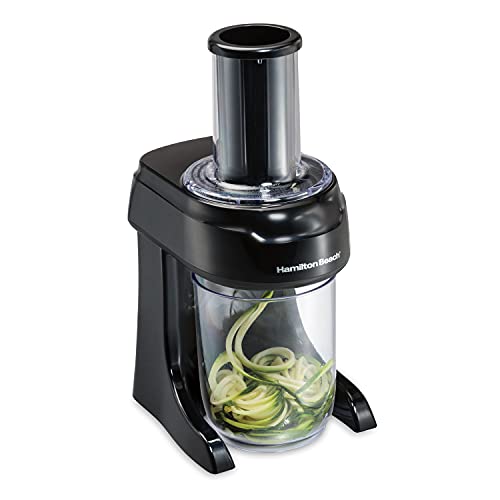
If you spiralize frequently, cook for a large family, or simply want the convenience of a machine that does the work entirely for you, the Hamilton Beach Electric Spiralizer is in a different category from every manual unit on this list. You load your vegetable, press the food holder down, and the motorized drive handles the rest — no cranking, no pushing, no effort beyond positioning the produce. The 2.5-inch round chute accepts whole zucchini, squash, and cucumbers without any precutting, which is a genuine time saver that manual units simply can't match, as most require you to trim your vegetables to fit the food holder before you even start.
The 6-cup bowl is generously sized for family meals, holding enough vegetable noodles for four servings in a single batch without stopping to empty the container. Three cutting cones produce spaghetti, linguine, and ribbon shapes, covering the most practical everyday cuts. The electric drive makes processing firmer vegetables — sweet potatoes, beets, kohlrabi — significantly easier than hand-cranked models, where those harder vegetables require sustained effort that can feel tiring in larger quantities. If you regularly process more than two or three vegetables at a time, the Hamilton Beach pays for itself in saved effort very quickly.
The trade-offs for all that convenience are real, though. Electric spiralizers take up more counter space, require a power outlet, and have more components than manual models, which makes cleanup slightly more involved. The blade selection is also more limited at three cuts, and the machine is not as portable as compact manual units. For anyone building a high-volume vegetable prep routine — particularly if you've committed to low-carb eating in 2026 and you're cooking veggie noodles several nights a week — the Hamilton Beach is the right tool. Pair it with a good single-serve blender and you have a powerful foundation for a healthy kitchen.
Pros:
Cons:
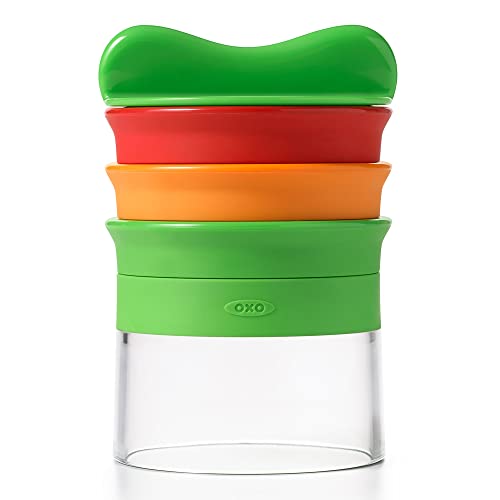
Not everyone needs a countertop unit with a suction base and multiple storage systems — sometimes you just need to spiralize one zucchini for a quick weeknight dinner without clearing half your counter. The OXO Good Grips Hand-Held Spiralizer is built precisely for that use case, and it executes it better than any comparable compact unit currently available. The non-slip grip makes it comfortable to hold through extended use, which is a detail that matters more than it sounds — competing hand-held spiralizers with smooth or thin handles become genuinely tiring after the first minute, especially with firmer vegetables.
The built-in food holder and protective cap keeps your fingers safely away from the blades during spiralizing, and it doubles as a storage cap when you put the unit away, meaning the sharp blades are covered and protected even when the spiralizer is loose in a kitchen drawer. Three blade options cover spaghetti, fettuccine, and ribbon cuts — the same range as the OXO tabletop model — and switching between them is straightforward. The compact size makes it easy to store anywhere, travel with, or take to a vacation rental kitchen where you're not going to pack a full countertop appliance.
The practical trade-off is that hand-held spiralizing requires you to hold the spiralizer with one hand and rotate the vegetable with the other, which is less efficient than a crank-driven tabletop unit when you're processing large quantities. For one or two zucchini, the OXO hand-held is perfect. For six zucchini for meal prep, you'll want one of the tabletop units. Think of this as the perfect secondary spiralizer or the ideal choice for a smaller kitchen, a single-person household, or anyone who wants to try spiralizing before committing to a larger unit.
Pros:
Cons:
The Brieftons 10-Blade Spiralizer is the most versatile manual spiralizer available in 2026, and it's the right choice for serious home cooks who want to explore the full spectrum of vegetable cutting without ever feeling limited by their equipment. Ten 420-grade Japanese stainless steel blades give you angel hair, spaghetti, tagliatelle, linguine, pappardelle, ribbons, curly fries, fine ridged pasta, crinkle chips, and lasagne-width flat cuts — that's a genuinely comprehensive range that covers every pasta substitute shape and specialty cut imaginable. Each blade is labeled for instant identification, so you spend your time cooking rather than squinting at nearly-identical discs trying to figure out which one you grabbed.
Like the 7-Blade model, the 10-Blade Brieftons spiralizes directly into an integrated catch container that snaps a keep-fresh lid for fridge storage. The storage system scales up to accommodate all ten blades: three sit in the onboard self-storage compartment, and the remaining seven go into the included blade caddy. Despite the additional blades, the entire unit still packs down as a single organized piece that fits in a standard kitchen cupboard or deep drawer. The strong suction base keeps everything steady on smooth countertops, and the build quality throughout is the same premium 420-grade steel and reinforced BPA-free plastic you get across the Brieftons line.
The honest conversation you need to have with yourself before buying the 10-Blade model is whether you'll actually use ten different cuts regularly — if the answer is three or four cuts at most, the 7-Blade model at a lower price is the smarter buy. But if you're the kind of cook who wants to experiment freely, who enjoys making different pasta shapes for different dishes, or who cooks for others regularly enough to want maximum creative range, the 10-Blade is worth every penny of the price difference. It pairs well with a quality pasta roller if you're building out a full homemade pasta and vegetable noodle kitchen.
Pros:
Cons:
The Brieftons QuickFold 5-Blade Spiralizer solves the single biggest objection people have to countertop spiralizers: storage. Full-size tabletop models are awkward to store in smaller kitchens because they're rigid, bulky structures that don't fit neatly in drawers and take up significant shelf space. The QuickFold folds completely flat in seconds, reducing its storage footprint to a fraction of what a standard countertop spiralizer requires, and it unfolds just as quickly when you need it — no assembly, no fumbling with parts, just unfold and attach the suction pad. This makes it the ideal choice for apartment kitchens, smaller homes, or anyone who wants countertop spiralizer performance without permanently dedicating cabinet real estate to it.
The five blades cover 2mm, 3mm, 5mm, and 7mm cuts plus ribbons — a well-chosen range that handles angel hair through pappardelle widths with a smaller corer that reduces food waste compared to many competing units. All five blades are the same 420-grade hardened Japanese stainless steel used across the Brieftons line, so sharpness and durability are not compromised in the name of compact design. The oversized suction pad is a genuine differentiator here — rather than the small, round suction cups you find on budget models, the QuickFold uses a wide-base pad that distributes suction across a larger surface area, keeping the unit stable even when folded open at an angle.
The included cleaning brush is a thoughtful addition that makes it easy to clear vegetable debris from the blade teeth, which can be fiddly to clean with a regular sponge. A blade caddy, printed user manual, and four recipe eBooks round out a package that offers strong value. If you're choosing between the QuickFold and the standard 7-Blade Brieftons, the decision comes down to storage: if space is your primary constraint, the QuickFold wins. If you want a catch container and two extra blades, go with the 7-Blade instead.
Pros:
Cons:
The Veggetti is the original twist-style handheld spiralizer that introduced millions of home cooks to vegetable noodles, and it remains a genuinely useful tool in 2026 for what it does — even if what it does is intentionally limited. The concept is elegantly simple: you push a vegetable into one end and twist it through the stainless steel blades, producing either thick or thin noodles depending on which end you use. There's nothing to assemble, nothing to suction to the counter, no interchangeable blades to organize, and no countertop space required. It's the most accessible entry point to spiral slicing available at any price point.
Build quality is honest for the price tier — the two stainless steel blades are functional and reasonably sharp, and the spiked vegetable holder grips the produce as it shortens, keeping your fingers clear of the cutting edges. The Veggetti works best with cylindrical vegetables of consistent diameter: zucchini, cucumbers, and yellow squash are ideal, while tapered carrots and irregular shapes produce less consistent results. It does not process very large vegetables, hard root vegetables like raw beets, or anything much bigger than a standard grocery-store zucchini, so your vegetable options are more limited than with any tabletop model on this list.
The Veggetti is the right answer to a specific question: "I want to try spiralizing without spending much money or committing counter space to a new gadget." If that's your situation, buy the Veggetti, make a few batches of zucchini noodles, and decide whether spiralizing belongs in your regular cooking rotation before upgrading to a larger unit. It also works well as a travel kitchen tool or for dorms and small apartments where larger equipment simply isn't practical. Think of it as the entry-level option that proves the concept — not the tool you'll reach for when you're serious about vegetable noodles long-term.
Pros:
Cons:
The single most important decision you'll make when buying a spiral slicer in 2026 is whether you want a countertop model or a handheld one, and the answer depends almost entirely on how much you plan to use it and how much kitchen storage you have to spare. Countertop spiralizers — the kind with a suction base, a hand crank, and interchangeable blades — are significantly faster for any quantity beyond a single vegetable, produce more uniform spirals because the food is held at a fixed angle while you crank, and generally offer more blade options. They are, however, larger, harder to store, and more expensive than handheld alternatives.
Handheld spiralizers like the OXO hand-held or the Veggetti are the opposite on every dimension: small, inexpensive, simple to use, and easy to store in a drawer, but slower, more tiring, and limited in the quantity they can process before your arms complain. For meal prep cooking and regular weeknight use, a countertop model is always the better investment. For occasional use, solo cooking, or first-time buyers who want to test the concept before committing, a handheld is a perfectly reasonable starting point. The electric Hamilton Beach option occupies a third category — more convenient than any manual model but requiring more space and a power outlet, making it best suited to frequent, high-volume use.
Marketing materials for spiralizers make blade count sound like the most important specification on the box, but the reality is more nuanced. Most home cooks use two or three cuts with any regularity — a spaghetti width for zucchini noodles, a wider fettuccine or linguine cut for heartier dishes, and occasionally a ribbon cut for salads. If that describes your cooking, a three-blade unit like either of the OXO models covers you completely. Blade material matters far more than blade count — 420-grade hardened Japanese stainless steel, which you find in all the Brieftons models, stays sharper longer, resists rust through repeated washing, and cuts through hard vegetables with noticeably less effort than softer stainless alternatives.
Where higher blade counts genuinely add value is in specialty cuts: crinkle chips, curly fries specifically (which require a different blade geometry than standard spaghetti spirals), and ultra-fine angel hair cuts that a standard spaghetti blade won't produce. If you bake sweet potato curly fries regularly or enjoy crinkle-cut vegetable chips, the Brieftons 7-Blade or 10-Blade is the right choice. If you're primarily making zucchini noodles with marinara sauce, three sharp blades are everything you need.
Every countertop spiralizer claims to have strong suction, but the differences in practice are significant and worth understanding before you buy. Poor suction means the unit scoots across the counter while you're cranking, which is both frustrating and genuinely dangerous when sharp blades are involved. The OXO StrongHold lever system is the gold standard in this category — the lever mechanism creates a mechanical lock between the suction cup and the countertop surface that holds even during aggressive cranking of firm vegetables. The Brieftons suction cup system is rated strongly and performs well on smooth surfaces, though it relies on the quality of your countertop's smoothness more than the OXO's lever design does. If your kitchen has textured or matte-finish countertops, pay close attention to the suction system on any unit you're considering, as smooth surfaces are where suction-based systems perform best.
A spiral slicer that's difficult to clean is a spiral slicer that stops getting used, regardless of how good the output is. Most countertop units are dishwasher safe when fully disassembled, but blade cleaning in particular deserves attention — the small teeth of spiralizer blades trap vegetable fibers that require either a dedicated cleaning brush (included with the Brieftons QuickFold and standard on most Brieftons units) or a brief soak to remove fully. The Brieftons catch container system also simplifies cleanup by keeping noodle debris in one contained area rather than spread across the counter. Storage is similarly practical: the QuickFold's flat-folding design, the OXO's onboard blade storage, and the Brieftons all-in-one packing system each solve storage differently, so match the storage solution to your specific kitchen layout. If you won't use a kitchen tool regularly because it's annoying to clean and store, the best tool is the one that actually gets used.
Zucchini is universally the best vegetable for spiralizing — it's the right diameter, has a consistent texture, and produces long, uniform noodles with minimal waste. Other excellent options include yellow squash, cucumbers, carrots, sweet potatoes, beets, kohlrabi, butternut squash necks, and apples for dessert uses. Very small vegetables, leafy greens, and anything with a hollow core (like bell peppers) don't spiralize well. Hard root vegetables like raw beets work best in countertop models with a crank drive, as they require more force than handheld units can comfortably deliver.
Yes, without qualification. Zucchini noodles (zoodles) contain roughly 4 grams of carbohydrates per cup compared to approximately 43 grams per cup for regular pasta, making a spiralizer one of the most impactful tools you can add to a low-carb kitchen. The transition from pasta to veggie noodles is far easier when the texture and presentation are similar, and a good spiralizer produces long, uniform strands that hold sauce effectively. Most people who buy a spiralizer for low-carb eating use it multiple times per week once they develop a few reliable recipes — it's not a gadget that collects dust.
Zucchini and other high-moisture vegetables release water as they cook, which can dilute your sauce and produce a watery finished dish. The most effective solution is to salt your spiralized vegetables lightly, let them sit in a colander for 10 to 15 minutes, and then pat them dry with paper towels before cooking. Alternatively, serve zucchini noodles raw or very briefly sautéed (under two minutes) over high heat — overcooking is the primary cause of watery noodles. Adding spiralized zucchini directly to hot sauce at the end of cooking rather than cooking it separately also reduces moisture loss significantly.
Spiralizer blades are categorized by the width and shape of the cut they produce. Angel hair blades create the finest, thinnest noodles (under 2mm) best used in light broths and delicate salads. Spaghetti blades produce the standard noodle width (around 3mm) suitable for most pasta dishes. Fettuccine and linguine blades cut wider flat noodles (5–7mm) that hold heavier sauces well. Ribbon blades produce wide, thin sheets ideal for salads and layered dishes. Crinkle and curly fry blades use a wavy edge to produce ridged cuts that brown more crisply when roasted or air-fried. The broader your blade selection, the more dish types you can make from the same vegetables.
No — a spiralizer and a food processor do fundamentally different things. A food processor chops, shreds, dices, and purees; a spiralizer creates long continuous spiral strands and ribbons. For the specific task of making vegetable noodles, a dedicated spiralizer produces far better results than any food processor attachment, giving you longer, more uniform strands with better texture. For everything else — chopping onions, shredding cabbage, making dough — a food processor remains the right tool. The two appliances complement each other rather than competing, and serious home cooks often own both.
Spiralizer blades are razor-sharp and require careful handling during cleaning. The safest approach is to rinse the blade immediately after use under running water, using a dedicated cleaning brush (included with most Brieftons models) to dislodge vegetable fibers from the blade teeth — never use your fingers to clear debris from a blade. Most blades are dishwasher safe on the top rack, though hand washing extends blade sharpness over the long term. Store blades in their dedicated caddy or onboard storage compartment rather than loose in a drawer, both for safety and to protect the cutting edge from contact with other utensils.
 |
 |
 |
 |

About Daisy Dao
Daisy Dao grew up in Honolulu, Hawaii, where coastal living and access to fresh local ingredients shaped her approach to home cooking from an early age. She has spent years experimenting with seafood preparation, healthy cooking methods, and ingredient substitutions — developing hands-on familiarity with a wide range of kitchen tools, techniques, and produce. At BuyKitchenStuff, she covers healthy recipes, cooking techniques, and ingredient substitution guides.
