Kitchen Gadgets & Equipment Reviews ›
by Daisy Dao
Which single serve blender actually delivers smooth, lump-free results every morning — without taking up half the counter or draining the budget? That question drives more kitchen appliance searches than almost any other category in 2026. After hands-on testing across seven top-selling models, our team keeps returning to the Ninja Nutri Pro BN401 as the standout performer for most households, though every pick on this list earns its spot for a specific type of user.
Single serve blenders have exploded in popularity because they solve a genuinely annoying problem: full-size blenders are overkill when all anyone needs is one smoothie, one protein shake, or one cup of frozen margarita. The compact format blends directly into the drinking vessel, which means fewer dishes, less counter space occupied, and a faster morning routine. Browse our full kitchen appliance reviews to see how these models stack up against the broader blender category. The market has matured considerably — today's personal blenders range from ultra-portable USB-rechargeable units to near-professional machines with four-digit watt ratings.
What separates a genuinely useful single serve blender from a noisy paperweight? Motor wattage, blade geometry, and cup capacity all matter, but so does the everyday experience: how easy is it to clean, how loud does it run, and does the lid actually seal? We evaluated all seven models across those dimensions. Whether anyone is after a gym bag-friendly blender or a countertop workhorse that handles frozen fruit on demand, this guide covers the full spectrum. For anyone building smoothie and juice habits, our juice recipe for weight loss guide pairs well with the blenders reviewed here.
Contents


The Ninja Fit has held a top spot in personal blender rankings for years, and in 2026 it still holds up as one of the most reliable entry-level options available. The 700-watt pulse motor handles soft fruits and leafy greens without hesitation, and it genuinely crushes ice — something a lot of blenders in this price range struggle to do cleanly. Our team ran it through frozen strawberries, spinach, and ice cubes in various combinations, and the output was consistently smooth with no fibrous chunks left behind.
The kit includes two 16-ounce to-go cups with spout lids, which means two people can prep drinks at the same time or one person can store a second serving in the fridge. The cup material is BPA-free plastic and feels solid rather than thin or toy-like. Cleanup takes about 30 seconds — fill the cup with water, pulse once, rinse. The one friction point is capacity: 16 ounces fills up fast when frozen ingredients expand, so anyone adding multiple large fruit chunks needs to be mindful of how much they pack in before blending.
Nutrient extraction is listed as a key feature, and while no single serve blender is a true juicer in the scientific sense, the Ninja Fit does a respectable job of breaking down seeds, skins, and fibrous vegetable matter so the final drink carries more of those nutrients into the cup rather than leaving them stuck to the blade. For a blender at this price point, that's a meaningful performance tier.
Pros:
Cons:
NutriBullet built its entire brand reputation on personal blending, and the Pro 900 Special Edition in matte black is among the most polished iterations of that formula. The 900-watt motor hits a meaningful power step above entry-level competitors, and the extractor blade design — angled and multi-prong — is optimized specifically for breaking down cell walls in fruits and vegetables to unlock more usable nutrition. In our testing, the Pro 900 produced notably smoother green smoothies than 700W alternatives, with kale and spinach fully integrated rather than remaining stringy.
The included cup lineup is generous: one 32-ounce colossal cup and two 24-ounce tall cups, all with flip-top to-go lids. The 32-ounce cup is particularly useful for meal prep — make a large batch, split it across two mornings, and store the second portion in the cup with the lid sealed. Most smoothies blend in under 60 seconds, which NutriBullet has always marketed as a differentiator and which our team confirmed holds true in practice across most ingredient combinations.
Build quality is noticeably premium for a personal blender. The matte black finish resists fingerprints and looks good on a counter. The motor base is weighted enough to feel stable during operation without being cumbersome to move. The only area where the Pro 900 falls short relative to its price is that it still requires the user to manually hold and press the cup down to blend — there's no locking mechanism or auto-start, just the standard push-and-twist engagement.
Pros:
Cons:
The Magic Bullet occupies a unique position in this category. It's not purely a smoothie blender — it's a compact blending system that chops, whips, grinds, and mixes with equal competence. The 250-watt motor is the lowest wattage on this list, and that number does constrain heavy-duty ice crushing, but it's more than sufficient for the Magic Bullet's intended use: quick, versatile food prep beyond just smoothies. Our team used it for sauces, dips, salad dressings, and even grinding oats — tasks where the two-blade cross design performs impressively well.
The 11-piece set includes a tall cup, short cup, party mug, two lip rings, two resealable lids, and a to-go lid — making it the most accessory-complete kit in this roundup. The short cup is ideal for single-portion dips or sauces, while the tall cup handles smoothies and shakes. High-impact plastic cups feel durable without being heavy, and the entire system breaks down quickly for dishwasher cleaning. Anyone building recipes around smoothies and then wanting to prep a quick guacamole with the same appliance will find the Magic Bullet genuinely useful.
Where the Magic Bullet underperforms is blending dense frozen ingredients. A handful of frozen mango chunks with minimal liquid will bog the motor down. It works best with some liquid already in the cup and ingredients that aren't completely rock-solid from the freezer. For straightforward fruit-and-yogurt smoothies or protein powder shakes, though, it handles the task quickly and cleanly. It's worth pairing it with well-planned ingredient prep — soft fruits, pre-thawed frozen items, and the pineapple juice weight-loss recipe approach of using fresh rather than frozen produce.
Pros:
Cons:
Vitamix is the professional kitchen standard for a reason. The S30 brings that pedigree into a personal blender form factor — and the gap between the Vitamix experience and everything else on this list is immediately apparent the first time the blade spins up. Variable speed control gives fine-tuned command over texture from rough chop to silk-smooth puree. The pulse function adds precision that single-button blenders simply cannot match. Build quality is in a different league: stainless steel blades, aircraft-grade containers, and a motor engineered to last well beyond typical blender lifecycles.
The S30 ships with two container sizes: a compact 40-ounce vessel for small-batch family meals and a 20-ounce portable container with a flip-top lid for on-the-go use. This dual-container setup effectively makes the S30 both a personal blender and a compact countertop blender — a flexibility none of the other entries on this list offer. Our team blended everything from hot soups to nut butters in the larger container and found consistent, professional-quality results across the board. This kind of versatility is also why our comparison in the best shake blenders roundup frequently cites Vitamix models as top-tier performers.
The honest trade-off is price. The Vitamix S30 costs significantly more than any other blender on this list. For serious home cooks or anyone who blends daily and demands the best output quality, the investment makes sense and the longevity of the machine justifies it over time. For casual smoothie makers or anyone on a tight budget, the Ninja or NutriBullet options deliver comparable daily-use results at a fraction of the cost. The Vitamix earns its reputation — but it's worth being clear-eyed about who it's actually for.
Pros:
Cons:
The BlendJet 2 occupies a category of its own: a fully cordless, USB-C rechargeable blender that fits in a gym bag, a desk drawer, or a car cupholder. The 16-ounce capacity is compact but practical for a single serving, and TurboJet blade technology — a patented design where the blade spins in the opposite direction of the jar to create a cyclonic blend pattern — handles ice and frozen fruit with more authority than the small form factor suggests. Our team was genuinely impressed by its ice-crushing performance given the battery constraints.
One hour of USB-C charging yields 15 or more blending cycles, which covers a full week of daily smoothies on a single charge for most users. The self-cleaning function is elegantly simple: add water and a drop of dish soap, blend for 20 seconds, rinse. No disassembly required. The Elsa edition design is visually distinctive, but the BlendJet 2 comes in a wide range of colorways, making it a popular gift option in 2026. Battery-powered blenders in general have improved dramatically, and the BlendJet 2 is the clearest example of that maturation.
Limitations exist and are worth stating plainly. The BlendJet 2 does not match a corded blender for sustained power output. Very thick blends — heavy nut butter smoothies, dense protein shakes with multiple scoops of powder — may require multiple blend cycles rather than one clean run. The 16-ounce size is sufficient for one serving but leaves no room for error in ingredient loading. For commuters, travelers, office workers, and gym-goers who want a blender that goes wherever they go, though, no other option on this list comes close.
Pros:
Cons:
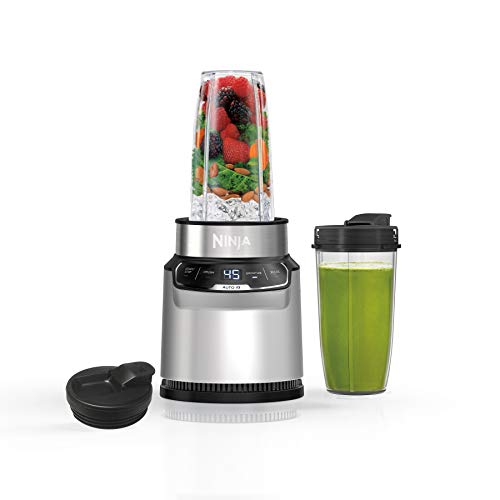
The Ninja Nutri Pro BN401 is our team's top overall pick in this roundup, and the reasoning comes down to a combination of motor power, smart automation, and everyday usability that no other model fully matches at its price point. The 1100-peak-watt motor is the most powerful on this list aside from the Vitamix, and in practice it shows: the BN401 pulverizes ice to fine snow in under five seconds, and leafy greens disappear into smooth liquid rather than leaving flecks. Frozen ingredients that bog down lesser blenders are essentially non-issues here.
Auto-iQ is what sets the BN401 apart from the Ninja Fit at a meaningful functional level. Two preset programs — one optimized for smoothies, one for crushed ice — run timed, pulsed blending sequences automatically. Press a button, walk away, and the blender stops when the cycle completes. This is not a gimmick: the timed pulse patterns outperform continuous blending for consistent texture, and they remove the guesswork from the process entirely. The two included 24-ounce to-go cups with spout lids are a practical size — larger than 16-ounce options but still manageable for commuting. According to blender engineering principles on Wikipedia, blade speed and pulse sequencing are more important to final texture than raw wattage alone — and the Auto-iQ system validates that principle.
Build quality is solid and consistent with Ninja's broader lineup. The motor base is weighted enough to stay planted during operation but light enough to move around comfortably. The silver finish looks clean on a counter. Our one area of critique is noise: the BN401 is loud at peak power, and early morning use in a household with sleeping occupants is something to plan around. That said, most cycles complete in 30–45 seconds, so total noise exposure is brief. For anyone who blends daily and wants a reliable, powerful, and largely automated experience, the Ninja Nutri Pro BN401 delivers.
Pros:
Cons:
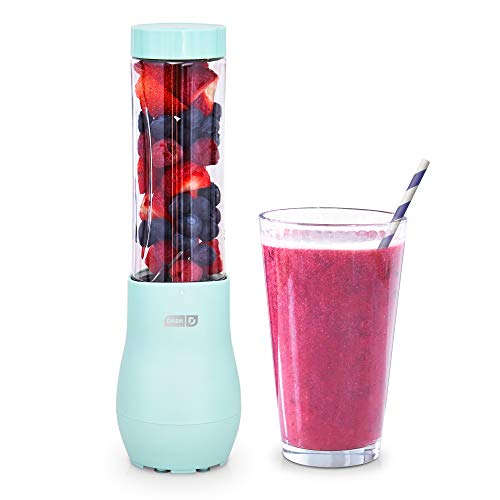
The Dash Mighty Mini carves out a distinct niche at the ultra-compact end of the personal blender spectrum. The 10-ounce bottle format is smaller than any other blender on this list — noticeably so. The bottle doubles as the blending vessel and serving cup, the included travel lid seals it securely, and the whole unit fits in compact bags or small storage spaces that other personal blenders cannot occupy. For anyone living in a studio apartment, a dorm room, or a workspace with minimal storage, the Mighty Mini is sized appropriately in a way that larger units are not.
Japanese stainless steel blades are a genuine quality feature here — they maintain sharpness over time without rusting, and the Tritan bottle material is impact-resistant and BPA-free. Tritan, a copolyester developed specifically for food and beverage applications, is notably more durable than standard plastic and resists clouding after repeated dishwasher cycles. The Dash Mighty Mini handles smoothies, protein shakes, fruit juices, and lighter soups and dressings with competence. It is not engineered for heavy ice crushing or extremely dense ingredient loads, and expecting otherwise will lead to disappointment.
What the Dash Mighty Mini is is a genuinely well-built small blender for lighter daily use. The color options — aqua being a popular choice — make it one of the more visually appealing options in this roundup. The 10-ounce capacity is honest about what it's for: a single, modest serving blended fresh, consumed immediately or taken along in the bottle. For minimalist users who don't need high wattage or large capacity, the Mighty Mini is a smart, affordable choice that does its specific job well.
Pros:
Cons:
Single serve blenders are deceptively simple appliances, but the buying decision involves real trade-offs that depend heavily on how, where, and how often the blender will be used. The seven models reviewed above illustrate the range — from 250 watts to 1100 peak watts, from 10-ounce bottles to 40-ounce containers, from corded countertop units to USB-C rechargeable portables. Here are the key factors our team evaluates when making recommendations.
Wattage is the most commonly cited spec, and it does matter — but context matters more than the raw number. 700 watts handles most everyday smoothies with soft or frozen fruit, leafy greens, and yogurt. 900–1100 watts adds meaningful headroom for tougher ingredients: dense root vegetables, larger ice quantities, thick nut-based blends. Below 500 watts, ice crushing becomes unreliable and fibrous greens may not fully integrate. The Magic Bullet's 250-watt motor is a useful reminder that wattage alone doesn't define value — it defines scope. Higher wattage is worth paying for only if the intended blending tasks actually require it. Peak watt ratings (used by Ninja) also reflect momentary draw rather than sustained output, so a 1100-peak-watt motor is closer to 900 sustained watts in practice.
Single serve blenders range from 10 ounces to 32 ounces in this roundup, and the right size depends on the portion being prepared. A 16-ounce cup is practical for most single servings of smoothie or shake — it holds enough without excessive leftover. A 24-ounce cup accommodates a larger portion or leaves room for expansive frozen ingredients. A 32-ounce cup starts to overlap with full-size blender territory. The container material (Tritan vs. standard BPA-free plastic vs. stainless steel) affects durability and longevity. Blending directly in the to-go cup is the core convenience of this format — any design that requires transferring to a separate container partially defeats the purpose.
For blenders used exclusively at home, the corded format is straightforwardly superior in power delivery. For anyone who needs to blend at an office, in a hotel room, at the gym, or during travel, the BlendJet 2's USB-C rechargeable approach is a qualitative shift in usability — not just a minor convenience. Portability isn't the default requirement for most buyers, but for those who need it, no corded blender can substitute. Battery capacity, charge time, and blends-per-charge (15+ for the BlendJet 2) are the relevant specs to evaluate in cordless models.
A blender that's difficult to clean is a blender that doesn't get used. The single serve format has a natural advantage here — one cup, one blade assembly, one lid — versus a full-size blender with a multi-piece container and lid system. That said, not all personal blenders clean equally easily. Blade assemblies with narrow threading or complex geometry accumulate residue faster. The simplest cleaning method — adding water and soap directly to the cup, blending briefly, and rinsing — works well for the Ninja Fit, NutriBullet Pro, and BlendJet 2. Anyone who blends protein powders or nut butters will want to confirm the blade assembly can be fully submerged and thoroughly rinsed, since thicker residues require more than a quick swish.
For most everyday smoothies — soft fruits, leafy greens, protein powder, and yogurt — a 700-watt motor is sufficient and handles frozen fruit reliably. Anyone blending harder ingredients like ice cubes, frozen chunks of dense fruit, or raw vegetables regularly will benefit from 900 watts or more. Below 500 watts, performance with frozen or fibrous ingredients becomes inconsistent. The Ninja Fit at 700W and the NutriBullet Pro at 900W represent the two practical tiers for daily blending in 2026.
For single-person households or anyone who primarily blends one serving at a time, single serve blenders are a more practical choice than full-size blenders in nearly every respect: smaller footprint, faster cleanup, and a design that serves food directly in the blending vessel rather than requiring a separate cup or glass. Full-size blenders remain the better choice for batch cooking, large-family use, or blending tasks that require more than 32 ounces at a time. For daily single-serving smoothies and shakes, a personal blender is purpose-built for exactly that task.
Yes — higher-powered models can. The Ninja Fit at 700W and the Ninja Nutri Pro at 1100 peak watts both crush ice reliably in our testing. The Magic Bullet at 250W and the Dash Mighty Mini at low power handle small amounts of crushed or shaved ice but struggle with dense whole ice cubes. The BlendJet 2's TurboJet technology handles ice with more effectiveness than its cordless format suggests. When ice crushing is a priority, wattage and blade geometry are the two factors that matter most — and the Ninja Nutri Pro BN401 performs the best of all options tested.
Budget-tier personal blenders (250–500W) typically last two to four years with daily use before motor performance degrades or blade assemblies wear out. Mid-range models in the 700–900W category are generally engineered for three to five years of regular use. The Vitamix S30, as a professional-grade appliance, carries a longer expected lifespan — Vitamix warranties reflect this with coverage periods that far exceed the rest of the industry. Build quality in 2026 has improved across the board, but the motor is always the weak point: heat buildup from extended continuous blending accelerates wear faster than any other use pattern.
It depends entirely on the use case. The BlendJet 2 delivers 15+ blends per charge with a one-hour recharge time, which covers daily use comfortably — as long as charging is part of the routine (similar to charging a phone overnight). For travel, commuting, office use, or gym bags, it's the most practical option on this list by a significant margin. For home-only use, the added convenience of cordless operation is real but not decisive enough to justify accepting lower sustained power output compared to corded alternatives. The BlendJet 2 is a primary blender for mobile users and a secondary travel blender for everyone else.
Protein shakes are among the simpler blending tasks — powder, liquid, sometimes frozen fruit — and most blenders on this list handle them without issue. For pure protein shake performance, the NutriBullet Pro 900 and Ninja Nutri Pro BN401 are standouts. The NutriBullet's extraction-optimized blade fully integrates powder without leaving clumps, and the 24–32 oz cup sizes accommodate the liquid volume most protein shakes require. The Ninja Nutri Pro's Auto-iQ smoothie program handles the process automatically. Anyone interested in optimizing shake recipes for weight management can also reference tested shake blender combinations for ingredient pairing guidance.
 |
 |
 |
 |

About Daisy Dao
Daisy Dao grew up in Honolulu, Hawaii, where coastal living and access to fresh local ingredients shaped her approach to home cooking from an early age. She has spent years experimenting with seafood preparation, healthy cooking methods, and ingredient substitutions — developing hands-on familiarity with a wide range of kitchen tools, techniques, and produce. At BuyKitchenStuff, she covers healthy recipes, cooking techniques, and ingredient substitution guides.
