Kitchen Gadgets & Equipment Reviews ›
by Rick Goldman
You've just decided to finally nail that competition-worthy brisket trim, so you hop on Amazon and search "brisket trimming knife." Suddenly you're staring at dozens of options — boning knives, slicing knives, breaking knives — and the prices range from $20 to well over $150. It's easy to get overwhelmed fast.
Trimming a brisket properly isn't just about aesthetics. Getting the fat cap down to the right thickness (usually about a quarter inch) directly affects how your bark forms and how evenly the meat cooks. A stiff, clunky knife makes that job frustrating. The right blade — flexible, sharp, and well-balanced — turns it into something almost meditative.
We dug into the best options available in 2026 and put together this guide covering seven knives worth your attention. Whether you're trimming your first flat or your fiftieth whole packer, you'll find a solid pick here. Browse our full kitchen product reviews if you're also outfitting the rest of your BBQ setup.
Contents




If you're just getting into brisket trimming and don't want to spend a fortune, the Victorinox Fibrox 6-inch boning knife is probably the most sensible place to start. It's a Swiss-made blade that's been a go-to in professional kitchens for decades — and its price point makes it almost a no-brainer for home pitmasters. The straight, narrow blade flexes just enough to follow the contours of the brisket without fighting you the whole way.
The ergonomic Fibrox handle is the real story here. It's textured, non-slip, and stays grippy even when your hands are coated in brisket fat — which, let's be honest, they will be. The blade comes out of the box impressively sharp and holds its edge through a reasonable number of trims before needing a touch-up. This isn't a forever knife, but it punches well above its weight class for the money.
Where it falls a little short is pure reach. At 6 inches, you'll do more passes on a full packer brisket compared to a longer blade. If you're trimming frequently and in volume, that can get tedious. But for casual weekend cooks, it's a completely capable tool that won't disappoint.
Pros:
Cons:
Dexter-Russell has been making knives in the United States since 1818, and that long heritage shows in this simple, no-frills boning knife. The curved blade design is a favorite among butchers and BBQ competitors who trim a lot of brisket — the curve lets you follow the fat cap and the flat's surface more naturally than a straight blade, reducing wasted motion and giving you better visual control over each cut.
The blade is semi-stiff, which means it has just a touch of flex but won't wobble on you. It's made from stain-free high-carbon steel (meaning it resists rust better than traditional carbon steel but still sharpens easily). The beech wood handle is classic and comfortable, though it's not the best choice if your hands get really wet — wood handles can get slippery compared to synthetic options. That said, many experienced trimmers prefer the feel of a wood handle.
This knife is unassuming. There's nothing flashy about it, and that's exactly the point. It's a workhorse built for butchers, and if you want something proven over generations rather than trendy and tech-forward, this earns its spot in the toolkit.
Pros:
Cons:
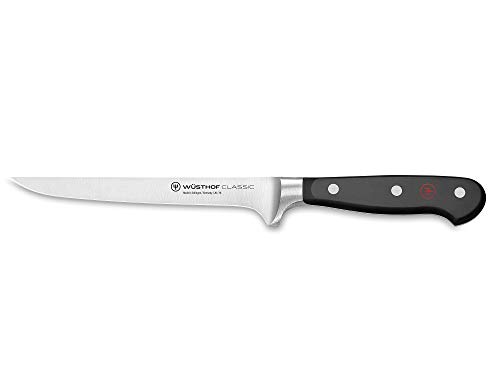
Wüsthof's Classic line has been a gold standard in German cutlery for generations. This 6-inch flexible boning knife carries all the hallmarks of that reputation: full tang construction (meaning the steel runs all the way through the handle), triple-riveted handle for durability, and a precision-forged blade from their proprietary high-carbon stainless steel. If you're serious about your craft — whether that's competitive BBQ or just cooking very well at home — this knife delivers a noticeably higher level of craftsmanship.
The flexible blade is the real asset for brisket trimming. You can work it under the fat cap and angle it precisely as you go, making cleaner, more intentional cuts than you'd get with a semi-stiff blade. The handle shape (Wüsthof's iconic triple-rivet design with a black synthetic grip) is ergonomically refined and stays comfortable through long trim sessions. This is a knife you'll be using in 10 years, assuming you give it basic maintenance.
The price is the main sticking point. You're paying significantly more than you would for the Victorinox or Dexter-Russell, and the performance gap — while real — may not matter to a casual weekend cook. But if you want a knife that doubles as an investment piece, this Wüsthof earns every dollar.
Pros:
Cons:
The Dalstrong Shogun ELITE is hard to ignore on a knife rack. The Damascus pattern on the blade — formed from 67 layers of high-carbon stainless steel wrapped around an AUS-10V Japanese steel core — is genuinely beautiful. But this knife isn't just visual flair. The AUS-10V core hits 62+ on the Rockwell hardness scale (a measure of how hard and edge-retentive steel is), which is significantly harder than most German knives. That translates to a finer, sharper initial edge and longer time between sharpenings.
The blade is hand-finished to a mirror polish at 8–12 degrees per side (most Western knives are 20–25 degrees) — it's genuinely scalpel-sharp out of the box. The tapered blade curves inward and has a fine tip that gets into tight spaces around joints and seams. The G10 handle (a fiberglass laminate common in high-end knives) is tough, moisture-resistant, and ergonomic. A sheath is included, which is a nice touch at this price.
The tradeoffs are worth knowing. Harder steel is more brittle — this isn't a knife you want to twist or drop. It also requires Japanese-style sharpening stones or a whetstone rather than a standard European pull-through sharpener. If you're already comfortable sharpening knives, that's a non-issue. If you aren't, pair this knife with a quality sharpener — check out our picks for the best electric knife sharpeners to find a compatible option.
Pros:
Cons:
This one plays a different role than the boning knives above. The Victorinox Fibrox 12-inch slicing knife with a Granton edge (those shallow oval divots along the blade that prevent meat from sticking) is the knife you reach for once the brisket has rested and it's time to slice for serving. If you've ever struggled with slices that tear, compress, or fall apart, a dedicated slicing knife is the answer — and this Victorinox is one of the most-recommended options in its price range.
The 12-inch blade is long enough to slice a full flat in one or two smooth passes rather than sawing back and forth. Less back-and-forth means cleaner slices and less juice lost. The Granton pockets reduce drag and friction, which you'll notice immediately with a well-rendered brisket where the fat slides under the blade. The Fibrox handle delivers the same non-slip grip you get from the 6-inch boning knife in this same lineup.
Keep in mind: this isn't a trimming knife. Don't try to navigate fat cap removal with a 12-inch slicing blade — use a boning knife for that job. But if you're building a complete brisket toolkit, this slicing knife fills the second half of that equation beautifully. It's been recommended by major culinary testing outlets, and the price is unbeatable for the quality you get.
Pros:
Cons:
ZWILLING J.A. Henckels has been making cutlery in Solingen, Germany for nearly 300 years — and the Pro series represents some of their most refined work. This 5.5-inch flexible boning knife is the most compact option on this list, and that actually works in its favor for detail trimming. When you're working around the point, cleaning up silver skin (a tough connective tissue membrane), or trimming in tight spots, a shorter blade gives you more maneuverability.
The blade is forged from a single piece of ZWILLING's proprietary high-carbon stainless steel using their SIGMAFORGE process — essentially a more precise cold-forging method that produces an exceptionally uniform, durable blade. The FRIODUR ice-hardening treatment (a controlled freeze-and-temper process during manufacturing) adds corrosion resistance and helps the blade stay sharp longer under daily use. The curved bolster (the thick junction between blade and handle) acts as a finger rest that naturally guides your grip into a safe, controlled position — a feature you'll appreciate during a long trim session.
The 5.5-inch length does mean more work on a large brisket compared to a 6-inch or longer blade. But if precision and comfort are your top priorities — and you're willing to pay for German engineering — this ZWILLING is a compelling choice. It's also dishwasher safe, though hand washing is always recommended for fine knives.
Pros:
Cons:
If you're buying whole packer briskets in bulk or regularly breaking down larger primals, the Victorinox Fibrox 10-inch curved breaking knife fills a gap that the smaller boning knives don't cover. Breaking knives (also called butcher knives) have wider, heavier blades designed to separate large muscle groups and cut through tougher connective tissue. This one's long enough to handle a full brisket flat in deliberate strokes while the curve helps you follow the natural seams of the meat.
The blade is made from high-carbon stainless steel, conical ground (meaning it tapers from spine to edge for reduced drag), and ice tempered for long-lasting sharpness. The wider blade adds just enough heft to make uniform slicing feel easier — the weight does some of the work so your wrist doesn't have to. The Fibrox handle, as always with this line, delivers a secure non-slip grip that's especially valuable when you're working through a large, heavy cut of meat.
This is a specialized tool, not an all-purpose trimmer. You wouldn't use it for the fine fat-cap trimming work that a 6-inch boning knife handles. But if your brisket workflow involves heavy initial prep before finishing with a detail knife, this breaking knife is a smart addition. Paired with the Victorinox 6-inch boning knife, you have a complete two-knife brisket system at a very reasonable combined price point.
Pros:
Cons:

Not every sharp knife is a good brisket trimming knife. Here's what actually matters when you're evaluating your options in 2026.
This is the single most important decision you'll make. Each blade flexibility has its use case:
For fat cap trimming specifically, flexible or semi-stiff is almost always the right choice. Stiff blades are better suited to the breaking knife role.
Blade length affects how many strokes you need and how much control you have:
Most pitmasters doing standard brisket prep use a 6-inch boning knife for trimming. If you're also slicing your own brisket, adding a 12-inch slicer gives you a complete toolkit. If you want ideas on what else to add to your grilling setup, our guide to the best indoor electric smokeless grills covers quality equipment at every budget level.
Steel choice affects sharpness, edge retention, and maintenance:
For most home pitmasters, high-carbon stainless steel is the most practical choice. It balances performance with low-maintenance care. According to Wikipedia's overview of kitchen knives, the trade-off between hardness and toughness is one of the most fundamental decisions in knife steel selection.
You might be trimming for 10–20 minutes straight. Handle comfort and grip matter more than they seem:
If you're new to brisket and building out your cooking setup, also consider how your prep station is arranged — having the right tools within reach matters as much as the tools themselves. Our guide to the best hunting knives covers additional blade options for those who do their own meat processing from field to table.
A 6-inch boning knife is the most popular choice for brisket trimming. It gives you enough reach to make clean passes while still being maneuverable enough for detail work around the point and flat. If you trim large whole packers frequently, some pitmasters prefer a slightly longer 7-inch blade, but 6 inches covers most situations well.
Flexible is generally preferred for fat cap trimming. A flexible blade bends to follow the surface of the brisket, letting you work close to the meat without cutting too deep. Semi-stiff blades work well too if you want more control. Stiff blades are better suited to breaking down larger primals rather than detailed fat trimming.
Technically yes, but it's not ideal. A chef's knife is wider and less maneuverable than a boning knife, making it harder to navigate the fat cap's contours without removing too much meat. You'll get cleaner, more efficient trims with a dedicated boning knife, especially when working around the seam between the flat and point.
Regular honing with a honing rod (which realigns the edge between sharpenings) will extend the time between full sharpenings significantly. For actual sharpening, German-style knives (Victorinox, Wüsthof, ZWILLING) work well with standard whetstones or pull-through sharpeners. Japanese-steel knives like the Dalstrong Shogun require Japanese-angle whetstones or a compatible electric sharpener set to the correct angle.
They serve different stages. A boning knife (typically 6 inches, flexible) is used before cooking to trim the fat cap and remove silver skin. A slicing knife (typically 12 inches, long and narrow) is used after cooking to cut the rested brisket into serving slices. If you want both results — clean trim and clean slices — you ideally have one of each.
The most widely recommended guideline is to trim the fat cap down to about one-quarter inch (roughly 6mm). Thicker fat doesn't render fully during the cook and creates an uneven eating experience. Thinner than a quarter inch risks drying out the flat. The right boning knife, used correctly, lets you hit that target consistently across the whole surface.
 |
 |
 |
 |

About Rick Goldman
Rick Goldman grew up traveling the Pacific Coast and developed an early appreciation for regional and international cuisines through exposure to diverse food cultures from a young age. That culinary curiosity shaped his approach to kitchen gear — he evaluates tools based on how well they perform across different cooking styles, ingredient types, and meal occasions. At BuyKitchenStuff, he covers kitchen equipment reviews, recipe guides, and food-focused buying advice.
