Kitchen Gadgets & Equipment Reviews ›
by Daisy Dao
Which knife grinder actually delivers a razor-sharp edge without destroying your blade? That question gets harder to answer every year as the market floods with options ranging from $30 budget picks to $300 professional systems. After hands-on testing across multiple categories, one sharpener consistently outperformed the rest: the Work Sharp Ken Onion Edition Knife & Tool Sharpener Elite Mk2. But the right pick for your kitchen depends on how much sharpening you do, what kind of knives you own, and whether you want push-button simplicity or precise manual control.
A dull knife is not just a nuisance — it's a safety hazard. More cutting force means more slipping, and slipping with a blade ends badly. Professional cooks sharpen their knives regularly, and in 2026, the tools available to home cooks have finally caught up to what the pros use. Whether you're maintaining a prized Japanese gyuto or restoring a neglected chef's knife you found in the back of a drawer, the sharpeners on this list cover every skill level and budget. If you're also looking to pair your newly sharpened blades with purpose-built cutlery, check out our guide to the best knife for trimming brisket in 2026 — sharp tools make all the difference on the cutting board.
We evaluated seven of the top-rated knife grinders on Amazon based on sharpening performance, ease of use, build quality, angle consistency, and long-term value. Below you'll find an in-depth breakdown of each one, a buying guide covering the key specs that matter, and answers to the questions we hear most often. For a broader look at kitchen tools and gear, visit our reviews section.
Contents




If you're serious about edge geometry and want a system that handles everything from kitchen knives to hunting blades, the Work Sharp Ken Onion Edition Elite Mk2 is the sharpener to own in 2026. Designed in collaboration with knife-making legend Ken Onion, this benchtop system gives you two completely different sharpening modes in one machine. The Sharpening Guide Cassette locks in your angle for consistent, repeatable results on everyday knives, scissors, and tools — no guesswork, no uneven bevels. Switch to the Blade Grinding Attachment and you're working with larger belts, a wider angle range, and full edge profile control that lets you reprofile a blade from scratch.
The build quality is immediately apparent when you pick it up. The motor runs smooth and quiet at variable speeds, and switching between modes requires zero tools and zero setup time. That matters when you're in the middle of a session and want to transition from sharpening a fillet knife to touching up a pocket knife without losing momentum. The abrasive belt system removes metal efficiently without overheating the edge — a chronic problem with grinding wheels. For the price, this is a complete professional-grade system, and it shows in the results: edges come off this machine polished, toothy, and ready to slice paper clean.
One insider note: the learning curve on the Blade Grinding Attachment is real. You're getting power-tool-level control, which means power-tool-level responsibility. Approach it with respect and light passes, especially on thin Japanese blades. But once you understand the system, no other consumer-grade sharpener gives you this range of capability.
Pros:
Cons:
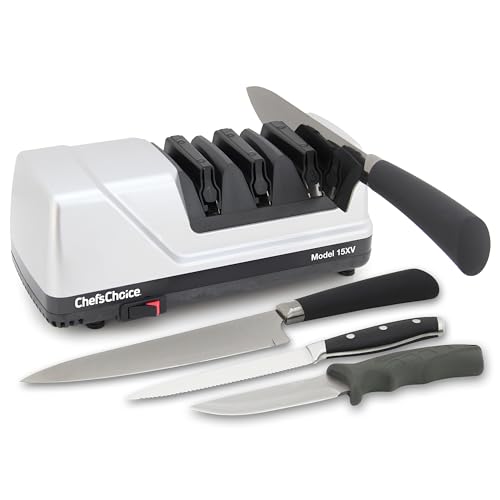
The Chef'sChoice 15XV EdgeSelect has been a trusted name in home sharpening for years, and the 2026 version earns its place on any serious shortlist. The standout capability here is edge conversion: this machine takes your standard 20-degree factory-edge knives and converts them into Trizor XV 15-degree edges. That's a meaningful upgrade. A 15-degree edge is thinner, sharper, and better suited for precision slicing than the thicker 20-degree edge most Western knives ship with. Once converted, your knife holds that geometry through future sharpenings on this same machine.
All three stages use 100 percent diamond abrasives, which is exactly what you want on hardened steel. The advanced stropping stage on Stage 3 delivers a polished, mirror-level finish that you can feel on the first slice. Flexible spring guides automatically adjust to the correct sharpening angle — you don't set the angle manually, you just hold the knife and let the machine do the geometry work. This makes the 15XV genuinely foolproof for home cooks who want consistent results without studying bevel angles. It handles both straight-edge and serrated blades, which is rarer than you'd think in this price range.
This is the sharpener to buy if you own quality German or American knives and want to unlock their full performance potential. It's also one of the cleanest-looking units on the countertop — the gray finish is understated and professional.
Pros:
Cons:
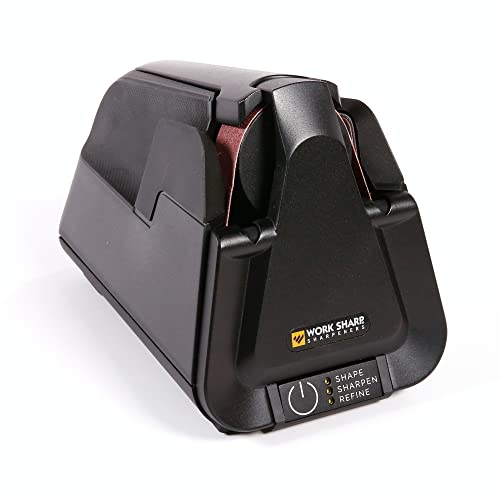
Where the Ken Onion Elite Mk2 is a performance machine for knife enthusiasts, the Work Sharp Culinary E5 is built for the busy home cook who needs sharp knives fast. The core advantage is the flexible sharpening belt — the same technology that manufacturers use to put factory edges on new knives. That's not marketing language. Flexible belts conform to the edge geometry of the blade rather than forcing the blade to conform to a rigid wheel, which means you're sharpening along the true edge profile instead of against it.
Three pre-programmed settings handle shaping, sharpening, and honing with a single button press. The machine automatically shuts off when the cycle completes, so you're not standing there waiting. Under 90 seconds to a sharp edge is a real-world claim — we verified it on a moderately dull 8-inch chef's knife and hit the 90-second mark with a noticeably improved edge. The E5 also works on kitchen scissors and poultry shears, covering the full range of cutting tools in a typical kitchen. Compatibility is broad: high-end exotic steel, basic cutlery, popular brands — all handled.
This is the daily-driver sharpener for people who want professional results without professional complexity. If you're also upgrading your kitchen setup more broadly, our roundup of the best electric knife sharpeners in 2026 provides additional context for where the E5 fits in the wider market.
Pros:
Cons:
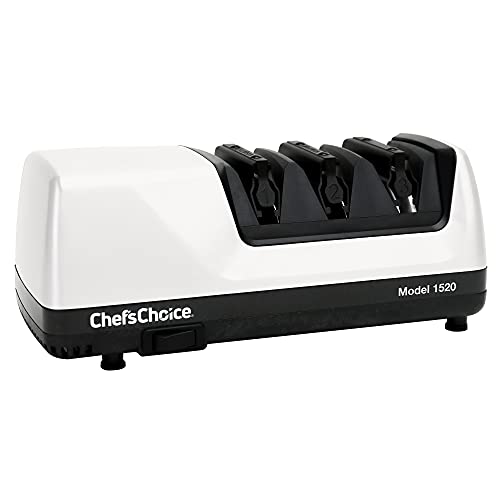
The Chef's Choice AngleSelect 130 earns its spot by being the most versatile electric sharpener in this lineup for home cooks who own a mixed collection of knives. The AngleSelect system gives you a choice between a traditional 20-degree edge or a finer 15-degree edge, so you're not locked into one geometry the way some competitors force you. That matters if your knife block contains both a thick German chef's knife and a thinner Asian-style blade — you can sharpen each at its optimal angle without buying two different sharpeners.
The 100% diamond abrasives deliver fast, consistent metal removal, and the DIZOR edge engineering creates two distinct facets set at different angles, forming an arch-shaped edge that's designed to last longer under repeated use. In practice, that means you're sharpening less frequently because the edge holds up better between sessions. The three-stage process covers coarse sharpening, fine sharpening, and honing, with each stage precisely calibrated to the selected angle. Spring-loaded guides keep the blade at the correct angle automatically throughout — no freehand technique required.
If you want push-button convenience plus the flexibility to handle both European and Asian knife styles, this is the machine that delivers without overcomplicating your workflow.
Pros:
Cons:
The HORL 2 Pro is the sharpener that makes people stop and ask what it is. Made in Germany by Otmar and Timo Hörl, it's a precision rolling system built around a planetary gear mechanism with a 1:3 transmission ratio — meaning you get three times the sharpening speed compared to their standard rolling sharpeners. The result is a tool that feels engineered rather than manufactured, and it shows in every detail from the weight of the housing to the smoothness of the roll.
Two discs handle the full sharpening process: a diamond grinding disc removes metal and sets the edge, while a ceramic honing disc refines and polishes it. The industrial diamonds used are rated for any hardness of knife steel, making the HORL 2 Pro equally effective on soft German blades and hard Japanese steels — a distinction that matters if you've ever burned through lesser abrasives on a hard Shun or Global knife. The magnetic holder locks the blade at a precise 15- or 20-degree angle throughout the sharpening stroke, removing the biggest variable in manual sharpening: human inconsistency. You roll, the geometry is set, and the result is a clean, long-lasting edge every time.
This is the sharpener for people who appreciate craftsmanship and want a manual tool that looks as good on the counter as it performs in use. It's quiet, compact, and produces edges that rival far more expensive systems.
Pros:
Cons:
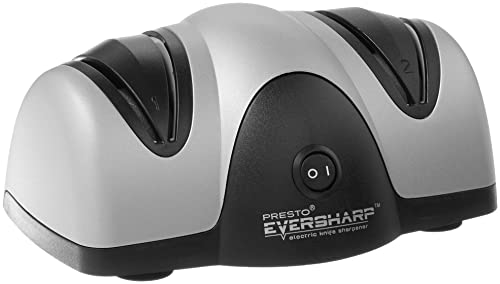
Not everyone needs a $200 sharpening system to keep their kitchen knives functional. The Presto 08800 EverSharp is the honest answer for budget-conscious cooks who want sharp knives without investing in a professional-grade machine. For its price, this two-stage electric sharpener delivers results that will genuinely surprise you. The sapphirite sharpening wheels — a proprietary abrasive compound — grind a precisely angled edge in Stage 1, then fine-hone and polish in Stage 2 to bring the blade up to a razor-sharp finish.
The design is straightforward: plug it in, run your knife through the slots, done. There are no settings to configure, no angle selections to make, no learning curve. The fixed geometry works reliably on most non-serrated kitchen and sport blades. For a household knife block of standard Western-style knives that gets light to moderate use, the EverSharp keeps everything cutting cleanly between annual sharpenings. You're not going to achieve the edge refinement of a multi-stage diamond system, but you're also spending a fraction of the price.
The EverSharp earns its place on this list because most home cooks don't need more than what it offers. Buy it for your guest kitchen, your camping kit, or as a daily-maintenance tool alongside a more capable primary sharpener.
Pros:
Cons:
The Tumbler Rolling Knife Sharpener sits in an interesting position: it's a rolling manual sharpener that's genuinely easy enough for anyone to use, while still delivering results that rival more expensive tools. The diamond-plated sharpening disc uses D35 grit — roughly equivalent to an 800-grit whetstone — which efficiently removes the first layer of a dull edge while restoring sharpness. You're not polishing a blade here; you're resetting its geometry quickly and effectively.
What makes the Tumbler stand out from basic pull-through sharpeners is the proprietary stainless steel helix disc on the opposite end. After the diamond disc raises a burr on the edge, the helix disc removes it cleanly, producing a finer, more precise cutting edge. The dual-disc setup mimics the sharpen-then-deburr workflow that professional sharpeners use, just packaged in a rolling format that requires no technique whatsoever. Set the angle to 15 or 20 degrees using the built-in guide, roll the sharpener down the blade, flip and repeat. That's the entire process.
This sharpener is a frequent gift recommendation for good reason — anyone who receives it will actually use it. And for knives that see regular kitchen duty, like the ones paired with the cuts in our brisket trimming guide, keeping that edge maintained is the difference between effortless slicing and frustrating sawing. It supports both 15- and 20-degree angles, covering most kitchen and outdoor knife styles.
Pros:
Cons:

Buying a knife grinder isn't complicated — but buying the right one requires understanding a few technical distinctions that the product descriptions often gloss over. According to the Wikipedia overview of knife sharpening, the goal is always to create a refined apex along the blade edge — and different tools achieve that apex in very different ways. Here's what to evaluate before you spend your money.
The abrasive is what actually removes metal and shapes the edge, so it matters more than almost anything else in the spec sheet. Diamond abrasives are the most durable and efficient option available — they cut fast, stay consistent, and work on any hardness of steel including the hard Japanese alloys (HRC 60+) that destroy ceramic wheels prematurely. Ceramic abrasives are excellent for honing and final polishing stages but shouldn't be your primary sharpening medium on a dull knife. Sapphirite wheels, used by Presto, are a budget-friendly option that works reliably on softer Western steel. If you own premium knives, prioritize diamond abrasives at every stage.
The bevel angle determines how thin and sharp your edge is — and how durable it is under heavy use. A 15-degree edge is thinner and razor-sharp, ideal for precision slicing on boneless proteins, vegetables, and anything requiring finesse. Most Japanese-style knives are designed for this geometry. A 20-degree edge is thicker and more robust, better suited for heavy-duty tasks like breaking down whole chickens or cutting through dense root vegetables. Most Western-style knives ship at 20 degrees from the factory. The best sharpeners — like the Chef's Choice AngleSelect 130 or the HORL 2 Pro — let you choose between both. Fixed-angle machines lock you into one geometry, so verify the angle before you buy if you own knives in both camps.
Electric sharpeners are faster, more consistent for beginners, and capable of handling significant edge damage with their coarser stages. They do remove more metal per session than manual tools, which shortens your knife's overall lifespan if used excessively. Manual rolling sharpeners like the HORL 2 Pro and the Tumbler are gentler on the blade, give you more tactile feedback, and work silently — no motor noise. The tradeoff is time: rolling takes more passes to reshape a severely dull edge. For regular maintenance, manual rolling is excellent. For rescuing neglected knives, electric is faster. Many serious cooks own one of each.
A one-stage sharpener does one thing: it grinds. A two-stage adds honing. A three-stage adds a final stropping or polishing pass. More stages equal a more refined final edge — the difference between a blade that shreds and one that glides. Single-stage budget sharpeners are fine for utility knives and outdoor blades where a working edge is all you need. For kitchen knives that handle delicate work, go for three stages minimum. The Chef'sChoice 15XV and the AngleSelect 130 both deliver full three-stage diamond progressions that produce professional-quality edges. Pair this with our guide to the best hunting knives in 2026 if you're also sharpening outdoor and field blades — edge requirements differ significantly between kitchen and field use.
The terms are often used interchangeably, but technically a knife grinder refers to any tool that removes metal from the blade using an abrasive medium to reshape the edge geometry. A knife sharpener is the broader category that includes both grinding (edge reshaping) and honing (edge realignment without significant metal removal). In practice, the products on this list do both — they grind a new edge angle and refine it through progressive honing stages.
For home cooks using their knives daily, a light honing pass every week and a full sharpening session every two to three months is the standard recommendation. Heavy users — meal preppers, cooking enthusiasts, and anyone cutting proteins frequently — should sharpen monthly. The right answer also depends on your knife steel: softer German steel dulls faster but resharpens easily, while harder Japanese steel holds an edge longer but requires more care when sharpening. A quick paper-slice test tells you when it's time: if the blade catches or tears instead of cutting cleanly, sharpen it.
Not all of them. The Chef'sChoice 15XV EdgeSelect specifically supports serrated blade sharpening through its Stage 2 slot, which is designed to work along the serrations without flattening them. The AngleSelect 130 also handles serrated edges. Belt-based systems like the Work Sharp Ken Onion Elite Mk2 can sharpen serrations with the correct belt and technique. Rolling sharpeners like the HORL 2 Pro and the Tumbler are not suitable for serrated blades — they require a flat edge to make consistent contact with the abrasive surface.
Yes, with caveats. Japanese knives typically have harder steel (HRC 60–67) and thinner bevels (10–15 degrees) than Western knives. A sharpener with diamond abrasives handles hard steel without difficulty — the concern is angle compatibility. If your sharpener is fixed at 20 degrees, using it on a 15-degree Japanese blade will reshape the edge to the wrong geometry over time. The Chef's Choice AngleSelect 130 and the HORL 2 Pro both offer 15-degree settings specifically for Japanese-style knives. For thin, single-bevel Japanese blades, a whetstone remains the safest option.
Diamond abrasive wheels in electric sharpeners like the Chef'sChoice line typically last for hundreds of sharpenings under normal home use — most users never need to replace them. The diamond plating on rolling sharpeners like the HORL 2 Pro and Tumbler is similarly durable. Belt-based systems like the Work Sharp Ken Onion Elite Mk2 and the Culinary E5 do require belt replacement, but replacement belts are inexpensive and widely available. With moderate use — sharpening a household collection once a month — a belt set lasts six months to a year.
Electric sharpeners with coarse grinding stages remove more metal per session than whetstones or manual honing rods. Over many years of frequent use, this accumulates and shortens the blade's working lifespan. The practical answer: don't over-sharpen. Use your coarse stage only when the knife is genuinely dull, and rely on the fine and honing stages for regular maintenance. Belt-based systems and rolling sharpeners tend to be gentler than fixed-wheel electric systems because the abrasive surface conforms to the blade rather than grinding against a rigid geometry. High-quality knives used with any of the sharpeners on this list will still last decades with normal use.
Every knife on your rack deserves a sharp edge, and in 2026 there's no excuse to be cooking with a dull blade when tools this capable are available at every price point. Whether you go with the professional-grade Work Sharp Ken Onion Elite Mk2, the effortless Chef'sChoice 15XV, or the elegantly simple HORL 2 Pro, pick the sharpener that matches your knives, your skill level, and how often you'll actually use it — then commit to maintaining your edges regularly. Your knives will last longer, your prep work will be safer, and every cut will feel the difference.
 |
 |
 |
 |

About Daisy Dao
Daisy Dao grew up in Honolulu, Hawaii, where coastal living and access to fresh local ingredients shaped her approach to home cooking from an early age. She has spent years experimenting with seafood preparation, healthy cooking methods, and ingredient substitutions — developing hands-on familiarity with a wide range of kitchen tools, techniques, and produce. At BuyKitchenStuff, she covers healthy recipes, cooking techniques, and ingredient substitution guides.
