Kitchen Gadgets & Equipment Reviews ›
by Rick Goldman
Hot pot cooking has exploded in popularity — the global hot pot restaurant market topped $47 billion in 2024 and continues climbing as more families bring the experience home. Whether you're into Sichuan-style spicy broth, classic Japanese shabu shabu, or just need a fast way to cook noodles in a dorm room, a dedicated hot pot cooker makes all the difference. The right electric pot gets your broth boiling in minutes, holds temperature precisely through a two-hour dinner, and cleans up without a fight.
But walk into any kitchen store or scroll Amazon and you'll find dozens of options ranging from $15 to $150. Capacity, material, power output, and whether you want a divided pot all matter — and the wrong choice means lukewarm broth and frustrated guests. We've dug into the specs, real user feedback, and hands-on details for the top models available in 2026 so you don't have to guess. Check out our full hot pot cooker reviews category for even more options, and keep reading for our six top picks broken down by use case.
If you're new to electric hot pots, think of them as a purpose-built countertop appliance — plug in, fill with broth, and cook directly at the table. No stove needed. Some models do double duty as a grill or sauté pan. Others are self-heating and don't need electricity at all. We cover all the major types below. For a quick overview of what separates the best from the rest, jump to our buying guide after the reviews.
Contents


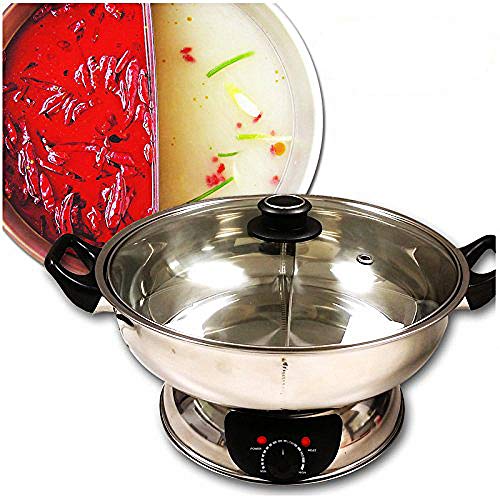


The Aroma ASP-610 is the go-to pick for families where everyone can't agree on a single broth. The 5-quart stainless steel pot splits into two separate sections, so you can run a spicy Sichuan broth on one side and a mild chicken stock on the other — simultaneously. That's a genuine game-changer at the dinner table. The adjustable power dial gives you three heat settings (Minimum, Medium, High), which is enough range to keep a gentle simmer on delicate ingredients or push to a rolling boil for thick cuts of meat.
Build quality is solid. The stainless steel construction feels durable without being unnecessarily heavy, so lifting the pot from stove to table is easy. Cleanup is one of the highlights here — the divided pot and all removable parts are fully dishwasher safe, which matters a lot after a two-hour hot pot session when nobody wants to scrub.
The main trade-off is heat control. Three fixed settings won't satisfy cooks who want fine-grained temperature adjustment. If one side needs to simmer at exactly 180°F, you'll be eyeballing it. But for the price and the core use case — a family shabu shabu night — this pot delivers everything you need.
Pros:
Cons:
If you're cooking for one and space is tight, the Dezin 2L is the pot you want. At just two liters, it fits comfortably on a dorm desk, heats up fast, and handles a wider menu than you'd expect. The non-stick coating lets you sauté steak, fry an egg, cook ramen, or simmer oatmeal — all from the same pan. The package even includes a silicone spatula and an egg rack so you can get started immediately without hunting for accessories.
Power is switchable between 250W (low simmer) and 600W (fast boil), which gives you real flexibility for delicate eggs versus a rapid noodle cook. The non-stick liner reduces oil usage and makes cleanup genuinely fast — a quick wipe usually does it. Overheat protection and boil-dry protection are both built in, which matters in a dorm where forgetting a pot on the stove is a real hazard.
The 2L capacity is the obvious limitation. This pot is not built for groups — if you're cooking for two or more, look at the larger options below. But as a compact, versatile, single-serve appliance, it's hard to beat. College students, frequent travelers, and anyone cooking in a small apartment will appreciate how much this little pot can do. If you enjoy Asian noodle dishes, pair it with a selection from our best cup noodles guide for quick weeknight meals.
Pros:
Cons:
When you're hosting a hot pot party and need something that handles a crowd without breaking a sweat, the Sonya 5.1L steps up. The 1500W heating element brings a large volume of broth to boil quickly — no waiting 20 minutes before guests can start cooking. The 5.3-quart (5L) capacity comfortably serves six or more people, and the internal divider lets you offer two different flavors simultaneously. Spicy and mild, Mongolian and Japanese — everyone gets what they want.
Safety is taken seriously here. Anti-skid feet keep the pot planted firmly on the table even during a lively meal, and the ETL listing (a North American safety certification) means the electrical components have been independently tested. The stainless steel construction is both hygienic and easy to wipe down between broth changes.
At this capacity and power level, the Sonya is clearly aimed at group dining. It's bigger and heavier than a single-serve pot, so if you're cooking alone, it's overkill. But for families or friend groups who want a restaurant-quality hot pot experience at home in 2026, this is the pot that delivers it.
Pros:
Cons:
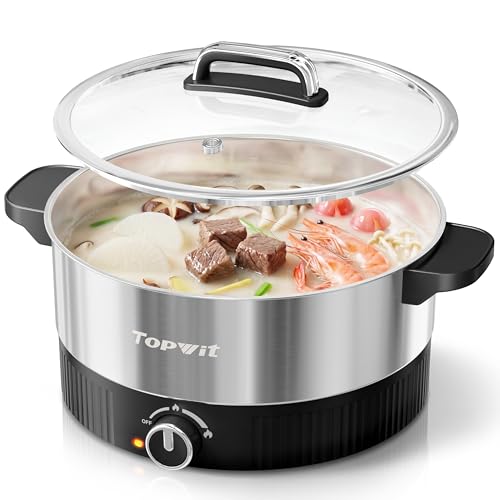
If you're skeptical of non-stick coatings — and plenty of health-conscious cooks are — the TOPWIT 4.5L gives you a clean alternative. The inner pot is bare stainless steel with no coating whatsoever: rust-resistant, odorless, non-toxic, and built to last. You're not worrying about scratches degrading a surface layer, and you're not dealing with any off-flavors transferring into your broth.
The 4.5L capacity with a 10.63-inch wide, 3.39-inch deep interior is the sweet spot for families of two to six. You get enough room to stir and simmer without overflow, and the 1200W element heats the pot to a rolling boil efficiently. Two heat settings — High and Low — keep operation simple. This isn't a precision instrument, but for hot pot, pasta, soup, porridge, and stews, two settings is genuinely all you need.
One clear boundary: TOPWIT specifies this pot is not for frying or stir-frying. The uncoated stainless surface will stick if you try to dry-sear at high heat. Stick to what it's designed for — wet cooking — and it performs exceptionally well. This is a no-fuss workhorse for regular family meals.
Pros:
Cons:
This one is completely different from every other product on this list — and that's exactly the point. The Moxiaoxian Self Heating Hot Pot requires no electricity, no fire, and no stove. You add a bottle of water to the heating pack, a chemical reaction generates heat, and your meal is ready in about 15 minutes. That's it. It's disposable, self-contained, and genuinely portable.
The flavor profile is authentic Sichuan hot pot — traditional Chinese soup base with vacuum-packed fresh vegetables. If you've had real Sichuan hot pot, you know the numbing, spicy punch of Sichuan peppercorns and chili. This delivers that in a box you can carry in a backpack. It's designed for camping, hiking, picnics, travel, office lunches — anywhere a stove or outlet isn't available.
The obvious limitation is that this is a single-use meal kit, not a reusable appliance. You're not getting the capacity or flexibility of an electric pot. But if your use case is convenience and portability — a hot meal anywhere in 15 minutes — there's nothing faster or simpler. Think of it less as a kitchen appliance and more as a premium instant meal with real broth character.
Pros:
Cons:
The LIVEN SK-J3201 does something none of the other pots on this list can: it combines a shabu shabu hot pot with a BBQ grill surface in a single unit. You can use just the hot pot, just the grill, or both at the same time — running a broth on one side while grilling meat on the other. For Korean BBQ or Japanese yakiniku fans, this is an exciting setup. The pot and grill are controlled independently, so you can keep the broth at a simmer while the grill runs hot.
The food-grade non-stick coating covers both cooking surfaces, handles high temperatures well, and cleans up with a soft cloth. The 1.3L pot capacity and 1300W power output at 120V are suited for intimate meals of one to three people. This isn't a family-sized appliance — it's a compact, feature-rich cooker for couples or small friend groups who want that Korean BBQ-plus-hot-pot combination without buying two separate appliances.
The trade-offs are real. The hot pot section is not removable from the combined unit, which makes deep cleaning more involved than a fully removable pot. Heat level is not adjustable — you get on/off for each section. And the 1.3L pot fills up fast. But if the dual grill-and-hotpot format is what you want, the LIVEN delivers a functional version at a reasonable price point. It's a nice complement to other tabletop cooking gear — if you enjoy that kind of entertaining, you might also appreciate our roundup of best fondue pots for another interactive dining format.
Pros:
Cons:
Not all hot pot cookers are built for the same job. Before you spend money, get clear on how you'll actually use it — solo weeknight meals, weekend family dinners, or outdoor adventures. Here are the factors that matter most in 2026.
Capacity is the first and most important decision. Buying too small means guests are waiting for refills; buying too large wastes energy heating unused volume.
For group hot pot, also consider whether you need a divided pot. Two people with opposite spice preferences will appreciate the dual-sided design far more than a single-broth pot.

The inner pot material shapes both cooking performance and long-term durability. According to Wikipedia's overview of hot pot cooking, the tradition spans centuries across Asia, and the vessel material has always mattered.
If you're buying a hot pot strictly for broth-based cooking, stainless steel is the more durable long-term choice. If you want sauté capability (eggs, fried rice), non-stick is the better fit.
Wattage determines how fast your pot heats up and whether it can maintain temperature during heavy use.
Heat adjustment options vary by model. Three-setting dials (Min/Med/High) are the most common. Simple High/Low dual controls work for most users. If you want precise temperature control for things like chocolate fondue or delicate seafood, look for models with a wider range — or consider a dedicated electric hot pot with thermostat controls.
Most electric hot pots require a standard 120V outlet. That covers your kitchen table, dorm room, and office break room. But if you need hot food at a campsite, on a hiking trail, or anywhere without power, the equation changes entirely.
A hot pot cooker is an electric appliance that heats broth or cooking liquid directly on the table. You plug it in, fill it with your broth of choice, bring it to a boil, then cook raw ingredients — thinly sliced meat, vegetables, tofu, noodles — by dipping them into the simmering liquid. It's a communal cooking format popular across Chinese, Japanese, Korean, and Southeast Asian cuisines. Electric models replace the traditional open flame with a built-in heating element for safer indoor use.
As a general rule, plan for about 1 liter of capacity per person at the table. A 2L pot handles one or two people comfortably. A 4.5L pot suits a family of four to five. For parties of six or more, go with a 5L+ model like the Sonya or the Aroma ASP-610. If you're frequently hosting different group sizes, err on the side of larger — you can always cook a smaller portion in a big pot, but you can't cook a big meal in a small one.
It depends on what you're cooking. For traditional hot pot with broth and simmering ingredients, stainless steel is the better long-term material — it's tougher, scratch-resistant, and doesn't degrade over time. For a more versatile pot that you'll also use for eggs, fried rice, or sautéed dishes, a non-stick coating makes cleanup easier and requires less oil. Just treat non-stick surfaces gently: stick to wooden or silicone utensils and hand wash when possible.
Absolutely. Most electric hot pot cookers double as general-purpose cooking pots. You can cook pasta, make soup, simmer oatmeal, heat up canned food, or boil eggs. Multifunctional models like the Dezin 2L go further — the non-stick surface lets you sauté meat and make fried rice. The LIVEN 2-in-1 adds a full grill surface. The TOPWIT is excellent for soups, stews, and pasta. The main exception is frying — pots designed for simmering shouldn't be used for deep or dry frying.
A divided hot pot has an internal wall that splits the cooking vessel into two separate sections. You fill each side with a different broth and cook ingredients in whichever liquid you prefer. It's perfect for households where one person wants spicy broth and another prefers mild, or for serving guests with different dietary needs at the same meal. If everyone in your household agrees on one broth, you don't need the divider — a single-chamber pot is simpler and gives you more total cooking space. If preferences vary, the dual-sided design is worth every penny.
Self-heating hot pots — like the Moxiaoxian reviewed above — serve a specific niche: hot meals without any power source. They use a chemical heating pack activated by water to cook a pre-packaged meal in about 15 minutes. For camping, hiking, long travel days, or emergency preparedness, they're excellent. As a replacement for a reusable electric hot pot at home, they're not the right tool. Think of them as premium instant meals with authentic flavor rather than kitchen appliances. If portability and convenience are your top priorities, they're absolutely worth it for that use case.
 |
 |
 |
 |

About Rick Goldman
Rick Goldman grew up traveling the Pacific Coast and developed an early appreciation for regional and international cuisines through exposure to diverse food cultures from a young age. That culinary curiosity shaped his approach to kitchen gear — he evaluates tools based on how well they perform across different cooking styles, ingredient types, and meal occasions. At BuyKitchenStuff, he covers kitchen equipment reviews, recipe guides, and food-focused buying advice.
