Kitchen Gadgets & Equipment Reviews ›
by Christopher Jones
Americans spend over $1.2 billion on food processors every year, and yet most people who buy one end up using it for only two or three tasks before it collects dust on a shelf. The problem isn't the machines — it's that most buyers pick the wrong one for how they actually cook. Whether you're pureeing soups, slicing vegetables for weekly meal prep, or kneading dough for homemade bread, the right food processor can cut your kitchen time in half and open up recipes you'd never attempt otherwise. In this guide, we've tested and reviewed seven of the best food processors available in 2026, covering every budget from under $50 to flagship premium models.
A food processor is fundamentally different from a countertop blender — it uses interchangeable discs and blades to slice, shred, mince, and dice solid ingredients rather than liquify them. If you've ever struggled to julienne carrots by hand or spent twenty minutes chopping onions, a good food processor transforms that work into thirty seconds of effortless prep. The challenge is that bowl size, motor power (measured in watts), and included attachments vary enormously across price points, and buying too small or too underpowered means you'll hit the machine's limits on your very first big cooking project.
We've organized this guide so you can jump straight to the product that fits your kitchen and cooking style. You'll find detailed breakdowns for each model, a side-by-side comparison, and a practical buying guide covering everything from bowl capacity to blade quality. Browse our full kitchen equipment reviews for more hands-on recommendations across every category.
Contents
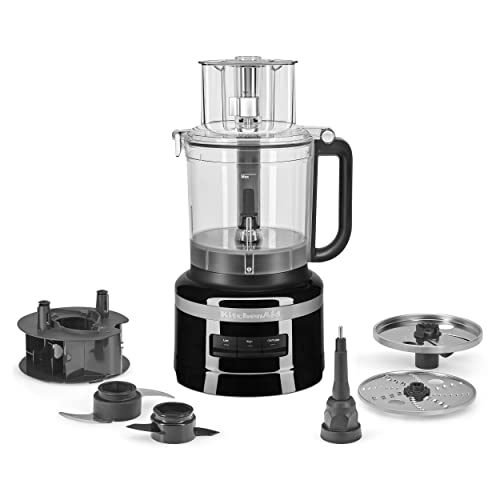




The KitchenAid KFP1318 sits in a sweet spot that very few food processors manage to hit: it's genuinely capable enough for serious cooking projects while remaining intuitive enough that you'll actually want to use it every day. The 13-cup bowl gives you real working room for family-sized batches of hummus, pie dough, or sliced vegetables, and the externally adjustable Exact Slice disc lets you dial in precise thickness without opening the lid — a detail that sounds minor until you realize how much time it saves when you're prepping a full sheet pan of potatoes.
Assembly is where this machine genuinely earns points over the competition. KitchenAid's one-click bowl assembly clicks into place without any twisting or alignment frustration, and the latched lid locks with a satisfying snap that makes the whole unit feel solid rather than plasticky. Cleanup follows the same logic: you add warm water and a drop of dish soap directly to the leak-resistant bowl, run a pulse cycle, and most residue clears out without scrubbing. The in-bowl storage caddy holds all the blades and discs in one organized unit so you're never hunting through a drawer for the right attachment.
Motor performance is strong across all standard tasks — chopping nuts, shredding cheese, slicing cabbage — and the machine handles light dough without the motor sounding strained. For most households cooking dinner four to five nights a week, this is the processor we'd recommend first without hesitation. It's not the cheapest option here, but it's built to last and designed to stay on your counter rather than migrate to a cabinet.
Pros:
Cons:
If you cook seriously and you want a food processor that keeps pace with your ambitions, the Breville Sous Chef 16 is in a different league from everything else on this list. The 16-cup capacity is the largest here and it makes a real difference when you're processing whole heads of cabbage for coleslaw, large batches of tomato sauce, or a double recipe of pie crust. The 24-size adjustable slicer (meaning you have 24 distinct thickness settings rather than the typical two or three) produces slices so consistent that the difference in cooking time across an entire batch of vegetables becomes negligible — that matters when you're making gratin or a layered vegetable tian where even thickness is what separates professional results from home-cook results.
The attachment lineup is comprehensive in a way that no other processor here matches: you get a reversible shredding disc, a French fries disc, a micro-serrated S-blade that handles everything from herbs to tough root vegetables, a dough blade, and a mini blade with its own small bowl for tasks like mincing garlic or making a tablespoon of pesto. Breville also includes access to the Breville+ app, which connects you to over 1,000 guided recipes and cook classes specifically tested and tuned for this machine — and while app integration in kitchen appliances is often gimmicky, the recipe library here is genuinely useful and well-curated.
Build quality is exceptional throughout: the brushed stainless steel housing feels substantial and the motor handles continuous use without overheating or laboring. This is the processor you buy when you've outgrown everything else, when you're cooking for a large family or entertaining regularly, or when precise, professional-quality cuts genuinely matter to the dishes you're making. If you're also into pasta nights, check out our guide to the 15 best electric pasta makers — the Breville pairs beautifully with a dedicated pasta machine for full from-scratch meals.
Pros:
Cons:

The Ninja BN601 delivers the most motor power per dollar of any machine on this list, and that 1000-peak-watt motor is the reason this processor can handle tough, fibrous, or partially frozen ingredients that would cause cheaper machines to stall or overheat. Auto-iQ technology — Ninja's name for its intelligent preset programs — removes the guesswork from four common tasks: chopping, slicing, pureeing, and dough. Each preset runs timed bursts and pauses calibrated for that specific function, which means you press one button and walk away instead of hovering over the machine and pulsing manually.
The 9-cup bowl is the right size for most households — large enough for a full batch of hummus or a week's worth of shredded carrots, but compact enough that the machine doesn't dominate your counter. The three included blades (chopping blade, dough blade, and disc for slicing and shredding) cover the tasks most people use a food processor for ninety percent of the time. You won't find the ultra-fine slicing adjustability of the Breville machines here, but for everyday prep — onions, garlic, vegetables, soft cheese — the performance is genuinely impressive given the price point.
Where the Ninja earns a strong recommendation is in its combination of power, simplicity, and value. If you want a machine that handles tough ingredients and automates the most common tasks without requiring you to learn a complicated interface, this is your processor. It's particularly well-suited to meal preppers who want to run several different prep tasks back to back on a Sunday afternoon without babysitting each one.
Pros:
Cons:
The Hamilton Beach 70730 makes a compelling case that you don't need to spend a lot of money to get a genuinely useful food processor. At 10 cups of capacity, it covers most everyday prep tasks — slicing, shredding, mincing, pureeing — and its most distinctive feature is the built-in bowl scraper that wipes the sides of the bowl as the blade spins, eliminating the need to stop the machine, lift the lid, and manually push ingredients back down. That single feature changes the workflow in a meaningful way, especially when you're processing sticky or thick mixtures like nut butter or blended soups.
Performance is solid for the price — the motor handles vegetables, soft cheese, and cooked ingredients without complaint, though it's not the machine you'd choose for heavy dough or large batches of fibrous raw vegetables. The stainless steel and black design holds up well aesthetically even after months of regular use, and the removable parts are dishwasher-safe, which matters a lot when you're using the machine daily. According to food processing principles, the key variables in any processor are blade geometry, bowl airflow, and motor torque — and Hamilton Beach gets two of these three right at a budget price.
If your cooking is more occasional than daily, if you're equipping a first kitchen, or if you simply want to see whether a food processor improves your cooking before committing to a higher-end model, the Hamilton Beach 70730 is the smart entry point. It won't disappoint you on the tasks it's designed for, and the scraper feature alone sets it apart from other machines in this price range.
Pros:
Cons:
The BLACK+DECKER FP1600B is the right answer when counter space is limited and your cooking needs are modest but real. At 8 cups, it handles single-household prep tasks — a batch of salsa, a cup of chopped onions, shredded cheese for dinner — quickly and without fuss. The food chute with pusher guides whole vegetables and fruits toward the slicing and shredding disc safely and consistently, giving you uniform results without requiring you to pre-cut everything into small pieces before processing.
The machine is compact, affordable, and the removable parts are all dishwasher-safe, which keeps the barrier to using it low. There's no elaborate setup, no confusing attachment system — you snap the bowl in place, choose your disc or blade, and run it. For someone who cooks for one or two people and wants a processor that doesn't require a dedicated cabinet shelf, this machine delivers exactly what it promises without overcomplicating anything.
You need to go in with realistic expectations: the 8-cup bowl will require multiple processing rounds if you're cooking for a large family, and the motor won't handle stiff bread dough or large quantities of hard root vegetables. But for the tasks where a compact food processor genuinely saves time, the BLACK+DECKER FP1600B is dependable, easy to clean, and costs less than most restaurant meals.
Pros:
Cons:

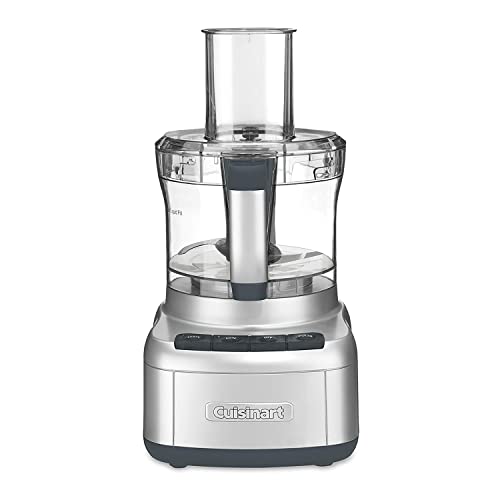
Cuisinart has been making food processors since the category was invented, and the FP-8SV reflects decades of refinement in a straightforward, well-executed package. The 350-watt motor is strong enough for the 8-cup bowl and handles slicing, shredding, pureeing, and light dough with steady performance that doesn't fade over a long processing run. The rubberized High, Low, Off, and Pulse controls feel solid underhand and give you real-time responsiveness — particularly the Pulse function, which lets you control texture precisely on tasks like chopping nuts or making chunky salsa where you want control rather than a fully automated result.
The reversible shredding and slicing disc gives you medium and fine options for both functions, which covers most everyday needs without requiring you to manage a large collection of separate discs. The integrated feed tube allows you to add ingredients while the machine runs — useful when you're emulsifying dressings or slowly adding oil to a food processor mayonnaise. Bowl measurement markings let you track quantities without transferring to a separate measuring cup, which is a small convenience that adds up over many cooking sessions.
The silver finish and clean design mean the Cuisinart looks at home on a modern kitchen counter. This is a machine that rewards regular use: it's not the most powerful or the most feature-rich option here, but it's honest, reliable, and backed by a brand whose replacement parts and service support are genuinely accessible. For someone who wants a step up from the cheapest options without spending premium prices, the Cuisinart FP-8SV is a confident choice in 2026.
Pros:
Cons:
The Breville BFP610 answers a specific question: what if you want Breville's precision and build quality but your kitchen can't accommodate the 16-cup model? The 9-cup Sous Chef compresses the premium Breville experience into a smaller footprint without sacrificing the attachment quality or performance that makes the brand worth the price. The onboard storage caddy integrates directly with the bowl and holds the dicing kit, S-blade, reversible shredder, adjustable slicer, and dough blade in a way that keeps each item independently accessible rather than piled on top of each other in a drawer.
The adjustable slicer is the standout feature here — you get consistent, repeatable thickness across fine slices of cucumber through thick cuts of potato, with precision that budget and mid-range processors simply can't match. The S-blade is micro-serrated, which means it grips and processes ingredients more efficiently than a standard straight blade, and the results in tasks like mincing herbs or pureeing roasted vegetables are noticeably cleaner. Breville+ app access is included here as well, connecting you to the same library of guided recipes and cook classes as the larger 16-cup model.
If you're the kind of cook who preps a lot of vegetables, makes homemade dips and spreads, or frequently works with ingredients where uniform cutting actually matters for the final dish, the BFP610 is the right sized machine with the right quality of execution. It also pairs well with fermentation projects — if you're using a food processor to prep vegetables for pickling or fermented condiments, the precision slicing makes a real difference in how evenly the vegetables cure. Pair it with a good food mill for complete sauce and preserve workflows in one compact kitchen setup.
Pros:
Cons:
Bowl capacity is measured in cups and directly determines how much food you can process in a single run without stopping to empty the bowl and start again. For one or two people, an 8-cup bowl covers almost every everyday task — a batch of salsa, shredded cheese for tacos, a cup of chopped vegetables. For a family of four or someone who does weekly meal prep on Sunday afternoons, you want at least 10 to 11 cups, and the 13-cup KitchenAid or 16-cup Breville become genuinely useful rather than just impressive on paper. The most common buying mistake is underestimating how much you'll actually use it once you have one — it's better to size up than to find yourself batching every single task.
Motor power is listed in watts and determines how well the processor handles tough ingredients — dense vegetables, stiff dough, partially frozen fruit. Standard motors in budget processors run 350 to 600 watts and handle everyday tasks without issue. The Ninja BN601 lists 1000 peak watts — "peak" refers to maximum surge power rather than continuous running power, so treat peak-watt ratings as a relative indicator rather than a direct comparison to continuous-watt ratings. For most home cooking, 600 to 700 continuous watts is more than sufficient; you only need to push higher if you're regularly making bread dough or processing very hard or fibrous ingredients.
Every food processor comes with a standard chopping blade (also called an S-blade), and most include at least one slicing and shredding disc. The features that separate mid-range from premium models are adjustable slicing thickness and the variety of specialized discs. An adjustable slicer is the single most useful upgrade because it lets you go from paper-thin cucumber slices to thick-cut potato rounds on the same machine — something a fixed-thickness disc simply can't do. If you bake bread or make pizza dough, a dedicated dough blade is worth having; without it, the standard S-blade works but requires more careful monitoring to avoid overworking the dough and toughening it.
A food processor you find annoying to use will end up in a cabinet within three months, so pay close attention to assembly, lid design, and cleanup when evaluating your options. Features like KitchenAid's one-click bowl assembly and Breville's onboard storage caddy make a real-world difference in whether you reach for the machine regularly or avoid the setup hassle. Dishwasher-safe parts are standard across all models here, but some bowls and lids are top-rack only — check the specific guidance before you run them through a hot cycle. The Hamilton Beach 70730's built-in bowl scraper is an underrated convenience that eliminates one of the most tedious steps in processing thick or sticky mixtures.
A food processor uses interchangeable blades and discs to slice, shred, mince, and dice solid ingredients, keeping their texture intact in distinct pieces. A blender liquifies ingredients using a fixed blade at the bottom of a narrow jar, pulling everything into the vortex for smooth, pourable results. If you want hummus, sliced vegetables, or shredded cheese, you want a food processor. If you want a smoothie, soup puree, or protein shake, you want a blender. Some tasks overlap — both can make smooth dips — but the two appliances are fundamentally designed for different outcomes and replacing one with the other produces compromised results.
For a family of four cooking most nights of the week, a 10 to 13-cup bowl is the practical sweet spot. An 8-cup bowl works for couples or individuals but requires multiple batches for larger family meals. A 16-cup bowl is genuinely useful if you meal prep in large quantities, entertain regularly, or cook for more than four people. The KitchenAid 13-cup and Ninja 9-cup are both well-sized for typical family use at different price points, while the Breville 16-cup is the choice when capacity is your primary priority.
Yes, most mid-range and premium food processors can make bread and pizza dough, but you need a dedicated dough blade rather than the standard S-blade for best results. The dough blade is blunt and kneads the dough rather than cutting it, which develops gluten properly without overworking the dough. The Breville models (both BFP810 and BFP610) include dough blades and handle dough confidently. The Ninja BN601 includes a dough blade and has an Auto-iQ preset specifically calibrated for dough. Budget models like the BLACK+DECKER or Cuisinart 8-cup can handle soft doughs but struggle with stiff, high-hydration bread doughs.
Most food processor bowls, lids, and blades are dishwasher-safe — top rack only for plastic components to prevent warping from high heat. For quick cleanup between tasks, add warm water and one or two drops of dish soap directly to the bowl, snap the lid on, and pulse a few times to flush residue from the blade area without disassembly. The KitchenAid KFP1318 is specifically designed for this method with its leak-resistant bowl. Always handle blades with care — they stay extremely sharp even after heavy use, and reaching into a bowl without looking is the most common source of processor-related cuts in the kitchen.
Yes, because the two appliances handle genuinely different tasks. Your blender excels at liquid-heavy preparations: smoothies, soups, sauces, and drinks. Your food processor handles solid prep work that a blender cannot do well: uniform slicing, shredding cheese, chopping vegetables to a specific texture, making pie dough, or producing chunky salsas where you want distinct pieces rather than a puree. If you find yourself hand-slicing vegetables for meal prep every week, spending twenty minutes mincing garlic and onions, or struggling to shred cheese without a processor, the appliance will pay for itself in saved time within the first few months of regular use.
The Hamilton Beach 70730 is the strongest budget option in 2026, offering 10 cups of capacity and the genuinely useful built-in bowl scraper at a price well below mid-range models. The BLACK+DECKER FP1600B is the pick if you need an even more compact machine for a small kitchen or want to spend the absolute minimum while still getting reliable performance on everyday tasks. Both are dishwasher-safe, straightforward to use, and capable of handling the slicing, shredding, and chopping tasks that most home cooks use a food processor for most often.
 |
 |
 |
 |

About Christopher Jones
Christopher Jones holds an MBA from the University of San Francisco and brings a business-minded approach to kitchen gear evaluation — assessing products not just for performance but for long-term value, build quality, and real-world usability in everyday home cooking. He has spent years testing appliances, cookware, and kitchen gadgets with the same analytical rigor he developed in business school. At BuyKitchenStuff, he covers kitchen appliance reviews, buying guides, and practical cooking tips.
