Kitchen Gadgets & Equipment Reviews ›
by Rick Goldman
Over 80 million kitchen knives are sold in the United States every year, yet fewer than 15% of home cooks own a blade they'd call genuinely sharp. That gap between owning a knife and owning the right knife is exactly where the Sabatier name enters the conversation. Rooted in the French cutlery tradition dating back to the early 1800s, Sabatier knives have built a reputation for balancing heritage craftsmanship with accessible pricing — a combination that keeps them on serious shortlists in 2026.
But here's the catch: "Sabatier" isn't a single brand. It's a designation tied to the Thiers region of France, and multiple manufacturers use the name. That means quality can vary dramatically from one Sabatier knife to the next. Some are fully forged in France from a single steel bar. Others are mass-produced with the name licensed out. Knowing which Sabatier knife actually delivers on the promise takes a closer look at materials, construction, and real-world performance — which is exactly what this guide provides.
We evaluated seven Sabatier knives across categories including chef knives, slicing knives, utility knives, and full block sets. Whether you're upgrading a worn-out starter knife or rounding out a collection that already includes quality kitchen essentials, you'll find a match below. Each product was assessed on blade steel, edge retention, handle ergonomics, and overall value for the price.

Contents


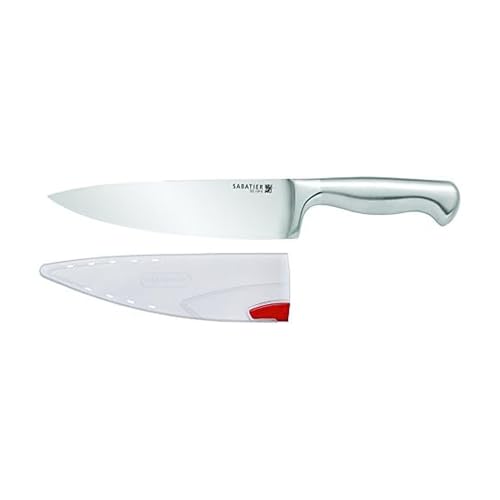

If you've ever pulled a knife out of a drawer only to realize it's too dull to slice a tomato cleanly, the Edgekeeper concept will immediately make sense to you. This 8-inch chef knife ships with a patented blade cover that contains a built-in sharpening mechanism. Every time you slide the knife in or out of the sheath, the ceramic elements hone the edge. It's not a gimmick — it genuinely reduces how often you need to break out a whetstone or electric sharpener.
The blade itself is forged from high-carbon stainless steel, which gives it a good balance of hardness and corrosion resistance. It holds an edge respectably well even without the Edgekeeper sleeve, though the sleeve is clearly the main selling point. The 8-inch length is versatile enough for most kitchen tasks, from dicing onions to breaking down a whole chicken. Weight distribution sits slightly forward of the bolster, which helps the knife do some of the cutting work for you through momentum alone.
Where this knife shows its price point is in the handle. It's functional and reasonably comfortable, but it doesn't have the contoured grip you'd find on premium German or Japanese knives. For daily home cooking, that's a non-issue. For someone spending hours doing prep work, it could cause fatigue. That said, the self-sharpening feature makes this one of the most maintenance-friendly chef knives you can buy in 2026.
Pros:
Cons:
Sometimes you just want a solid chef knife without any extras — no sheath systems, no bells, no whistles. The Sabatier Triple Riveted 8-inch fills that role well. It's a straightforward high-carbon stainless steel blade with a triple-riveted handle that provides stability and a confident grip. The gray handle has a classic look that won't clash with any kitchen aesthetic.
Performance-wise, this knife punches above its price. The blade arrives sharp out of the box and handles standard kitchen tasks — mincing garlic, slicing vegetables, portioning meat — without complaint. The triple-rivet construction means the handle isn't going to loosen over time, which is a common failure point on cheaper knives. The balance is neutral, sitting right around the bolster, which makes it feel controlled during rocking cuts on a cutting board.
The trade-off is that without the Edgekeeper system, you'll need to maintain the edge yourself. High-carbon stainless steel is forgiving, but regular honing with a steel rod every few uses will keep it performing at its peak. If you already own a honing steel or are comfortable with basic knife maintenance, this is arguably a better value than the Edgekeeper model because you're paying only for the blade and handle — no accessories inflating the price. It pairs well with a quality kitchen utensil holder to keep it accessible on the counter.
Pros:
Cons:
This is the real deal. Made by one of the original Sabatier families in the Thiers region of France — the historic heart of French cutlery since the Middle Ages — the SABATIER FRÈRES IDEAL carries a lineage that stretches back to 1885. Every knife is fully forged from a single steel bar and hand-polished by skilled craftsmen. You can feel the difference the moment you pick it up.
The 6-inch blade length makes this a more nimble option than the 8-inch chef knives above. It's ideal for cooks who work on smaller cutting boards, in compact kitchens, or who simply prefer a lighter knife with quicker handling. The round bolster and triple-riveted handle follow the traditional French design that has influenced kitchen knives worldwide. The blade geometry favors a slicing motion over a rocking chop, which is characteristic of French knife design.
The premium here is authenticity and craftsmanship, not flashy features. There's no self-sharpening sleeve, no modern ergonomic handle — just centuries of forging tradition executed at a high level. If you care about provenance and want a knife that connects you to the roots of professional French cooking, this is your pick. Just be aware that the 6-inch size limits its versatility for larger tasks like breaking down melons or squash.
Pros:
Cons:

Starting from scratch or replacing an entire set at once? The 15-piece block set is the most cost-effective way to outfit your kitchen with Sabatier steel. It includes all the essential blade profiles — chef knife, bread knife, utility knife, paring knife, steak knives, and kitchen shears — housed in a handsome acacia wood block with white-handled knives that look genuinely elegant on a countertop.
Every knife in the set is forged from high-carbon stainless steel, which means you're getting consistent quality across the board rather than the uneven mix of stamped and forged blades some budget sets try to sneak in. The acacia wood block is a standout — it's denser and more moisture-resistant than the rubberwood or pine blocks that ship with most knife sets at this price point. The white handles with triple-rivet construction add a modern touch that photographs well and cleans up easily.
The reality with any 15-piece set is that you'll probably use five or six knives regularly and the rest sit in the block. That's not a knock against this set — it's just how knife sets work. The chef knife and paring knife are the workhorses, and both perform well here. The steak knives are serviceable for dinner service. If you're someone who prefers to build a collection one knife at a time, skip this and buy individual pieces. But if you want everything in one purchase with a block included, this is a strong option. It also makes a solid gift, especially for anyone setting up a kitchen after a move — pair it with a set of quality bakeware and you've covered the essentials.
Pros:
Cons:
There's a strong argument that most home cooks really only need three knives: a chef knife, a utility knife, and a paring knife. This set delivers exactly that. The 8-inch chef knife handles the heavy lifting, the 5.5-inch serrated utility knife tackles bread and tomatoes, and the 3.5-inch paring knife takes care of detail work like peeling and deveining shrimp.
All three blades are crafted from high-carbon stainless steel with solid edge retention. The navy handles with gold rivets are a design choice that sets this set apart visually — they look more upscale than the typical black or gray handles in this price range. The triple-rivet construction is consistent with the rest of the Sabatier lineup, ensuring the handles won't wobble or separate over time.
The value proposition here is compelling. Instead of spending on a 15-piece set where half the knives collect dust, you get three knives you'll actually use daily. Each one fills a distinct role without overlap. The serrated utility knife is particularly useful — it's the one you'll grab when you don't want to dirty your chef knife for a quick slicing task. If you're equipping a first apartment, a dorm, or just trimming down to essentials, this three-piece set respects both your counter space and your budget.
Pros:
Cons:
A dedicated slicing knife isn't something every cook thinks to buy, but once you own one, you'll wonder how you managed without it. This 8-inch Sabatier slicer is purpose-built for carving roasts, slicing deli-style meats, and portioning large cuts with precision. The narrower blade profile reduces drag through dense proteins, letting you make clean, even slices that a broader chef knife can't replicate.
Like the Edgekeeper chef knife, this model ships with the same self-sharpening blade cover. The built-in ceramic honing elements maintain the edge every time you store or retrieve the knife. For a slicing knife — which often sits in a drawer between holidays and special dinners — this is especially practical. A blade that sees occasional use is more likely to go dull from oxidation and micro-corrosion than from actual cutting. The Edgekeeper sleeve keeps it ready for action even after months of dormancy.
The high-carbon stainless steel blade is thin enough for precise slicing but sturdy enough that it doesn't flex excessively under pressure. It handles turkey, ham, brisket, and even large roasted vegetables with equal competence. If you regularly host dinners or cook large format proteins, this is a worthwhile addition to a Sabatier collection built around the chef knife reviewed above.
Pros:
Cons:
The utility knife is the unsung hero of most kitchens. It's the blade you reach for when the chef knife feels like overkill and the paring knife feels too small. This 5-inch Sabatier serrated utility handles that middle ground perfectly. The serrated edge grips the skin of tomatoes, cuts through crusty sandwich rolls, and slices citrus without the blade skating across the surface — tasks where a straight-edged knife at the same price point often struggles.
Build quality follows the same blueprint as the rest of the Sabatier Triple Riveted line. The handle is secure, the rivets are properly set, and the blade is made from high-carbon stainless steel with the same hardness profile as its larger siblings. The white handle adds a clean aesthetic, and the compact size makes it easy to store in a drawer or on a magnetic strip without taking up much space.
One thing to keep in mind with serrated knives: they're effectively maintenance-free for years because the recessed teeth stay protected during cutting, but once they do eventually dull, resharpening is significantly more difficult than with a straight edge. You'll either need a specialized rod sharpener or professional services. For most home cooks, though, a quality serrated utility knife will hold its edge through several years of regular use before sharpening becomes a concern.
Pros:
Cons:
Every Sabatier knife reviewed here uses high-carbon stainless steel, but construction method matters just as much as material. Forged knives — stamped from a single piece of heated steel and then shaped — tend to be heavier, more balanced, and more durable than stamped alternatives. The Sabatier FRÈRES IDEAL takes this furthest with true single-bar forging. The more affordable models in the lineup are still forged, but with less hand-finishing. If you're choosing between two similarly priced knives, prioritize forged over stamped every time.
An 8-inch chef knife is the industry standard for good reason — it's long enough to handle most tasks but not so unwieldy that it feels dangerous in tight spaces. If you have smaller hands or work on a compact cutting board, the 6-inch FRÈRES IDEAL may feel more natural. For specialized tasks like carving roasts, the dedicated slicing knife's narrow profile will outperform any chef knife. Think about your cooking habits honestly. If you roast a turkey once a year, the slicing knife is a luxury. If you host monthly dinner parties, it's essential.
Triple-riveted handles are the standard across most of the Sabatier line, and they deliver reliable stability. But stability and comfort aren't the same thing. The traditional handle shape used by Sabatier is straight and symmetrical, which works fine for short prep sessions but may cause fatigue during extended use. If you find yourself doing 30-plus minutes of continuous cutting regularly, pay attention to how the handle fills your palm. The 3-piece set's navy handles have slightly more contouring than the gray or black models, though the difference is subtle.
Your approach to knife maintenance should directly influence which model you buy. If you own a honing steel and use it regularly, any knife in this lineup will serve you well — the Triple Riveted models offer the best value in that scenario. If you'd rather not think about maintenance at all, the Edgekeeper models earn their premium through genuine convenience. The self-sharpening sheath won't replace occasional professional sharpening, but it extends the interval between sharpenings dramatically. For serrated knives, maintenance is a non-issue for years, but replacement rather than resharpening is often the practical endgame.
Sabatier is not a single brand. It's a designation associated with the cutlery-making tradition of Thiers, France. Multiple manufacturers — some with direct lineage to the original 19th-century makers and others with licensed use of the name — produce knives under the Sabatier label. Quality varies significantly, so always check the specific manufacturer. Sabatier Frères, for example, is one of the original families, while other Sabatier-branded products are made outside France entirely.
For standard Sabatier knives without the Edgekeeper system, hone the blade with a steel rod before or after every two to three uses, and sharpen on a whetstone or with an electric sharpener every three to six months depending on usage frequency. Edgekeeper models need professional sharpening less often — typically once a year for average home use — because the sheath maintains the edge between sessions.
Technically some models are labeled dishwasher-safe, but you should always hand-wash your Sabatier knives. The high heat, harsh detergents, and jostling inside a dishwasher degrade the blade edge, discolor the steel, and can loosen handle rivets over time. A quick hand wash with warm soapy water and immediate drying takes less than a minute and will extend the knife's lifespan significantly.
The core blade steel and construction quality are comparable between both lines. The primary difference is the Edgekeeper's inclusion of a self-sharpening blade cover with built-in ceramic honing elements. The Triple Riveted line omits this accessory, resulting in a lower price point but requiring manual edge maintenance. If you already own sharpening tools, the Triple Riveted line offers better value. If convenience is your priority, the Edgekeeper justifies the upcharge.
Sabatier knives occupy a middle ground that works well for serious home cooks and culinary students. The French-made FRÈRES IDEAL line approaches professional grade and is used in some professional European kitchens. However, most professional chefs working high-volume lines tend to gravitate toward brands like Wüsthof, Zwilling, or Japanese makers like Shun and Global for their harder steels and specialized blade geometries. For home use and semi-professional cooking, Sabatier delivers excellent performance relative to price.
Start with an 8-inch chef knife — it handles roughly 80% of kitchen cutting tasks. The Sabatier Triple Riveted Chef Knife offers the best value as a starting point. Add a paring knife next for detail work, then a serrated utility knife for bread and tomatoes. The 3-piece set bundles exactly this combination. Only after you have these three essentials should you consider specialized blades like the slicing knife or a full block set.
Buy the knife you'll actually maintain — the sharpest blade in the world is useless if it lives in a drawer going dull.
 |
 |
 |
 |

About Rick Goldman
Rick Goldman grew up traveling the Pacific Coast and developed an early appreciation for regional and international cuisines through exposure to diverse food cultures from a young age. That culinary curiosity shaped his approach to kitchen gear — he evaluates tools based on how well they perform across different cooking styles, ingredient types, and meal occasions. At BuyKitchenStuff, he covers kitchen equipment reviews, recipe guides, and food-focused buying advice.
