Kitchen Gadgets & Equipment Reviews ›
by Rick Goldman
Picture this: a kitchen counter cluttered with spatulas, tongs, and ladles shoved into a coffee mug that tips over every time someone grabs the whisk. It's a scene our team has witnessed in dozens of kitchens, and it's exactly why a dedicated utensil holder makes such a practical difference. The right crock or caddy keeps cooking tools upright, accessible, and organized — no more rummaging through overstuffed drawers mid-sauté.
We spent weeks evaluating seven of the best kitchen utensil holders available in 2026, testing everything from stainless steel cylinders to handcrafted olivewood crocks. Our criteria covered stability, capacity, material quality, ease of cleaning, and how well each holder blends into a real kitchen setup. Whether the priority is a sleek modern look or farmhouse charm, there's a standout option in this roundup.

Kitchen organization doesn't have to be complicated. A well-chosen utensil holder eliminates counter chaos, protects drawer mechanisms from heavy tools, and puts everything within arm's reach while cooking. If an average kitchen remodel isn't in the budget, swapping in a quality utensil crock is one of the simplest upgrades that actually changes daily workflow. Below, we break down every holder we tested — material by material, feature by feature — so the right choice becomes obvious.
Contents
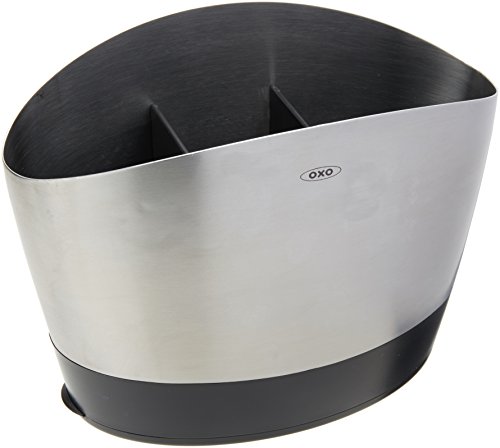




The OXO Good Grips earns our top recommendation for a reason: it nails every fundamental requirement without a single weak point. The elliptical shape — measuring 8.4" x 4.75" x 6.25" — fits flush against a backsplash or tucks neatly beside a stove, which is something round crocks simply cannot do. Our team loaded it with 16 large-handled tools including silicone spatulas, wooden spoons, and metal tongs, and there was still room for a couple more slim utensils.
Build quality is exactly what OXO's reputation promises. The brushed stainless steel resists fingerprints better than polished alternatives, and the contoured interior bottom keeps tools upright rather than letting them lean and topple. We appreciated that the base has enough heft to prevent tipping when pulling out heavier items like a cast-iron ladle. Cleaning is straightforward — warm soapy water and a soft cloth handle any splatter buildup.
Where the OXO truly separates itself is in space efficiency. That elliptical footprint uses roughly 20% less counter space than a round holder of equivalent capacity. For anyone with limited counter real estate — especially in apartment kitchens — this design choice matters enormously. It's also dishwasher-safe, which none of the ceramic or wood options in this roundup can claim.
Pros:
Cons:
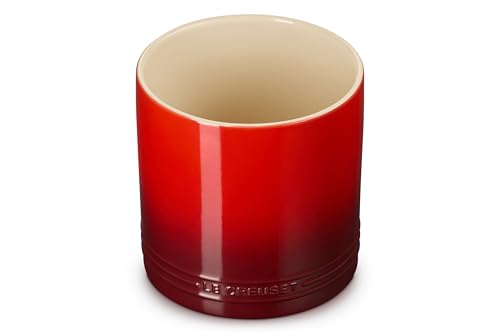
Le Creuset has built its reputation on premium craftsmanship, and this 2.7 qt. stoneware crock lives up to the name. The Cerise (cherry red) colorway immediately commands attention on a countertop, but it's the underlying engineering that justifies the higher price tag. The stoneware body is dense and heavy — heavy enough that our team never once experienced a tip-over during testing, even when yanking out a pair of spring-loaded tongs.
The nonporous, non-reactive glaze is the standout feature here. Unlike unglazed ceramic or porous materials, this surface won't absorb odors from garlic presses or stain from tomato-coated spoons. We left a sauce-covered ladle sitting in the crock overnight, and the interior wiped clean with a damp cloth the next morning. The glaze also resists chipping, scratching, and the micro-cracking (known as crazing) that plagues cheaper stoneware over time.
At 2.7 quarts, capacity is generous. We fit approximately 12-14 standard utensils without crowding. The wide mouth makes it easy to grab any tool without disturbing the others. The primary drawback is cost — this is the most expensive option in our roundup by a significant margin. But for home cooks who treat kitchen tools as long-term investments, the Le Creuset will likely outlast every utensil placed inside it.
Pros:
Cons:
The FUN ELEMENTS crock hits a sweet spot between decorative appeal and functional performance that most ceramic holders miss. At 7.2" tall with a 6.25" x 6.25" footprint, it's genuinely large — our team fit 13 utensils during testing, including bulky silicone spatulas and a long-handled wooden spoon. The vintage lace emboss pattern in Christmas Red gives it a distinct farmhouse aesthetic that photographs beautifully on a kitchen counter.
Weight is a legitimate advantage here. The thick ceramic walls make this holder noticeably heavier than stainless steel alternatives, which translates directly to stability. During our tipping tests, the FUN ELEMENTS crock stayed put even when we deliberately tried to knock it over while removing a heavy meat fork. The polished bottom also prevents scratching on granite, marble, and laminate countertops — a small detail that shows thoughtful design.
One consideration is the square footprint. While the 6.25" x 6.25" base provides ample interior room, it does consume slightly more counter space than the round or elliptical options. For kitchens where every inch counts, this might matter. But for anyone who wants a utensil holder that doubles as a decorative accent piece, the FUN ELEMENTS delivers on both fronts admirably. It's also priced well below the Le Creuset while offering comparable build quality.
Pros:
Cons:

For buyers prioritizing sustainability without sacrificing function, this bamboo utensil holder delivers a compelling package. Bamboo is one of the most rapidly renewable materials on earth, growing up to three feet per day in ideal conditions — making it a genuinely eco-conscious alternative to plastic, metal, or mined stone. The warm, darker-shade brown finish blends naturally with wood cutting boards, butcher block countertops, and other organic kitchen elements.
The standout design feature is the four ventilation holes drilled into the bottom. This is something none of the other holders in our roundup offer, and it solves a real problem: moisture trapped beneath utensils can breed mold and bacteria over time. Those drainage holes allow air circulation that keeps the interior dry, which is especially valuable in humid climates or kitchens where damp utensils go straight from the drying rack into the holder.
At 6" tall and 5" in diameter, this is the most compact option we tested. It held about 8-10 standard utensils comfortably. The smaller footprint is ideal for tight countertops, but home cooks with extensive tool collections may find the capacity limiting. The bamboo construction is lightweight compared to ceramic or stainless steel, so it can shift slightly when pulling out heavier items. A simple rubber grip pad underneath would solve this entirely.
Pros:
Cons:
The Oggi stainless steel holder proves that a weighted base changes everything. At a 5" diameter, it's a standard cylindrical design — nothing flashy — but the weighted bottom insert provides rock-solid stability that many competing stainless holders lack entirely. During our testing, this holder never wobbled, slipped, or shifted on any surface, including a slightly angled butcher block island. That kind of reliability matters when someone is cooking quickly and grabbing tools without looking.
Capacity is generous for the footprint. We loaded it with spatulas, ladles, a whisk, tongs, and several wooden spoons — roughly 12 tools total — before the opening started to feel crowded. The tall, straight-sided design accommodates utensils of varying lengths without the shorter ones disappearing into the bottom. Stainless steel construction means no concerns about staining, odor absorption, or material degradation over time.
Oggi recommends handwashing, which is the one minor inconvenience compared to the dishwasher-safe OXO. In practice, a quick wipe-down with warm soapy water takes about 30 seconds — hardly a dealbreaker. For anyone looking for a reliable, no-nonsense stainless steel utensil holder at a price point well below the OXO, the Oggi is the clear pick. It does exactly what a utensil holder should do, nothing more, nothing less. Keeping kitchen tools organized and accessible is one of those essential kitchen habits that compounds into real time savings over weeks and months.
Pros:
Cons:
The LoeJan crock packs a surprising amount of thoughtful engineering into an affordable ceramic package. At 6.7" tall and 5.2" wide, the dimensions are deliberately calibrated for daily use — large enough for 10-15 utensils but compact enough that it doesn't dominate counter space. The clean white finish and smooth lines make it versatile enough for modern, transitional, and minimalist kitchen styles alike.
What separates the LoeJan from generic ceramic crocks is the 3mm cork mat integrated into the base. This isn't a flimsy felt pad — it's a thick, purpose-built cork layer that serves three functions: preventing countertop scratches, dampening noise when placing or removing utensils, and adding a slight grip that keeps the holder from sliding. Our team specifically tested the cork base on polished granite and glass surfaces, and it performed excellently on both.
LoeJan markets this holder as multi-functional, and we agree with that assessment. The clean design translates well beyond the kitchen — we could see it working as a bathroom organizer for brushes and combs, a desk caddy for pens and scissors, or even a minimalist vase. The smooth, non-porous surface wipes clean effortlessly, resisting the stain rings that plague unglazed ceramics. For anyone who wants ceramic aesthetics at roughly half the cost of the Le Creuset, the LoeJan is our recommendation.
Pros:
Cons:
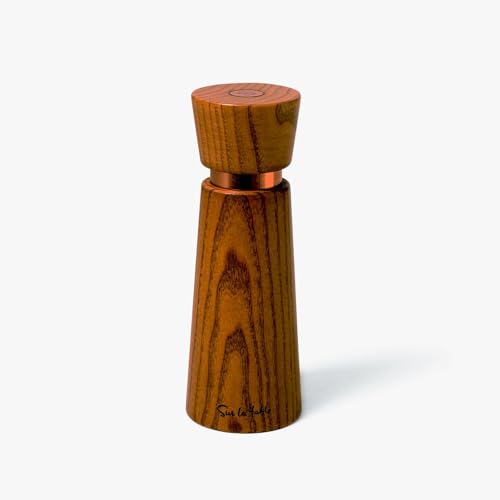
Every other holder in this roundup is manufactured — stamped from steel, poured into molds, or assembled on a production line. The Sur La Table olivewood crock is different. Each piece is carved from solid olivewood, which means no two crocks have identical grain patterns. The natural swirls and variations in the wood create a genuinely one-of-a-kind kitchen accent that mass-produced alternatives simply cannot replicate.
Olivewood is exceptionally hard and naturally resistant to moisture absorption, which makes it well-suited for a countertop application that will inevitably encounter splashes and drips. The dimensions — 5.12" x 5.12" x 7.01" tall — provide generous capacity for spatulas, spoons, whisks, and tongs. We fit about 11 standard utensils during testing, with the tall profile accommodating even 14" wooden spoons without any overhang issues.
The warm, organic aesthetic works across multiple kitchen styles. Our team found it equally at home in a Mediterranean-themed kitchen as in a modern Scandinavian setup. The primary consideration is maintenance: olivewood benefits from occasional treatment with food-safe mineral oil to maintain its luster and prevent drying. This isn't a high-maintenance task — once every few months with a quick wipe — but it is an extra step that stainless steel and ceramic owners never have to think about. For anyone who values craftsmanship and natural materials, though, the Sur La Table olivewood crock is the most visually striking option we tested in 2026. It pairs beautifully with other natural kitchen items, much like how the right kitchen sink choice ties a whole workspace together.
Pros:
Cons:
The material decision shapes everything else — longevity, appearance, weight, and maintenance. Stainless steel (OXO, Oggi) offers maximum durability and easiest cleaning, ideal for busy kitchens where practicality outranks aesthetics. Ceramic and stoneware (Le Creuset, FUN ELEMENTS, LoeJan) provide superior weight for stability and come in a wider range of decorative finishes, but they can crack if dropped. Bamboo is lightweight and eco-friendly with natural antimicrobial properties, though it lacks the heft for heavy-tool stability. Olivewood offers unmatched artisan appeal but requires periodic maintenance.
For most buyers, ceramic or stainless steel will be the most practical long-term choice. Both materials resist staining and odor absorption, tolerate regular cleaning, and maintain their appearance over years of daily use.
Before selecting a holder, count the utensils that actually need countertop access. Most home cooks actively use 8-12 tools regularly — a couple of spatulas, wooden spoons, tongs, a whisk, a ladle, and perhaps a slotted spoon. A holder rated for 10-15 utensils covers this range comfortably with room for occasional additions.
Height matters as much as width. Holders under 6" tall may leave long-handled tools leaning at angles, which creates a tipping hazard. The ideal height for most utensil sets is 6.5" to 7.5" — tall enough to support 12-14" handles while keeping the holder's center of gravity low enough for stability.
A utensil holder that tips over defeats its own purpose. Three design features contribute to stability: total weight (heavier is better), a weighted base (concentrated low center of gravity), and base friction (cork pads, rubber feet, or textured bottoms). The best performers in our testing — the Le Creuset, FUN ELEMENTS, and Oggi — all excel because they prioritize at least two of these three factors.
Lightweight holders like bamboo models work fine for small utensil collections but become precarious once loaded with heavy stainless steel tools. Anyone stocking their holder with cast-iron ladles or heavy metal tongs should lean toward ceramic or weighted stainless steel options.
Consider cleaning requirements realistically. Stainless steel and glazed ceramic wipe clean in seconds and resist permanent staining. Unglazed ceramics and natural wood require more attention — spills should be wiped immediately to prevent absorption, and wood needs periodic oiling. Dishwasher compatibility is a bonus (the OXO wins here), but most holders only need a quick hand-rinse since they don't contact food directly. The holders that best match a low-maintenance kitchen philosophy are glazed ceramic and stainless steel — materials that demand almost nothing from their owners beyond the occasional wipe. For more ways to keep a kitchen running efficiently, our guide on recommended kitchen products covers complementary tools and accessories worth considering.
For most households, a utensil holder measuring 5-6 inches in diameter and 6.5-7.5 inches tall accommodates 10-15 everyday cooking tools comfortably. This size provides enough room for standard spatulas, spoons, tongs, and whisks without consuming excessive counter space. Home cooks with larger collections — 15+ tools — should look for holders with 6"+ diameters or consider using two smaller holders positioned at different workstations.
Moisture is the primary culprit. Always ensure utensils are fully dry before placing them in the holder. Holders with drainage holes (like the bamboo option in our review) naturally ventilate and prevent moisture buildup. For sealed holders, remove all utensils once a week, wipe the interior with a cloth dampened in diluted white vinegar, and let it air-dry completely before restocking. Glazed ceramic and stainless steel resist odor absorption inherently, making them lower-maintenance choices for humid environments.
Both materials excel, but they serve different priorities. Stainless steel is more durable, lighter, often dishwasher-safe, and virtually indestructible — ideal for busy kitchens or families with children. Ceramic and stoneware offer superior weight (better stability), wider decorative options, and a premium countertop presence. Ceramic can crack if dropped, while stainless steel at worst dents. Our team recommends stainless steel for pure functionality and ceramic for buyers who value aesthetics equally.
Unfinished bottoms on ceramic and stoneware holders can scratch softer countertop materials like laminate, butcher block, or marble over time — especially when slid rather than lifted. Look for holders with cork pads, felt bases, or polished bottoms. The LoeJan's 3mm cork mat and the FUN ELEMENTS' polished base both address this issue effectively. Stainless steel holders rarely cause scratching but can leave circular marks on light-colored surfaces from metal oxidation if moisture sits underneath for extended periods.
Our team recommends keeping only tools used at least three times per week in a countertop holder. For most households, that means 8-12 core utensils: two spatulas, two wooden spoons, tongs, a whisk, a ladle, a slotted spoon, and perhaps a pasta fork or meat fork. Overpacking a holder makes it harder to grab individual tools and increases the risk of tipping. Rarely used specialty tools belong in drawers or hanging racks.
Absolutely. A weighted base is the single most impactful feature separating reliable holders from frustrating ones. Without adequate weight — either from the material itself or an added base insert — holders tip forward whenever a heavy tool gets pulled out at an angle. The Oggi's weighted base and the Le Creuset's dense stoneware body both demonstrate this principle. For anyone tired of toppled utensil holders, investing in a weighted option eliminates the problem permanently.
 |
 |
 |
 |

About Rick Goldman
Rick Goldman grew up traveling the Pacific Coast and developed an early appreciation for regional and international cuisines through exposure to diverse food cultures from a young age. That culinary curiosity shaped his approach to kitchen gear — he evaluates tools based on how well they perform across different cooking styles, ingredient types, and meal occasions. At BuyKitchenStuff, he covers kitchen equipment reviews, recipe guides, and food-focused buying advice.
