Kitchen Gadgets & Equipment Reviews ›
by Daisy Dao
Which deep fryer delivers the crispiest results without turning your kitchen into a greasy mess? That question gets asked thousands of times every week, and after testing and researching the top models available in 2026, the Breville Smart Fryer stands out as the clear top pick for most home cooks. But the right fryer for you depends on how many people you cook for, whether you need something compact, or whether you want to take the party outside with a propane setup. This guide covers all of those angles so you can make the best decision for your kitchen and your budget.
Deep frying at home gets a bad reputation, but when you use the right equipment and the right technique, deep frying produces results that no oven or air fryer can replicate — a shatteringly crisp exterior with a moist, juicy interior. The secret is oil temperature control, and that is exactly what a quality countertop deep fryer gives you. Whether you are making classic french fries, fried chicken, donuts, or calamari, a dedicated fryer with a thermostat beats a pot on the stove every single time. The models reviewed here range from a compact personal fryer all the way up to a four-gallon outdoor propane beast, so there is something for every household size and cooking style.
Before you jump into the individual reviews, take a moment to think about capacity, wattage, and how easy the unit is to clean. Those three factors determine whether your deep fryer becomes your most-used kitchen appliance or collects dust in a cabinet. You can also browse our kitchen appliance reviews for more buying guides across every category. Now, let's find the right fryer for you.

Contents






If you want the best countertop deep fryer money can buy in 2026, the Breville Smart Fryer is the one to get. It comes loaded with seven one-touch cooking presets — fries, twice-fried fries, fish, wings, calamari, donuts, and a custom program for your own recipes — which means you do not have to babysit a thermometer every time you cook. The 1800-watt heating element heats oil fast and recovers temperature quickly between batches, which is critical because dropping cold food into oil that has cooled down produces soggy, greasy results rather than golden, crispy ones.
What really separates the Breville from competing four-quart fryers is the Cool Zone Technology. The heating element reflects heat upward while a protective cool zone sits underneath, trapping oil residue and food particles away from the main cooking area. This keeps your oil cleaner for longer, which saves you money on oil and means less of that dark, bitter flavor that used to oil develops when it accumulates burnt bits over multiple uses. The brushed stainless steel build is genuinely premium — it feels like a product that belongs in a serious kitchen, not a budget appliance that will crack within a year. The four-quart capacity comfortably handles a full chicken wing batch or a generous portion of french fries for four people without crowding the basket.
Cleanup is straightforward because the oil tank, basket, and lid all remove for washing. If you have been looking at non-stick grill pans as an alternative for high-heat cooking, the Breville makes a compelling argument that a dedicated fryer simply does the job better for anything involving batter or breading. The only real drawback is the price, which is higher than most competitors. But if you fry regularly, the oil savings from the Cool Zone Technology and the consistent results justify the investment quickly.
Pros:
Cons:

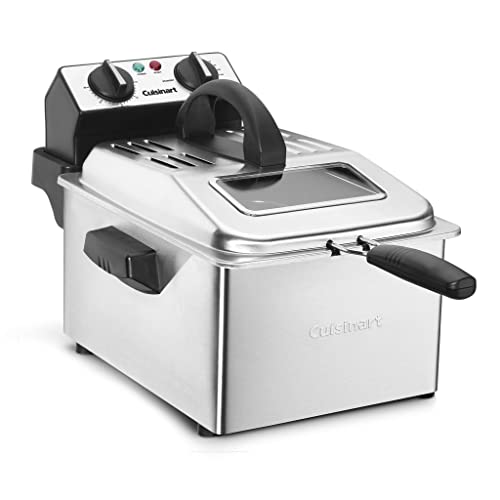
The Cuisinart CDF-200P1 is the sweet spot between budget and premium for anyone who fries regularly but does not want to pay Breville prices. It uses an 1800-watt immersion-style heating element — meaning the element submerges directly into the oil rather than heating through the bottom of a tank — and this design is excellent at fast heat-up times and rapid temperature recovery between batches. You can fry potatoes, onion rings, seafood, chicken, vegetables, and donuts, and the unit handles all of them without complaint. The four-quart capacity can cook up to 2.3 pounds of food at once, which is a realistic serving for a family dinner without needing to run multiple batches.
Cuisinart built a solid reputation around kitchen appliances that get the basics right, and this fryer is no exception. The temperature dial gives you manual control, the basket has a comfortable handle, and the unit is straightforward to set up and use without a learning curve. There is no LCD display or preset programs like the Breville, but for many home cooks, that simplicity is actually a feature rather than a limitation — fewer components means fewer things that can break or malfunction over years of use. The oil capacity and power rating put it on par with the Breville in terms of actual frying performance, even if the build materials feel slightly less premium.
Cleaning the CDF-200P1 requires a bit more attention than some competitors because the immersion element needs careful wiping around the base, but the basket and bowl are dishwasher-safe which speeds up the process. This is a workhorse fryer that will serve you well for years, making it one of the best values in the mid-range category for 2026.
Pros:
Cons:

If you are cooking for a large family or hosting a party where fried food is the centerpiece, the Chefman 4.5-liter fryer gives you the largest capacity of any electric countertop model in this roundup. That extra half-liter over the four-quart competition makes a genuine difference when you are frying big batches of french fries, chicken pieces, or homemade chips all at once. The 1700-watt heating element keeps temperatures stable across the larger oil volume, and the temperature control dial adjusts easily without any tools or complicated settings — you simply turn it to your target temperature and wait for the oil to come up to heat.
The basket clips to the side of the fryer so oil drains back into the pot automatically, which is a genuinely useful feature that keeps your counter cleaner and your hands away from hot oil. The basket itself is removable and dishwasher-safe, and the oil container is also detachable, which makes emptying and cleaning the unit significantly easier than fryers with fixed tanks. Chefman also included an air filter to cut down on cooking odors — a thoughtful addition if your kitchen is open to your living room or dining area. The stainless steel body handles the heat well and wipes clean easily between uses.
Where the Chefman falls slightly short is in the precision of the temperature control, which uses an analog dial rather than a digital thermostat. For most fried foods, the dial is accurate enough, but if you are frying delicate items that need a very specific temperature window — like tempura batter — you may want a unit with digital temperature display. For everyday family cooking, however, this is an outstanding value at its price point in 2026.
Pros:
Cons:

The Presto FryDaddy has been a staple in budget-conscious kitchens for years, and the 2026 version continues that tradition with one important upgrade: a PFAS-free ceramic nonstick surface inside and out that makes it more attractive to health-conscious buyers who want to avoid traditional nonstick coatings. If your counter space is limited, the FryDaddy's compact footprint is genuinely impressive — it uses just four cups of oil to produce four servings of french fries, which means you spend less on oil and the whole unit stores easily in a cabinet between uses. This is the fryer for apartment kitchens, dorm rooms, or anyone who fries occasionally rather than weekly.
The automatic temperature control is a standout feature at this price. Unlike a pot on the stove where you are constantly adjusting the burner and guessing whether your oil is at the right temperature, the FryDaddy maintains the correct frying temperature on its own. You get consistent, crispy results every time without monitoring the heat. The tradeoff is that there is no adjustable thermostat — the unit is set to a single frying temperature designed to work well across most common fried foods like shrimp, chicken, and onion rings. If you need variable temperature control for specialized recipes, you will want to step up to one of the other options in this guide.
The ceramic nonstick surface cleans up quickly, which is one of the most important practical considerations for any kitchen appliance — if it is hard to clean, you will use it less. The FryDaddy delivers genuinely restaurant-quality fried food at a fraction of the price of larger units, making it the top recommendation for budget shoppers and occasional fryers in 2026.
Pros:
Cons:

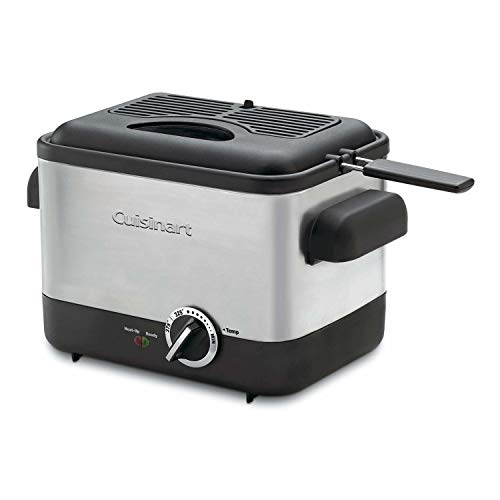
When you are cooking for one or two people and counter space is at an absolute premium, the Cuisinart CDF-100NAS delivers a full deep-frying experience in one of the smallest footprints available. The basket holds up to three-quarters of a pound of food — enough for a single serving of fries or a small batch of wings — and the 1.1-liter maximum oil capacity means you are not storing a large pot of used oil between uses. Fast heat-up time is a genuine strength here, making this the fryer you reach for when you want a quick snack without waiting ten minutes for a large unit to come up to temperature. The spur-of-the-moment convenience factor is real.
Cuisinart packed this compact unit with thoughtful features that you do not always find at this size. The nonstick diecast bowl includes a pouring spout for easy oil disposal, the basket handle is detachable for compact storage, and a charcoal anti-odor filter sits in the filter cover to reduce frying smells in your kitchen. The detachable power cord keeps things tidy on the counter and makes the unit easier to move and store. A recipe book is included, which is a nice touch for anyone new to home deep frying who wants starting points for oil temperatures and cooking times.
The limitation, as you would expect from a 1.1-quart unit, is capacity. You cannot cook for a family with this fryer — it is a personal-size appliance. If you find yourself regularly needing to cook more than one or two portions, step up to the Chefman or one of the four-quart models. But for a single person who loves the occasional fried snack without the commitment of a large fryer, the CDF-100NAS is the right tool in 2026. Think of it as a companion to your food dehydrator — another compact appliance that earns its counter space through regular use.
Pros:
Cons:

If you have children in the house or you simply want the peace of mind that comes from a fryer designed with safety as the primary concern, the Presto CoolDaddy is your best option. The cool-touch exterior stays safe to handle even when the oil inside is at full frying temperature, which eliminates one of the most common deep-frying accidents — accidental contact with a hot outer surface. The locking cover is another safety feature that prevents oil splatter from reaching surrounding surfaces or people standing nearby, while an extra-large viewing window lets you monitor your food without ever lifting the lid and exposing yourself to steam or hot oil.
The adjustable thermostat gives you genuine temperature control, with an indicator light that signals when the oil has reached your target temperature and is ready for frying. This is the feature that separates good fryers from frustrating ones — if you drop food into oil that is not hot enough yet, it absorbs oil rather than crisping quickly and you end up with greasy, heavy results. The indicator light removes all of the guesswork. The CoolDaddy handles chicken, shrimp, french fries, and most standard fried foods without any issues, and the unit cleans up without excessive effort.
Compared to the Breville and Cuisinart models, the CoolDaddy offers slightly less capacity and fewer advanced features, but that is not the point of this unit. The point is safety and reliability, and on both counts it delivers. If you are buying a fryer for a household where burn risk is a real concern — whether from curious kids or simply from a kitchen layout where the fryer is in a high-traffic area — the CoolDaddy earns its place on this list firmly.
Pros:
Cons:
Everything changes when you move from countertop electric fryers to the Bayou Classic outdoor propane fryer. This is a four-gallon beast designed for outdoor cooking events — think Thanksgiving turkey fries, large fish fry gatherings, tailgate parties, or backyard cookouts where you are feeding a crowd. The four-gallon oil capacity dwarfs every electric countertop fryer in this roundup, and the propane-powered rear jet burner delivers the kind of heat output that electric models simply cannot match. If you have ever tried to cook a whole turkey in an electric fryer, you know exactly why propane exists for this purpose.
The advanced heating technology channels hot air through vent tubing for even heat distribution throughout the oil, which prevents hot spots that can burn food on the exterior while leaving the interior undercooked. The stainless steel construction resists rust and handles the wear of outdoor use, and the included 48-inch braided LPG hose gives you safe clearance between the propane tank and the fryer. A bottom drain valve makes oil disposal straightforward — you do not have to lift a heavy four-gallon container to pour it out. Two baskets are included, along with a thermometer and regulator, so you have everything you need to get started.
The critical thing to understand about the Bayou Classic is that it is strictly an outdoor appliance — using a propane fryer indoors is a serious carbon monoxide hazard and a fire risk. You also need to think about stability on uneven ground and wind conditions that can affect burner performance. But for its intended purpose — large outdoor frying events — this fryer has no real competition at its price point. Pair it with a quality marinade approach and slow-cooked sides and you have the foundation for a memorable outdoor feast in 2026.
Pros:
Cons:

With seven solid options reviewed above, narrowing down the right fryer for your situation comes down to a handful of practical factors. Here is what you need to evaluate before making your final decision in 2026.
Capacity is the single most important specification when choosing a deep fryer, because overcrowding the basket — lowering the oil temperature too quickly by adding too much cold food at once — is the number one cause of greasy, disappointing fried food. As a rule of thumb, you should never fill more than half the basket depth with food for any single batch. For a single person or couple, the Cuisinart CDF-100NAS (1.1 quart) or the Presto FryDaddy handles everyday needs without excess. For a family of four, the four-quart Breville or Cuisinart CDF-200P1 hits the sweet spot. For large gatherings and outdoor events, the Chefman at 4.5 liters or the Bayou Classic at four gallons are the only units that keep up with real crowd-sized demand. Buying too small and running multiple batches wastes time and energy; buying too large means storing a bulky appliance for occasional use.
For electric countertop fryers, 1800 watts is the gold standard. At this wattage, oil heats up in roughly 10–15 minutes and recovers temperature quickly after each batch, which is essential for consistent results when you are cooking multiple rounds of food. Lower-wattage units around 1700W are acceptable for large-capacity fryers where the oil volume requires less heating per unit, but for smaller fryers, you want the full 1800W. Temperature control matters just as much as raw wattage — a precise thermostat (ideally with a digital readout rather than an analog dial) ensures your oil stays within the target range rather than swinging too hot or too cold between batches. The ideal frying temperature for most foods sits between 350°F and 375°F, with specific foods like donuts preferring the lower end and french fries benefiting from a two-stage approach starting at 325°F and finishing at 375°F.

Hot oil is one of the most dangerous substances in any kitchen, reaching temperatures of 375°F or more during regular use. The safety features built into a fryer are not marketing extras — they directly affect the risk of burns and kitchen fires. Look for these specific features when evaluating your options. A cool-touch exterior, like the one on the Presto CoolDaddy, means accidental contact with the body of the fryer does not result in a burn. A locking lid with a viewing window lets you monitor cooking without releasing steam or exposing yourself to hot oil. A magnetic safety cord (common on premium models) detaches cleanly if someone trips on the cord, preventing the fryer from being pulled off the counter. At minimum, any fryer you bring into a home with children should have a locking lid and a stable, low center of gravity that does not tip easily. When thinking about maintaining a clean, safe kitchen, pairing your fryer with the right cleaning products matters too — if you are remodeling around your appliances, check out the best cleaners for quartz countertops to keep your prep surfaces protected from oil splashes.
Every deep fryer review eventually comes back to the same point: the hardest part of home frying is not the cooking, it is the cleanup. Units with removable oil containers, dishwasher-safe baskets, and nonstick interiors get used far more frequently than fryers that require extensive disassembly and hand-scrubbing. When evaluating cleaning ease, check whether the oil tank lifts out entirely for transport to the sink, whether the basket handle detaches cleanly, and whether the interior surface is genuinely nonstick or just smooth-feeling before the first use. An anti-odor filter (charcoal or otherwise) is a bonus feature worth considering if your kitchen is in an open floor plan where frying smells linger — the Chefman and the Cuisinart CDF-100NAS both include this. Oil management also matters: a drain valve at the bottom (like on the Bayou Classic) makes oil changes easy for large units, while a pouring spout on the bowl (Cuisinart CDF-100NAS) handles the job for compact fryers.
The Breville Smart Fryer 4 Quart is the best overall home deep fryer in 2026. It combines seven one-touch preset programs, Cool Zone Technology that extends oil life, and an 1800-watt heating element in a premium stainless steel build. For budget shoppers, the Presto FryDaddy offers excellent crispy results at a much lower price. For families needing maximum capacity, the Chefman 4.5-liter fryer handles the largest batches of any electric model in this roundup.
The amount depends entirely on your fryer model, but the general rule is to fill the oil to the marked minimum line, which ensures the heating element is fully submerged and the food is completely covered during frying. For the Presto FryDaddy, that is four cups of oil. For a four-quart model like the Breville or Cuisinart CDF-200P1, you will use approximately three to four quarts. Never fill above the maximum fill line, as hot oil expands and bubbles when food is added, and overflow causes serious fire hazards.
For home use, most frying oils remain usable for 8–10 frying sessions before the quality degrades noticeably. Oil breaks down faster when you fry battered foods, fish, or anything with a strong flavor, because these items leave particles and flavor compounds in the oil. Filter your oil between uses by pouring it through a fine-mesh strainer to remove food debris, and store it in a cool, dark place in a sealed container. Fryers with Cool Zone Technology, like the Breville, keep oil cleaner longer by trapping debris in the cool zone below the heating element rather than allowing it to recirculate through the cooking area.
They serve different purposes, and the honest answer is that a deep fryer produces superior texture for foods that require a true crispy crust — classic french fries, fried chicken with a battered coating, donuts, calamari, and anything dipped in wet batter before cooking. An air fryer circulates hot air to create a dry, browned exterior, which works well for frozen foods and lighter coatings but cannot replicate the dense, shatteringly crisp texture of true deep-frying. If your primary goal is the authentic restaurant-style fried food experience, a deep fryer wins. If you want a lower-fat cooking method for everyday meals, an air fryer is the more versatile appliance.
Vegetable oil, canola oil, and peanut oil are the three best choices for deep frying because they all have high smoke points — the temperature at which oil begins to break down and produce acrid smoke. Peanut oil is the top choice for flavor neutrality and a very high smoke point of around 450°F, which gives you a comfortable margin above standard frying temperatures of 350–375°F. Canola oil is the most budget-friendly option with a smoke point around 400°F. Avoid olive oil for deep frying — its lower smoke point and strong flavor make it a poor choice at high frying temperatures, though it excels in other applications like dressings and low-heat sautéing.
It depends on the specific components. Most modern deep fryers have dishwasher-safe baskets and removable bowls, but the heating element and the main body should never go in the dishwasher or be submerged in water. Always check the manufacturer's instructions for your specific model. The Chefman 4.5-liter fryer explicitly lists the basket as dishwasher-safe, and the Cuisinart CDF-200P1 also has dishwasher-safe components. The Cuisinart CDF-100NAS includes a nonstick diecast bowl that cleans easily by hand. For the main unit body, wipe down with a damp cloth after the fryer has cooled completely.
 |
 |
 |
 |

About Daisy Dao
Daisy Dao grew up in Honolulu, Hawaii, where coastal living and access to fresh local ingredients shaped her approach to home cooking from an early age. She has spent years experimenting with seafood preparation, healthy cooking methods, and ingredient substitutions — developing hands-on familiarity with a wide range of kitchen tools, techniques, and produce. At BuyKitchenStuff, she covers healthy recipes, cooking techniques, and ingredient substitution guides.
