Kitchen Gadgets & Equipment Reviews ›
by Daisy Dao
Picture this: someone is staring at a pile of tomatoes fresh from the garden, trying to figure out the best way to turn them into sauce without seeds and skins ruining the texture. A blender leaves the wrong consistency. A strainer takes forever. That's the moment when a food mill becomes the obvious answer. We've been there too, which is why our team spent weeks testing the top food mills on the market to put together this guide for 2026.
A food mill is a manual kitchen tool that strains and purees cooked food while separating skins, seeds, and fibers. It works where blenders fail — producing silky mashed potatoes without becoming gluey, smooth applesauce without bitter skin bits, and lump-free tomato sauce without seeds. For anyone serious about home cooking, it's a tool that earns its cabinet space. We've also covered the broader category in our Top 10 Best Food Mills Buying Guide for 2026 if a deeper comparison is useful.
In this review, we've tested and ranked seven of the best food mills available right now across a range of sizes, price points, and build qualities. Whether someone is making baby food in small batches or processing a full harvest of tomatoes, there's a solid pick on this list. We've also put together a buying guide and FAQ at the bottom to make the decision easier.

Contents
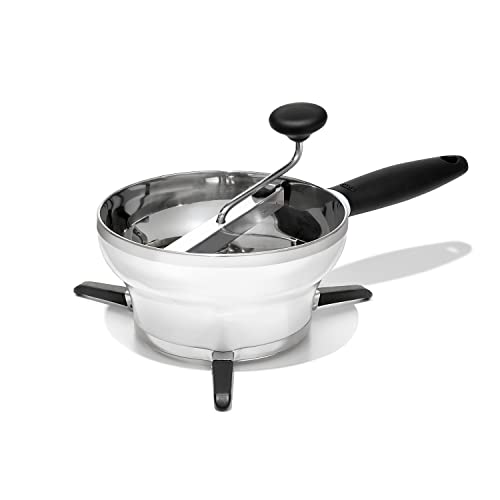


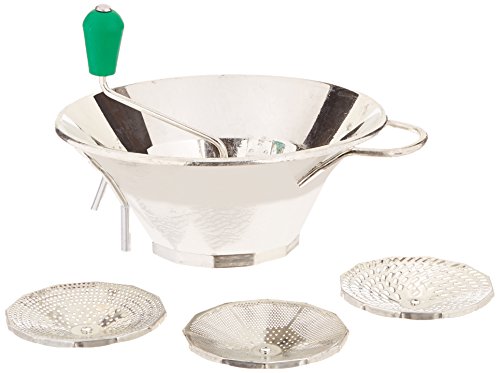


The OXO Good Grips Stainless Steel Food Mill is our top pick in 2026 for a reason: it gets everything right without overcomplicating anything. The stainless steel bowl handles hot foods straight from the stove, and the non-reactive material means no metallic taste contaminating delicate fruit purees or tomato sauce. The disc exchange system is the standout feature here — the spring-loaded lever makes swapping between fine, medium, and coarse grinding discs a one-handed operation, and reassembly takes seconds. Most food mills require fumbling with screws or clips, but OXO eliminated that frustration entirely.
During our testing, we processed everything from boiled tomatoes to cooked carrots and roasted butternut squash. The mill seated firmly over a standard mixing bowl, and the grip handles stayed comfortable through extended cranking sessions. Output quality was consistently smooth — the fine disc produced a velvety tomato puree with zero seed fragments, while the coarse disc gave excellent texture for rustic applesauce. Cleanup is straightforward: the three-piece design disassembles fully and goes in the dishwasher. For home cooks who want a reliable, well-designed tool that works across a wide range of kitchen tasks, this is the one we recommend first.
The capacity sits in the medium range, which is appropriate for most home cooking scenarios. Anyone regularly processing full canning batches may want to look at a larger model, but for everyday sauce-making and seasonal preserving in moderate volumes, the OXO handles the workload without strain.
Pros:
Cons:
Cuisinart built a strong reputation with countertop appliances, and this stainless steel food mill carries that quality into manual kitchen tools. At 2.3 quarts, it's a practical size for most household cooking — big enough for a batch of applesauce or marinara, compact enough to store without dedicating an entire cabinet shelf. The durable stainless steel construction is solid, with no flex in the bowl walls and a crank mechanism that feels built for repeated use rather than light occasional work.
The three cutting discs — fine, medium, and coarse — produce clean results across all textures. We found the medium disc particularly effective for tomato sauce, straining out seeds and skins in a single pass without excessive effort on the crank. The fine disc handled cooked potato well, though we noticed mashed potato output required slightly more cranking pressure than with the OXO. The mill seats securely over bowls with its adjustable legs, and the integrated design resists shifting during use. For the price, this is an impressive package — home cooks who want the Cuisinart brand reliability without paying a premium will find this hits a strong value point in 2026.
Cleanup is simple. The stainless parts rinse clean quickly, and the discs pop out without tools. Anyone making weekly tomato sauce or running regular preserving sessions will find the Cuisinart holds up to that schedule reliably.
Pros:
Cons:

The RSVP International Endurance Food Mill earns its spot on this list by delivering reliable stainless steel performance at one of the lowest prices in the category. Built from 18/8 stainless steel (the grade used in quality cookware — nonreactive and hygienic), this 7.75-inch diameter mill is sized for small to medium batches. At 4.25 inches tall, it fits neatly over most mixing bowls and stores easily in a drawer or cabinet. The material quality is the real story here — this isn't a cheap tinplate mill with a stainless-looking finish, it's genuine 18/8 construction that won't rust, stain, or impart off-flavors.
We tested it with applesauce, tomato sauce, strained carrots, peach puree, and raspberry coulis — exactly the tasks RSVP markets it for. Results were consistent and clean across all applications. The single included disc produces a medium texture that works well for most uses. Home cooks who don't need multiple disc options will find this perfectly adequate. The tradeoff compared to the OXO and Cuisinart is the lack of disc interchangeability, which limits texture control. For basic sauce-making and puree work, though, the RSVP delivers solid results without the premium investment. Budget-conscious buyers who check our kitchen tool reviews regularly will recognize this as a genuinely worthwhile value pick.
The compact footprint makes this a natural choice for small kitchens where storage space is limited. It performs the essential food mill functions without any of the complexity of higher-end models.
Pros:
Cons:
The Granite Ware Deluxe Food Mill is the pick we recommend for making baby food, small-batch sauces, and single-serving soups. At 2 quarts, it sits at the smaller end of the capacity range — which is exactly the right size when the goal is precision and control over small volumes rather than high-output batch processing. The hand crank mechanism is notably smooth, with an ergonomic handle that reduces fatigue during extended use. The stable base keeps the mill positioned firmly over a bowl without shifting, which makes single-handed steadying unnecessary.
Three interchangeable discs cover fine, medium, and coarse textures, and the disc swap process is simple enough. The stainless steel construction resists rust reliably, and the dishwasher-safe design makes cleanup after sticky fruit purees or starchy potato milling painless. We found this particularly effective for baby food preparation — the fine disc produced ultra-smooth carrot and sweet potato puree with no fibrous bits, which is exactly what that application demands. For parents making homemade baby food or cooks who process smaller quantities of specialty ingredients, the Granite Ware hits the right combination of size, ease of use, and material quality.
The 2-quart capacity does mean more frequent refilling when processing larger batches, so anyone regularly cooking for a crowd should step up to the 5-quart options further down this list. For everyday small-batch work, though, this is a well-executed tool.
Pros:
Cons:

When someone needs to process a full bushel of tomatoes or a large batch of applesauce for canning, the smaller 2-quart mills simply can't keep up without constant refilling. The Paderno World Cuisine 5-Quart Food Mill solves that problem directly. Five quarts of capacity is the standard benchmark for serious home preserving, and the Paderno delivers that volume in a tool that's built to work hard. Three interchangeable cutting plates cover the standard range of textures — fine for smooth purees and coarse for chunkier results.
This is a traditional-style mill with a tin construction rather than stainless steel, which puts it in a different category from the other picks. The tin material is food-safe and effective, but it does require hand-washing and more careful drying to prevent rust — a tradeoff that experienced canners typically accept without complaint. The five-quart bowl processes large quantities of cooked vegetables quickly, and the three cutting plates allow cooks to switch between applications without compromising on texture. We found it particularly effective for large-scale tomato sauce runs where stopping to refill a smaller mill would disrupt the workflow. For anyone who regularly processes garden harvests or buys produce in bulk, the Paderno's capacity makes it a working kitchen tool rather than an occasional-use gadget. If making tomato-based recipes is a regular activity, a quality food mill paired with tips from our tomato juice preparation guide makes the whole process more efficient.
The Paderno doesn't have the refined ergonomics of the OXO, but it gets the job done at scale. Home cooks who prioritize volume over premium finishes will find this a practical and cost-effective workhorse.
Pros:
Cons:
The Winco Food Mill takes a different approach from every other model on this list: instead of the standard three discs, it comes with five grater plates. That's a meaningful upgrade for anyone who needs precise texture control across a wider range of applications. At 5 quarts and full stainless steel construction, this is also a mill built to commercial-kitchen standards — the kind of durability that holds up to daily use in a professional environment. Five cutting plates give professional-level texture precision that the standard three-disc setups simply can't match.
The stainless steel is corrosion-resistant and built for longevity, and the design handles substantial batch volumes efficiently. We found the additional plate options particularly valuable when switching between applications that demand distinctly different textures — ultra-fine for delicate coulis, chunky-coarse for rustic soups. The 5-quart bowl processes enough food to support genuine professional kitchen demands or serious home canning operations. Cleanup is straightforward given the stainless construction, though like all large food mills it requires a bit more counter space during operation.
Home users who regularly cook for large groups or run a small catering side operation will find the Winco bridges the gap between consumer and professional tools effectively. The five-plate system is the defining advantage here — for anyone who finds three plates limiting, this is the natural upgrade path. Those interested in precision kitchen tools alongside their food mill should also explore our guide to the best countertop blenders for a complete puree and sauce-making setup.
Pros:
Cons:
Rösle is a German kitchenware brand known for high-grade stainless steel tools, and this food mill represents the premium end of the market. Built from 18/10 stainless steel (slightly higher chromium and nickel content than 18/8 — making it marginally more corrosion-resistant and with a brighter finish), the Rösle mill is a precision instrument designed for longevity. The near-zero blade-to-sieve gap is the engineering highlight — the blade sits almost flush against the sieve, which means food passes through with minimal effort and maximum throughput. No food mills in our testing matched its milling speed for equivalent batch sizes.
Three support points on the mill base create a secure, wobble-free grip over any standard bowl, and the one-piece turning knob construction eliminates welding seams that can collect food residue or become failure points over time. The design is elegant in the German engineering tradition — functional without unnecessary complexity. Two grinding disc sieves are included, which covers most cooking scenarios well. The handles are comfortable for extended use, and the overall build quality communicates clearly that this is a tool built for decades of service rather than a few seasons. For home cooks who invest in quality kitchen tools once and don't replace them, the Rösle justifies its premium price through long-term durability and superior milling efficiency.
The one consideration is that two discs rather than three means slightly less texture range than the OXO or Cuisinart at lower price points. For most users who primarily work in one or two texture ranges, this is a non-issue. Anyone building a complete precision kitchen toolkit may also want to read our review of the best electric knife sharpeners to complement their Rösle investment with equally quality-focused cutting tools.
Pros:
Cons:
After testing seven models across dozens of kitchen sessions, we've identified the criteria that actually separate a good food mill from a frustrating one. Here's what matters when shopping in 2026.
Capacity is the first filter. A 2-quart mill works well for everyday household cooking — a pot of tomato sauce, a batch of applesauce for the family, baby food for the week. A 5-quart mill is for preserving, canning, and cooking for groups. The math is simple: if the cooking pot holds more than 2 quarts of prepared food, a 2-quart mill requires multiple loads. For most home kitchens making sauces from garden harvests or bulk produce, the 5-quart models are worth the counter footprint. For typical weeknight cooking and occasional batch prep, 2 to 2.5 quarts handles the workload without taking over the kitchen.
Most food mills include three interchangeable discs: fine, medium, and coarse. This covers the majority of applications — smooth baby food and fruit coulis (fine), standard tomato sauce and applesauce (medium), and rustic chunky soups or textured mash (coarse). The Winco's five-plate system extends this range for specialized applications, while the RSVP and Rösle offer fewer options. Three discs is the practical sweet spot for most home cooks. The Rösle's two-disc setup is only a limitation if regular use spans the full texture spectrum — for most single-purpose users, two discs is perfectly sufficient.
All but one pick on this list uses stainless steel construction, and for good reason. Stainless steel is nonreactive (no metallic taste in acidic foods like tomatoes), rust-resistant, easy to clean, and dishwasher-safe in most cases. The 18/8 and 18/10 grades (referring to chromium and nickel percentages in the alloy) both perform well for kitchen use — 18/10 offers a marginally better finish and resistance level. Tin mills like the Paderno are traditional, food-safe, and effective at a lower price point, but they require hand-washing and thorough drying to prevent rust. For most buyers in 2026, stainless steel is the clear choice. Tin makes sense only when budget and large capacity are the primary priorities.
The details of daily use matter. Disc-swapping mechanisms range from the OXO's one-handed spring-loaded lever to traditional clip-and-screw systems. The easier the disc change, the more likely the right disc gets used for each task rather than defaulting to whatever disc is already installed. Stability during operation — whether the mill stays in place over the bowl without requiring a stabilizing hand — determines how comfortable extended cranking sessions feel. Dishwasher-safe components are worth prioritizing for anyone who cooks regularly, since hand-washing multiple small disc components after processing sticky fruit or starchy potato gets old quickly. All six stainless models on this list offer at least partial dishwasher compatibility.
A food mill is a manual kitchen tool that strains and purees cooked food while automatically separating skins, seeds, and fibrous material. Common uses include making tomato sauce, applesauce, mashed potatoes, baby food, fruit coulis, soups, and jams. It produces a smoother, more consistent texture than a manual strainer and avoids the gluey over-processed texture that blenders can create in starchy foods like potatoes.
A food mill and a blender serve overlapping but distinct purposes. A food mill strains while pureeing, removing skins and seeds in a single step — something a blender cannot do. A blender processes faster and handles liquids and cold foods more effectively. For tomato sauce, applesauce, and baby food, a food mill produces superior results. For smoothies, soups that include the skin and fiber, and cold applications, a blender is the better tool. Most serious home kitchens benefit from having both.
The disc determines the texture of the output. Fine discs produce ultra-smooth purees — ideal for baby food, fruit coulis, and smooth soups. Medium discs are the all-purpose choice for tomato sauce, applesauce, and standard purees. Coarse discs leave more texture in the output, suitable for rustic soups, chunkier mashes, and preparations where some body is desirable. Most home cooks use the medium disc most frequently, with fine reserved for specialized smooth applications.
Most stainless steel food mills are at least partially dishwasher safe, but the specific components and conditions vary by model. The OXO, Cuisinart, and Granite Ware models on this list are fully dishwasher safe. The Rösle and Winco can go in the dishwasher but benefit from hand-drying to maintain the premium finish. The Paderno tin mill should always be hand-washed and dried immediately to prevent rust. Always check the manufacturer's instructions for specific guidance.
Rinse the mill immediately after use before any tomato pulp dries in the disc mesh — dried tomato is significantly harder to clean than fresh residue. For dishwasher-safe models, a hot dishwasher cycle handles everything. For hand-wash models, a stiff brush works through the disc mesh effectively. For the bowl, standard dish soap and warm water cleans up in seconds. Stainless steel mills resist staining from tomato acid, which is one reason we recommend stainless over tin for tomato-heavy cooking.
For typical home cooking — sauce-making, applesauce, occasional batch prep — a 2 to 2.5-quart food mill handles the workload comfortably. The OXO and Cuisinart both fall in this range and represent the most practical size for everyday use. Home canners and cooks who regularly process large batches from garden harvests should step up to the 5-quart models like the Paderno or Winco. A 5-quart mill is overkill for weekly single-family cooking, but essential for anyone putting up preserves in any serious volume.
 |
 |
 |
 |

About Daisy Dao
Daisy Dao grew up in Honolulu, Hawaii, where coastal living and access to fresh local ingredients shaped her approach to home cooking from an early age. She has spent years experimenting with seafood preparation, healthy cooking methods, and ingredient substitutions — developing hands-on familiarity with a wide range of kitchen tools, techniques, and produce. At BuyKitchenStuff, she covers healthy recipes, cooking techniques, and ingredient substitution guides.
