by Daisy Dao
Ever stared at a box of Bagel Bites wondering exactly how long to cook bagel bites in the microwave without ending up with rubbery dough or a cold, soggy center? The answer is closer than most people think — and the fix is simpler than adjusting a recipe. Our team has run through every wattage level and quantity combination so home cooks can skip the trial-and-error phase. For most people, the standard microwave time for 9 Bagel Bites is 2 minutes 20 seconds, but that number shifts based on how many bites go in at once and how powerful the unit is. Anyone looking to broaden their quick-cook knowledge will find more in our full microwave cooking guide collection.

Bagel Bites have been a freezer staple for decades, and that staying power comes down to one thing: convenience. Our team finds that the microwave method is by far the most popular choice among home cooks who want a satisfying snack without preheating an oven. The trade-off between speed and texture is real, though — understanding it is the difference between a decent bite and a genuinely satisfying one.
In this guide, our team breaks down cook times by quantity, explains why wattage matters more than most people realize, and shares advanced techniques for improving texture. We also cover the honest pros and cons of microwaving versus oven-baking, so most people can make an informed choice based on what the moment actually calls for.
Contents
Bagel Bites are bite-sized frozen snacks built from mini bagel dough, tomato sauce, and cheese — often topped with pepperoni or sausage crumbles. According to Wikipedia's entry on Bagel Bites, the brand became one of the best-selling frozen snacks in the United States within just a few years of its 1985 launch. Their compact size is precisely what makes them well-suited to microwave cooking — the dough is thin enough for microwave energy to penetrate all the way to the center in a matter of minutes.
That said, knowing how a microwave interacts with these ingredients helps most people understand why timing matters so much. It's not arbitrary — it's physics applied to a layered food item.
Microwaves work by exciting water molecules within food, generating heat from the inside out. For Bagel Bites, this creates a specific challenge: the sauce and cheese melt quickly, often before the dough layer is fully heated. A few dynamics our team has observed repeatedly:
Understanding this helps most people avoid the two most common outcomes: overcooked toppings with an underdone base, or a lukewarm center that looks ready from the outside.
Microwave wattage is the single biggest variable in determining how long to cook Bagel Bites in the microwave. Most household units fall between 700W and 1200W. Package instructions from Heinz are calibrated for a 1100W microwave. Anything outside that range requires adjustment.
Most microwaves display their wattage on a label inside the door frame. Our team recommends checking this before the first cook session rather than guessing based on results.
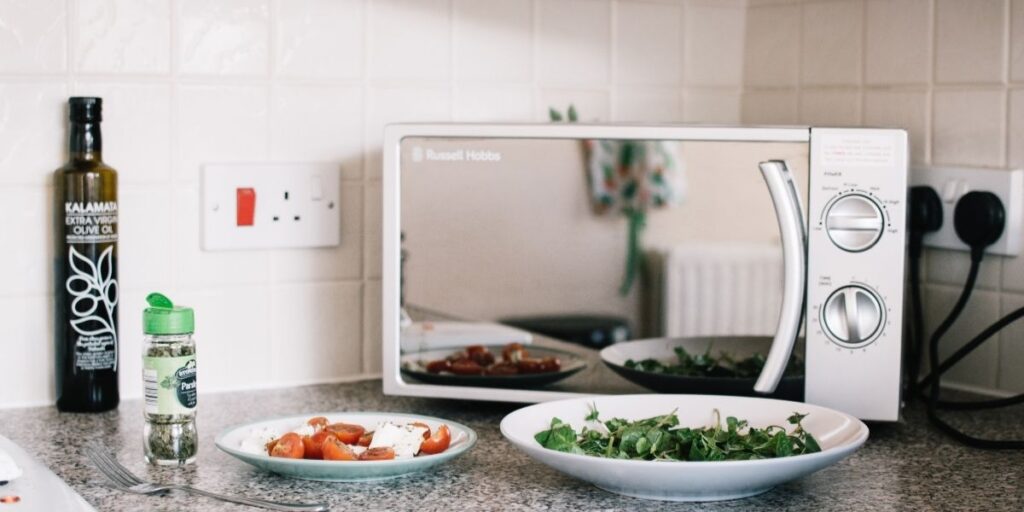
Getting the timing right is straightforward once quantity and wattage are dialed in. Our team recommends using a microwave-safe crisper tray when one is available — it won't produce oven-level crispiness, but it does reduce the amount of steam trapped under the bites, which noticeably improves the base texture.
The official package guidelines are a reliable starting point. Our team verified these times against a 1100W unit and found them accurate when bites are arranged in a single, even layer with small gaps between each one.
| Quantity | 1100W Microwave | 800W Microwave (adjusted) | Safe Internal Temp |
|---|---|---|---|
| 4 bites | 1 min 20 sec | 1 min 50 sec | 165°F (74°C) |
| 9 bites | 2 min 20 sec | 3 min 00 sec | 165°F (74°C) |
| 12 bites | 3 min 00 sec | 3 min 45 sec | 165°F (74°C) |
| 20+ bites | Not recommended | Not recommended | Use oven instead |
Our team recommends allowing Bagel Bites to rest for 60 seconds after the microwave finishes. Internal temperature continues rising during standing time, and the toppings settle so the cheese doesn't slide off on the first bite. Skipping this step is the most common reason people report unevenly heated results.
Here is how our team approaches the standard microwave method for a nine-bite serving — the most common quantity for a single person:
Tip: Our team always arranges Bagel Bites in a ring around the plate's outer edge rather than in the center — microwave energy is strongest at the outer ring of the turntable, so this placement leads to noticeably more even heating across the whole batch.

The microwave is not always the optimal cooking method for Bagel Bites, even though it is undeniably the fastest. Our team has found that most people default to it without considering what the situation actually calls for — and that leads to unnecessary disappointment about texture.
This approach pairs naturally with our team's broader research on reheating frozen and fast-food items in the microwave — many of the same timing and power-level principles carry over directly.
Our team generally recommends the oven for any situation where presentation and texture are priorities over speed.
Most people follow the package instructions and call it done — and that's a perfectly reasonable approach for everyday snacking. But for those who want to push past the baseline, a few intermediate techniques can meaningfully improve results without any special equipment.
For anyone just getting started with Bagel Bites, the package method is reliable and requires no additional knowledge:
Our team considers this the reliable floor. It's consistent, safe, and requires no guesswork beyond matching quantity to the time chart.
Our team has experimented with power-level and timing adjustments that soften the extremes of microwave heating — primarily the over-melted cheese and under-warmed dough problem.
Warning: Our team advises against covering Bagel Bites with a paper towel during cooking — rather than absorbing moisture, it tends to trap steam against the toppings, turning the cheese layer mushy instead of allowing it to set properly.
The debate between microwave and oven for Bagel Bites comes down to priorities. Our team has cooked them both ways dozens of times and can say confidently that each method has a legitimate place depending on the situation — neither is universally superior.
Our team acknowledges that convenience is a legitimate factor, not just a consolation prize. For the average weeknight snack, the microwave is the practical winner for most households.
For anyone who values texture above all else, the oven is the clear choice. Our team consistently reaches for the oven when Bagel Bites are being served to guests rather than consumed as a quick solo snack.
Understanding when microwave-cooked Bagel Bites genuinely shine helps most people approach the product without unrealistic texture expectations — and get more satisfaction out of every serving.
For larger gatherings, the oven is typically the primary tool — but the microwave has a legitimate supporting role. Our team recommends it for:
The key in a party context is managing expectations — microwave bites served fresh are perfectly enjoyable, but they shouldn't be compared directly to the oven batch sitting next to them.
This is where the microwave genuinely earns its place. Most solo snackers don't want to wait nearly 20 minutes for a handful of bites, and our team doesn't think they should have to. The microwave transforms Bagel Bites from a party appetizer into a viable 3-minute weekday snack.
Our team also notes that the microwave's small-batch limitation — impractical above 12 bites — is actually an advantage for portion awareness. It's harder to accidentally cook 20 bites at midnight when the method only performs well at smaller quantities.
The long-term goal with any frozen snack is repeatability — knowing exactly what steps to take and what result to expect. Most people settle on a time and wattage combination after a few batches, but a more deliberate calibration process gets there faster and produces a more reliable baseline.
Our team recommends a simple calibration process when using a new microwave with Bagel Bites for the first time:
This process rarely takes more than two or three batches to complete. Once the right combination is established, results become predictable every single session — no more guessing or checking mid-cook.
Leftover cooked Bagel Bites are a common situation, and proper handling makes a real difference in the reheat result. Our team's recommendations for managing leftovers:
For most households, the simplest approach is to cook only what will be eaten in a single sitting — the microwave's small-batch efficiency makes this easy and eliminates the storage question entirely.
Our team advises against intentionally thawing Bagel Bites before microwaving. The package instructions are calibrated for frozen bites, and thawing changes how moisture distributes through the dough — the result is often a softer, soggier bite than intended. If bites have accidentally partially thawed, reduce the cook time by roughly 20–30% and check early.
Sogginess typically comes from one of three causes: too many bites cooked at once, cooking at high power for too short a time, or skipping the standing rest period. Our team finds that allowing the full 60-second rest after cooking addresses most sogginess complaints — the standing time redistributes steam rather than trapping it against the bagel base.
The crisping tray included in some Bagel Bites packages is helpful but not essential. Our team tested both methods and found a modest improvement in base texture with the tray — roughly comparable to using a sheet of parchment paper. The tray's primary advantage is elevating the bites so steam can escape from the bottom rather than pooling beneath them.
Our team's practical upper limit is 12 bites in a single microwave session. Beyond that, heating becomes too uneven to guarantee all bites reach a safe and consistent internal temperature. For batches of 20 or more, the oven is the recommended method — either a conventional oven at 425°F for 14 minutes or a toaster oven at 375°F for the same duration.
In our team's experience, cook times hold consistent across all standard flavors — three cheese, pepperoni, and combination varieties all behave similarly in the microwave. Varieties with denser meat toppings may benefit from an additional 10–15 seconds, but the core timing remains reliable across the product line.
The most reliable check is cutting one bite from the center of the plate — the geographic center of the batch is always the last spot to reach temperature. The interior should be steaming, with no cool or dense dough visible. A food thermometer reading of 165°F (74°C) confirms safe internal temperature if precision is needed.
 |
 |
 |
 |

About Daisy Dao
Daisy Dao grew up in Honolulu, Hawaii, where coastal living and access to fresh local ingredients shaped her approach to home cooking from an early age. She has spent years experimenting with seafood preparation, healthy cooking methods, and ingredient substitutions — developing hands-on familiarity with a wide range of kitchen tools, techniques, and produce. At BuyKitchenStuff, she covers healthy recipes, cooking techniques, and ingredient substitution guides.
Check for FREE Gifts. Or get our Free Cookbooks right now.
Disable the Ad Block to reveal all the recipes. Once done that, click on any button below
|
|
|
|
