Kitchen Gadgets & Equipment Reviews ›
by Christopher Jones
The HAHA Vending Smart Combo Vending Machine takes our top spot for 2026 thanks to its AI-powered grab-and-go technology that makes restocking and sales tracking almost effortless. If you're looking to start or expand a vending business, choosing the right machine is the single most important decision you'll make.
Vending machines have come a long way from the clunky coin-operated boxes of the past. Today's commercial units feature touchless payment systems, refrigeration controls, and even artificial intelligence that can track inventory in real time. Whether you're placing a machine in an office break room, a gym lobby, or a busy retail corridor, the right vending machine pays for itself faster than you'd expect. The global vending machine industry continues to grow as businesses look for passive income streams with low overhead.
We spent weeks comparing build quality, payment flexibility, capacity, refrigeration performance, and total cost of ownership across the leading commercial vending machines available in 2026. Below you'll find detailed reviews of the four best models, a practical buying guide, and answers to the most common questions buyers have. If you're also outfitting a commercial kitchen or break room, our guide to the best French door refrigerators is worth a look for keeping staff lunches cold alongside your vending operation.
Contents




The HAHA Vending Smart Combo is the most technologically advanced vending machine we reviewed in 2026. It runs on an AI system that delivers 99% accurate checkout without traditional dispensing mechanisms. Customers simply open the refrigerated door, grab what they want — snacks, fresh food, drinks — and the machine automatically detects what was taken and charges the correct amount. It feels more like shopping at a miniature convenience store than using a vending machine, and that experience drives higher sales per location.
What really sets this unit apart is the app-based smart management platform. You can monitor stock levels, track real-time sales data, auto-generate restock orders, and even handle customer complaints directly from your phone. For operators running multiple machines across different locations, this remote management capability saves hours of driving around to physically check each unit. The refrigerated US-360 model keeps perishable items at safe temperatures, opening up your product mix to fresh sandwiches, salads, and dairy items that traditional snack machines can't handle.
The AI grab-and-go format does come with a learning curve. You'll need to train the system on your specific product lineup, and the initial setup is more involved than a standard coil-based machine. But once it's dialed in, the checkout accuracy is remarkable, and the wider product variety translates directly into higher revenue per machine. If you're serious about building a vending business in 2026, this is the machine to start with.
Pros:
Cons:
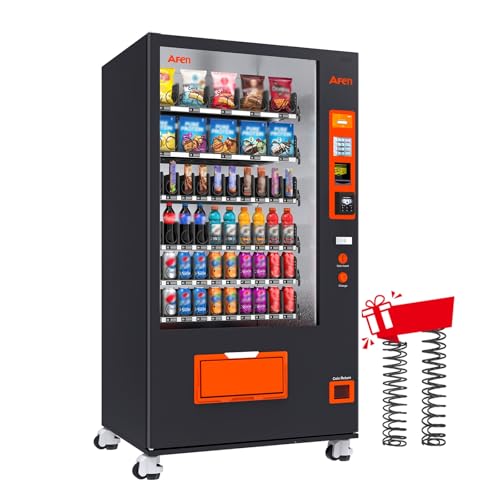
If sheer capacity is your priority, the Afen Commercial Vending Machine delivers. With 60 slots holding up to 390 items, this is one of the largest combo units available to small business operators. It handles both snacks and beverages in a single footprint, which matters when you're paying rent on floor space in a busy office building or factory break room. The two different spring slot types accommodate roughly 80% of standard food packaging sizes on the market, so you won't have to custom-order oddball springs for most products.
Payment flexibility is a major strength here. The Afen accepts $1, $5, and $10 bills, nickels, dimes, quarters, and dollar coins, plus all the cashless options you'd expect in 2026 — Visa, Mastercard, Apple Pay, Google Pay, Samsung Pay, Amex, Alipay, PayPal, and Venmo. That coverage means you'll almost never lose a sale because a customer couldn't pay. The high-recognition-rate bill acceptor handles wrinkled and slightly worn bills without rejecting them constantly, which is a frustration anyone who has used older vending machines knows well.
The refrigeration system uses a high-density microporous foam layer and a powerful compressor to maintain temperatures between 39°F and 77°F. The anti-fog glass keeps the display clear even in humid environments, so customers can always see what's inside. Temperature control is straightforward — set it and forget it. For operators who need to stock both chilled beverages and room-temperature snacks, the stratified temperature zones give you that flexibility. Just keep in mind that at 390 items, restocking takes a bit longer. Plan your route time accordingly if you're running multiple locations.
Pros:
Cons:
The Crane Merchant 6 solves one of the biggest headaches in the vending business: recurring software fees that eat into your margins. Unlike many modern vending machines that lock you into monthly platform subscriptions ranging from $30 to $100 per machine, this unit operates with zero monthly software fees. Your only recurring cost is standard payment processing at roughly $10 per month. For operators running five, ten, or twenty machines, that savings adds up to thousands of dollars annually.
This is a remanufactured and fully tested unit built on the Crane Merchant 6 platform, one of the most widely deployed commercial vending machines in workplaces across the United States. The Merchant 6 earned its reputation for a reason — it's built like a tank, parts are readily available, and any vending technician in the country knows how to service it. The machine ships with a credit card reader, bill acceptor, and coin mechanism already installed, so you're not scrambling to source and install payment hardware after delivery.
The trade-off is clear: this is a snack-only machine without refrigeration, so you're limited to shelf-stable items like chips, candy bars, cookies, crackers, and similar dry goods. If you need cold beverages, you'll need a separate drink machine alongside it. It's also designated for indoor use only, ruling out outdoor placements at parks, car washes, or gas station exteriors. But for an office, warehouse, school, or gym lobby where snacks are the primary demand, the Crane Merchant 6 gives you a proven platform with the lowest operating costs in our lineup. When you're calculating your break-even timeline, those zero software fees make a real difference. Our guide to best freezer baskets covers organizing bulk snack inventory if you're buying wholesale to stock multiple machines.
Pros:
Cons:
The EPEX EP-G654 is a heavy-duty combo vending machine built for locations that need both cold drinks and snacks in a single unit with serious cooling power. It features stratified temperature control, meaning different zones inside the cabinet can be set to different temperatures. You can keep bottled water and sodas ice-cold on one shelf while maintaining chips and candy at a moderate temperature on another. This dual-zone approach eliminates the need for two separate machines in space-constrained locations.
Under the hood, a 1HP Donper compressor paired with DuPont R134A refrigerant delivers reliable, consistent cooling. The power consumption averages 400W to 500W, which is reasonable for a machine of this size and cooling capacity. At 275 kg (roughly 606 pounds), this is a substantial piece of equipment — you'll need proper flooring support and a clear delivery path. The dimensions of 1034mm wide by 750mm deep by 1900mm tall (about 41" x 30" x 75") make it comparable in footprint to a standard commercial refrigerator.
The EPEX is built with a commercial-grade focus on durability. The compressor is designed for 24/7 operation in high-traffic environments like hospital lobbies, factory floors, and apartment common areas. It runs on standard 110-220V power, giving you flexibility across different building electrical setups. The stratified temperature control is the standout feature here — if your location demands both beverages and dry snacks and you only have space for one machine, the EPEX handles both categories without compromise. It's a solid workhorse that prioritizes cooling performance and longevity over flashy tech features.
Pros:
Cons:
The first question to answer is: what are you selling and how much of it? A machine placed in a 200-person office building needs far more capacity than one in a small gym lobby. The Afen's 390-item capacity means less frequent restocking trips, which directly impacts your labor costs and route efficiency. But if you're stocking a low-traffic location, a smaller machine avoids tying up capital in slow-moving inventory that might expire before it sells.
Think about your product mix too. If you want to sell fresh sandwiches, yogurt, or other perishables, you need a refrigerated unit like the HAHA Vending, Afen, or EPEX. The Crane Merchant 6 is snack-only, which is perfectly fine for locations where chips, candy, and granola bars are all anyone wants. Match the machine's capabilities to the actual demand at your specific location — don't buy refrigeration you won't use, and don't skip it if your customers want cold drinks.
In 2026, cashless payment isn't optional — it's expected. Every machine in our lineup accepts credit and debit cards, which is the bare minimum. The Afen goes furthest with support for Apple Pay, Google Pay, Samsung Pay, Venmo, PayPal, and even Alipay. The HAHA Vending machine uses its app ecosystem for payments. The Crane Merchant 6 keeps it simple with standard card processing plus cash.
Consider your location's demographics. A tech office with younger workers will use mobile payments almost exclusively. A manufacturing plant or school might still see significant cash usage. The more payment options you offer, the fewer sales you lose to "I don't have the right payment method" walk-aways. If your machine only takes cash in a cashless world, you're leaving money on the table — literally.
The sticker price of a vending machine is just the beginning. You need to factor in monthly software fees, payment processing costs, electricity, product spoilage (for refrigerated units), maintenance, and your time spent restocking and servicing the machine. The Crane Merchant 6 wins on operating costs with its zero-software-fee model. The HAHA Vending machine's AI platform may carry subscription costs but can generate higher revenue per machine through its enhanced shopping experience.
Calculate your break-even point before buying. Take the machine cost, add six months of estimated operating expenses, and divide by your projected monthly profit. If that number scares you, consider starting with a lower-cost remanufactured unit like the Crane Merchant 6 to prove the location works before investing in a premium machine. For more tips on managing food-related business equipment costs, browse our reviews section for comparable buying guides.
Don't overlook the physical requirements. The EPEX weighs over 600 pounds, so you need a ground-floor location or a freight elevator. All refrigerated units need adequate ventilation space around the back and sides for the compressor to function efficiently. You'll need a dedicated electrical outlet — never daisy-chain a vending machine off a power strip or shared circuit.
Check whether your location agreement specifies indoor-only placement. The Crane Merchant 6 is explicitly indoor-only, while the refrigerated units can handle semi-outdoor covered areas depending on climate. Also confirm that the floor can support the weight. A 600-pound machine on a weak raised floor in an old building is a problem waiting to happen. Always verify power, space, weight capacity, and climate before committing to a machine for any location.
Starting a single-machine vending business typically costs between $3,000 and $10,000, depending on whether you buy new or remanufactured equipment. That figure includes the machine, initial inventory, payment processing setup, and any location fees or commissions. Remanufactured models like the Crane Merchant 6 bring the entry cost down significantly. Budget an additional $200–$500 per month for restocking inventory, payment processing fees, and electricity at the location. Most operators see their first machine pay for itself within 12 to 18 months in a good location.
Combo machines that sell both snacks and cold beverages tend to generate the highest revenue per location because they capture a wider range of customer cravings. Cold drinks alone carry high margins — a bottle of water that costs you $0.25 wholesale sells for $1.50 to $2.00. AI-powered machines like the HAHA Vending can boost profitability further by offering fresh food items with even higher margins. The key factor is location quality. A perfectly positioned basic machine will outperform a high-tech machine in a dead location every time.
Restocking frequency depends on the machine's capacity and the foot traffic at the location. A 390-item machine like the Afen in a busy office might need restocking once or twice a week. A smaller machine or one in a low-traffic spot could go two weeks between visits. Most experienced operators plan their restocking routes to visit each machine when it reaches about 30% to 40% capacity. Smart machines with app monitoring, like the HAHA Vending, let you check inventory levels remotely so you only visit when actually needed, saving time and fuel costs.
Requirements vary by state and city, but most locations require at least a general business license and a sales tax permit. If you're selling food items, many jurisdictions also require a food handler's permit or a vending machine operator's license. Some states require annual machine inspections. Check with your city clerk's office and state department of agriculture or health for specific requirements in your area. The startup paperwork is usually straightforward and inexpensive — typically under $100 for all permits combined in most states.
A remanufactured vending machine is a used unit that has been professionally disassembled, inspected, repaired, and tested to meet original performance specifications. The Crane Merchant 6 in our review is a remanufactured model. The advantage is significantly lower cost — often 40% to 60% less than a comparable new machine. The trade-off is that cosmetic wear may be visible, and the remaining lifespan is shorter than a brand-new unit. For first-time operators testing a location, remanufactured machines make financial sense because they lower your risk if the location underperforms.
No. You need written permission from the property owner or manager for every location. Most commercial properties require a vending agreement that specifies revenue sharing (typically 5% to 25% of gross sales to the property owner), machine placement details, liability insurance requirements, and terms for removal. High-traffic locations like hospitals, airports, and universities often have exclusive vending contracts with large operators, making them difficult for independent operators to access. Focus on mid-sized businesses, apartment complexes, auto repair shops, and similar locations where you can negotiate directly with the owner. Good locations are the single biggest factor in vending success — the machine itself is secondary. For more appliance and equipment guides, check out our roundup of best air fryers under $100 to see how we evaluate value-focused products.
The best vending machine for you comes down to your budget, your location, and the products you plan to sell. Go with the HAHA Vending Smart Combo if you want cutting-edge AI technology and the highest revenue potential, choose the Afen for maximum capacity, pick the Crane Merchant 6 to keep operating costs rock-bottom, or grab the EPEX for reliable dual-temperature performance. Whichever you choose, lock in a solid location first, stock products your customers actually want, and let the machine do the work — your future self will thank you for starting today.
 |
 |
 |
 |

About Christopher Jones
Christopher Jones holds an MBA from the University of San Francisco and brings a business-minded approach to kitchen gear evaluation — assessing products not just for performance but for long-term value, build quality, and real-world usability in everyday home cooking. He has spent years testing appliances, cookware, and kitchen gadgets with the same analytical rigor he developed in business school. At BuyKitchenStuff, he covers kitchen appliance reviews, buying guides, and practical cooking tips.
