Kitchen Gadgets & Equipment Reviews ›
by Rick Goldman
Which stand mixer actually deserves a permanent spot on the counter — and which ones are marketing fluff dressed up in chrome? We've spent serious time testing, comparing specs, and running real baking sessions to answer that question for 2026. The short answer: the KitchenAid Artisan Series 5-Quart is still the benchmark every other machine gets measured against, but several challengers this year have closed the gap in meaningful ways. Our full stand mixer reviews cover the broader category, but this guide focuses on the seven machines that rose to the top of our testing pool.
A great stand mixer is one of those investments that pays off over years of use — across cookie batches, bread doughs, buttercreams, and meringues. The difference between a mediocre machine and a great one isn't always obvious at the store, but it becomes very clear when the motor strains on a stiff dough or the bowl wobbles under heavy ingredients. We've tested everything from budget-friendly compact models to professional-grade commercial units to give a complete picture of what's available in 2026. If a stand mixer is paired with the right tools — like a quality pastry mat or a reliable rolling pin — the results in the kitchen improve dramatically.
According to Wikipedia's entry on stand mixers, the category has evolved significantly since the first domestic models appeared in the early 20th century. Today's machines range from lightweight compact units designed for small apartments to NSF-certified commercial powerhouses built to handle continuous professional use. Bowl capacity, motor wattage, planetary action, and drive type are the four pillars of any honest evaluation — and we've dug into all of them across every machine in this guide.

Contents




If there's one stand mixer that has defined the category for decades, it's the KitchenAid Artisan. The KSM150PS, available in Empire Red and a long list of other finishes, remains our top overall recommendation in 2026 for the same reasons it's always been at the front of the pack: exceptional build quality, unmatched attachment ecosystem, and dead-reliable performance across virtually every mixing task a home baker faces. The all-metal construction doesn't just look premium — it ensures the machine stays planted and stable even during extended kneading sessions, a feature that cheaper plastic-housing competitors simply can't match.
The 5-quart stainless steel bowl handles batches from a single cup of whipped cream up to nine dozen cookies in one go (using a 28g dough standard), which covers the full spectrum of home baking needs. The tilt-head design is intuitive and well-executed: lifting the head gives clear, unobstructed access to the bowl and beater, and locking it back into place takes a single firm click. We found the 59-touchpoint bowl contact excellent at eliminating the dry unmixed pockets that plague off-brand machines. The motor is rated at 325 watts but performs above expectations for its class — handling stiff bread doughs with confidence when mixed at appropriate speeds.
The attachment hub is what truly separates the Artisan from the competition long-term. Pasta rollers, meat grinders, ice cream makers, spiralizers — the optional accessory lineup transforms this mixer into a multi-tool workstation. For anyone who also works with fresh pasta, pairing this machine with a dedicated pasta roller attachment is a genuinely excellent combination. The one limitation worth noting is bowl capacity: for bakers consistently working with eight or more cups of flour, the 5-quart bowl starts to feel limiting. But for the vast majority of home baking, it's exactly the right size.
Pros:
Cons:
The KSM8990 is a different animal from the Artisan — it's engineered for environments where the mixer runs for hours, not minutes. NSF certification means it meets the rigorous sanitation and safety standards required for commercial foodservice operations, and every design choice reflects that professional-grade intent. The bowl-lift mechanism is the standout feature here: rather than tilting the head, a lever smoothly raises the 8-quart bowl up into beater-to-bowl contact position, which provides dramatically more stability when dealing with heavy loads like stiff bread dough or large-batch cookie recipes.
At the core of the KSM8990 is a high-efficiency DC motor that's engineered to run for extended periods without the heat buildup that kills motors in lighter-duty machines. We ran sustained kneading tests well past the point where most home-grade mixers would start to bog down or emit that telltale burning smell — the commercial motor handled it without complaint. Torque output is noticeably higher than the Artisan, which translates to smoother, more consistent results when tackling recipes requiring long mixing times or particularly dense ingredients like whole wheat dough or stiff pastry dough.
The 8-quart stainless steel bowl is a significant capacity jump over the consumer-grade lineup, and for bakeries, catering operations, or ambitious home bakers who routinely make double and triple batches, it's genuinely useful extra volume. The price is premium even by KitchenAid's already elevated standards, but for professional or semi-professional use the investment is justified by the longevity and capacity gains. This isn't a machine for someone baking one loaf of sourdough a week — it's for operations where the mixer needs to be ready to work again immediately after the previous batch finishes.
Pros:
Cons:
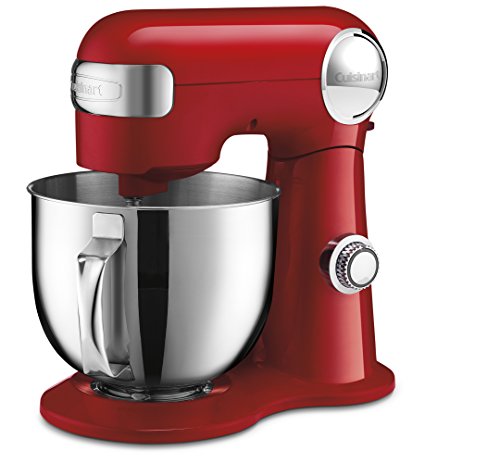
Cuisinart has built a strong reputation for delivering solid performance at prices that undercut the premium competition by a meaningful margin, and the SM-50R stands as the clearest expression of that value proposition in their lineup. The die-cast metal construction gives it a substantial, confident feel on the counter — this isn't a machine that slides around during aggressive mixing, which is a very real problem with lighter-weight alternatives in its price range. The 500-watt motor paired with 12 precise speed settings gives it genuine versatility across baking tasks, from the delicate low-speed folding of whipped cream into batter all the way up to full-speed meringue whipping.
The 5.5-quart polished stainless steel bowl gives it a slight capacity advantage over the standard KitchenAid Artisan, and the tilt-back head works smoothly and securely. The included accessory bundle is comprehensive: a chef's whisk, dough hook, flat mixing paddle, and a splash guard with a pour spout are all in the box, meaning most bakers don't need to purchase anything extra out of the gate. The instruction manual and recipe book included with the SM-50R are notably more thorough than what competitors include, which matters for first-time stand mixer owners learning which speed and attachment combination to use for different recipes.
One honest limitation is the attachment ecosystem: the single optional power outlet exists, but Cuisinart's range of optional accessories is considerably thinner than KitchenAid's extensive catalog. For bakers who see the machine purely as a mixer and have no desire to expand into meat grinding or pasta making, this gap is irrelevant. But for those who want a single machine that grows into a multi-functional kitchen hub, the SM-50R has a ceiling that the Artisan doesn't. As a pure standalone mixer delivering excellent results at a fair price in 2026, it earns our best value designation confidently.
Pros:
Cons:
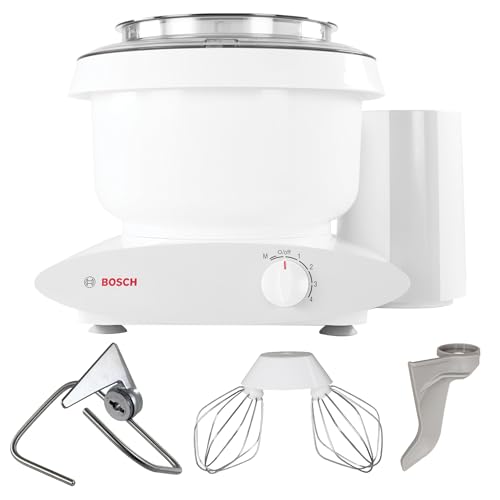
The Bosch Universal Plus takes a fundamentally different engineering approach from every other mixer in this guide, and that approach pays off in specific, measurable ways for serious bread bakers. The machine uses bottom-drive technology rather than the top-head planetary action found in KitchenAid and Cuisinart units, meaning the motor sits at the base rather than the top. This bottom-drive design, combined with a belt-driven transmission, enables the Bosch to handle up to 14 loaves — 15 pounds — of whole grain bread dough in a single batch, a figure that's simply not achievable on top-drive machines at this price point.
The 6.5-quart BPA-free plastic bowl is large and lightweight by design, making it easier to handle than a heavy stainless steel bowl when it's loaded with dense dough. The removable drive shaft makes cleaning straightforward, and the bowl is dishwasher safe — practical details that matter after the tenth loaf of the week. The dual beaters deliver a triple whipping action that the company claims handles tasks from a single egg white all the way up to 10 pounds of mashed potatoes, and in testing we found those claims credible. The wire whips bundled in this NutriMill package extend the machine's capability further for lighter mixing tasks.
The tradeoff is ergonomics and aesthetics. The Bosch Universal Plus has a utilitarian, functional look that's entirely appropriate in a working bakery but less elegant on a display counter. Adding ingredients during mixing requires working around the bowl in a way that feels less intuitive than the tilt-head designs. For dedicated bread bakers who prioritize raw kneading capacity and motor endurance over design refinement, though, the Bosch delivers in 2026 at a level that the head-drive machines in this guide simply can't match pound-for-pound.
Pros:
Cons:
Not every stand mixer buyer needs — or wants — to spend several hundred dollars on a machine. The Hamilton Beach 4-quart stand mixer exists specifically for that buyer: someone who wants the convenience and hands-free operation of a stand mixer without the premium price tag, and who bakes often enough to justify owning one but not so frequently that industrial-grade capacity is necessary. At 300 watts with planetary mixing action and a 4-quart stainless steel bowl, this machine covers the essential stand mixer use cases — cookie dough, cake batter, bread dough, whipped cream — at an entry-level price that makes it genuinely accessible.
The planetary mixing action, where each attachment rotates around the bowl as it spins, ensures thorough bowl coverage that prevents the unmixed pockets common in cheaper tilt-head machines with imprecise bowl-to-beater clearances. Seven speed settings give enough range to handle both delicate tasks at low speed and more vigorous mixing at higher settings. The 300-watt motor is modest by the standards of the other machines in this guide, but it maintains consistent speed under load better than the wattage figure alone might suggest — we ran standard cookie dough batches without notable bogging or speed loss.
The included attachment set — dough hook, whisk, and flat beater — covers everything most home bakers need on a regular basis. The splash guard is a practical inclusion that prevents flour clouds and batter spray during mixing. The 4-quart bowl capacity is the practical constraint: it's fine for standard recipes but runs out of headroom quickly when anyone tries to double a recipe or tackle large-batch bread production. For smaller households, apartment bakers, or first-time stand mixer owners, the Hamilton Beach offers a legitimate entry point into the category in 2026 without a painful financial commitment.
Pros:
Cons:
SMEG occupies a unique position in the appliance market: the Italian brand designs products where aesthetics and function carry equal weight, and the SMF03 stand mixer is a direct expression of that philosophy. The signature 50s retro curves, rounded chrome accents, and bold colorway options make this mixer a genuine statement piece on any counter, and it's the machine our team most consistently gets asked about by visitors who see it in use. But this is emphatically not a machine that sacrifices performance for looks — the 600-watt motor is actually the highest wattage in this entire review group.
Ten speed settings provide genuinely fine-grained control across the full spectrum of mixing tasks. The transition from speed 1 to speed 10 is smooth and progressive, which matters particularly for tasks like meringue where control over the rate of aeration affects the final texture. The 5-quart stainless steel bowl with its ergonomic handle handles standard home baking batches comfortably, and the tilt-head mechanism operates with the kind of smooth, substantial feel that reflects the machine's overall build quality. In testing, the SMEG handled bread dough, cake batter, and whipped cream with consistent performance across all task types.
The honest caveat for the SMF03 is price: it commands a meaningful premium over comparably specified machines, and a significant portion of that premium reflects the design and brand positioning rather than raw functional gains. Anyone buying purely on a performance-per-dollar basis has better options in this guide. But for buyers who see their kitchen appliances as part of an aesthetic vision — and who will genuinely appreciate a beautifully designed machine every single day — the SMEG SMF03 delivers both style and substance without meaningful compromise on the technical side. It's a genuinely complete package in 2026.
Pros:
Cons:
Counter space is a real constraint for a significant portion of home bakers, particularly those in apartments, smaller homes, or kitchens where every square inch is already allocated. The Dash Everyday Stand Mixer addresses that constraint directly: at under five pounds and standing just 10.4 inches tall, it fits under most standard kitchen cabinets and takes up a fraction of the counter footprint of any other machine in this guide. The compact form factor doesn't compromise the core mixing experience — the 250-watt motor and six-speed configuration handle the recipes that come up most frequently in small-household baking with genuine capability.
The 3-quart stainless steel bowl handles standard single-recipe batches for most baked goods: one standard layer cake, a dozen cookies, a small loaf of bread, or a batch of whipped frosting. The tilt-head design makes bowl and attachment access straightforward, and the six speed options — ranging from a low gentle fold to a high-speed whip — cover the fundamental mixing spectrum. In testing, the Dash Everyday performed solidly on lighter tasks like cake batter and frosting. Stiffer doughs push the 250-watt motor closer to its limits, and bakers working regularly with dense whole-grain bread recipes will likely feel constrained by both the motor capacity and the bowl size.
The Aqua colorway is genuinely attractive, and Dash offers the machine in a range of other color options to suit different kitchen aesthetics. The value proposition is clear: this is the right machine for anyone who wants stand mixer convenience in a smaller package, for smaller batches, at a lower price. It's not a machine that will replace a full-size unit for committed bakers, but as a dedicated small-batch mixer or a starter machine for someone new to the stand mixer category, the Dash Everyday earns its spot on this list in 2026.
Pros:
Cons:
Wattage is the figure that gets cited most often in stand mixer marketing, but it's one of the more misunderstood specifications in the category. Higher wattage doesn't automatically mean better performance — motor efficiency, transmission type, and torque output all factor into real-world capability. The machines in this guide range from 250 watts (Dash Everyday) to 600 watts (SMEG SMF03), and that range reflects genuine differences in what each machine is designed to handle. For light baking — cake batters, cookie dough, whipped cream, light bread doughs — anything from 300 watts upward handles the work confidently. For sustained heavy baking with dense whole-grain doughs or very large batches, 500 watts and above, or a belt-driven transmission like the Bosch, is where reliable long-term performance lives. We recommend looking at motor type alongside wattage: DC motors run more efficiently and generate less heat than equivalent AC motors under sustained load.
Bowl capacity is arguably the specification that most directly determines whether a machine works for a particular buyer's baking habits. The 3-quart Dash handles small single-recipe batches. The 4-quart Hamilton Beach covers standard home recipe volumes. The 5 to 5.5-quart range — KitchenAid Artisan and Cuisinart SM-50R — suits the full range of typical home baking including double batches of most recipes. The 6.5-quart Bosch and 8-quart KitchenAid commercial unit are for high-volume bakers, small commercial operations, and anyone who routinely makes large quantities. A bowl that's too small creates frustration and limits recipes; a bowl that's too large for typical batch sizes leaves ingredients spread too thin for the attachments to reach effectively. Our team's general recommendation for most home bakers is a 5-quart bowl as the practical sweet spot.
The vast majority of stand mixers on the market use planetary mixing action: the attachment orbits around a central point while also spinning on its own axis, covering the bowl in a pattern that resembles a planet orbiting a sun. This design is effective, well-understood, and works well across the capacity range from 3 to 6 quarts. The Bosch Universal Plus uses a fundamentally different bottom-drive approach, with the motor at the base powering the bowl from beneath. Bottom-drive systems excel at handling very large, very stiff doughs — the mechanical advantage and heat dissipation characteristics are superior for extended heavy-duty kneading. For most home bakers, planetary action is the right choice. For dedicated bread bakers who routinely work with large quantities of whole grain dough, the bottom-drive Bosch design deserves serious consideration.
A stand mixer's attachment ecosystem determines its long-term utility and value beyond straight mixing tasks. KitchenAid's attachment hub is the gold standard here: decades of third-party and first-party attachments cover meat grinding, pasta rolling, ice cream making, vegetable spiralizing, grain milling, and more. This extensibility transforms the machine from a single-purpose appliance into a kitchen hub. The Cuisinart and SMEG offer some optional attachment support, but at considerably fewer options. The Hamilton Beach and Dash are functionally attachment-limited to the included bundle. For buyers who see a stand mixer purely as a mixing machine, this distinction doesn't matter much. For those interested in maximizing the utility of a single motor platform, KitchenAid's ecosystem advantage is decisive and worth factoring into the purchase decision alongside the upfront price comparison.
Our top recommendation for most home bakers in 2026 is the KitchenAid Artisan Series 5-Quart. It delivers the best combination of build quality, performance, bowl capacity, and long-term utility through its extensive attachment ecosystem. The Cuisinart SM-50R is the best alternative for anyone who wants similar quality at a lower price point without needing the KitchenAid attachment catalog.
For standard bread doughs using all-purpose or bread flour, a 300-watt motor handles the task adequately in most machines with efficient transmission design. For consistently working with dense whole-grain doughs, stiff enriched doughs, or large batches, 500 watts and above — or a belt-driven bottom-drive system like the Bosch Universal Plus — provides the motor headroom needed to run sustainably without heat buildup or motor strain over time.
A tilt-head stand mixer, like the KitchenAid Artisan, pivots the upper motor head backward to provide access to the bowl and attachments. A bowl-lift mixer, like the KitchenAid Commercial Series, keeps the head fixed while a lever raises the bowl into position against the beater. Tilt-head designs are easier to use for most everyday tasks and bowl changes. Bowl-lift designs are more stable under heavy loads and large batch sizes, which is why commercial-grade machines universally use this configuration.
For the majority of home baking applications, a 5-quart bowl is the ideal size. It handles standard recipes without restriction and accommodates double batches of most cookie and cake recipes comfortably. The limitation appears when working with very large bread batches — multiple loaves simultaneously — or when scaling commercial recipes. Bakers who consistently work at that volume are better served by a 6.5-quart or 8-quart machine.
The Dash Everyday 3-quart handles light bread doughs — standard white sandwich bread, soft dinner rolls — with reasonable success, but its 250-watt motor and 3-quart bowl impose real limits. Very stiff doughs like dense whole wheat or high-hydration ciabatta will push the motor hard and potentially exceed the bowl capacity. For anyone whose baking regularly involves substantial bread production, the Dash is a supplemental machine rather than a primary one.
Stand mixer attachments are not universally interchangeable between brands — each manufacturer uses a proprietary hub design and attachment interface. KitchenAid attachments are exclusive to KitchenAid machines, Cuisinart attachments to Cuisinart, and so on. Within the KitchenAid lineup specifically, most attachments designed for the tilt-head models are compatible across the entire tilt-head range regardless of bowl size, which is a meaningful practical advantage of the platform's long-term consistency in hub design.
 |
 |
 |
 |

About Rick Goldman
Rick Goldman grew up traveling the Pacific Coast and developed an early appreciation for regional and international cuisines through exposure to diverse food cultures from a young age. That culinary curiosity shaped his approach to kitchen gear — he evaluates tools based on how well they perform across different cooking styles, ingredient types, and meal occasions. At BuyKitchenStuff, he covers kitchen equipment reviews, recipe guides, and food-focused buying advice.
