Kitchen Gadgets & Equipment Reviews ›
by Daisy Dao
A staggering 72% of home bakers say their dough sticks to the counter at least occasionally — and most of them are just one good pastry mat away from solving that problem permanently. Whether you're rolling out pie crusts, kneading pizza dough, or working with fondant, the surface beneath your hands matters as much as the recipe itself. A quality pastry mat gives you measurement guides, a non-slip grip, and a cleanable surface that your countertop simply can't match. After testing the top contenders in 2026, we've narrowed the field to seven that actually deliver on their promises.
Pastry mats come in two main material camps: silicone and cotton canvas. Silicone mats wipe clean in seconds and offer a naturally non-stick surface, while traditional cotton pastry cloths absorb flour directly into the fibers, creating a surface that veteran pie bakers swear by for ultra-flaky crusts. Each has a place in a serious baker's kitchen. If you're also investing in tools like a pasta roller, you'll quickly find that a reliable rolling surface pays dividends across dozens of dough-based recipes — not just pastry.
We evaluated these mats across five key performance areas: non-slip stability, ease of cleaning, accuracy of printed measurements, durability over repeated use, and how well each material handles different dough types. The result is a list that covers every budget and baking style. Browse our full baking supplies reviews if you want to round out your setup beyond the mat itself. For now, here's everything you need to make the right call in 2026.

Contents




Silpat is the brand that professional pastry chefs reach for first, and the Roul'Pat earns that reputation immediately. At 23 x 15 inches, this fiberglass-reinforced silicone mat sits flat on any countertop without curling at the edges — a problem that plagues cheaper mats after a few months of use. The silicone coating creates a naturally non-stick surface that releases even the stickiest enriched doughs without needing a dusting of extra flour. That matters because excess flour toughens pastry; the less you add, the flakier and more tender your final product.
The ruler guides and measurement indicators printed directly into the mat are accurate and genuinely useful. You can roll croissant dough to exact millimeter thickness or size a pie shell for a 9-inch pan without holding a separate measuring tape. The mat rolls up tightly for storage — an underrated feature in kitchens where counter space is precious. Cleaning takes under a minute: wipe with a damp cloth, and it's done. Unlike cotton canvas alternatives, there's no flour-soaking maintenance cycle required.
Where Silpat charges a premium, you feel it in the material density. This mat has real weight and heft. It doesn't shift around during aggressive kneading the way thin silicone mats do. If you bake seriously and want one mat that performs flawlessly across bread dough, puff pastry, and cookie dough alike, this is the benchmark product in the category.
Pros:
Cons:
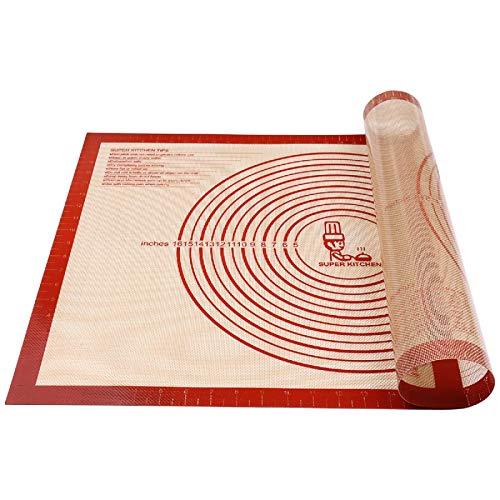
When you need real estate on your counter, the Folksy Super Kitchen mat delivers with a generous 28 x 20-inch footprint — the largest on this list and nearly twice the surface area of some competing mats. That extra space is genuinely useful when you're rolling out large batches of sugar cookies, sheeting pasta dough (great complement to a pasta roller), or working with large fondant sheets for cake decoration. You won't constantly be running out of mat mid-roll.
The thickness is where Folksy makes its strongest technical argument. At 0.7mm, this mat is almost double the thickness of the industry-standard 0.4mm silicone mats. In practical terms, that extra thickness means the mat stays flat under pressure rather than bunching or wrinkling when you lean hard into a rolling pin. The food-grade silicone construction is certified safe — no off-gassing odors even when used near warm surfaces. The red color makes it visually easy to spot spots where dough is sticking.
Cleaning is straightforward: the non-stick surface releases most doughs without scrubbing. The printed measurement rings for pie sizes and circular guides are accurate and legible. The mat's grip on the counter is solid — it doesn't travel during rolling the way thin mats often do. For bakers who work with large-format doughs regularly, this mat removes the surface-size constraint entirely.
Pros:
Cons:
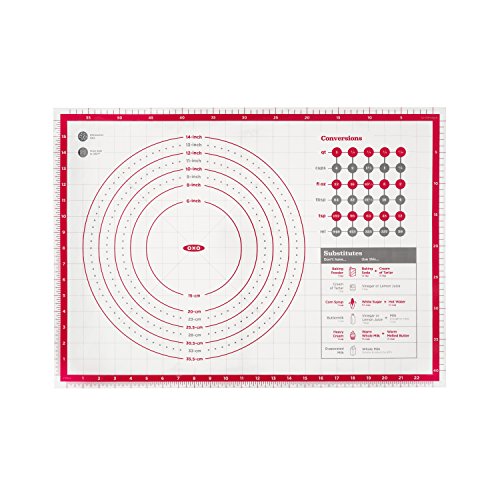
OXO's design philosophy is built around removing friction from cooking tasks, and the Good Grips pastry mat follows that blueprint precisely. The built-in measurement guides are the most clearly printed of any mat we tested — high contrast, easy to read at a glance, and comprehensive enough to cover standard pie sizes, cookie dimensions, and rolling widths. For anyone new to scratch baking who isn't yet eyeballing dough thickness by feel, those guides provide genuine confidence and reduce wasted dough from re-rolling mistakes.
The non-slip base grips the countertop firmly. During testing with a heavy marble rolling pin, the mat didn't shift even when working thick bread dough at full pressure. The food-safe silicone surface provides enough natural release that most doughs lift off cleanly after rolling. OXO's quality control is consistent — this is a brand that tests for durability across product lines, and you can trust that the mat you receive matches the design specifications. The surface also doubles effectively as a counter protector during tasks like kneading or working with hot items briefly placed on the counter.
The size is practical for most home kitchens without being unwieldy. OXO mats clean quickly under running water. If you're building a kitchen from scratch and want tools that just work without a learning curve, OXO is a reliable entry point into the category. Pair this with a good rolling pin and you're fully equipped for 90% of home pastry projects.
Pros:
Cons:
Mrs. Anderson's carves out a strong position in the budget segment without cutting the corners that actually matter. At 18 x 24 inches, the surface is a comfortable working size for most home baking tasks, and the printed references go well beyond basic circles. You get specific size guides for 6-inch tarts, 8-inch, 9-inch, and 10-inch pies, and a 16-inch pizza crust — practical targets that real recipes call for, not decorative rings. The inch, centimeter, and US measurement conversion references printed on the mat are a smart addition for bakers who switch between American and metric recipes.
Made in the USA, the build quality punches above its price. The non-slip backing keeps the mat planted during rolling, and the silicone surface handles all standard dough types without requiring excessive flour. For pizza dough, pie crusts, and biscuit rolling, this mat performs exactly as expected. The size guides for pizza in particular are well-positioned — rolling out a 16-inch pizza crust to the exact target is straightforward when you can see the ring beneath your dough.
The mat is dishwasher safe, which is a practical advantage for busy baking sessions. If you want a capable, American-made pastry mat that covers all the standard use cases at an accessible price, Mrs. Anderson's delivers without compromise. It won't outlast a Silpat, but it will serve most home bakers reliably for years.
Pros:
Cons:
There's a reason professional pie bakers reach for cotton canvas over silicone: flour absorbs directly into the cloth fibers, creating a surface that is categorically better for ultra-flaky, tender pastry crusts. According to pastry technique principles, minimizing excess flour incorporation is critical to achieving the right texture in shortcrust and pie pastry — and a well-seasoned cotton mat achieves exactly that, because the flour you rub in stays in the cloth rather than migrating into the dough. Silicone mats, by contrast, leave flour sitting on top of the surface where it can be picked up by the dough.
The Regency Wraps set includes a 20 x 24-inch heavy-duty cotton cloth and a 15-inch rolling pin cover — a pairing that matters. The rolling pin cover works on the same principle: flour the cover once and the pin rolls without sticking, without dumping extra flour directly into your pastry. The sewn edges on both pieces prevent fraying, which is a durability concern with cheaper canvas alternatives. This is a heavyweight cloth that feels substantial and lays flat without curling even after repeated washings.
Using this system requires a slightly different workflow than silicone mats. You rub flour generously into the cloth before rolling, which takes a minute but creates a surface that veteran bakers consider superior for flaky results. Cleanup involves shaking out flour and hand-washing or machine-washing on gentle. If your primary goal is the flakiest possible pie crust in 2026, this cotton set is your most direct path to that result. It's also worth noting this pairs naturally with any good non-stick cookware for a complete scratch-baking setup.
Pros:
Cons:
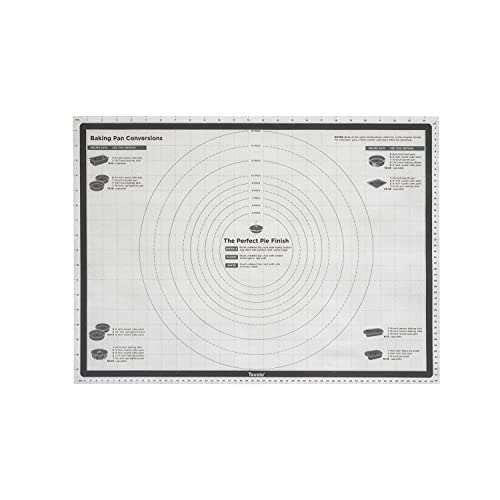
Tovolo positions the TrueBake mat as both a practical rolling surface and an environmentally conscious choice, and both claims hold up. At 25 x 18 inches, the size is generous enough for nearly any home baking project. The imprinted one-inch grid across the entire mat surface is the standout design feature — it's not just a few measurement rings at the center, but a comprehensive grid that lets you track exact dimensions from any angle and any position on the mat. For uniform cookie cutting, precisely portioned dough pieces, or achieving consistent rolled thickness, the grid is a genuinely useful working tool.
The eco-friendly angle centers on parchment paper reduction. If you currently line every baking sheet with parchment paper or foil before use, the TrueBake mat eliminates that habit both on the prep surface and — when used as a pan liner — during baking itself. The material is food-safe silicone rated for oven use, so a single mat covers both rolling prep and pan protection. Over a year of regular baking, that's a real reduction in single-use material waste and supply cost. The pan protection aspect is legitimate: the silicone layer between dough and pan reduces the thermal stress on bare metal pans during repeated baking cycles.
Cleaning is quick: non-stick surface, wipe or rinse. The mat stores flat or rolled without creasing. For bakers who want measurement precision across the entire surface rather than just the center, and who want to reduce disposable baking supplies, the TrueBake is the most versatile choice on this list.
Pros:
Cons:
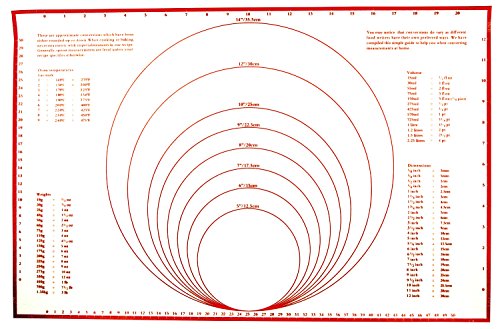
The Fox Run mat earns its spot on this list through sheer reference value. At 23.25 x 15.25 inches, the size is comparable to the Silpat, but Fox Run packs temperature conversions, weight conversions, and volume conversions directly onto the mat surface alongside the standard measurement guides. For bakers who regularly switch between American and metric recipes — or who use European baking references that specify ingredients by weight rather than volume — having those conversion tables permanently on the work surface is a practical advantage that eliminates another piece of paper on the counter.
The food-grade silicone reinforced with glass weave (a fiberglass mesh embedded in the silicone layer) makes this mat stain-proof and significantly more stick-resistant than plain silicone alternatives. The glass weave also adds dimensional stability — the mat lays completely flat and doesn't curl or warp with temperature changes or extended use. This is the same construction philosophy as the Silpat, at a more accessible price. The surface releases dough cleanly and handles both dry and enriched doughs without issue.
If you're also working with pasta dough and want a surface that handles both rolling tasks, Fox Run's dimensions and construction are well-suited for that crossover use — check out the best pasta roller reviews if you're building out a full dough-rolling toolkit. For bakers who use the mat as a kitchen reference tool as much as a rolling surface, Fox Run provides the most comprehensive on-mat information of any product on this list.
Pros:
Cons:
This is the first decision and the most consequential one. Silicone mats are easy to clean, inherently non-stick, and durable without any maintenance ritual. They work well for most dough types and are the right default choice for the majority of home bakers. Cotton canvas mats require you to rub flour into the fibers before use, but that absorbed flour creates a surface that produces noticeably flakier pie crusts and biscuits by preventing excess flour from entering the dough. If pie crust is your primary project, cotton deserves serious consideration. For everything else — pizza, cookies, pasta, fondant — silicone wins on convenience.
A small insider note: silicone can absorb strong flavors over time. If you regularly roll out savory garlic-heavy doughs and then switch to delicate pastry work, wash the mat thoroughly between sessions.
Match the mat size to your most ambitious projects, not your average ones. A 16-inch pizza crust, a large sheet of rolled fondant, or a batch of 24 cut-out cookies all need room. If you regularly make 12-inch pies or 14-inch pizzas, a mat of at least 20 x 24 inches gives you working space around the target size rather than forcing you to work right at the mat's edge. Smaller mats (23 x 15 inches) are appropriate for pie crusts and standard cookie rolling when counter space is limited.
Not all measurement guides are created equal. Look for mats that print specific target sizes for the recipes you actually make — pie sizes (8-inch, 9-inch, 10-inch), pizza (12-inch, 16-inch), and general ruler guides along the edges. Grid-pattern mats like the Tovolo TrueBake offer the most flexibility because every position on the mat is measurable. Bonus reference features like temperature conversion tables (Fox Run) add lasting value for bakers who work from international recipes or frequently switch between Fahrenheit and Celsius.
Thickness directly affects stability. Standard silicone mats run around 0.4mm; premium options reach 0.7mm. Thicker mats resist wrinkling and bunching under rolling pressure — a real problem with thin mats when you're applying force to stiff dough. The non-slip bottom is non-negotiable: a mat that slides as you roll is worse than no mat at all. Check for textured or grippy backing surfaces. For storage, rollable mats (like the Silpat) are easier to store in cramped kitchens than rigid flat mats that require drawer or cabinet space proportional to their full dimensions.
A pastry mat is a non-stick work surface used for rolling out dough — pie crusts, pizza bases, cookie dough, pasta, fondant, and bread dough. It protects your countertop, provides measurement guides so you roll dough to the correct size, and creates a surface from which dough releases cleanly without tearing. Most mats also grip the counter to prevent sliding during rolling.
Cotton canvas is traditionally preferred for pie crust because flour absorbs into the fibers rather than sitting on top. This means less excess flour migrates into the dough during rolling, which keeps the crust tender and flaky. Silicone mats work fine for pie crust but may require more care to avoid over-flouring. For all other dough types, silicone is the more convenient and versatile choice.
Most silicone pastry mats are dishwasher safe — check the manufacturer's instructions for your specific mat. Mats like Mrs. Anderson's are explicitly rated dishwasher safe. Cotton canvas pastry cloths should be hand-washed or machine-washed on a gentle cycle without heat drying, which can shrink or distort the fabric. Never put a glass-weave reinforced mat through a dishwasher without confirming the manufacturer allows it, as high heat cycles can affect the lamination.
Choose a mat with a textured non-slip backing — most quality silicone mats include this feature. If your mat still slides on a smooth granite or quartz countertop, you can place a damp kitchen towel beneath the mat before rolling. This creates friction that anchors the mat in place during heavy rolling. Heavier, thicker mats (0.7mm silicone or glass-weave reinforced) also tend to stay put better than thin lightweight alternatives simply due to their mass.
For standard home baking — 9-inch pies, 12-inch pizzas, batch cookie rolling — a mat of 18 x 24 inches or similar covers most projects. If you regularly make large-format items like 16-inch pizzas, large bread loaves, or rolled fondant for full-size cakes, a 28 x 20-inch mat like the Folksy Super Kitchen gives you the working room those projects require. When in doubt, go larger — unused surface area doesn't hurt, but an undersized mat is genuinely limiting.
Rinse a silicone pastry mat under warm water and wipe with a soft cloth or sponge. For sticky residues like butter-enriched doughs, a small amount of dish soap cuts through the fat without damaging the silicone. Avoid abrasive scrubbers that can scratch the non-stick surface over time. After washing, dry the mat flat or hang it to air dry before rolling for storage. Most silicone mats are also dishwasher safe on the top rack.
The right pastry mat doesn't just protect your counter — it removes every excuse between you and perfect dough, every single time.
 |
 |
 |
 |

About Daisy Dao
Daisy Dao grew up in Honolulu, Hawaii, where coastal living and access to fresh local ingredients shaped her approach to home cooking from an early age. She has spent years experimenting with seafood preparation, healthy cooking methods, and ingredient substitutions — developing hands-on familiarity with a wide range of kitchen tools, techniques, and produce. At BuyKitchenStuff, she covers healthy recipes, cooking techniques, and ingredient substitution guides.
