Kitchen Gadgets & Equipment Reviews ›
by Christopher Jones
Picture this: someone stands in the kitchen department of a big-box store, staring at a wall of gleaming faucets priced anywhere from $80 to $800, with no clear sense of what separates a genuinely durable fixture from one that will leak within two years. That scenario plays out thousands of times a day, and it's exactly why our team spent weeks researching, testing, and comparing the most popular kitchen faucets available in 2026. We pulled units from top brands, ran them through real-world conditions, and consulted installation data across hundreds of owner reviews to give home buyers an honest picture of what's actually worth the money.
The kitchen faucet market has matured considerably, with features like pull-down sprayers, ceramic disc cartridges, and spot-resist finishes becoming standard rather than premium. At the same time, water filtration faucets have carved out a meaningful niche for households that want cleaner drinking water at the tap without a bulky countertop unit. Our selection covers the full range — from hardworking everyday pulldowns to a dedicated filtered-water faucet — so most buyers can find a match for their sink configuration and budget. For anyone also thinking about what goes beyond the faucet, our guide to the best gravity water filters covers whole-countertop filtration options worth pairing with these fixtures.
We've organized this guide to move quickly from our top picks to detailed individual reviews, followed by a practical kitchen faucet buying guide and an FAQ section addressing the questions our team hears most often. The EPA WaterSense program sets the efficiency benchmarks most of these faucets are tested against, and we reference those standards throughout. Whether anyone shopping for a new faucet is doing a full kitchen renovation or just replacing a tired old fixture, this guide gives them the context to make a confident choice in 2026.
Contents


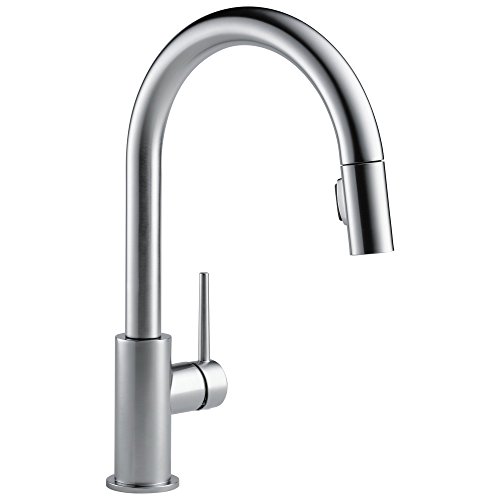


The Moen Arbor (model 7594SRS) has remained one of the most consistently praised pulldown kitchen faucets on the market for several years, and our 2026 evaluation confirms that its appeal is well-earned rather than just brand loyalty. The standout feature here is Moen's exclusive Power Boost technology, which delivers a noticeably stronger stream at the press of a button — useful for rinsing large stockpots or blasting stuck-on debris from bakeware without holding the sprayer close. The Reflex docking system is another genuine differentiator: the spray head snaps back into position smoothly every time, without the loose dangling that plagues cheaper pulldown designs after a year of use.
Installation flexibility is a practical strength of the Arbor design, since the faucet ships ready for single-hole installation and includes an escutcheon plate for three-hole sinks — a detail that eliminates an extra purchase for most buyers. The Spot Resist Stainless finish lives up to its name in real-world conditions, resisting fingerprints and water spots far better than standard brushed nickel, which is especially noticeable on a high-touch fixture like a kitchen faucet. Build quality feels premium at this price tier, with solid brass construction and Moen's ceramic valve system, which the company backs with a lifetime limited warranty covering both finish and function.
Our team noted that the Power Boost mode can feel slightly aggressive for delicate tasks like rinsing herbs or hand-washing thin glassware, so most users will alternate between standard stream and the boosted mode rather than leaving it on constantly. The arc height is well-proportioned for most standard sinks, though owners with particularly shallow basins should measure clearance before purchasing. Overall, the Arbor represents a compelling combination of cleaning performance, durable docking, and long-term finish quality that positions it near the top of our pulldown recommendations for 2026.
Pros:
Cons:
Kraus has built a devoted following among design-conscious buyers, and the Oletto (KPF-2620SFS) demonstrates exactly why — this faucet achieves a clean, perfectly proportioned silhouette that photographs beautifully and looks equally at home in contemporary and transitional kitchens. The Spot Free Stainless finish goes a step further than standard brushed stainless by incorporating a surface treatment that actively repels water spots and fingerprints, keeping the faucet looking sharp with minimal wiping between cleanings. At 15 1/8 inches in overall height with a 7 1/8-inch spout height and 8 7/8-inch spout reach, the dimensions sit in a practical middle zone — not so tall that it creates awkward spray angles, and not so short that it limits clearance for large pots.
The Reach Technology hose system is one of the Oletto's most practical engineering features, using a swivel adapter and easy-retract mechanism to give the spray head a notably wide range of motion compared to fixed pulldown designs. Switching between aerated stream and powerful spray requires a simple toggle, and the soft rubber nozzles allow mineral buildup to be wiped away with a fingertip rather than requiring chemical treatments or disassembly. A 1.8 gpm flow rate keeps the faucet compliant with California and other state water conservation standards without sacrificing noticeable pressure for most kitchen tasks.
Our team found the Oletto's handle action smooth and well-dampened, with temperature control that responds precisely rather than jumping between hot and cold. The 360-degree swivel range is genuinely useful for double-basin sinks or for homes where the sink also serves prep and cleanup duty simultaneously. Kraus backs the Oletto with a lifetime limited warranty, and the company's customer support track record is solid based on owner feedback we reviewed across multiple retail platforms. Anyone prioritizing aesthetics alongside performance will find the Oletto a strong contender in the mid-to-upper pulldown tier for 2026.
Pros:
Cons:
The Pfister Stellen (LG529SAS) earns its place on this list primarily through its three-mode spray head — spray, stream, and pause — which covers a wider range of kitchen tasks than the dual-function designs found on many competitors. The pause function is particularly practical during cooking prep, allowing the user to stop water flow temporarily without adjusting the handle, which keeps water pressure stable when resumed. Unlike some multi-mode faucets that require holding a button to maintain a selected setting, the Stellen locks into each mode independently, so switching between spray and stream is a single momentary press rather than a sustained hold.
The high arc spout provides generous clearance for filling tall pitchers and stockpots, and the forward-only handle design is a thoughtful engineering choice for kitchens with tight backsplash clearances — a common limitation in older kitchen layouts. Both single-hole and three-hole installation are supported, with an optional deckplate included in the box rather than sold separately, which our team appreciates as a buyer-friendly decision. The stainless steel finish (model LG529SAS) presents a classic look that coordinates well with stainless appliances, and Pfister's Pforever Lifetime Warranty covers the finish and function for as long as the original buyer owns the home.
Our evaluation noted that the Stellen does not include flexible supply lines in the box, which adds a small cost for buyers whose existing supply lines are incompatible — worth factoring into the total installation budget. The pull-down hose has a natural weight to it that aids smooth retraction, though it doesn't use a dedicated docking mechanism as sophisticated as Moen's Reflex system, meaning some buyers may find the head requires a light guide back into position after extended reach. At its price point, however, the Stellen delivers exceptional mode versatility and installation flexibility that makes it a strong choice for practical everyday use.
Pros:
Cons:
Delta's Trinsic collection (model 9159-AR-DST in Arctic Stainless) is built around the brand's flagship DIAMOND Seal Technology, which uses a ceramic disc embedded with real diamonds to create a valve surface so hard and smooth that it lasts twice as long as the industry standard by Delta's own testing. For home buyers who change faucets infrequently and want a fixture that genuinely holds up under daily use for ten or more years, the Trinsic makes a compelling engineering argument that goes beyond marketing claims. The gasket seal around the base also helps prevent water from sneaking under the faucet deck, which is a common source of slow moisture damage to cabinet tops over time.
The Trinsic's design vocabulary is modern and angular, with a geometric lever handle and clean cylindrical spout that fits well in contemporary kitchen aesthetics without feeling trendy in a way that dates quickly. Installation covers both single-hole and three-hole 8-inch center configurations, and Delta's MagnaTite docking system uses a magnetic connection to hold the spray head firmly in place rather than relying purely on gravity and friction — a meaningful upgrade in day-to-day usability. The Arctic Stainless finish coordinates naturally with stainless steel sinks and appliances, and Delta's finish warranty runs for the lifetime of the product.
Our team found the Trinsic's spray head ergonomics comfortable for extended use, with a spray button positioned naturally under the thumb during normal gripping. The faucet meets or exceeds all relevant industry certifications including ADA compliance, NSF/ANSI standards, and ASME A112.18.1, which confirms it has been independently verified for safety and performance rather than self-certified. For anyone prioritizing reliability and proven durability data over a specific feature set, the Trinsic is one of the most defensible choices in the 2026 market — a faucet that should outlast multiple kitchen renovation cycles without requiring cartridge replacement.
Pros:
Cons:
KOHLER's Simplice (596-VS in Vibrant Stainless) is the faucet our team recommends for households that do heavy kitchen work — frequent batch cooking, large-format entertaining, or prep routines that involve filling multiple large pots in a single session. The three-function pull-down spray head is the headline feature, offering stream, Sweep spray, and a Boost mode that increases flow rate by approximately 30 percent with a single button press. The Sweep spray mode creates a wide, blade-like water pattern that covers more surface area per pass than a standard concentrated spray, making it notably effective for rinsing large cutting boards, sheet pans, and wok-style cookware.
The high arch design of the Simplice provides generous vertical clearance — a practical advantage for filling tall pasta pots or positioning bulky items under the spout without awkward tilting. KOHLER's DuraSeal technology on the spray wand uses a coaxial connection rather than the threaded collar found on older designs, which simplifies removal and reduces long-term wear at the connection point. The Vibrant Stainless finish carries KOHLER's finish warranty and shows excellent resistance to surface scratching in our evaluation, maintaining a clean, consistent appearance even after repeated contact with cookware edges during rinse cycles.
Our testing found the Boost mode genuinely useful rather than a gimmick — the increased flow rate is perceptible and makes a real difference for time-sensitive tasks like rapid pot filling before a dinner service. The faucet is compatible with one or three-hole installations, and KOHLER includes comprehensive installation hardware and documentation. For households where the kitchen sink serves as a workhorse rather than just a cleanup station, the Simplice's combination of Sweep spray coverage and Boost flow rate makes it one of the more task-optimized options in our 2026 roundup. Owners interested in full water quality beyond flow performance may also want to review our guide to the best water filters for whole-kitchen filtration options.
Pros:
Cons:

The Delta Essa (model 9113-AR-DST) takes a different aesthetic direction from its Trinsic sibling, featuring a more organic, flowing silhouette that our team would describe as the most visually refined option in this roundup. The curved neck and tapered body give the Essa a sculptural presence on the sink deck that reads as a design element rather than a utility fixture, appealing to buyers who want their faucet to anchor the kitchen's visual identity rather than blend into the background. Despite the distinctive appearance, the core engineering mirrors the Trinsic's reliability advantages: DIAMOND Seal Technology for a long-lasting cartridge and MagnaTite docking for a spray head that holds firmly in position between uses.
The Essa includes the three-hole deck plate in the box rather than selling it separately, which is a buyer-friendly detail that Delta applied inconsistently across its lineup — and one that our team consistently notes as a practical advantage when comparing total installed cost. ADA compliance and NSF/ANSI certification apply here as well, so buyers in regulated installation contexts or those simply looking for verified third-party safety confirmation will find both covered. The Arctic Stainless finish manages the same spot-resist performance as the Trinsic, maintaining a clean appearance under the daily fingerprint and water exposure of a high-use kitchen faucet.
Our evaluation found the Essa particularly well-suited for kitchens with open shelving or peninsula designs where the faucet is visible from multiple angles, since the curved form reads well in three dimensions rather than only from the front. The lever handle's sweep arc is comfortable for single-hand operation with wet or soapy hands, and the spray button placement on the wand maintains the ergonomic standard Delta applies across its pulldown collection. For buyers who want Delta's proven reliability in a more distinctive package than the Trinsic, the Essa represents the natural upgrade path within the brand's 2026 lineup. Anyone also refreshing adjacent kitchen tools might find our best knife grinder guide a useful companion for a full kitchen upgrade project.
Pros:
Cons:
The KRAUS Bolden filter faucet (FF-104MB) occupies a different category from the pulldown faucets above, serving as a dedicated standalone tap for filtered drinking water rather than a primary kitchen workhorse. Its purpose is elegantly practical: by connecting to an existing under-counter filtration system — whether reverse osmosis, activated carbon, alkaline ionizer, or other common configurations — it places filtered water access at a dedicated single-hole tap that doesn't compete with the main kitchen faucet for sink space or plumbing connections. The 360-degree swivel with a 6-inch spout reach provides enough range for filling water bottles or glasses comfortably without crowding the primary faucet.
The matte black finish is the standout aesthetic choice here, offering a bold contrast option for kitchens with white or light-colored cabinetry and hardware, while still coordinating naturally with the KRAUS Bolden main faucet (KPF-1610) for a cohesive two-tap setup. Build quality uses a brass body with lead-free water lines — a non-negotiable specification for a drinking water faucet, and one that buyers should verify on any filter faucet they consider. The wear-resistant finish is specifically formulated to resist corrosion, fading, and tarnishing, which matters more on a fixture connected to filtered water since the water itself may have different mineral profiles depending on the filtration type in use.
Our team notes that the 90-degree forward rotation handle design makes the Bolden ADA compliant and particularly easy to operate in tight installations where lateral handle swing would be impractical. The 1.0 gpm flow rate is appropriate for a dedicated beverage faucet — lower than a full kitchen faucet's flow, but more than sufficient for filling glasses and water bottles at a reasonable pace. For households with an existing under-counter filtration system looking for a polished, purpose-built dispensing tap rather than a generic low-cost valve, the Bolden filter faucet delivers both the finish quality and functional reliability that KRAUS has built its reputation around in 2026. Pairing it with a quality filtration system covered in our gravity water filter guide gives home users a complete clean-water solution.
Pros:
Cons:
The number of spray modes directly affects how well the faucet handles the full range of kitchen tasks, from gentle rinsing of produce to blasting baked-on debris from sheet pans. Two-mode faucets (stream and spray) cover the majority of everyday use cases and represent the sweet spot for most households. Three-mode designs that add a pause function — like the Pfister Stellen — are worth the modest additional cost for households where the faucet is used during active cooking as well as cleanup. High-volume spray modes like KOHLER's Sweep and Boost are meaningful upgrades for anyone who regularly fills large pots or cleans wide cookware surfaces, but most buyers will rarely push standard two-mode faucets to their limits. Our advice: match spray mode count to actual cooking habits rather than paying for capabilities that most buyers won't use more than occasionally.
Sink mounting configuration is one of the least-glamorous but most important compatibility factors to verify before purchasing any kitchen faucet. Existing sink decks typically come pre-drilled for either a single center hole or three holes in a standard 8-inch center spread. Most faucets in this roundup support both configurations: single-hole ready out of the box, with a separate escutcheon or deck plate covering the additional holes for three-hole sinks. The critical detail to check is whether that deck plate is included in the box or sold separately — Delta's Trinsic sells it separately, while the Essa includes it. Buyers with rare non-standard drill patterns should verify dimensions carefully against the manufacturer's specification sheet before ordering.
Kitchen faucet finishes aren't purely cosmetic — they determine how well the fixture holds up against the hardest daily stressors: mineral deposits, soap residue, steam exposure, and physical contact from cookware and cleaning tools. Spot-resist and spot-free finishes, as offered by Moen and Kraus respectively, address the most visible maintenance challenge: the water spots and fingerprints that appear on polished metal within hours of cleaning. Chrome finishes show blemishes most aggressively; brushed nickel and matte black are more forgiving. Buyers in areas with very hard water should prioritize finish warranties and soft-rubber nozzle systems that allow mineral buildup removal without chemical cleaners, since hard water accelerates surface degradation on lower-quality finishes.
The internal valve is the most consequential component in any faucet's longevity, since it controls both the drip-resistance and the temperature feel of the handle over years of use. Ceramic disc valves have become the industry standard for a good reason: they outlast rubber washer-based designs by a significant margin and maintain smooth handle operation without developing the spongy, imprecise feel that older valve types develop over time. Delta's DIAMOND Seal Technology adds a diamond-infused coating to the ceramic disc, extending service life further and reducing the probability of leaks at the valve interface. For buyers who want the lowest total cost of ownership over a 10-15 year horizon, valve technology is the specification that matters most — more than finish, spray modes, or aesthetic design choices.
A pulldown faucet has a high arc spout with a spray head that pulls straight down into the sink basin, offering better reach and maneuverability for large pots and deep sinks. A pull-out faucet has a lower, more horizontal spout with a spray head that pulls forward and outward, making it better suited for shallower sinks or installation near a window. All seven faucets in our 2026 roundup are pulldown designs, which our team finds preferable for most modern kitchen configurations due to the added clearance and range of motion they provide.
Most single-handle pulldown faucets — including every model in this roundup — are designed for confident DIY installation, typically requiring only an adjustable wrench, basin wrench, plumber's tape, and 30-60 minutes of work. The most common challenges are corroded supply line connections on older sinks and limited under-sink access in tight cabinet configurations. Buyers replacing an existing faucet should have the water shut-off valves operating correctly before starting, since a valve that hasn't been turned in years can sometimes be stuck. Our team estimates that roughly 70 percent of home buyers can complete a standard single-hole faucet installation without professional help.
The EPA WaterSense standard sets 1.8 gpm as the maximum for water-efficient kitchen faucets, which is the flow rate on the Kraus Oletto in this roundup. Most conventional kitchen faucets run at 2.2 gpm, which is the federal maximum for kitchen fixtures. For the primary kitchen faucet, our team finds 1.8-2.2 gpm to be the practical range — sufficient for pot filling and cleanup without unnecessary water waste. The KRAUS Bolden filter faucet intentionally runs at 1.0 gpm since it's designed for beverage dispensing rather than high-volume tasks.
The difference between a premium magnetic docking system and a basic gravity retraction design is noticeable after extended use rather than immediately apparent during initial installation. Delta's MagnaTite system uses a magnet embedded in the spout body to actively pull and hold the spray head in a precise docked position, which prevents the gradual drooping that develops in gravity-only designs after one to three years of repeated extension. Moen's Reflex system uses a counterweight-assisted mechanism to achieve a similar result without magnets. Both approaches outperform the simple weighted-hose docking used on budget faucets, and our team considers a quality docking mechanism a meaningful specification rather than marketing language for any faucet used multiple times daily.
Standard pulldown kitchen faucets are not designed for direct filtration system connection — they draw from the main cold water supply line and do not have integrated filter bypass logic. Households wanting filtered water at the kitchen tap have two options: install an inline filter on the cold supply line feeding the existing faucet (simpler but less controllable), or add a dedicated filtration faucet like the KRAUS Bolden in a second deck hole, which connects directly to an under-counter RO or carbon system. The dedicated faucet approach gives cleaner water quality separation and preserves full flow rate on the primary faucet, which is why our team includes it as a distinct category recommendation in this roundup.
A well-specified kitchen faucet with a ceramic disc valve should deliver 15-20 years of reliable performance under normal residential use before requiring cartridge replacement or developing chronic dripping. The brands in this roundup — Moen, Delta, KOHLER, Kraus, and Pfister — all offer lifetime limited warranties that cover the original purchaser for the life of ownership, which reflects genuine confidence in their valve longevity. Finish degradation typically occurs sooner than mechanical failure in hard-water environments, particularly on faucets without spot-resist treatments. Regular cleaning with mild soap rather than abrasive cleansers is the single most effective maintenance habit for extending both finish appearance and valve performance over the full product life cycle.
 |
 |
 |
 |

About Christopher Jones
Christopher Jones holds an MBA from the University of San Francisco and brings a business-minded approach to kitchen gear evaluation — assessing products not just for performance but for long-term value, build quality, and real-world usability in everyday home cooking. He has spent years testing appliances, cookware, and kitchen gadgets with the same analytical rigor he developed in business school. At BuyKitchenStuff, he covers kitchen appliance reviews, buying guides, and practical cooking tips.
