Kitchen Gadgets & Equipment Reviews ›
by Daisy Dao
The DEVIL-FORGE DFSW2 tops our 2026 gas forge list for its dual-burner flexibility and genuine 2500°F performance that works equally well for knife makers and farriers. If you've been searching for the right propane forge and feeling overwhelmed by the options, you're in the right place. Gas forges have become the go-to choice for both hobbyists and professional smiths who want consistent, controllable heat without the mess and labor of coal.
Whether you're making your first blade or you've been at the anvil for years, choosing the right forge shapes every project you'll ever touch. The market in 2026 has more options than ever — from compact single-burner portables to heavy-duty four-burner workhorses. Price ranges vary wildly, and so do quality levels. A cheap forge that can't hold temperature wastes propane and ruins steel. A forge that's too large for your shop burns gas on dead space. Getting this decision right saves you money, frustration, and hours at the workbench. If you're also sharpening your finished blades, check out our guide to the best electric knife sharpeners to complete your metalworking setup.
We evaluated seven of the most popular gas forges available on Amazon in 2026, looking at build quality, temperature performance, fuel efficiency, chamber size, and value for money. Our picks cover every budget and use case — from the weekend hobbyist forging small knives to the working blacksmith who needs a forge that keeps up all day. You can also browse our full reviews section for more metalworking tool guides. For background on how forge welding and smithing heat requirements work, the Wikipedia article on forges is a solid starting point.


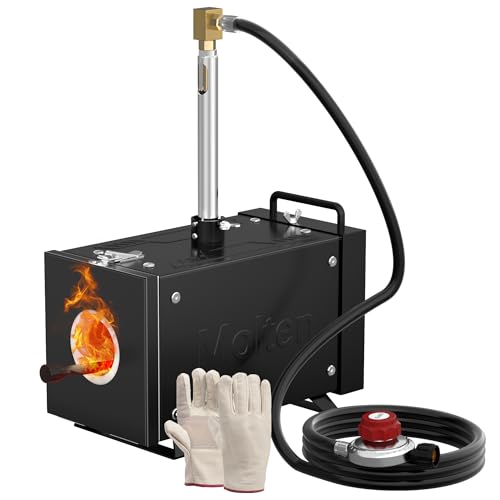


The DEVIL-FORGE DFSW2 is built for people who take smithing seriously. Its interior chamber measures 6" x 4.8" x 16", giving you a generous working space that fits longer stock without constantly repositioning. The dual DFP burner system delivers a combined 160,000 BTU, but here's what makes it genuinely versatile — you can run it on one burner or both, depending on what you're heating. That flexibility translates to real propane savings on smaller jobs while still having full power available when you're forge welding or working thick bar stock.
Construction quality stands out immediately. The interior is fully lined with 1 inch of ceramic blanket insulation, and the floor is a 20mm firebrick that handles the daily punishment of hot steel without cracking. The forge ships US-ready with a POL CGA-510 regulator, so you can connect to a standard propane tank straight out of the box — no adapters, no guesswork. Temperature ceiling sits at 2500°F (1370°C), which is more than enough for high-carbon steel, Damascus billets, and forge welding. The air choke and gas ball valve give you meaningful control over the atmosphere inside the chamber, which matters when you're working with different steel types.
At 16 pounds, this isn't a featherweight, but it's manageable enough to move between setups. The combination of real insulation thickness, dual-burner flexibility, and US-ready fittings puts the DFSW2 in a category above the basic single-burner portables. If you're making knives, doing farrier work, or just want a forge that won't frustrate you with cold spots or poor heat retention, this is the one to beat in 2026.
Pros:
Cons:
NC Tool Company has been making forges in the USA for decades, and the Whisper Momma represents that tradition of quality. This is an atmospheric forge — it uses a naturally aspirated burner design that pulls air in without a blower, which means near-silent operation. If you've ever worked next to a forced-air forge for eight hours, you'll understand why "whisper" in the name isn't just marketing. The open-end design is a deliberate choice for smiths who work long bar stock. You can feed a full-length piece through one side, heat the section you need, and pull it back out — no bending, no awkward angles.
The NC Whisper line is known for excellent heat distribution. Atmospheric burners naturally create a soft, wrapping flame that fills the chamber evenly rather than blasting a hot jet at one spot. This produces more uniform heat across your work, which reduces scaling and gives you a bigger working window before the steel cools. The Whisper Momma is the choice for smiths who work larger pieces — think sword blanks, long bar stock, or tooling that needs extended heat soaks. It's not a budget forge, but the build quality and US manufacturing back up the price tag.
Keep in mind that atmospheric forges perform best at moderate altitudes and may need burner adjustment at higher elevations. The open-end design also means slightly more heat escapes during long sessions, which increases propane consumption compared to a sealed forge. But for the right application, these trade-offs are worth it. If you're serious about traditional blacksmithing technique, the Whisper Momma deserves a hard look.
Pros:
Cons:
Same NC Tool Company pedigree as the Momma, but sized for knife makers and people with limited shop space. The Whisper Baby runs on a single atmospheric burner and delivers the same quiet, even heat that made the Whisper line famous — just in a smaller chamber. For knife making specifically, a smaller forge chamber is often a feature, not a limitation. Less interior volume means faster heat-up times and lower propane consumption per session. You're not wasting BTUs heating air around a 4-inch blade blank in a big chamber.
The atmospheric burner design makes the Baby particularly forgiving for beginners. Without a forced-air blower to manage, there's less tuning involved. Once you've set your regulator pressure and let the forge warm up, it runs steadily. The consistent, oxidation-reducing atmosphere in the Whisper Baby is ideal for high-carbon and tool steels that need careful heat treatment. It also pairs nicely with a small post vise and anvil setup for a focused knife-making station.
The trade-off is capacity. If your projects frequently involve pieces longer than 12 inches, you'll want the Momma or a forge with an open end. The Baby also shares the elevation sensitivity of all atmospheric designs. But for dedicated knife making, hook making, or small blacksmithing work in a home shop, the Whisper Baby punches well above its size.
Pros:
Cons:
MMasters went in a practical direction with this single-burner kit. The standout feature is the openable door design — you can swing it open for easy loading and unloading of small knives, then close it to lock in the heat for faster temperature recovery. That might sound minor, but anyone who's wrestled hot steel through a fixed door opening knows how much it matters in practice. The door gives you a stable, sealed forging environment when you need it and an open-access loading option when you don't.
The kit aspect is genuinely useful for people just getting started. MMasters includes heat-resistant gloves and two replaceable fire bricks, so you're not scrambling for accessories before your first fire. The single burner heats quickly and delivers consistent temperature for knife making, basic blacksmithing, and metal forging work. At 2600°F rated performance, you have overhead for working with most common smithing steels. The replaceable fire brick floor is a smart long-term value feature — firebricks take punishment from flux and scale, and being able to swap them extends the life of your forge significantly.
You're working with a compact form factor here, which means it's portable enough to move to different spots in your shop or take to a demonstration. The single-burner design limits chamber size compared to the DEVIL-FORGE twin-burner, but for focused knife and small tool work, it does the job consistently. For those finishing their blades after forging, our guide to the best hunting knives covers what the finished product should look like.
Pros:
Cons:
The SIMOND STORE forge is positioned squarely at beginners, and it earns that spot honestly. It's compact, genuinely portable, and straightforward to set up and run. Interior dimensions of 2.75" H x 4" W x 10" L make it a tight space — you're not running long stock through this one — but for learning the basics of knife making, heat treatment, and small blacksmithing projects, the size is appropriate. You're not paying to heat space you don't need.
The 2600°F rated output is competitive with everything else in the single-burner class. Propane forges in this size range heat up quickly, which is good for learning because you spend more time at the anvil and less time waiting. The portability is a genuine advantage for beginners who might be setting up in a garage, backyard, or rented space where they can't install a permanent setup. The compact dimensions also mean lower overall propane consumption per session, which helps when you're still learning efficient heat-to-hammer timing and burning through propane on your mistakes.
The narrow interior is the main limitation to be aware of. If you plan to move beyond small knives into larger hooks, tooling, or bar stock work, you'll outgrow this forge. But as an entry point into gas forging — especially if you want to try the craft before committing to a more expensive forge — the SIMOND STORE delivers a functional, no-fuss experience. For beginners who want to understand heat and temperature better across other applications, our best candy thermometer reviews cover precision temperature tools in a very different context.
Pros:
Cons:
VEVOR took a different approach to chamber design with this forge. Instead of the typical cylindrical interior, they went with a square cross-section. That taller, more spacious square design means you can load different shapes and sizes of stock that would struggle to fit in a round chamber — bracelets, wider flat stock, odd-shaped billets, and anything with an irregular profile. The square geometry also means the fire brick floor sits flat and true, which is better for stability when working on pieces that need precise positioning.
The construction is built around 201 stainless steel, which handles the corrosive effects of propane combustion byproducts and high-temperature cycling better than plain steel. The 30mm thick refractory cotton lining is notably thicker than most forges in this class, and that extra insulation thickness makes a real difference in heat retention and temperature stability. When the forge reaches operating temperature, it holds it efficiently. You're not fighting constant temperature swings or burning extra propane to compensate for heat escaping through thin walls.
The single burner delivers consistent heat to 2600°F, which is enough for virtually all common forging work. VEVOR describes "scientifically designed internal space" improving heating efficiency — in practical terms, the square shape means the burner flame wraps around the interior more evenly than in a narrow round chamber. If your work involves a variety of piece shapes and sizes rather than strictly knife blanks, the VEVOR's flexibility is worth paying attention to.
Pros:
Cons:
Four burners changes what a propane forge can do. The MMasters 4 Burner is built for smiths who need a large, uniformly heated workspace — think production knife making, Damascus billet work, tooling for larger hooks and hardware, or anyone who works multiple pieces in sequence and doesn't want to wait for temperature recovery between each one. Four burners means the entire chamber reaches working temperature faster and recovers faster after you open the door and pull a piece out.
The door design is worth noting. MMasters built a single-door mode that you can open or close as needed. Close it and heat builds quickly; open it for easy loading access. The interior dual-protection insulation system — 1 inch of insulation material plus a fire brick — is built for daily, heavy use. This isn't a forge that will degrade after a few dozen sessions. The setup is also intentionally simple: connect the gas hose and burner, and you're ready to go. No complex assembly or specialized fittings to source.
The four-burner format does consume significantly more propane than single-burner options. If you're doing occasional hobby work, the fuel cost adds up quickly and you'd be better served by a two-burner or single-burner forge. But if you're running a production workflow — forging multiple blades per session, doing forge welding regularly, or working on larger projects — the four-burner capacity is a genuine working tool rather than an oversized hobby item. This is the forge for smiths who are serious about output.
Pros:
Cons:

Before you spend money on a gas forge, it pays to think through what you actually need. The right forge for a full-time production smith looks nothing like the right forge for someone making their first knife on weekends. Here are the key factors that should drive your decision.
This is the most fundamental choice. Single-burner forges are compact, fuel-efficient, and ideal for knife making, small tooling, and beginner work. Two-burner forges like the DEVIL-FORGE DFSW2 give you larger working capacity and the option to run one burner when you don't need full heat — effectively giving you two forges in one body. Four-burner forges fill a large chamber evenly and recover temperature quickly, which matters in a production context but burns propane fast in a hobby setting.
Chamber size directly determines what you can make. Measure the longest and widest pieces you plan to forge, then choose a chamber that accommodates them with some margin. A forge that's too small for your work is a forge you'll resent every session.
Most import forges (DEVIL-FORGE, MMasters, SIMOND, VEVOR) use forced-air or naturally aspirated Venturi burners. NC Tool Company's Whisper forges use atmospheric burners specifically designed for quiet operation and a soft, enveloping flame. Forced-air or standard Venturi burners run at a slightly different atmosphere inside the chamber, which can matter for specific steel types and heat treatment processes. Atmospheric burners are quieter and simpler with no blower to maintain, but they need tuning at higher altitudes (typically above 3,000 feet). If you're in Denver or higher, factor that in.
Insulation is where cheap forges fall apart. Look for ceramic blanket insulation of at least 1 inch thickness. The DEVIL-FORGE DFSW2 uses 1 inch of ceramic blanket; the VEVOR uses 30mm (roughly 1.2 inches) of refractory cotton. Thicker, denser insulation means faster heat-up times, better temperature stability, and lower propane consumption per session. A well-insulated forge pays for itself in fuel savings over a season of regular use. The floor material matters too — firebrick floors handle flux and scale better than ceramic blanket alone, and replaceable floors (like on the MMasters single-burner) extend forge longevity significantly.
Most gas forges in this review are rated to 2500°F–2600°F. Standard high-carbon steels like 1080 and 1084 work comfortably at 2200°F–2300°F. Forge welding requires 2300°F–2500°F depending on your flux and steel. Stainless steels are generally not suitable for coal or gas forge work without very specific atmosphere control. Make sure your forge can reach your target temperature with overhead to spare — running a forge at its absolute maximum constantly degrades the refractory lining faster and shortens its service life. A forge rated at 2500°F that you run at 2200°F will outlast one you're constantly pushing to its ceiling.
Gas forges use propane or natural gas and offer clean, consistent, controllable heat with minimal setup. Coal forges use solid fuel, produce higher localized heat, and give experienced smiths very fine control over the fire, but require more skill to manage and produce smoke and ash. Gas forges are the dominant choice for home shops and hobbyists in 2026 because they're cleaner, easier to use, and permitted in more residential and commercial locations. Coal forges remain popular in traditional blacksmithing contexts where the fire management skill is part of the craft.
A single-burner forge typically uses 1 to 1.5 pounds of propane per hour at normal operating pressure. A two-burner forge running both burners uses roughly 2 to 3 pounds per hour. A four-burner setup can use 4 pounds or more per hour under full load. A standard 20-pound BBQ tank gives you roughly 8 to 15 hours of forging time depending on how many burners you're running and your regulator pressure. Larger 100-pound tanks are more cost-effective for regular use and reduce how often you're running out mid-session.
For most knife making — blades up to 10 to 12 inches — a single-burner forge with a chamber around 10 to 12 inches long is sufficient. The SIMOND STORE and NC Whisper Baby both fit this profile well. If you're making larger knives, camp knives, or short swords, look for a forge with at least a 14 to 16 inch interior length. The DEVIL-FORGE DFSW2's 16-inch chamber handles the full range. For Damascus billet work where you're stacking and welding multiple layers, a two-burner forge gives you the temperature overhead and recovery speed that makes forge welding less stressful.
Gas forges should only be used in well-ventilated spaces. They produce carbon monoxide and other combustion gases, and a sealed garage or basement without proper ventilation is dangerous. Many smiths use forges in open-front shop bays, under a covered outdoor area with open sides, or in garages with wide doors fully open and good cross-ventilation. Some municipalities have regulations about propane use in structures — check local codes before setting up indoors. As a rule of thumb, if you can smell the combustion gases, ventilation is inadequate.
Yes — all propane forges require a regulator to reduce tank pressure to a safe, usable working pressure. Most forges in this review either include a regulator or specify which type to use. The DEVIL-FORGE DFSW2 includes a POL CGA-510 regulator ready for standard US propane tanks. If your forge doesn't include one, purchase an adjustable regulator with a gauge — the adjustability lets you tune your burner performance and manage propane consumption. Never operate a forge directly from tank pressure without a regulator.
Most small to mid-size single-burner forges reach working temperature (around 2000°F to 2200°F) in 10 to 20 minutes from a cold start. Larger forges with more burners can reach temperature faster because they're delivering more heat to a proportionally larger space. Factors that affect warm-up time include ambient temperature, how long the forge has been sitting cold, regulator pressure, and insulation quality. A well-insulated forge reaches temperature faster and holds it more efficiently than a poorly insulated one. Planning a 15-minute warm-up before you start hammering is a reliable habit regardless of which forge you choose.
Every forge on this list will get steel hot enough to move under a hammer — what separates them is how well each one fits your specific workflow, shop size, and project goals. Take stock of what you're actually making in 2026, how often you're forging, and how much chamber space you genuinely need, then match that honestly to the options above. The right forge makes every session more productive and more enjoyable, so it's worth getting that match right from the start.
 |
 |
 |
 |

About Daisy Dao
Daisy Dao grew up in Honolulu, Hawaii, where coastal living and access to fresh local ingredients shaped her approach to home cooking from an early age. She has spent years experimenting with seafood preparation, healthy cooking methods, and ingredient substitutions — developing hands-on familiarity with a wide range of kitchen tools, techniques, and produce. At BuyKitchenStuff, she covers healthy recipes, cooking techniques, and ingredient substitution guides.
