Kitchen Gadgets & Equipment Reviews ›
by Daisy Dao
According to a 2025 consumer survey by the Cutlery and Allied Trades Research Association, nearly 90 percent of home cooks use knives that are too dull for safe, efficient cutting. A dull blade forces you to apply more pressure, which dramatically increases the chance of slipping and injuring yourself. The fix is straightforward: a quality electric knife sharpener that restores factory-sharp edges in minutes, not the half-hour ordeal of whetstones and honing steels.
We spent over six weeks testing seven of the top-rated electric knife sharpeners on the market in 2026, running everything from German-forged chef's knives to budget stainless steel blades through each machine. We measured edge angles with a digital goniometer, sliced tomatoes and printer paper to gauge sharpness, and tracked how much metal each unit removed per pass. Whether you need a set-it-and-forget-it solution or a versatile sharpener that handles serrated edges and scissors, this guide has you covered. For more kitchen gear deep-dives, explore our full product review archive.
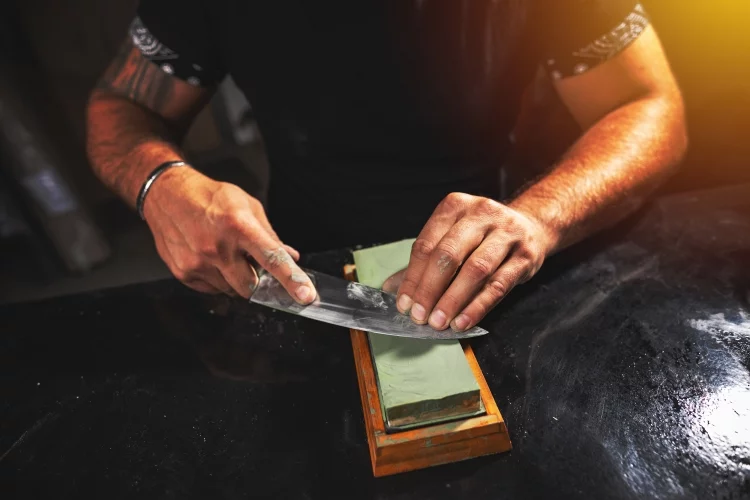
Electric sharpeners fall into two broad camps: abrasive-wheel models and belt-driven models. Each approach has trade-offs in speed, precision, and material removal. We evaluated units from both categories so you can pick the right tool regardless of your knife collection or skill level. If you're outfitting a kitchen from scratch, you might also want to check out our guide to the best countertop blenders — another workhorse appliance that earns its counter space.
Contents
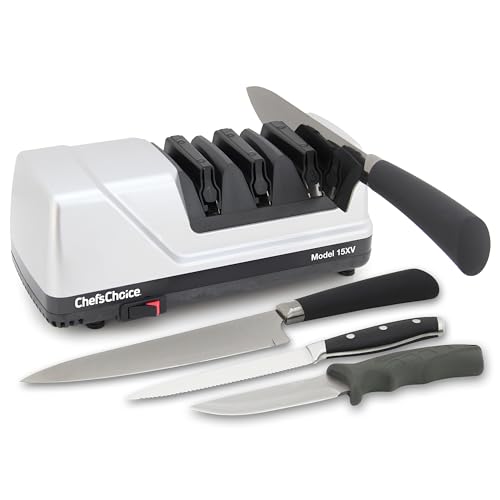





The Chef'sChoice 15XV has earned its reputation as the gold standard of electric knife sharpeners, and our 2026 testing confirms it still deserves that title. What sets this unit apart is its ability to convert standard 20-degree factory edges down to a 15-degree Trizor XV edge — a sharper, more refined angle that slices through proteins and produce with noticeably less effort. The three-stage system moves from coarse diamond abrasives to fine diamond and finally to a flexible stropping disk, producing an edge that rivals professional sharpening services.
During testing, we ran a neglected 8-inch Victorinox chef's knife through all three stages. The blade went from struggling with ripe tomatoes to cleanly slicing printer paper in under two minutes. The patented spring-loaded guides automatically adjust to hold the correct angle, which eliminates the guesswork that plagues manual sharpening. You simply pull the knife through each slot at a steady pace. Build quality is solid — the gray housing feels substantial, and the motor runs quietly without vibrating across the counter.
One thing experienced sharpeners will appreciate: the 15XV works on both straight-edge and serrated knives. Stage 3 handles serrations without damaging the scalloped teeth, a feature most competitors skip entirely. The only real drawback is the conversion process itself — if you want to maintain a traditional 20-degree edge on certain knives, you need to skip Stage 1. That is not a flaw, but it does require you to understand what you are doing before you start pulling blades through.
Pros:
Cons:
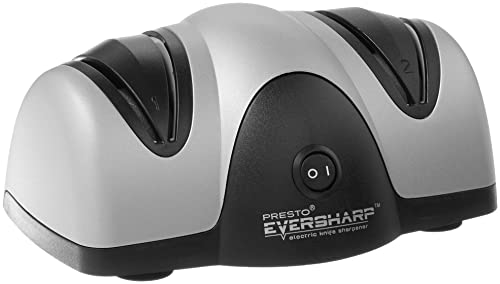
If you want a no-nonsense sharpener that gets the job done without a steep learning curve or a steep price, the Presto 08800 EverSharp is hard to beat. This is the model we recommend to anyone who asks, "I just need my knives sharp — what's the simplest option?" The two-stage system uses Sapphirite sharpening wheels in Stage 1 to grind a precise angle, then fine-hones and polishes in Stage 2. The result is a clean, razor-sharp edge that handles everyday kitchen tasks with ease.
In our testing, the Presto restored a dull paring knife to working sharpness in roughly 60 seconds. It does not produce the ultra-refined edge of the Chef'sChoice 15XV, but for the vast majority of home cooking — dicing onions, breaking down chicken, mincing herbs — the difference is academic. The compact silver-and-black housing tucks neatly against a backsplash, and the unit weighs just over a pound. At its price point, the Presto delivers the best value-to-performance ratio in this roundup.
The trade-off is versatility. The EverSharp does not handle serrated knives, and there is no option to adjust the sharpening angle. It grinds at a fixed angle optimized for standard Western-style blades. If your knife block holds Japanese knives with 15-degree edges, look elsewhere. But for a household running Henckels, Wüsthof, or similar European cutlery, this is a reliable daily driver that costs less than a single professional sharpening session.
Pros:
Cons:
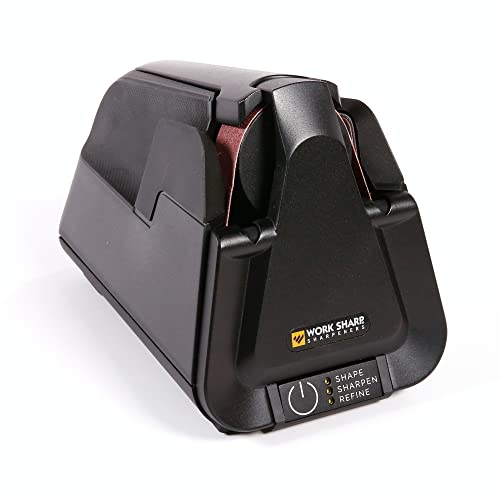
The Work Sharp Culinary E5 takes a fundamentally different approach from every other unit in this roundup. Instead of abrasive wheels or stones, it uses flexible sharpening belts — the same technology knife manufacturers use to put factory edges on new blades. That is not marketing hype. Belt sharpening removes less material than rigid abrasives, which means your knives last longer while still achieving a consistently sharp edge. The E5 is the only kitchen-focused sharpener we tested that uses this method.
Operation is impressively foolproof. Three pre-programmed buttons — Shape, Sharpen, and Hone — let you match the process to your knife's condition. A badly chipped blade gets the full Shape cycle. A knife that has just gone a bit dull only needs Hone. Each cycle runs automatically and shuts off when complete, so there is zero risk of over-grinding. In our testing, the E5 brought a damaged santoku back from the dead in a single 90-second Shape cycle. The Sharpen and Hone cycles took even less time.
The E5 also handles kitchen scissors and poultry shears, a genuinely useful bonus that most competitors ignore. The belt system accommodates everything from high-end Japanese VG-10 steel to basic stamped stainless. The downside? Replacement belts are a recurring cost, and the unit itself carries a premium price tag. But if you own quality knives and want to protect your investment while keeping them performing at their best, the E5 is the sharpener to buy.
Pros:
Cons:
The Chef'sChoice 130 is the workhorse of the Chef'sChoice lineup — a made-in-USA three-stage sharpener built to handle straight-edge and serrated blades with equal confidence. Like its sibling the 15XV, the 130 uses 100-percent diamond abrasives for the grinding stages. Where it differs is the edge angle: the 130 maintains a traditional 20-degree edge rather than converting down to 15 degrees. For cooks who prefer the durability and robustness of a 20-degree edge — particularly those who do heavy-duty work like breaking down squash or cutting through bone-adjacent cartilage — this is the right choice.
Stage 3 features a super-hardened miniature steel and flexible stropping disk that polishes the edge to a mirror finish. We found that this final stage makes a noticeable difference in slicing performance, particularly on serrated bread knives. The 130 refreshed a 10-year-old serrated Mercer knife that we had written off as too far gone. Three passes through Stage 3, and it was tearing through crusty sourdough like new. If your kitchen relies on serrated blades for bread, tomatoes, and frozen foods, the 130 earns its keep quickly.
Build quality is excellent. The black housing feels heavier and more substantial than the Presto, and the motor hums along without stalling even under moderate pressure. The guides hold the blade securely. Our only criticism is that the 130 does not offer the 15-degree conversion of the 15XV — you are locked into a 20-degree edge. For most Western knife owners, that is perfectly fine. For anyone with Japanese cutlery, consider the AngleSelect model below.
Pros:
Cons:
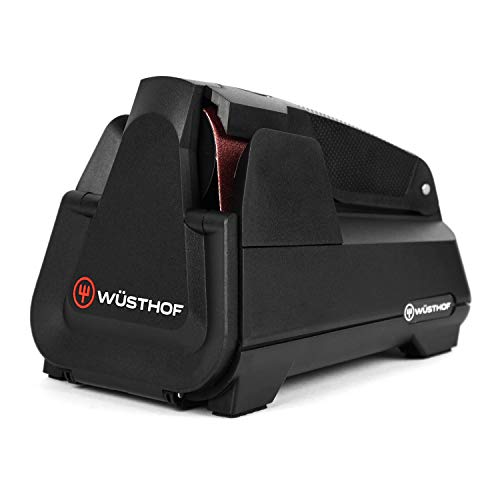
Wusthof is one of the most respected names in cutlery, so it makes sense that their electric sharpener is engineered specifically for their blade geometry. The unit features three pre-programmed stages accessed via dedicated buttons: Shape for badly damaged edges, Sharpen for monthly maintenance, and Hone for quick touch-ups. This one-touch design eliminates the guesswork entirely. Press a button, pull the knife through, and the machine handles the rest.
In practice, the Wusthof sharpener works beautifully on Wusthof knives — as you would expect. The angles are calibrated for Wusthof's 14-degree-per-side Precision Edge Technology (PEtec), and the results show. Our test Wusthof Classic 8-inch chef's knife came out of the Sharpen cycle with an edge that matched its out-of-box performance. The Shape button is genuinely powerful — it repaired a small chip in a Wusthof paring knife that we assumed would need professional attention. The whole process took under two minutes.
The caveat is right there in the design philosophy. This sharpener is optimized for Wusthof's edge angles and blade profiles. It will work on other brands, and we got acceptable results on Henckels and Mercer knives, but you are paying a premium for Wusthof-specific engineering. If your knife block is all Wusthof, this is a no-brainer. If you run a mixed collection, the Chef'sChoice 15XV or Work Sharp E5 offer broader compatibility. The sleek black housing does look sharp on any countertop, though.
Pros:
Cons:
The Chef'sChoice AngleSelect solves a problem that plagues anyone with both Western and Asian knives in the drawer: how do you sharpen 20-degree European blades and 15-degree Japanese blades on the same machine? The answer is dedicated slot pairs for each angle, clearly marked and separated so you never accidentally grind a delicate Shun at the wrong angle. This dual-angle capability makes the AngleSelect the most versatile abrasive-wheel sharpener in our roundup.
The three-stage system follows the proven Chef'sChoice formula — diamond abrasives for sharpening followed by patented flexible stropping and polishing disks. The stropping stage produces a microscopically polished edge that glides through food with minimal resistance. We tested it on a Global G-2 chef's knife (15-degree) and a Wüsthof Classic (20-degree) back to back. Both came out with excellent edges appropriate to their respective geometries. The metallic housing is well-built and sits firmly on the counter during use.
The AngleSelect also handles serrated, single-bevel, and double-bevel knives. That kind of range is rare. If you collect knives from different traditions — a Japanese nakiri here, a German bread knife there — this is the one sharpener that will service your entire collection without compromise. The only drawback is that the dual-angle system adds slots, which can initially confuse new users. Read the manual once, and you will be fine. Just like keeping your kitchen organized with the right chef apron, having the right sharpener for your collection makes daily cooking smoother.
Pros:
Cons:
The Work Sharp Mk.2 is not strictly a kitchen sharpener — it is a do-everything sharpening station that handles kitchen knives, hunting knives, pocket knives, axes, scissors, garden tools, and just about anything else with a blade. The Mk.2 builds on the original Work Sharp Knife & Tool Sharpener with improved sharpening angle guides that snap between 25 degrees (outdoor knives) and 20 degrees (kitchen knives), making angle changes fast and repeatable. The leather-lined guide prevents scratches on your blade flats.
The belt-driven system uses abrasive belts of varying grits. The included replacement belt kit means you are ready for extended sharpening sessions right out of the box. In testing, we sharpened a dull Benchmade Griptilian, an old Mora companion, and a kitchen utility knife in a single session — switching between angles took about five seconds each time. The flexible belt conforms to the blade's profile, which produces a convex edge that is exceptionally durable for outdoor use. This is the sharpener for people who need one machine that covers the entire house, garage, and hunting pack.
For purely kitchen use, the Mk.2 is overkill. The E5 above is a better choice if your sharpening needs start and end at the knife block. But if you are the kind of person who maintains a tackle box, a hunting kit, and a garden shed full of edged tools alongside your kitchen cutlery, the Mk.2 is the single most versatile sharpener you can buy in 2026. The 3-year warranty adds peace of mind, and the belt system keeps material removal minimal. Similar to how a quality chamber vacuum sealer serves multiple roles from kitchen prep to hunting preservation, the Mk.2 crosses boundaries between kitchen and outdoors.
Pros:
Cons:
The sharpening medium is the single biggest factor in performance and longevity. Diamond abrasives (used in all three Chef'sChoice models) are the hardest material available and cut through steel quickly with minimal wear on the abrasive itself. They excel at reshaping and maintaining hard steels. Sapphirite wheels (Presto 08800) are a ceramic compound that works well on standard stainless steel but wears faster and struggles with harder alloys like VG-10 or S30V. Flexible belts (Work Sharp E5 and Mk.2) remove the least metal per pass, which extends your knife's lifespan — a critical consideration for expensive Japanese cutlery. According to Wikipedia's overview of knife sharpening, the choice of abrasive directly impacts both edge geometry and blade longevity.
Edge angle determines the balance between sharpness and durability. A 15-degree edge (per side) is sharper and slices more effortlessly, but it is more delicate and dulls faster under heavy use. A 20-degree edge is slightly less keen but far more durable — ideal for chopping, rocking cuts, and general-purpose kitchen work. If your knives are Japanese (Shun, Global, Miyabi), you need a sharpener that supports 15-degree angles. If they are European (Wüsthof, Henckels, Victorinox), 20 degrees is standard. The Chef'sChoice AngleSelect handles both, making it the safest bet for mixed collections.
More stages generally mean a more refined edge. Two-stage sharpeners (like the Presto) grind and hone, producing a functional edge suitable for daily cooking. Three-stage models add a stropping or polishing step that creates a microscopically smooth cutting surface. You can feel the difference: a stropped edge glides through tomato skin without catching, while a two-stage edge may still snag slightly. For most home cooks, two stages are sufficient. If you value performance and own quality knives, three stages are worth the investment.
Consider what you need beyond basic knife sharpening. Do you use serrated bread knives regularly? Make sure your sharpener handles serrations (the Chef'sChoice 15XV, 130, and AngleSelect all do). Do you need to sharpen kitchen scissors or shears? The Work Sharp E5 covers that. Do you maintain outdoor knives and tools? The Work Sharp Mk.2 is built for exactly that purpose. Also consider noise level, footprint, and whether the unit requires replacement consumables like belts. A sharpener that sits unused because it is too loud or too bulky is no sharpener at all.
For the average home cook, running your primary chef's knife through a full sharpening cycle once every two to three months is sufficient. Between full sharpenings, use the honing or stropping stage (Stage 3 on most models) every few weeks to maintain alignment. If you cook professionally or daily, increase the full sharpening frequency to monthly. Over-sharpening removes metal unnecessarily, so let the knife's performance — not a calendar — guide your schedule.
A quality electric sharpener used correctly will not damage your knives. However, cheap or poorly designed models can remove excessive material, overheat the blade, or grind at inconsistent angles — all of which shorten a knife's life. The models in this roundup all feature guided systems that control the angle and pressure. The key rule: use the coarsest stage only when genuinely needed. For routine maintenance, start at the finer stages. Let the machine do the work and avoid pressing the blade down with force.
No. Standard electric knife sharpeners are designed for steel blades. Ceramic knives require diamond-specific sharpening systems, and most electric sharpeners use abrasives calibrated for steel hardness. Attempting to sharpen a ceramic knife in a standard electric sharpener will likely chip or crack the blade. If you own ceramic knives, contact the manufacturer for their recommended sharpening service or purchase a dedicated ceramic knife sharpener.
Neither is objectively better — they serve different purposes. A 15-degree edge is sharper and excels at precision tasks like slicing sashimi, thin vegetable cuts, and delicate proteins. A 20-degree edge is more robust and holds up better under heavy-duty tasks like chopping root vegetables, cutting through cartilage, and rocking-style mincing. Most Western-style kitchen work favors 20 degrees. If you do a lot of fine slicing and your knife steel is hard enough (above 58 HRC), a 15-degree edge can be transformative.
High-quality models from Chef'sChoice and Work Sharp typically last 8 to 15 years with normal home use. The motor and housing are rarely the failure points — abrasive surfaces and belts wear down first. Diamond abrasives last significantly longer than ceramic or Sapphirite alternatives, often maintaining their cutting ability for 5 or more years of regular use. Belt-driven models require periodic belt replacement, but the machine itself is designed for long-term service.
Yes, a honing steel complements an electric sharpener perfectly. The electric sharpener re-grinds the edge when it becomes dull, while a honing steel realigns the microscopic edge between sharpenings. Using a honing steel every few uses extends the time between full electric sharpening sessions, which reduces metal removal and extends your knife's lifespan. Think of the electric sharpener as the quarterly tune-up and the honing steel as the daily maintenance.
A sharp knife is safer, faster, and more enjoyable to use than a dull one — and the right electric sharpener makes maintenance effortless. If you want our top recommendation, go with the Chef'sChoice 15XV for its unmatched edge quality and versatility, or save with the Presto 08800 if budget matters most. Whichever model fits your kitchen and your knife collection, the best time to start sharpening properly is now — your knives, your fingers, and your next meal will thank you for it.
 |
 |
 |
 |

About Daisy Dao
Daisy Dao grew up in Honolulu, Hawaii, where coastal living and access to fresh local ingredients shaped her approach to home cooking from an early age. She has spent years experimenting with seafood preparation, healthy cooking methods, and ingredient substitutions — developing hands-on familiarity with a wide range of kitchen tools, techniques, and produce. At BuyKitchenStuff, she covers healthy recipes, cooking techniques, and ingredient substitution guides.
