Kitchen Gadgets & Equipment Reviews ›
by Rick Goldman
You're standing in the kitchen staring at a pile of fresh tomatoes, a dull knife, and a cutting board covered in seeds and juice. Every slice comes out uneven, the soft flesh squishes under pressure, and you end up with a mess instead of a clean, restaurant-quality plate. Sound familiar? You're not alone — and the good news is that the right tomato slicer completely changes that experience.
Whether you're prepping ingredients for a summer salad, building burgers for a backyard cookout, or just trying to get uniform slices for a charcuterie board, the tools you use make a real difference. In 2026, the market has a solid mix of dedicated tomato slicers, corers, handheld mandolines, and multi-use cutters — each built for a slightly different need. We've put together this guide to help you find the one that fits your kitchen and your cooking style. Browse the rest of our kitchen product reviews if you want to explore other gear while you're here.
Below you'll find seven carefully selected picks ranging from heavy-duty stainless steel slicers to compact handheld tools. We cover the features that actually matter, the honest trade-offs, and a buying guide that makes the decision easy. Let's get into it.

Contents
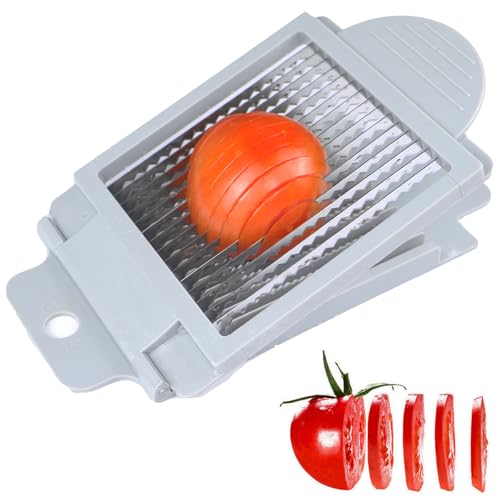


If you want one tool that handles tomato slicing from start to finish with zero fuss, this stainless steel slicer is your answer. The vertical frame design holds the tomato securely while 15 ultra-sharp stainless steel blades slice through in a single press, producing perfectly even slices at 0.28 inches (about 0.7 centimeters) thick — ideal for sandwiches, salads, and plated dishes. The blades are made from food-grade stainless steel, meaning they resist rust and corrosion and won't degrade over time even with daily use.
The ergonomic soft silicone handle gives you a confident, non-slip grip whether your hands are wet or dry. That matters more than people realize — a slipping cutter on a soft tomato is how accidents happen. The stable base keeps the slicer from rocking during the cut, and the whole unit is dishwasher safe, so cleanup is genuinely a non-issue. You press, you slice, you toss it in the dishwasher. Done. For anyone who regularly preps tomatoes for a crowd — burgers, bruschetta, caprese — this is the tool that earns its space on the counter.
The 2026 version features an improved safety lock design that keeps the blades protected when not in use, which is a smart addition if you store it in a drawer with other utensils. It won't disappoint experienced home cooks or beginners who just want consistent results without learning a complicated technique.
Pros:
Cons:
The Draduo Tomato Slicer proves you don't have to spend a lot to get reliable, clean cuts. Its ultra-sharp serrated blades handle even the softest, ripest tomatoes without squishing the flesh or dragging through the skin — a common complaint with cheaper slicers that use straight blades on soft produce. The serrated edge grips the tomato surface immediately and cuts through smoothly in one press, which means you don't need to apply extra force that could misshape the fruit.
Operation couldn't be simpler: place the tomato on the base, line it up, and press down. No technique required. That makes it a great entry-level pick for home cooks who are tired of uneven cuts from a knife but aren't ready to invest in a premium slicer. The materials are BPA-free (meaning no harmful bisphenol-A chemical leaching into your food), food-grade stainless steel and durable plastic — both meeting standard food safety requirements. For a budget-friendly kitchen upgrade, this delivers serious value.
The Draduo doesn't offer adjustable thickness, but for most everyday tomato slicing tasks, the fixed setting is exactly what you need. If you're also looking to upgrade other cutting tools in your kitchen, check out our roundup of the top serrated knives of 2026 — the right knife pairs well with a dedicated slicer for different tasks.
Pros:
Cons:
Westmark has been making quality kitchen tools in Germany for decades, and the V-Hobel (a German term for V-shaped plane, referring to the V-blade design) vegetable slicer shows exactly why their reputation holds up. This handheld slicer adjusts from paper-thin 0.04-inch slices all the way to chunky 1.2-inch cuts — giving you far more versatility than any fixed-thickness slicer on this list. That range covers everything from translucent tomato carpaccio to thick slabs for grilling or stacking on burgers.
The included finger guard (a protective plate that holds the food while keeping your fingers away from the blade) is a genuine safety feature, not an afterthought. It attaches securely and actually works, which isn't always the case with cheaper handheld slicers. The V-shaped blade orientation means both sides of the blade make contact with the tomato simultaneously, which reduces the lateral (sideways) drag that causes soft tomatoes to slip or tear. Westmark builds these to last — the construction is solid and doesn't flex under pressure.
This is the pick if you regularly slice multiple types of produce, not just tomatoes. Cucumber, zucchini, onion, beets — the adjustable blade handles them all. It's more compact than countertop slicers and stores easily in a drawer. If you love preparing fresh vegetable dishes and want one tool that does it all, this Westmark delivers.
Pros:
Cons:
This one solves a different problem entirely. You've sliced a large tomato, used half of it, and now you're wondering what to do with the rest. Wrap it in plastic? Stick it in a container that's too big? The Hutzler Pro-Line Tomato Food Saver is designed specifically to extend the shelf life of a cut tomato by keeping the exposed face protected and the tomato's natural moisture locked in. It's the smart solution for reducing food waste and keeping your tomato fresh and ready to use the next day.
The design is brilliantly simple: the saver fits snugly around the cut end of a halved tomato, creating a seal that slows oxidation (the chemical process that causes cut produce to brown and deteriorate). It's easy to spot in the refrigerator — which sounds minor until you've spent two minutes hunting through containers for that leftover tomato half. For outdoor entertaining, it keeps sliced tomatoes fresh at the table without drying out in the open air. It's also great for serving sliced tomatoes at summer barbecues where you're dealing with heat and direct sunlight.
This isn't a slicer in the traditional sense — it won't cut your tomatoes for you. Think of it as the essential companion product to any slicer on this list. Once you've made your cuts, this keeps the unused portion at peak freshness. According to FDA food safety guidelines, cut tomatoes should be refrigerated within two hours — and this saver makes storing them properly effortless.
Pros:
Cons:
Before you slice, you core. That tough, pale stem end of a tomato — called the core — is woody, flavorless, and hard to chew. The Fox Run Tomato Core-It Corer removes it in seconds with a simple grip-and-twist motion. The sharp, serrated stainless steel tip bites into the core and extracts it cleanly, leaving the rest of the tomato completely intact and ready to slice, dice, or stuff. This small tool does one specific job perfectly, and that focus is exactly why it belongs in your kitchen.
At just 4.5 inches long, it fits easily in any utensil drawer or holder. The durable polypropylene plastic handle (a tough, heat-resistant plastic commonly used in kitchen tools) gives you a secure grip, and the stainless steel tip stays sharp through years of regular use. It works equally well on Roma tomatoes, beefsteaks, heirlooms, and even soft fruits with stubborn stems. If you prep tomatoes frequently — for sauces, stuffed tomatoes, salads — this is the prep step tool that saves time and improves your final dish.
The technique is straightforward: push the tip into the stem end of the tomato at a slight angle, then rotate the handle in a circle while applying gentle downward pressure. The core comes out in one clean piece. No knife required, no wasted tomato flesh.
Pros:
Cons:
Cherry tomatoes are notoriously tricky to cut. They roll around on the cutting board, squirt juice when you apply the knife, and take forever to halve one by one. The Talisman Designs Grape Cutter solves all of that in a single squeeze. Load the tray, press the top down, and every cherry tomato (or grape, or olive) gets split precisely in half in under two seconds. The sharp stainless steel blades slice cleanly rather than crushing, which preserves the integrity of each piece for salads and presentations.
This tool is particularly valuable for families with young children. Cherry tomatoes are a documented choking hazard for kids under four years old, and cutting each one individually is tedious. The Talisman cutter eliminates that tedium entirely — and the ergonomic grip design means even kids old enough to help in the kitchen can use it safely with supervision. The cap on the bottom doubles as a stable base during cutting, which keeps the whole unit from sliding on your counter.
Cleanup is simple: the whole thing is dishwasher safe. The compact design stores easily in a drawer, and it handles grapes, cherry tomatoes, and pitted olives with equal ease. If you're making Greek salad, Nicoise salad, or any dish where small produce dominates, this becomes one of the most-used tools in your kitchen. Pair it with a quality slicer for regular tomatoes and you've covered every tomato prep scenario.
Pros:
Cons:
If you want professional-level slicing results across a full range of vegetables and fruits, the OXO Good Grips V-Blade Mandoline is the most capable tool on this list by a significant margin. A mandoline (a flat slicing platform with an adjustable blade) sounds intimidating, but OXO has designed this one to be genuinely approachable. Four thickness settings — 1.5mm, 3mm, 4.5mm, and 6mm — cover everything from translucent tomato slices for bruschetta to thick cuts for sandwiches and grilling.
The V-shaped hardened stainless steel blade is the key feature here. It contacts the food from both sides simultaneously, which distributes the cutting force evenly and prevents soft tomatoes from being pushed sideways instead of sliced cleanly. You also get a straight blade for standard slices, a wavy blade for crinkle-cut results, and julienne blades (for cutting food into thin matchstick strips) for julienned vegetables — making this a genuinely versatile kitchen tool, not just a tomato tool. The food holder has a textured grip surface that prevents slipping and keeps your fingers safely away from the blade. If you've been hesitant about mandolines after hearing about blade injuries, the OXO food holder is the reason to trust this one.
If you enjoy making dishes that require precise, restaurant-quality cuts — caprese salads, layered gratins, fancy salads — this mandoline belongs in your kitchen. It handles potatoes, cucumbers, zucchini, onions, and soft fruits with equal ease. For more versatile vegetable prep ideas, our review of the best spiral slicers of 2026 is worth reading alongside this one. And if you're building out a full kitchen toolkit, our best stovetop grill pan guide covers another essential for the summer cooking season.
Pros:
Cons:

The single most important factor in any tomato slicer is the blade. Tomatoes have a thin, slippery skin over soft, high-moisture flesh — a combination that defeats dull or straight blades instantly. You want stainless steel with either a serrated edge (for gripping and cutting through skin without slipping) or a hardened V-blade (for even pressure distribution across soft flesh). Food-grade stainless steel resists rust and corrosion, stays sharp longer, and doesn't react chemically with acidic foods like tomatoes. Avoid slicers with blades described only as "metal" without specifying stainless — those tend to corrode quickly and dull even faster.
Serrated blades are generally better for soft, ripe tomatoes. They grab the skin immediately and saw through cleanly rather than pushing down and compressing the fruit. V-shaped blades — as found on mandolines — are better when you need precise, uniform thickness across multiple produce types.
Fixed-thickness slicers are simpler, less expensive, and perfectly adequate if you always need the same cut. If you're making salads and sandwiches with standard tomato slices, a fixed-thickness press slicer at around 0.25 to 0.3 inches works great. But if your cooking varies — thin slices for bruschetta, thick slabs for burgers, translucent cuts for caprese — you need adjustability. Handheld mandolines like the Westmark and OXO give you that range. Think about how you actually cook before deciding which type fits your kitchen better.
A tomato slicer that's a pain to clean is a tomato slicer you'll stop using within a week. Look for dishwasher-safe construction — most quality slicers specify this clearly. For slicers with multiple blade components, check that all parts (not just the body) are dishwasher safe. Alternatively, slicers with minimal crevices and smooth construction clean up easily by hand under running water. Avoid slicers with lots of tight joints, exposed springs, or hollow handles — those trap tomato juice and seeds and become unsanitary over time.
Tomato slicers involve sharp blades and soft, slippery produce — a combination that requires genuine attention to safety design. Look for these specific features: a stable non-slip base that won't rock during use, a food holder or finger guard that keeps your hands away from the cutting edge, and a blade lock or safety cover for storage. The OXO mandoline's food holder and the stainless steel slicer's built-in safety lock are both examples of safety features done right. Don't assume a cheap slicer without a guard is fine because it "looks simple." Those are the tools that cause kitchen injuries.
For very ripe, soft tomatoes, a serrated blade is your best option. Straight blades tend to compress the flesh and cause the tomato to squish rather than slice cleanly. Both the Draduo Tomato Slicer and the Fox Run Corer use serrated edges that grip the skin immediately and cut through without crushing. If you frequently buy ripe summer tomatoes from a farmers market, prioritize serrated blades in any slicer you choose.
Yes — most tomato slicers handle other soft produce well. Cucumbers, soft cheese, mushrooms, and zucchini all work with press-style and handheld slicers. The Westmark handheld slicer and OXO mandoline are specifically designed as multi-vegetable tools and handle firm produce like potatoes and beets in addition to soft fruits. The dedicated press slicers (Stainless Steel and Draduo) are optimized for tomatoes but work reasonably well on similarly sized soft produce.
Most modern tomato slicers are dishwasher safe, but always verify before purchase. The Stainless Steel Tomato Slicer and Talisman Designs Grape Cutter are explicitly dishwasher safe. For mandolines like the OXO, the blade assembly and food holder are typically top-rack dishwasher safe. Handwashing is always gentler on any sharp blade and extends the sharpness over time, even when dishwasher safe is specified.
Two factors affect this most: blade sharpness and technique. A sharp blade requires minimal downward pressure, which means the tomato holds its shape during the cut. A dull blade forces you to press harder, compressing and deforming the flesh. Make sure your slicer's blades are clean and undamaged. For press-style slicers, place the tomato firmly against the base before pressing — any lateral movement during the cut will cause uneven slices. Chill your tomatoes for 15 to 20 minutes before slicing; slightly firmer flesh holds up better under the blade.
For sandwiches and burgers, slices between 0.25 and 0.35 inches thick give you enough substance to taste the tomato without making the sandwich soggy. For salads and plates, thinner slices around 0.15 to 0.2 inches look more elegant and dress more easily. For caprese or bruschetta, aim for the thinner end. The fixed-thickness press slicers (around 0.28 inches) hit the sandwich sweet spot perfectly. For thinner or thicker cuts, you need an adjustable slicer like the Westmark or OXO.
A tomato slicer is a dedicated tool optimized specifically for slicing round, soft produce in a single pressing motion. It's simpler, faster for that specific task, and easier to use for beginners. A mandoline (a flat slicing platform with an adjustable blade) is a more versatile kitchen tool that slices a wide range of produce at multiple thicknesses — but requires more setup, practice, and careful safety technique. If you only slice tomatoes a few times a week, a dedicated slicer is more practical. If you prep vegetables frequently for a range of dishes, the mandoline's versatility justifies the additional investment.
 |
 |
 |
 |

About Rick Goldman
Rick Goldman grew up traveling the Pacific Coast and developed an early appreciation for regional and international cuisines through exposure to diverse food cultures from a young age. That culinary curiosity shaped his approach to kitchen gear — he evaluates tools based on how well they perform across different cooking styles, ingredient types, and meal occasions. At BuyKitchenStuff, he covers kitchen equipment reviews, recipe guides, and food-focused buying advice.
