Kitchen Gadgets & Equipment Reviews ›
by Daisy Dao
What's the best portable food warmer you can buy in 2026 — and is it even worth the upgrade from a plain old thermos? If you've ever opened your lunch bag to find cold leftovers or lukewarm soup, you already know the answer. Spoiler: the Crock-Pot Electric Lunch Box tops our list for most people, but the right pick really depends on how and where you eat. Let's break it all down.
Portable food warmers have come a long way. Today you can find sleek electric lunch boxes that heat your food in under 30 minutes, 12-volt plug-in units made for truck drivers and road warriors, and vacuum-insulated food jars that keep soup steaming hot for 14 hours without a single watt of power. Whether you're commuting to an office, hauling freight across the country, or just tired of nuking leftovers in a break-room microwave, there's a warmer built for your situation. If you're also shopping for ways to carry your meals in style, check out our guide to the 8 Best Japanese Lunch Boxes — some pair beautifully with the thermal jars reviewed here.
In this guide we've tested and researched seven of the top-rated portable food warmers on the market. We cover plug-in electric models, 12-volt car warmers, and non-electric vacuum jars so you can find the exact match for your lifestyle. You'll also find a buying guide, a side-by-side comparison table, and answers to the most common questions buyers ask. Browse all our kitchen picks at our full reviews hub when you're done.

Contents




We looked at real-world performance, build quality, portability, and value. Here's what you need to know about each model before you buy.
The Crock-Pot name carries serious kitchen credibility, and the 20-ounce Electric Lunch Box lives up to it. The concept is simple: fill the container with your leftover pasta, stew, or rice, plug it in at your desk or in your car, and come back to a genuinely hot meal. The 20-ounce capacity is right in the sweet spot — big enough for a real lunch, compact enough to slip into a bag without hogging space. The inner pot is dishwasher safe, which is a bigger deal than it sounds after you've hand-scrubbed a food warmer one too many times.
What sets this one apart from cheaper electric lunch boxes is the detachable cord. It doesn't dangle awkwardly while you're eating or carrying the container around. The seal-and-store lid does a solid job of preventing spills in transit — not airtight, but reliable enough for soups if you don't flip the bag upside down. Heat-up time runs about 30 to 45 minutes depending on food density, so plug it in when you sit down at your desk and it's ready by mid-morning or lunchtime. It works on standard 120V outlets only, so this isn't a car plug-in model — keep that in mind.
Build quality is good for the price range. The exterior stays cool to the touch while heating, which means you won't burn yourself reaching for it. The all-black finish looks professional enough to use in an office environment without standing out. If you're mainly working from an office or home and want the most convenient plug-and-eat experience, this is the one to beat in 2026.
Pros:
Cons:
If you spend your days behind the wheel — as a truck driver, sales rep, or weekend road-tripper — the Gideon 12-volt lunch box is worth a serious look. It plugs directly into your vehicle's cigarette lighter (also called a 12V outlet, for those unfamiliar with the older term), so you don't need a wall outlet at all. Just set it on the passenger seat or floor mat, plug in before you leave, and your meal is warm by the time you hit your first rest stop.
The heating is even and consistent. Gideon claims it warms food without drying it out or overcooking the edges — and that's largely true, especially for dense foods like rice or casseroles. It handles canned foods and leftovers particularly well. The lightweight, compact body makes it easy to tuck into a truck cab or back seat. It's not going to win awards for capacity — you're looking at a single-compartment design — but for a solo driver eating on the road, it's plenty.
Even heating through a 12V system is genuinely impressive, and it's one of the reasons this model has stayed popular for years. The main tradeoff is heat time, which can stretch to 45–60 minutes depending on outside temperature and your vehicle's electrical output. If your truck idles cold in winter, budget extra time. Overall, though, this is one of the most dependable car-use warmers you can buy.
Pros:
Cons:

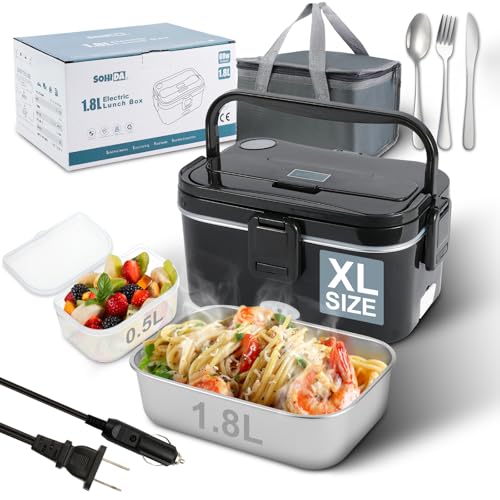
If you have a big appetite or you're packing a full home-cooked meal — think rice plus a side dish plus maybe some soup — the SOHIDA is the food warmer that can actually handle it. The total capacity of 2.3 liters (a 1.8L main compartment plus a 0.5L side container) is noticeably larger than most competitors in this price range. One important note: the 0.5L side compartment is for cold foods only. SOHIDA is upfront about this — don't put that section on the heating element or it will melt. Use it for salads, fruit, or anything you want kept cool.
The 80-watt heating system is this unit's headline feature, and it delivers. Most foods heat through in 25 to 40 minutes, which is faster than many 12V and lower-wattage alternatives. The triple-voltage compatibility (12V/24V/110V) means you can use it in a car, a semi-truck, or plugged into a wall outlet — genuinely versatile. The included utensils are longer than standard (6.69 inches), which sounds like a small detail but matters when you're digging into a deep container.
The built-in phone stand is a clever touch if you eat alone and want to watch something during lunch. It's not a game-changing feature, but it shows SOHIDA thought about the actual user experience. The overall build feels solid and the exterior wipes down easily. If capacity and heating speed matter most to you, this is one of the strongest options available in 2026. Pair it with a good microwave rice cooker at home and you've got a complete meal-prep workflow.
Pros:
Cons:
There's something almost nostalgic about the Koolatron. It looks like the classic metal lunch box a construction worker would carry, but it has a 12V electric heater built right in. The design is part of the appeal — it's rugged, chunky, and doesn't look like a gadget. If you work a job site and want something that fits the aesthetic without looking out of place, this one delivers.
The real headline is the heat output. The Koolatron reaches up to 300°F (149°C), which is hot enough to cook raw food, not just reheat it. Most portable food warmers are designed for reheating only — reaching 165°F or so. The Koolatron's higher ceiling gives you more flexibility if you want to do simple cooking like heating canned soup from cold or even warming up a hot dog. The 1.6-quart (1.5L) interior is a reasonable size for a lunch, though not as large as the SOHIDA above.
The 6-foot power cord wraps neatly around built-in hooks on the back of the unit, which is a practical detail you appreciate when you're not in the mood to untangle a cord. The Koolatron is a 12V car unit, so you'll need your vehicle or a 12V power source. For construction workers, truckers, or anyone who regularly eats in or near their vehicle, this is a durable, no-nonsense option that's been proven over many years.
Pros:
Cons:
Not everyone wants to deal with cords, outlets, or heating times. If you want your food hot when you open the lid — right now, no waiting — the Thermos Stainless King is for you. Vacuum insulation (a sealed space between two walls with the air removed) is one of the most effective ways to retain temperature, and Thermos has been perfecting it for over a century. This 24-ounce jar keeps soups hot for up to 14 hours and cold foods cold for up to 24 hours — numbers that hold up in real-world testing.
The construction is 18/8 stainless steel (that's food-grade, rust-resistant steel used in high-quality kitchenware). The exterior stays cool when filled with hot food, so you're not burning your hands when you grab it from your bag. It's dishwasher safe — top rack recommended. The wide mouth makes it easy to fill and easy to eat from directly, even with a spoon.
The Stainless King is the most reliable option if you work in an environment with no outlet access — outdoors, on a construction site, in a school without break room access, or anywhere else power is scarce. It won't heat cold food, so you need to start with hot food and keep it hot. But if your morning routine includes heating up soup before you leave the house, this jar will keep it perfectly hot until you're ready to eat. It's a simple, proven tool with no moving parts and nothing to break.
Pros:
Cons:

Zojirushi is a Japanese brand with a reputation for building kitchen products that outlast the competition, and this 25-ounce food jar is no exception. If you've spent time with Japanese lunch containers before — see our roundup of the best Japanese lunch boxes — you'll recognize the same philosophy here: simple, functional, built to last. The clear-coated finish on the exterior reduces fingerprints and makes wipe-downs a breeze. The dimpled lid might sound like a minor detail, but when your hands are cold or greasy, having a better grip point is genuinely useful.
Temperature retention is excellent. The stainless steel vacuum insulation keeps hot food at a safe serving temperature for hours, comparable to the Thermos above. At 25 ounces, it's slightly larger than the Thermos Stainless King and works well for fuller servings of soup, curry, chili, or stewed dishes. The wide mouth accommodates a standard soup spoon without awkward angles.
The main upside of this jar over the Thermos is the premium fit and finish. The lid seals more smoothly, the exterior coating is noticeably higher quality, and the overall impression is of something that will still be in your bag in five or ten years. It costs a bit more, but if you're the type to spend on quality once rather than replace cheaper products every year, the Zojirushi earns its price. No electricity, no fuss — just excellent engineering.
Pros:
Cons:
The Tiger LWR-A092 takes a different approach from everything else on this list. Instead of a single container, you get a full thermal lunch box system: a vacuum-insulated outer case plus three separate microwavable containers inside — one for a main dish, one for a side dish, and one for soup. It even includes chopsticks. The outer case keeps everything warm while the individual containers let you mix and match your meal components without flavors bleeding together.
The vacuum-insulated case is the star of the show. Tiger has built a reputation for thermal performance that rivals Thermos and Zojirushi, and the LWR-A092 holds up. You pack hot food in the morning and it's still at a proper eating temperature at lunchtime. The three-container system is ideal if you eat structured meals — rice, a protein, and a soup, for example. If your typical lunch is a single-dish stew or chili, the setup may feel like more containers than you need to wash.
The microwavable containers are a standout feature — most competing thermal lunch boxes use containers that can't go in the microwave at all. If you end up with lukewarm food and there's a microwave nearby, you can pop the containers in without swapping vessels. The champagne gold finish is attractive and professional-looking. Tiger has long been known for quality thermal products, and this one is a mature, well-designed system for someone who wants a complete lunch solution rather than just a jar or a heating box.
Pros:
Cons:
With so many options ranging from simple vacuum jars to powered electric boxes, it helps to know what actually matters for your situation. Here are the four key things to think through before you buy.
This is the most important decision you'll make. Electric food warmers (like the Crock-Pot, Gideon, SOHIDA, and Koolatron) can heat cold food from scratch — so you can pack your leftovers straight from the fridge. The tradeoff is that you need a power source: a wall outlet for 110V models or a 12V car outlet for vehicle-based ones. Non-electric vacuum jars (Thermos, Zojirushi, Tiger) require no power at all, but you must start with hot food — they preserve temperature, they don't generate heat.
If you work in an office with easy outlet access, an electric plug-in model gives you maximum flexibility. If you're outdoors, on a job site, or somewhere with no reliable power, a high-quality vacuum jar is the smarter and simpler choice. If you're on the road all day, a 12V car model threads the needle nicely.
Most portable food warmers in this guide fall between 20 and 25 ounces for single-container models, and up to 2.3 liters (roughly 78 oz) for the largest multi-compartment electric options. For a light lunch — soup plus a small side — 20 to 24 ounces is plenty. For a full home-cooked meal with multiple components, look at the SOHIDA or Tiger systems that offer separate compartments.
Also think about shape. A tall, narrow food jar stores upright in a bag easily. A wide electric lunch box may not fit neatly in all bags or desk drawers. Measure your bag before you buy if size is a concern. If you often cook big batch meals — say, a large pot of oatmeal or a pasta dish — pairing a larger warmer with the right cookware (check out our best pasta pot reviews for size guidance) can help you plan portions more efficiently.
Electric models vary widely in how fast and how hot they heat. The SOHIDA's 80W element heats food in 25–40 minutes. The Gideon's 12V system may take closer to 45–60 minutes, especially in cold weather. The Koolatron can reach 300°F, making it capable of actual cooking — not just reheating — which is rare at this price point.
For food safety, the FDA recommends reheating leftovers to 165°F internally. Most electric food warmers exceed that easily. If you're using a vacuum jar, make sure your food is already hot (above 165°F) before sealing it in, and consume within 4–5 hours for best safety and quality.
Cleanup matters more than most buyers think — especially after a workday when you just want to rinse and go. Dishwasher-safe inner containers (like the Crock-Pot's) save daily effort. The Thermos and Zojirushi jars are also dishwasher-safe, but top-rack only. The Koolatron's non-removable interior can be harder to scrub fully. If you pack oily or heavily-seasoned foods, look for smooth interiors with no tight corners where residue can hide.
For durability, stainless steel beats plastic every time for the outer shell. All seven models on this list use stainless steel in at least their insulated sections. Electric lunch boxes tend to use more plastic in the exterior housing — inspect seam quality and cord attachment points if durability is a priority for you.
Most portable food warmers are designed to reheat food, not cook raw ingredients from scratch. The exception on this list is the Koolatron 12V, which reaches up to 300°F and can handle basic cooking tasks. For the electric plug-in models like the Crock-Pot and SOHIDA, think of them as slow, gentle reheaters — great for leftovers, but not a replacement for a stove or oven. Vacuum jars don't generate any heat on their own; they only preserve the temperature of food that's already hot.
Heat-up time depends on the wattage of the unit, the starting temperature of the food, the density of the food, and ambient conditions like room temperature. As a general rule, expect 25–40 minutes for an 80W unit like the SOHIDA, and 35–50 minutes for lower-wattage or 12V models. Cold food straight from the refrigerator will take longer than room-temperature food. Plugging in your lunch box as soon as you arrive at work or get in your car gives it plenty of time to heat by lunch.
Yes, as long as you use a model rated for standard 110–120V outlets. All the plug-in models reviewed here draw relatively modest power (typically under 100W), much less than a microwave or electric kettle. They don't pose any unusual electrical risk. The exterior of well-designed units stays cool during heating, reducing burn risk. Always place them on a flat, stable surface while in use and don't cover the ventilation areas.
A food warmer (electric type) actively generates heat using electricity to warm food that may have cooled down. A vacuum-insulated food jar uses an airless chamber between two walls of stainless steel to slow the transfer of temperature — keeping hot food hot and cold food cold for many hours. The jar can't recover food that has already cooled to room temperature. If you want to pack cold leftovers and have them heated by lunchtime, you need an electric warmer. If you want to pack hot food in the morning and eat it hot at noon, a vacuum jar works perfectly and needs no power at all.
Not directly. A 12V car adapter is designed for vehicle cigarette lighter sockets (which output 12 volts DC), while standard wall outlets provide 110–120V AC. Plugging a 12V device directly into a wall outlet would instantly damage or destroy it. However, you can use a power inverter — a device that converts household AC power to 12V DC — to run a 12V food warmer from a wall outlet. Alternatively, look for a multi-voltage model like the SOHIDA, which accepts 12V, 24V, and 110V and includes the appropriate cords for each situation.
Rinse the inner container as soon as possible after eating — don't let food sit and dry inside. For dishwasher-safe models (Crock-Pot, Thermos, Zojirushi), the dishwasher does the heavy lifting. For hand-washing, warm soapy water and a soft sponge handle most residue. For stubborn odors — especially after garlic-heavy or fish dishes — fill the container with a mix of baking soda and warm water, let it sit for 20–30 minutes, then rinse thoroughly. Avoid abrasive scrubbers on stainless steel interiors as they can scratch the surface and make it harder to clean over time.
 |
 |
 |
 |

About Daisy Dao
Daisy Dao grew up in Honolulu, Hawaii, where coastal living and access to fresh local ingredients shaped her approach to home cooking from an early age. She has spent years experimenting with seafood preparation, healthy cooking methods, and ingredient substitutions — developing hands-on familiarity with a wide range of kitchen tools, techniques, and produce. At BuyKitchenStuff, she covers healthy recipes, cooking techniques, and ingredient substitution guides.
