Kitchen Gadgets & Equipment Reviews ›
by Rick Goldman
The Spyderco Para Military 2 is our top pick for 2026 because it delivers premium CPM S45VN steel performance at a price most serious EDC enthusiasts can actually justify. American-made pocket knives represent a particular standard in the cutlery world — one grounded in decades of craftsmanship, rigorous material science, and engineering accountability that import blades rarely match. Our team spent considerable time evaluating the current market across price brackets, from classic heritage designs to contemporary titanium-framed folders, and assembled this guide to help anyone shopping for the best USA made pocket knife make a genuinely informed decision.

American-manufactured knives carry a certain provenance that matters beyond patriotism. Domestic production means stricter quality control at every stage — from raw steel sourcing to final fit and finish — and brands like Benchmade, Spyderco, Chris Reeve Knives, and Zero Tolerance have built reputations on exactly that consistency. According to Wikipedia's overview of pocketknife history, folding knives have been essential everyday carry tools for centuries, and the modern American craft tradition traces directly to that lineage. Whether the priority is ultra-lightweight trail carry, heavy-duty hunting utility, or a heirloom-grade blade worth passing down, the domestic market in 2026 has something genuinely exceptional at every tier. Browse our full knife and kitchen tool reviews for additional buying guides alongside this one.
We evaluated each knife on blade steel composition, edge geometry, handle ergonomics, locking mechanism reliability, deployment smoothness, and overall value relative to its price point. We also considered real-world EDC practicality — clip depth, carry weight, one-handed operation, and how each knife holds up after extended use without maintenance. The seven knives in this roundup represent the strongest performers across those dimensions, ranging from the workaday Case Sod Buster to the surgical-grade Chris Reeve Small Sebenza 31.
Contents



The Spyderco Para Military 2 has held the title of best overall American-made folder for years, and the 2026 production run with CPM S45VN steel confirms that reputation is entirely deserved. S45VN is a meaningful upgrade over the S30V steel that defined earlier generations — it incorporates niobium carbides alongside vanadium carbides, producing a finer grain structure that makes the edge both more wear-resistant and notably tougher against lateral stress. Our team found the blade's full-flat grind to be exceptionally thin behind the edge, which translates to a slicer's geometry that dramatically outperforms knives with thicker convex grinds in everyday cutting tasks.
Spyderco manufactures the Para Military 2 at its Golden, Colorado facility, and the machining tolerances visible in the nested skeletonized liners and the G-10 handle scales reflect genuine precision manufacturing. The Compression Lock mechanism sits on the spine rather than the spine's liner, which means the mechanism actually gets stronger under load — a genuinely clever engineering solution that most competing lockback and liner-lock designs cannot match. One-handed opening via the signature round hole feels instinctive after a day of carry, and the forward finger choil gives control during detailed work without requiring a dedicated tool-length blade. For any serious knife user seeking a domestic EDC under $200, this remains our definitive recommendation in 2026.
The open-backed construction keeps weight minimal — the Para Military 2 carries light enough that most buyers forget it's clipped to a pocket — while maintaining structural rigidity that heavier solid-construction handles sacrifice ergonomics to achieve. The four-position clip accommodates tip-up or tip-down carry on either side, making this genuinely ambidextrous in daily use. Build quality on every unit we inspected was consistently excellent, with blade centering and lock engagement arriving from the factory at a standard that competing brands charge significantly more to deliver.
Pros:
Cons:
Chris Reeve Knives operates out of Boise, Idaho, and the Small Sebenza 31 represents the pinnacle of what American folding knife manufacturing achieves when cost is a secondary concern to perfection. The blade steel is Magnacut, a third-generation stainless steel formulated specifically to outperform both S45VN and M390 across the full spectrum of edge retention, toughness, and corrosion resistance — and hardened here to 63-64 RC, which is exceptionally hard for a folding knife blade without sacrificing meaningful toughness. Our team was impressed by how refined the action feels: the pivoting system is so precisely machined and lubricated that the blade drops shut under gravity with a smooth, controlled arc that feels mechanical rather than floppy.
The handle is solid Grade 5 titanium, machined from a single billet rather than assembled from separate scales and liners, which gives the Sebenza 31 a monolithic rigidity that composite-handled knives cannot replicate. This construction adds weight but eliminates the micro-flex and rattle that eventually develops in most multi-piece handle assemblies over years of carry. The integral lock bar is cut directly from the titanium frame, making this a true integral framelock rather than a liner lock with titanium scales — a distinction that matters significantly for long-term reliability. For anyone serious about owning a domestic folding knife that genuinely qualifies as a lifetime tool, the Small Sebenza 31 is the standard against which everything else is measured.
The Sebenza's ergonomics are deliberately conservative — Chris Reeve Knives prioritizes neutral, fatigue-free grip geometry over aggressive contouring — which makes the knife more comfortable across multi-hour use than most aggressively sculpted competitors. The thumb stud opens smoothly from either hand with practice, and the overall dimensions of the small variant sit appropriately between a dedicated EDC folder and a field blade, covering both roles with composure. Maintaining this knife is straightforward; keeping the action smooth requires only occasional pivot cleaning and a single drop of high-quality lubricant, consistent with what our guide to the best leather strops recommends for maintaining premium blade edges between sharpenings.
Pros:
Cons:
The Buck 110 Folding Hunter is arguably the most recognizable American folding knife ever produced, and its continued production in Post Falls, Idaho remains a testament to an enduring design that simply works. The 3-3/4" 420HC clip-point blade is heat-treated through Buck's proprietary process to achieve hardness well beyond what standard 420HC typically delivers — Buck's process consistently produces blades that outperform budget 420HC knives from import manufacturers while maintaining the corrosion resistance the steel is known for. For hunting applications specifically, the clip-point geometry provides the piercing tip geometry needed for field dressing while the belly gives ample slicing surface for skinning.
The lockback mechanism is the design that revolutionized the folding knife industry when Buck introduced the 110 in 1964, and the current production version remains as solid and reliable as any lockback manufactured anywhere in the world. Opening requires two hands via the nail notch, which we consider appropriate for a hunting knife — this is not an EDC speed-deployment tool but a deliberate working blade that rewards intentional use. The ebony handle with brass bolsters adds weight at 7.2 ounces, making this among the heavier knives in this review, but that heft contributes to the knife's planted, confident feel during sustained field work.
The included leather sheath is a genuine value addition — it's made to a quality standard that most manufacturers have abandoned in favor of nylon alternatives — and the overall package feels complete out of the box. Our team found the 110's cutting performance on field tasks to be excellent; the convex grind geometry pushes material away from the edge efficiently, and the blade geometry handles everything from cutting cordage to food prep in camp with equal competence. Buyers who value heritage, reliability, and American manufacturing integrity over modernity and lightweight carry will find the Buck 110 to be one of the most satisfying purchases in the domestic knife market in 2026.
Pros:
Cons:

Benchmade builds the Bugout at its Oregon City, Oregon facility, and the knife's defining characteristic is an almost aggressive commitment to minimizing carry weight without compromising the structural integrity of the blade or lock. At well under two ounces, the Bugout achieves a carry presence so low that most users report forgetting it's in their pocket during full days of wear — an experience that heavier knives in this roundup simply cannot replicate. The CPM-S30V drop-point blade is skeletonized through the spine, the Grivory handle is molded glass-filled nylon rather than metal, and the overall design eliminates every gram that doesn't contribute directly to cutting performance or safe deployment.
CPM-S30V steel at 58-60 HRC provides a well-balanced performance profile for everyday cutting tasks — it sharpens more easily than harder steels like S45VN or Magnacut while still providing excellent corrosion resistance and respectable edge retention under normal use conditions. The AXIS lock mechanism, Benchmade's proprietary ambidextrous locking system, remains one of the most mechanically elegant folding knife locks in production anywhere in the world, engaging and releasing with a smooth, positive action that improves rather than degrades with use. Our team considers the AXIS lock's ambidextrous one-handed closing capability to be a meaningful safety advantage over liner locks and compression locks for users who frequently close their knife while hands are occupied.
The Grivory handle's texture provides a surprisingly confident grip for a material that reads as utilitarian on paper — it doesn't feel as premium as G-10 or titanium but performs equally well in wet conditions, and its glass-fiber reinforcement resists impact damage that would crack or chip heavier materials. Benchmade's LifeSharp service program backs the Bugout with free lifetime sharpening and adjustments, which meaningfully extends the value calculation. For backpackers, trail runners, and travelers who carry strict weight budgets for their gear, the Bugout represents the clearest domestic answer to ultralight carry needs, and it pairs well with a quality sharpening setup — our team recommends pairing it with options from our best knife grinder guide for maintaining S30V at home.
Pros:
Cons:
The Benchmade 940 Osborne is the knife our team reaches for when asked to recommend a single American-made folder that handles every realistic EDC task with distinction and looks refined doing it. Designed by Warren Osborne and manufactured in Oregon City, Oregon, the 940-2 features a reverse tanto blade geometry in CPM-S30V steel — an unusual profile that creates two distinct working sections on a single blade: a thin, acute primary tip for piercing and detail work, and a broader belly section for slicing that the reversed edge geometry keeps remarkably sharp through sustained use because most cutting loads never contact the tip.
The G-10 handle on the 940-2 is resin-impregnated fiberglass — a material specification that produces dimensional stability across extreme temperature ranges and complete imperviousness to moisture — making this knife equally reliable in a mountain camp at freezing temperatures and a coastal kitchen during humid summers. The handle geometry is flat and thin, designed for deep-pocket carry that presents a minimal printing profile, which most professional and office-environment users find significant. The AXIS lock provides the same ambidextrous deployment and closing capability found on the Bugout, and the overall package feels more dressed than tactical without sacrificing any functional capability.
The 940-2 occupies a price tier between the Bugout and the higher-premium Spyderco and Chris Reeve options, and our team considers it to be exceptional value at that position — the fit and finish quality, the handle material specification, and the blade geometry sophistication collectively represent a level of design investment that most knives at this price point don't approach. The knife deploys reliably, carries comfortably, cuts efficiently across diverse tasks, and presents professionally in any context. For anyone investing in a single American-made folder that serves as both a daily workhorse and a refined carry piece, the Osborne 940-2 is the choice our team makes without hesitation.
Pros:
Cons:

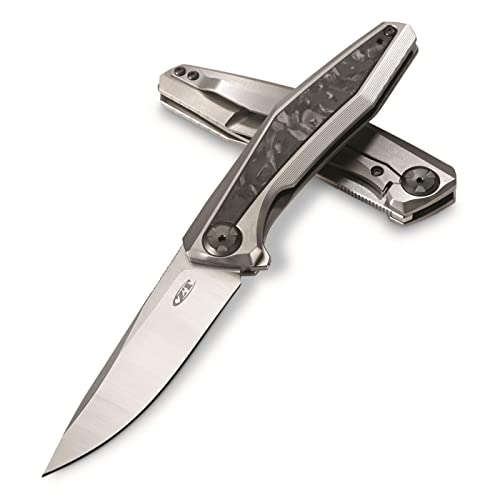
Zero Tolerance designs its knives to a specification level typically reserved for custom work, and the 0470 Sinkevich demonstrates exactly what that commitment produces when applied to a production folder. Designed in collaboration with Russian maker Dmitry Sinkevich and manufactured in Tualatin, Oregon, the 0470 features a 3.4-inch CPM 20CV blade — a high-vanadium stainless steel that delivers edge retention competitive with M390 while maintaining the corrosion resistance characteristics critical for carry use — finished in a combination of bead blast and machine satin that creates visual depth unusual for production knives.
The bead-blasted titanium handle is the knife's most distinctive physical feature, providing a carry weight substantially lower than steel-framed alternatives while delivering a grip texture that inspires confidence during use without aggressively abrading pocket material over time. The KVT ball-bearing opening system — Zero Tolerance's proprietary pivot design incorporating caged ball bearings rather than phosphor bronze washers — produces a deployment action so smooth and effortless that it redefines expectations for what production knife opening should feel like. The integrated flipper tab adds an additional tactile opening point, making the 0470 genuinely fast from a pocket draw.
The overall build quality on the 0470 reflects ZT's positioning at the top of the production knife market — blade centering, lock engagement, and handle fit arrive from the factory at tolerances that competing brands charge significantly more to achieve. The marbled carbon fiber front insert adds visual distinction without the weight penalty of a full carbon fiber handle, and the overall color palette of the knife reads sophisticated rather than tactical. For the serious EDC collector or user who wants the finest American-produced titanium folder available in 2026 without commissioning a custom piece, the 0470 Sinkevich represents the strongest single answer on the market. Buyers who want to maintain the 20CV blade at peak sharpness will find our guide to precision kitchen knives useful for understanding edge geometry principles that apply equally here.
Pros:
Cons:
W.R. Case and Sons has manufactured knives in Bradford, Pennsylvania since 1889, and the Sod Buster represents the simplest, purest expression of that heritage — a single-blade slip-joint folder with chrome vanadium steel in a smooth yellow synthetic handle that carries lighter than almost anything else in a pocket and costs less than a tank of gas. Chrome vanadium (CV) steel is a carbon steel alloy that Case has heat-treated to their own specification for generations, and it produces blades that take a sharper edge than most stainless steels, hold that edge longer under sustained use, and respond beautifully to a leather strop — the tradeoff being that CV requires more diligent drying and occasional light oiling to prevent surface patina.
The skinner blade profile — broad at the belly, tapering to a controlled rounded tip — makes the Sod Buster genuinely versatile for the farm, garden, and camp applications its name implies, handling produce prep, cordage cutting, and light wood work with equal ease. There is no locking mechanism; this is a traditional slip-joint design where blade tension holds the blade open during use, which means the knife is not appropriate for hard-use scenarios where lateral force might close the blade unexpectedly, but is entirely adequate for the light-to-moderate cutting tasks that define most everyday use for most people. The smooth synthetic handle is lightweight, easy to clean, and impervious to the cracking that affects natural handle materials in variable humidity.
For anyone who wants an authentic American-made pocket knife at an accessible price — as a first knife for a young person, a working tool for daily farm or garden tasks, or a nostalgic carry for someone who grew up with Case knives — the Sod Buster delivers genuine quality and real heritage at a price that makes it essentially risk-free to try. Our team considers it the most honest value proposition in the domestic knife market in 2026, and the consistency of Case's manufacturing over 130 years of production gives buyers confidence that the knife they receive matches the specification they expect.
Pros:
Cons:
Blade steel is the single most consequential spec in any knife purchase, and the gap between entry-level and premium steel is wide enough to affect daily use in measurable ways. The key performance dimensions are edge retention (how long the blade stays sharp under use), toughness (resistance to chipping under lateral stress or impact), and corrosion resistance (how much the steel resists rust and oxidation). Modern powder metallurgy steels like CPM S45VN, CPM 20CV, and Magnacut achieve all three properties simultaneously at a level that older generation stainless steels like 420HC and AUS-8 cannot approach, but they also require more sophisticated sharpening equipment to maintain. Our team recommends matching steel selection to maintenance capability — there is no benefit to Magnacut's edge retention if the owner sharpens on a gas station rod that can't achieve the geometry the steel requires. Chrome vanadium and 420HC respond beautifully to basic sharpening setups and remain entirely valid choices for buyers who want a low-maintenance relationship with their knife.
The locking mechanism determines whether a folder is appropriate for hard use, and each design type has meaningful trade-offs that affect daily carry. Liner locks and frame locks are the most common modern designs — the blade is held open by a sprung bar of metal inside the handle, and they work reliably but can be defeated by certain lateral force directions. Benchmade's AXIS lock uses a spring-loaded bar that crosses the full width of the handle, engaging both sides of the blade tang simultaneously, making it substantially more resistant to unintended closure under load than conventional liner locks. Spyderco's Compression Lock engages from the spine rather than the liner, and the mechanism strengthens under load — pushing on the blade actually presses the lock bar harder into engagement. Slip-joints like the Case Sod Buster have no lock at all — the blade is held open by tension only — and are appropriate for light tasks where lateral force is not a concern. For any application involving sustained hard cutting, a dedicated locking mechanism is essential.
Handle material affects grip security, carry weight, aesthetic, and long-term durability in ways that spec sheets don't fully capture. G-10 — the compressed fiberglass weave used on the Para Military 2 and Osborne — is our team's preference for most EDC and field applications because it is dimensionally stable across temperature ranges, completely waterproof, abrasion-resistant, and available in a range of surface textures from aggressive to refined. Titanium, as used on the Sebenza 31 and ZT 0470, is lighter than steel, extremely durable, and develops a wear patina that most users find attractive over time, but it costs more to machine precisely and adds expense proportional to quality. Grivory (glass-filled nylon) is the most practical ultralight option — not as premium-feeling as G-10 but equally moisture-resistant and significantly lighter per unit area. Natural materials like bone and wood are traditional and beautiful but require maintenance to prevent moisture damage. The brass bolsters and ebony handle on the Buck 110 are exceptional for a heritage knife but add weight that modern synthetic alternatives don't carry.
Blade length, grind type, and tip geometry collectively determine what a knife does well and what it struggles with, and matching these specifications to actual intended use avoids the common mistake of purchasing a tactically aesthetic knife that performs poorly for realistic daily tasks. Drop-point blades — like the Benchmade Bugout — offer a controlled, strong tip and broad belly that handles most general-purpose cutting tasks with competence. Clip-point blades — like the Buck 110 — provide a sharper, more acute tip geometry suited for piercing and field dressing while retaining functional belly for skinning. The reverse tanto on the Osborne 940-2 creates two distinct working geometries on one blade, which is functionally advantageous but requires some adaptation from users expecting conventional blade behavior. Full-flat grinds like the Para Military 2's produce exceptional slicing geometry but have less material behind the edge than hollow grinds, which affects durability in batoning or prying applications — neither of which a folding knife should be subjected to regardless of grind type.
A knife marketed as Made in USA must have all significant manufacturing processes — including blade forging or stamping, grinding, heat treatment, handle assembly, and quality control — performed within the United States. Brands like Benchmade, Spyderco, Buck, Chris Reeve Knives, Zero Tolerance, and Case all meet this standard with domestic production facilities in Oregon, Colorado, Idaho, and Pennsylvania. Some brands produce both domestic and imported lines, so verifying the specific model's production origin rather than the brand's general reputation is important for buyers who prioritize American manufacturing.
For most everyday carry use in 2026, CPM S45VN and Magnacut represent the strongest all-around steel choices because they balance edge retention, toughness, and corrosion resistance at a level that previous-generation steels like S30V cannot match. S45VN is our team's practical recommendation for most buyers — it is available in knives at more accessible price points than Magnacut, sharpens on quality diamond stones without difficulty, and provides edge retention that substantially outlasts 420HC and AUS-8 under real use conditions. Magnacut is the technically superior steel but is currently found primarily in high-end production and custom knives that price it beyond most buyers' budgets.
Our team's assessment is that the Para Military 2 is one of the strongest value propositions in the American-made knife market, particularly in its current S45VN configuration. The combination of premium steel, a Compression Lock that outperforms liner locks on reliability, precision G-10 handle construction, and a full-flat grind that produces exceptional cutting geometry would individually justify portions of the price — collectively they produce a knife that outperforms most alternatives costing considerably more. For serious EDC users who will carry and use the knife daily rather than collect it, the Para Military 2 consistently demonstrates that value over years of service.
The Bugout is the strongest domestic production folder for backpacking and trail use specifically because its weight is low enough that it adds negligible burden to a gram-counted pack, while its AXIS lock and S30V blade provide genuine functional capability for trail tasks. Our team has tested it on multi-day trips where the knife handled food prep, cordage cutting, fire-related tasks, and first-aid kit cutting without difficulty. The Grivory handle resists wet grip degradation better than natural materials and most synthetics, and the AXIS lock's ambidextrous one-handed closing is a meaningful safety advantage when hands are cold or occupied with other tasks simultaneously.
The Buck Knives 110 Folding Hunter remains our strongest recommendation for dedicated hunting use in 2026. The clip-point geometry is specifically optimized for field dressing — the acute tip handles initial incisions cleanly while the belly provides ample skinning surface — and the lockback mechanism provides the secure, rattle-free blade engagement that hunters working in cold, wet conditions with gloved hands require. The included leather sheath adds practical value in the field, and Buck's heat treatment produces 420HC performance that handles sustained skinning work without requiring sharpening mid-task under normal hunting conditions.
Maintenance for American-made folders involves three consistent practices: periodic cleaning of the pivot and lock mechanism to remove debris and old lubricant, fresh lubrication of the pivot with a quality knife oil or PTFE-based product, and regular edge maintenance appropriate to the blade steel. Stainless steels like S30V, S45VN, and 20CV benefit from regular stropping between sharpenings to realign the edge wire before a full sharpening becomes necessary — our team's guide to the best leather strops covers this in detail. Carbon steels like Case's chrome vanadium additionally require wiping dry after use and a thin coat of oil to prevent surface oxidation. Pivot maintenance frequency depends on use intensity — weekly for daily hard users, monthly for casual EDC carry.
Every knife in this 2026 roundup represents a genuine choice that our team can recommend without reservation — the Spyderco Para Military 2 for the buyer who wants the best overall domestic EDC, the Chris Reeve Small Sebenza 31 for those investing in a lifetime blade, the Buck 110 for dedicated hunters, the Benchmade Bugout for ultralight carry, the Osborne 940-2 for refined all-around performance, the Zero Tolerance 0470 for premium titanium EDC, and the Case Sod Buster for authentic heritage value — so we encourage anyone serious about owning an exceptional American-made pocket knife to match their budget and intended use to the right option from this list, visit Amazon to check current pricing via the links above, and invest in quality that will outlast anything an import blade of equivalent price can offer.
 |
 |
 |
 |

About Rick Goldman
Rick Goldman grew up traveling the Pacific Coast and developed an early appreciation for regional and international cuisines through exposure to diverse food cultures from a young age. That culinary curiosity shaped his approach to kitchen gear — he evaluates tools based on how well they perform across different cooking styles, ingredient types, and meal occasions. At BuyKitchenStuff, he covers kitchen equipment reviews, recipe guides, and food-focused buying advice.
