Kitchen Gadgets & Equipment Reviews ›
by Christopher Jones
Fresh pasta consumption in the United States has grown by over 30% in the past five years, and home cooks are increasingly skipping the dried box stuff in favor of making their own noodles from scratch. If you've ever bitten into a plate of silky, freshly extruded rigatoni or homemade bucatini, you already know there's no comparison to the dried alternatives sitting on grocery store shelves. The right pasta extruder machine takes all the guesswork and elbow grease out of the process, letting you go from flour and water to perfectly shaped noodles in as little as ten minutes flat.
Whether you're feeding a family of six every Sunday or just want to impress guests at your next dinner party, there's a pasta extruder machine on this list that fits your lifestyle and your kitchen counter space. We've tested and researched the top options available in 2026, from fully automated all-in-one units to manual extruders for pasta purists who love a bit of hands-on craft. If you're also in the market for accessories to complete your pasta setup, check out our guide to the best pasta drying racks to keep your fresh noodles perfectly separated while they wait for the pot. And if you want a broader look at the category before diving into extruder-specific options, our complete pasta maker buying guide covers everything from rollers to extruders in one place.
In this guide, we're focusing specifically on extruder-style machines — the kind that push (extrude) dough through shaped dies (the metal discs with holes that determine your pasta shape) to produce tubes, spirals, and thick rods that a traditional roller simply can't make. We cover seven top picks across every budget and use case, followed by a buying guide and FAQ to help you make the smartest choice. Let's get into it.

Contents




The Philips 7000 Series with ProExtrude Technology is, without any hesitation, the best pasta extruder machine you can buy in 2026 for home use. It's the machine we'd recommend to virtually anyone — beginner or seasoned home cook — because it combines genuine ease of use with results that taste and feel like real fresh pasta. From start to plated noodles, you're looking at under ten minutes, and that's not a marketing exaggeration. The 150W motor is powerful enough to push stiff semolina dough through the dies without laboring or overheating, and the Perfect Mixing Technology ensures your dough is evenly hydrated every single time before extrusion begins.
One of the standout features here is the HomeID app integration, which gives you guided recipes and precise water-to-flour ratios for each of the eight included discs. This is a genuinely useful feature, not a gimmick — if you've ever wondered why your homemade pasta turns out grainy or too soft, having the machine tell you exactly how much water to add based on your flour type solves that problem immediately. The machine also doubles as a mixing unit for cookie dough, pizza dough, and bread starts, which makes it a legitimately multi-purpose counter appliance. Capacity is generous at up to eight portions in one batch, so you're covered for family dinners without needing to run multiple cycles.
Cleanup is streamlined thanks to dishwasher-safe dies and a removable mixing chamber. The white finish looks clean and modern, and the footprint is compact enough that most kitchens can keep it on the counter without sacrificing too much space. If you want one machine that does everything well without a steep learning curve, this is it. It's priced at a premium, but you genuinely get what you pay for here.
Pros:
Cons:
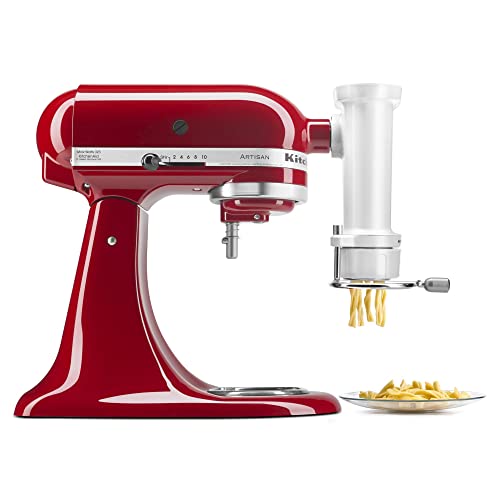
If you already own a KitchenAid stand mixer, this attachment transforms it into a fully capable pasta extruder without adding another appliance to your kitchen. The Ksmpexta fits every household KitchenAid stand mixer and uses the mixer's powerful motor to drive the extrusion, which means you're getting serious, consistent pressure through the die without any additional electrical components to worry about. The attachment itself is well-built, with a solid feel that matches the quality standard KitchenAid owners expect from their accessories.
The six interchangeable discs cover the shapes people actually want to make most — spaghetti, bucatini, rigatoni, fusilli, large macaroni, and small macaroni — and swapping between them is quick and intuitive. The whole system, including all six discs, stores in a dedicated case that comes with the attachment, so nothing gets lost in a drawer somewhere. The pasta it produces is excellent, with a texture that holds sauce beautifully because extruded pasta (as opposed to rolled pasta) has a slightly rougher surface from the die.
The main limitation here is obvious: you need a KitchenAid stand mixer to use it. If you already have one, this is an outstanding value. If you don't, you'd be spending significantly more to buy both pieces, at which point the Philips 7000 all-in-one starts making more financial sense. But for KitchenAid owners, this is a no-brainer addition that vastly expands what your existing investment can do. For inspiration on what to do with your finished pasta, browse our picks for the best pasta bowls — presentation matters when the food is this good.
Pros:
Cons:
The Lello PastaMaster is a workhorse in the truest sense of the word. A 300-watt motor pushes out three pounds of pasta in about 20 minutes, which is more volume per cycle than nearly any other home extruder on the market today. If you're regularly cooking for large groups — think holiday dinners, meal prepping for the week, or feeding a household of pasta lovers — this machine justifies its footprint and price point in a way that smaller units simply can't match. It has a long track record in the market, and that longevity speaks to its reliability.
Safety is thoughtfully designed into the Lello's operation. The machine won't run unless both the mixing bowl and the cover are properly seated, which prevents accidental starts and keeps fingers away from moving components. There's also an overheat protection system with automatic shutoff, which is a critical feature when you're running a motor hard through multiple large batches. The UL listing (meaning it's been independently safety-certified for use in the United States) is a reassuring credential that not every imported pasta machine can claim.
The trade-off with the Lello is that it's a more specialized tool. It's not going to help you with cookie dough or pizza prep the way the Philips 7000 does, and it's a larger, heavier unit that may not be ideal for smaller kitchens. But if raw pasta production volume is your primary goal, nothing else on this list beats it for output per cycle. This is the pasta extruder for serious home cooks who entertain frequently and want to make pasta in quantity without multiple machine runs.
Pros:
Cons:
This bundle pairs the Philips 7000 Series Pasta Maker with the Avance Collection 4-in-1 disc set, which adds angel hair, pappardelle, thick spaghetti, and tagliatelle shapes to your repertoire in one combined purchase. The ProExtrude Technology — combining a powerful motor, metal mixing paddle, and metal front panel — delivers a smooth, even dough finish regardless of which shape disc you're using. If you've ever had a pasta machine struggle and groan through a stiff semolina dough, you'll appreciate how effortlessly the Philips system handles it. The fully automated process means you add your flour and water, then step back and let the machine do the mixing, kneading, and extruding on its own.
The optimized mixing chamber design is worth calling out specifically because it's what separates the Philips from cheaper automated pasta makers. The chamber geometry and the metal blending bar are engineered to produce a precisely even dough base every single time, which directly translates to pasta that has a consistent texture from the first piece to the last. You won't get a gummy, overworked batch followed by a crumbly, under-kneaded one — the machine handles the consistency for you.
For anyone who wants the Philips 7000 experience but with more disc variety right out of the box, this bundle is the way to go. The Avance Collection discs are easy to clean and the shapes they produce — particularly the angel hair and pappardelle — are genuinely impressive for a home machine. If you're buying the Philips 7000 anyway, it makes more sense to get this bundle than to buy the base unit and the disc set separately later.
Pros:
Cons:
The Hamilton Beach 86650 is the machine you buy when you want to get into fresh pasta without committing a significant chunk of your budget upfront. It mixes, kneads, and extrudes automatically — giving you two to three servings of fresh pasta in just 15 minutes — and it comes with seven disc shapes covering the most common pasta types: thick spaghetti, lasagna, spaghetti, angel hair, wide noodle, penne, and fettuccini. For a solo cook or a couple, that variety is more than enough to keep your pasta nights interesting for months.
The built-in internal scale is a clever feature that you don't always see at this price range. It weighs your ingredients directly in the machine and helps you calculate the correct flour-to-water ratio, which is the step where most pasta beginners go wrong. Once you've run a few batches and internalized the ratios, you may not use the scale as much, but it's an excellent training wheel feature that gets you to good results faster. The machine doesn't require any drying time after extrusion — you can drop the noodles straight into boiling water, which simplifies the whole process considerably.
Where this machine asks you to compromise is in batch size and build quality. Two to three servings per cycle is limiting if you're cooking for a family regularly, and the plastic construction doesn't feel as durable as the Philips or Lello units over the long term. That said, for occasional fresh pasta nights at home without spending a lot, the Hamilton Beach genuinely delivers solid results for its price. It's a great starter machine that lets you figure out whether you love fresh pasta enough to upgrade later. If you eventually step up to a higher-end unit, you'll already know exactly what shapes and features you use most.
Pros:
Cons:
If shape variety is your top priority, this electric pasta maker gives you 13 different pasta shapes — including spaghetti, penne, fettuccini, thin noodles, thick round noodles, wide flat noodles, and even dumpling skins — at a competitive mid-range price. The 260W motor combined with a dual-direction dough press (meaning it rotates the dough in alternating directions to improve kneading quality) sets it apart from simpler single-direction extruders that can sometimes produce unevenly worked dough. The result is a more consistent pasta texture across the full batch, which makes a real difference when you're making shapes like penne that need structural integrity to hold their form.
The 650g flour capacity means you can produce enough pasta for four to six people in a single ten-minute cycle, which places it between the Hamilton Beach and the Lello in terms of batch output. The smart touch panel makes operation straightforward even if you've never used an extruder machine before, and the built-in safety lock — which requires the cover to be closed before the machine will start — is a practical safety feature that protects both you and the machine during operation.
What we appreciate most about this machine is that it doesn't make you choose between versatility and convenience. Thirteen shapes, large capacity, and full automation in a single package is genuinely impressive. The brand isn't as established as Philips or KitchenAid, which is the main reason it's not our top pick — you're taking a slight leap of faith on long-term durability. But for the price and the shape variety it offers, it's one of the most compelling value propositions on this list, especially if you love experimenting with different pasta types and don't want to be limited to just five or six options. Pair this machine with a good set of pasta cutter wheels for the shapes that require trimming, and you'll have a complete fresh pasta setup.
Pros:
Cons:
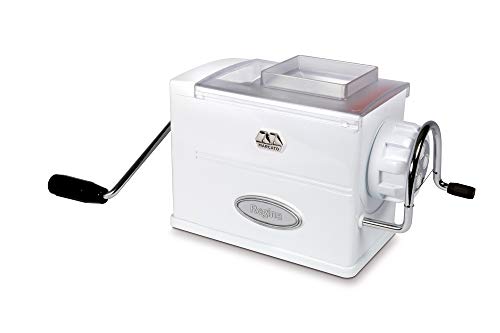
The MARCATO Regina is the pasta extruder for cooks who believe that the best kitchen tools have a crank on them. 100% made and assembled in Italy, this manual extruder is the most traditional option on our list, and it's a genuinely beautiful piece of kitchen equipment that will outlast most of its electric competitors by decades if you treat it well. It clamps to your counter, you load your prepared dough into the barrel, and you turn the hand crank to push pasta through one of five included dies — bucatini, fusilli, maccheroni, maccheroncini, or rigatoni — with satisfying, tactile feedback that no electric machine can replicate.
The set includes everything you need to get started: the machine body, the hand crank, the counter clamp, all five pasta dies, the wrenches for changing dies, and instructions. Build quality is exceptional — this is a tool built to Italian manufacturing standards from real metal components, and it shows in every detail from the threading of the dies to the smoothness of the crank mechanism. The pasta it produces has excellent texture because the slow, controlled extrusion pressure (which you control with the crank speed) produces dense, well-compressed noodles that hold their shape beautifully in boiling water.
The honest trade-off is effort and time. You're doing the work here, which means larger batches require real physical effort over the course of several minutes. It's also not for someone who wants to prep pasta quickly on a Tuesday after work — this is more of a weekend ritual, a deliberate slow-food activity that you'll enjoy if you find that kind of hands-on cooking satisfying. But if you care about authenticity, craftsmanship, and want a machine that connects you to a centuries-old Italian food tradition — and according to Wikipedia's history of pasta, Italy's pasta culture dates back to at least the 13th century — the MARCATO Regina is in a category of its own. You'll find it in the broader pasta makers category alongside other top-rated options if you want to compare it to roller-style alternatives.
Pros:
Cons:
Motor wattage is one of the most important factors when you're shopping for an electric pasta extruder, because dough — especially stiff semolina dough — puts a serious load on a motor. Machines under 150W will struggle with denser doughs and may overheat during longer batches, which shortens their lifespan considerably. Look for at least 150W for casual home use, and go to 250W or higher if you're planning to run multiple batches or make pasta regularly for four or more people. Batch capacity goes hand-in-hand with motor power — a stronger motor can push more dough per cycle without laboring. If you're cooking for a family, aim for a machine that can handle at least 500–650g of flour per cycle to avoid having to run two or three batches just to fill the pot.
The dies (also called pasta plates or discs) are the shaped pieces that determine what kind of pasta comes out of the machine, and the number included varies widely between models. A machine that comes with 6 dies gives you solid everyday variety, while a machine with 13 gives you room to experiment with shapes you've never made at home before. More important than the total count is whether the included dies match the pasta shapes you actually eat. If your household loves rigatoni and bucatini, make sure those dies are in the box before you buy. Also check whether additional dies are available for purchase separately, since some brands support an extensive accessory ecosystem while others are closed systems.
Fresh pasta dough dries out and hardens quickly once it's exposed to air, which means cleanup timing matters more with a pasta extruder than with most kitchen appliances. Dishwasher-safe dies are a significant convenience feature — if you have to hand-scrub bronze or stainless dies after every session, it adds meaningful friction to the experience. Some machines also have removable mixing chambers that rinse clean in seconds, while others have internal components that require patience and a small brush to clean properly. Before you buy, check the cleaning instructions and decide honestly how much maintenance time you're willing to put in after each pasta session. The answer to this question might move you from a machine with bronze dies (which produce better texture) to one with easier-clean Teflon-coated alternatives.
There's a meaningful spectrum between a hand-crank manual extruder like the MARCATO Regina and a fully automated all-in-one unit like the Philips 7000, and the right choice depends on what kind of cooking experience you want. Fully automated machines handle mixing, kneading, and extruding in one continuous process, which is ideal for busy households where speed and convenience are the priority. Manual and semi-manual machines require you to pre-make your dough before loading it into the extruder, which adds 10–15 minutes of prep time but gives you more tactile control over your dough's texture and hydration. If you already enjoy making pasta by hand and see the extruder as a shaping tool rather than a full production machine, a manual option makes a lot of sense. If you want to minimize active cooking time, go fully automatic.
A pasta roller (or pasta machine with rollers) flattens dough into thin sheets, which you then cut into flat shapes like fettuccine, pappardelle, or lasagna noodles. A pasta extruder pushes dough through shaped dies under pressure to produce tubular and three-dimensional shapes like rigatoni, penne, bucatini, and fusilli. You can't make rigatoni with a roller, and you typically can't make lasagna sheets with an extruder. Many serious pasta cooks own both types, since they produce fundamentally different pasta shapes.
Semolina flour (made from durum wheat) is the traditional choice for extruded pasta shapes, and it's what gives Italian dried pasta its characteristic firm texture and golden color. Most extruder machines work well with semolina, all-purpose flour, or a blend of the two. Semolina dough is stiffer than all-purpose flour dough, so it requires a stronger motor to extrude — which is why motor wattage matters when you're shopping. Start with a 50/50 blend of semolina and all-purpose flour if you're new to pasta making, since it's more forgiving and easier to work with than pure semolina.
The most effective way to prevent freshly extruded pasta from clumping is to dust it immediately with semolina flour as it comes out of the machine and separate the pieces right away. Letting extruded pasta sit in a pile will cause the pieces to fuse together quickly, especially in a warm kitchen. A pasta drying rack is the best long-term solution — it holds individual pieces separately until you're ready to cook. If you're cooking immediately, drop the pasta directly into boiling salted water as it comes out of the machine, which is the easiest approach of all.
Yes, most pasta extruder machines can handle gluten-free pasta doughs, but the experience requires some adjustment. Gluten-free doughs (typically made from rice flour, chickpea flour, or blended gluten-free flour mixes) behave differently from wheat doughs — they're often stickier, more fragile after extrusion, and harder to hold together under the pressure of the die. You'll generally need to add a binder like xanthan gum (a common food thickener used in gluten-free baking) to give the dough enough structure to extrude cleanly. Check your specific machine's manual for guidance on gluten-free use, since some machines are better suited to it than others.
Freshly extruded pasta is best cooked and eaten the same day, but you have a few options if you want to prepare it ahead. At room temperature, dried fresh pasta (pasta you've spread out to air-dry on a rack for a couple of hours) will keep for up to two days. In the refrigerator, fresh pasta keeps for about two to three days when stored in an airtight container dusted with semolina. For longer storage, freeze fresh pasta on a baking sheet until solid, then transfer to a freezer bag — it'll keep for up to three months and goes straight from frozen into boiling water with only a minute or two of extra cooking time.
Yes, absolutely. The Philips 7000 Series pasta maker is worth its premium price for anyone who plans to make fresh pasta regularly. The combination of under-10-minute pasta production, the HomeID app for guided recipes, an eight-portion batch capacity, and a genuinely easy cleanup process makes it the best overall value when you factor in the long-term convenience it delivers. If you're on the fence about cost, consider that a pasta extruder machine of this quality will likely last you many years of regular use — and the per-batch cost of fresh homemade pasta is dramatically lower than buying fresh pasta from a specialty grocery store.
 |
 |
 |
 |

About Christopher Jones
Christopher Jones holds an MBA from the University of San Francisco and brings a business-minded approach to kitchen gear evaluation — assessing products not just for performance but for long-term value, build quality, and real-world usability in everyday home cooking. He has spent years testing appliances, cookware, and kitchen gadgets with the same analytical rigor he developed in business school. At BuyKitchenStuff, he covers kitchen appliance reviews, buying guides, and practical cooking tips.
