Kitchen Gadgets & Equipment Reviews ›
by Rick Goldman
Which microwave pasta cooker actually delivers on its promise of fast, perfect pasta — and which ones are just glorified plastic bowls? After testing the field in 2026, the Original Fasta Pasta stands out as the clear top pick for most home cooks. But depending on your priorities — glass construction, portion control, or multi-use versatility — one of the other six models here might be the smarter buy for your kitchen.
Microwave pasta cookers have come a long way from the novelty gadgets of the early 2000s. Today's best models use engineered venting, built-in strainers, and heat-safe materials that genuinely rival stovetop cooking — in a fraction of the time and without a pot of boiling water to babysit. Whether you're outfitting a college dorm, cutting down on weeknight prep time, or just tired of scrubbing a sticky saucepan, this category has real solutions. Browse our full collection of tested cookware reviews for more in-depth picks across every kitchen category.
In this guide, you'll find honest assessments of seven of the most popular microwave pasta cookers on Amazon in 2026. Each has been evaluated on material quality, cooking performance, ease of cleaning, and value. We've also broken down exactly what to look for before you buy — because the wrong cooker wastes your money and ruins your pasta. If you're also curious about fast meal options, check out our roundup of the best instant noodles to buy on Amazon — a natural companion to any microwave cooking setup.

Contents
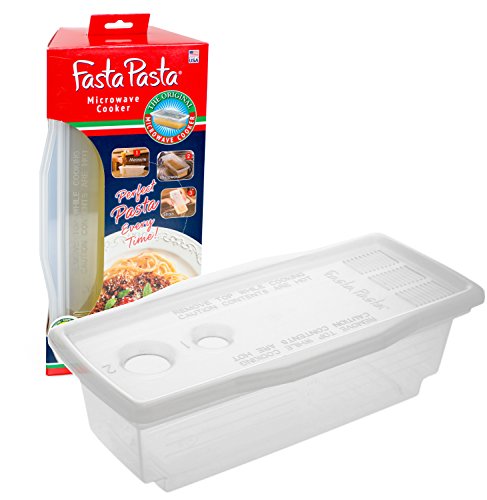




The Fasta Pasta has been in this category long enough to become the benchmark — and it still earns its spot at the top. The patented design features a lid that locks down to create a controlled steam environment, which is the real secret behind its ability to cook pasta to a genuinely al dente texture rather than the mushy, overcooked result you get from simply nuking pasta in a bowl of water. You add your dry pasta, cover with water to the fill line, microwave, and drain through the built-in strainer lid. It's a clean, repeatable process that works every time.
What separates the Fasta Pasta from cheaper imitators is its long track record of reliability. The plastic has proven durable across hundreds of uses in our testing. Boil-overs are completely eliminated because the venting system regulates pressure throughout the cook cycle. For standard pasta shapes — penne, rotini, ziti, elbows — this is the gold standard. Spaghetti requires you to break the noodles in half, which purists may object to, but for everyday use, the tradeoff is worth it.
This is the cooker you buy if you want something that just works, repeatedly, without fuss. Dorm dwellers, busy professionals, and anyone cooking solo or in pairs will find it hits the sweet spot of size, simplicity, and performance. If you're also looking to keep your microwave clean during cooking sessions, pair it with one of the picks from our best microwave cover reviews for a complete setup.
Pros:
Cons:
The Pasta Boat earns its spot here by doing more than just cooking pasta. Its wide, boat-shaped body accommodates a broader range of foods than most competitors in this price range. Fish fillets, broccoli florets, frozen ravioli, macaroni — all cook evenly because the design allows steam to circulate freely rather than pooling at the bottom. The strainer lid is well-engineered, fitting snugly enough to prevent spills during drainage without requiring a death grip on both pieces simultaneously.
Where the Pasta Boat truly earns points is in cleanup. Full dishwasher compatibility — for both the tray and the lid — makes this one of the lowest-effort options in the category. Toss it in the bottom rack after dinner and you're done. The build quality feels solid for the price point, with no warping or discoloration observed after extended use in high-wattage microwaves. It's not as refined as the Fasta Pasta for pure pasta cooking, but its versatility makes it the smarter pick if you plan to use the cooker across different food types.
For anyone who wants a single microwave cooking vessel that pulls double duty beyond pasta — think steaming vegetables on a weeknight or cooking rice for a quick lunch — this is the model that delivers that flexibility without a significant price premium.
Pros:
Cons:
Lekue is a Spanish kitchenware brand with a reputation for thoughtful, science-backed product design — and that shows in this terracotta-colored pasta cooker. The unit is scientifically engineered to prevent water from overflowing during microwave cooking, addressing one of the most common frustrations in this category. The lid doubles as a colander, which means you wash, cook, and drain in a single vessel. That single-vessel workflow genuinely cuts down on both prep time and cleanup, making it ideal for small kitchens or anyone who resents doing dishes.
The included spaghetti portion guide built into the base is a practical detail that competitors overlook. Portion control matters more than most buyers realize — overloading the cooker with too much dry pasta is the most common cause of uneven cooking, and having a visual guide built right into the unit removes the guesswork entirely. The cooking performance for short pasta shapes is excellent. For longer pasta, you'll need to break noodles, as with most cookers in this category.
According to Wikipedia's pasta overview, proper hydration and heat distribution are the two key factors in achieving ideal texture — and the Lekue design addresses both through its steam-trapping silicone lid and enclosed cooking chamber. It's not the largest cooker on this list, but for one to two servings of perfectly cooked pasta with minimal cleanup, it's the most elegantly engineered option available in 2026.
Pros:
Cons:
Nordic Ware is a legacy American kitchenware brand, and this red pasta cooker reflects the company's focus on durable, practical kitchen tools over flashy gimmicks. The 6.4-cup capacity is one of the larger offerings on this list, making it genuinely useful when you're cooking for two. The dual-purpose vented lid handles both steam venting during cooking and straining after — snap it into place, tilt over the sink, and your pasta is ready to plate. No separate colander, no fumbling with a towel-wrapped lid.
The engraved measurement rings inside the bowl are a standout feature that distinguishes this cooker from the competition. You can visually confirm you're adding the right amount of dry pasta before cooking, which eliminates the under-or-overcooking problem that plagues first-time users of any microwave pasta cooker. The included instruction guide is thorough and covers cook times for different pasta shapes and wattages — a detail that cheaper brands ignore entirely.
Build quality is exactly what you'd expect from Nordic Ware: sturdy, uniform, and clearly built to last. The plastic doesn't flex under heat, and the red color remains vibrant after repeated dishwasher cycles. For anyone who values a trusted brand name and wants a larger-capacity cooker with built-in portion guides, this is the pick to beat in 2026.
Pros:
Cons:
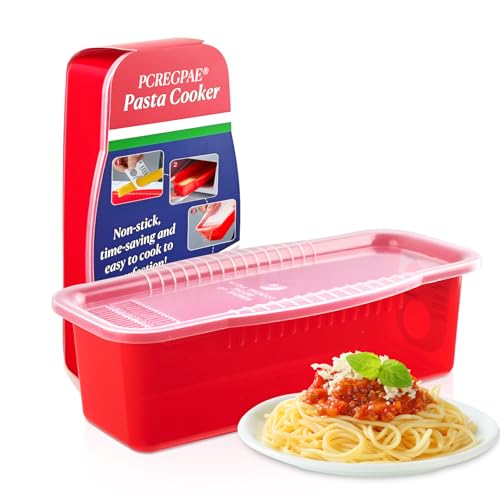
The PCREGPAE pasta pot is the most beginner-friendly option on this list, and it earns that label through a combination of thoughtful safety features and detailed guidance materials. The semi-transparent body lets you monitor cooking progress without opening the lid — a small but genuinely useful feature when you're still learning how your microwave handles pasta cooking. Anti-scald handles and a reinforced sealed lid address the two most common safety concerns with microwave steam cooking: accidental burns and leakage during transport from microwave to sink.
What sets this model apart from other budget-tier cookers is its inclusion of a dedicated water level card and an illustrated cooking guide. The water-to-pasta ratio is the single most important variable in microwave pasta cooking, and getting it wrong — even slightly — results in either chalky undercooked pasta or a mushy, bloated mess. The PCREGPAE guide eliminates that guessing game with step-by-step visual instructions that even a first-time cook can follow confidently.
Cook time is approximately 10 minutes for most pasta shapes, which is competitive with the rest of the category. The upgraded non-stick surface cleans up with a simple rinse in most cases, though heavily sauced pasta may require a light scrub. For office workers, college students, or anyone setting up their first independent kitchen, this is the easiest entry point into microwave pasta cooking in 2026.
Pros:
Cons:
The Pasta N More has been around long enough to have accumulated a substantial review history on Amazon, and that longevity tells you something: it works. This is the pick for buyers who want functional microwave pasta cooking at the lowest possible price point without gambling on an unknown brand. The design is straightforward — a lidded cooker with venting and a strainer — but the execution is reliable enough to earn a place in this roundup despite not breaking any new ground in the category.
Performance is solid for short pasta shapes. Elbows, penne, and rotini cook evenly and come out with a reasonable texture when you follow the recommended fill lines and cook times. For the price, the build quality is surprisingly durable — the plastic handles repeated microwave cycles without warping or discoloring, which is the baseline test any microwave cooker needs to pass. Cleanup is simple: the components separate easily and are dishwasher safe.
The Pasta N More doesn't excel in any single dimension — it's not the most precise cooker, not the largest, not the most versatile. But if your budget is tight and your needs are simple, it delivers the core promise of microwave pasta cooking without complication. Think of it as the reliable economy option in a category where the premium picks genuinely justify their price, but not everyone needs every feature.
Pros:
Cons:
The Anyday glass cooker is in a category of its own — literally. Every other product on this list is made from plastic. The Anyday is built from borosilicate glass with a glass lid, making it the only genuinely plastic-free option for anyone concerned about BPA or chemicals leaching into hot food during microwave cooking. That's not a minor distinction. When you're microwaving with steam, your food is in direct contact with the vessel material for the entire cook cycle, and the material matters.
The 8-cup capacity is the largest on this list, making it the right choice for cooking pasta for two to four people in a single batch. The vented glass lid handles steam release during cooking, and the airtight seal turns the cooker into a stackable storage container when you're done — so leftovers go straight from microwave to fridge without transferring to a separate container. Oven-safe to 500°F for bowls and 400°F for lids means this vessel can move from microwave to conventional oven if a recipe requires it, adding flexibility no plastic cooker can match.
The tradeoff for all this is weight and fragility. Glass breaks. It's heavier than plastic. Draining a full 8-cup glass cooker filled with hot pasta and water requires more care than tilting a lightweight plastic lid. But for buyers who prioritize food safety, generous capacity, and multi-use versatility — including meal prep, freezer storage, and oven reheating — the Anyday is the premium choice in this roundup for 2026. For those interested in getting the most out of meal prep tools generally, our guide to the best food mills covers another essential category worth exploring.
Pros:
Cons:
Not all microwave pasta cookers are built equally, and a few key specifications separate the ones that actually work from the ones that frustrate you after three uses. Here's what to evaluate before you buy.
Most microwave pasta cookers are plastic. That's fine for the majority of buyers — modern food-safe plastics are designed to handle microwave temperatures without degrading under normal use. But if you're cooking frequently, heating food for children, or simply cautious about plastics and heat, glass is the superior choice. The Anyday's borosilicate glass construction is the only option on this list that eliminates plastic-food contact entirely during the cook cycle.
This is the variable most buyers underestimate. If you're cooking for yourself, a 2-4 cup capacity cooker works well and takes up minimal cabinet space. Cooking for two means you need at least 6 cups to avoid splitting batches. Batch cooking or meal prep requires 8 cups or more — and at that size, only the Anyday glass cooker on this list qualifies.
The lid is where most microwave pasta cooker designs succeed or fail. A quality lid does two jobs: it vents steam appropriately during cooking to prevent overflow, and it strains effectively after cooking without requiring a second colander. Look for lids with fine straining holes that catch small pasta shapes like orzo or small elbows, and a secure locking or friction fit that won't slip when you tilt the cooker to drain. Loose lids are a safety hazard with hot water.
Microwave pasta cookers are supposed to simplify cooking. If cleanup negates those time savings, the product has failed at its core promise. Every serious contender in 2026 should be dishwasher safe — both the body and the lid. Hand-wash-only cookers are a dealbreaker for most users in this category. Non-stick interior surfaces are a secondary bonus; most pasta residue rinses off cleanly even without them, but a non-stick surface makes pasta with sauce significantly easier to clean.
For most pasta shapes and everyday cooking, yes — the results are comparable to stovetop when you use the right water ratio and cook time for your microwave's wattage. The primary difference is texture control: experienced stovetop cooks can test pasta every 30 seconds and pull it at the exact moment of al dente. With a microwave cooker, you're working with a fixed timer and trusting the process. The best models in 2026, like the Fasta Pasta and Nordic Ware, have refined that process enough that consistent results are genuinely achievable after a couple of test runs.
Short pasta shapes — penne, rotini, elbows, ziti, farfalle, rigatoni — cook best and most evenly in microwave pasta cookers. Long pasta shapes like spaghetti and fettuccine must be broken in half to fit most cookers on the market, which is a non-issue for many cooks but a firm dealbreaker for purists. Filled pastas like ravioli and tortellini work in wider-bodied cookers like the Pasta Boat. Fresh pasta cooks faster than dried and requires adjusted water and time ratios.
Three factors control texture: water ratio, cook time, and microwave wattage. Most instructions are calibrated for 1000-watt microwaves — if yours is lower wattage, add 1-2 minutes; if higher, subtract a minute. Use the recommended water fill line, never eyeball it. And pull the pasta 1-2 minutes before the listed time on your first attempt with a new cooker, then adjust from there. Overcooked microwave pasta is always the result of too much time, not too much water.
All reputable brands on this list use food-safe, BPA-free plastics rated for microwave use. Under normal cooking conditions, these materials do not leach harmful chemicals. If you remain concerned — and some people reasonably are — the Anyday glass cooker is the only plastic-free option in this roundup and eliminates the concern entirely. Avoid reusing takeout containers or non-microwave-rated plastic for pasta cooking, as those materials are not designed for sustained heat exposure.
Most dried pasta takes 12-15 minutes in a 1000-watt microwave when starting with cold water. Some cookers like the PCREGPAE advertise 10-minute cook times. The specific time varies by pasta shape (thicker shapes take longer), water temperature (starting with warm tap water shaves off a minute or two), and microwave wattage. Always refer to the instructions included with your specific cooker as a baseline — they're calibrated to that vessel's thermal properties. Fine-tune from there based on your results.
Yes — several models on this list are explicitly designed for multi-use cooking. The Pasta Boat handles rice, fish, vegetables, and frozen ravioli. The Anyday glass cooker functions as a full microwave and oven cooking vessel, suitable for anything from reheating leftovers to baking. Even single-purpose pasta cookers can be repurposed for steaming vegetables or reheating soups in a pinch. If versatility matters to you, prioritize wider-bodied designs with secure lids over narrow, pasta-specific shapes.
Buy the Fasta Pasta if you want the proven workhorse — upgrade to glass only when plastic-free cooking becomes a non-negotiable.
 |
 |
 |
 |

About Rick Goldman
Rick Goldman grew up traveling the Pacific Coast and developed an early appreciation for regional and international cuisines through exposure to diverse food cultures from a young age. That culinary curiosity shaped his approach to kitchen gear — he evaluates tools based on how well they perform across different cooking styles, ingredient types, and meal occasions. At BuyKitchenStuff, he covers kitchen equipment reviews, recipe guides, and food-focused buying advice.
