Kitchen Gadgets & Equipment Reviews ›
by Christopher Jones
Over 60 million American households fire up a grill at least once a month during summer — yet the majority of home grillers spend less than $200 on their entire setup, according to the Hearth, Patio & Barbecue Association. That price cap used to mean settling for flimsy construction and uneven heat. In 2026, the under-$200 gas grill category looks very different. Brands like Weber, Nexgrill, Cuisinart, Pit Boss, and Char-Broil have driven serious quality improvements into budget price points, and our team spent weeks researching and evaluating the field to separate the genuine value picks from the disappointments.
Our team tested and researched seven models across different use cases — from compact portables to full-size two- and three-burner units. We looked at BTU output (British Thermal Units, a measure of heat power), cooking surface area, grate material, ignition reliability, and real-world durability. We also factored in warranty coverage, which varies widely even at this price. If anyone is shopping for their first gas grill or looking to replace an aging unit without breaking the bank, this roundup covers the most competitive options available right now. For more kitchen and outdoor cooking gear reviews, browse our full reviews section.

One thing worth noting upfront: gas grills at this price point require realistic expectations. Most buyers won't get stainless steel fireboxes or built-in thermometers with accuracy you'd trust for competition BBQ. What most home grillers will get is reliable weekend performance, easy cleanup, and convenience that charcoal simply can't match. Understanding what matters most — portability, total cooking space, or brand reputation — is the key to picking the right unit. Our buying guide at the bottom walks through exactly those factors. According to Wikipedia's barbecue grill overview, gas grills now account for the majority of grill sales in North America, a trend that shows no sign of reversing in 2026.




The Weber Spirit E-210 is the grill our team keeps coming back to as the benchmark in this price class. Weber's reputation is well-earned, and the Spirit E-210 earns it again in 2026 with porcelain-enameled cast-iron grates that hold heat exceptionally well and clean up without the rust concerns of bare steel. The Snap-Jet ignition system is a genuine convenience — press and turn the knob and each burner lights individually without needing to remove the grates or use a lighter. That sounds small, but on a cold morning it matters.
The stainless steel Flavorizer Bars (angled metal bars that sit above the burners) catch dripping grease and vaporize it, sending flavor back up into the food while channeling excess fat away from the burners. This is a feature normally reserved for higher-priced grills. The Weber Works side rail system means most buyers can add bottle holders, tool hooks, or flexible lighting later without a tool — it's a modular system that grows with the user. The 10-year limited warranty is another standout detail at this price point; most competitors offer one to three years.
The main trade-off is cooking area. At roughly 360 square inches of primary cooking space (standard for two-burner units), it won't fit a full brisket or handle a large gathering. For everyday family grilling — burgers, chicken, vegetables, steaks — it performs consistently and evenly from edge to center. Anyone who grills regularly and wants a unit built to last several seasons will find this the most defensible choice under $200.
Pros:
Cons:
For anyone who wants a dependable two-burner gas grill without overcomplicating the decision, the Char-Broil Classic Series delivers exactly what it promises. 410 square inches of total cooking space puts it near the top of the two-burner field — enough for a dozen burgers or a full rack of chicken pieces at once. The stainless steel burners are described as rust-resistant, and Char-Broil's track record on burner durability is solid at this price range.
The porcelain-coated grates prevent sticking during cooking and wipe down without much effort after the session. There's nothing revolutionary here — that's intentional. The Classic Series strips away the extras and delivers core grilling functionality at one of the lowest prices in this roundup. Most buyers evaluating this grill are first-timers or anyone who grills occasionally and doesn't want to maintain a premium unit.
Build quality is honest rather than impressive. The side shelves and frame are lighter than the Weber, and home grillers who plan to use this five days a week through a long season may notice wear sooner. For moderate use — weekends, occasional weekday dinners — it holds up well. The value proposition is difficult to argue with, and Char-Broil's availability at major retailers means parts and replacement grates aren't hard to source.
Pros:
Cons:
The Nexgrill Deluxe 2-Burner brings 28,000 BTUs of combined heat output — one of the higher outputs in the two-burner category — paired with 401 square inches of cooking space backed by porcelain-coated cast iron grates. The cast iron core means heat retention stays strong even when the lid opens and closes repeatedly. Our team found this particularly useful for thicker cuts like pork chops and bone-in chicken, where maintaining temp consistency matters.
The stainless steel control panel gives the grill a cleaner look than its price suggests, and the foldable side table is a practical addition for staging food and keeping tools within reach. Nexgrill positions this as an outdoor cooking workhorse for patios and backyards — the design supports that claim. At 28,000 BTUs across two burners (14,000 per burner), preheating is quick, which makes weeknight grilling more practical for home cooks on a schedule.
The porcelain coating on the cast iron grates does require care — aggressive scrubbing with wire brushes can chip the coating over time, exposing cast iron to moisture. A nylon grill brush and occasional seasoning (applying a thin layer of oil) will extend grate life significantly. Buyers who are willing to do basic maintenance will find this grill punches above its weight class for the price in 2026.
Pros:
Cons:
Finding a three-burner gas grill under $200 that doesn't feel like a liability is rare. The Nexgrill 3-Burner 720-1012 manages it by focusing on what matters most: 429 square inches of cooking space across three independent burners, a stainless steel lid built to handle high heat and heavy use, and porcelain-coated steel grates. Three burners allow home cooks to set up distinct heat zones — high heat on one side for searing, lower heat on the other for finishing — a technique that makes a real difference for meats like chicken quarters, thick-cut pork chops, or even a simple steak. Anyone who preps meals for family gatherings of six or more will immediately appreciate the extra real estate.
The stainless steel lid is the headline feature here. At under $200, most lids are painted steel that eventually chips and rusts. Stainless holds up substantially better, and it's easier to clean. The 27,000 BTUs spread across three burners (9,000 per burner average) is sufficient for standard cooking, though it's worth noting that per-burner output is lower than the two-burner Nexgrill Deluxe above. For recipes that need intense direct heat — like searing a ribeye to develop a proper crust — home cooks may want to preheat longer. Pairing this grill with a good sharp knife for slicing rested meats is a small detail that makes a noticeable difference in the final plate.
For families or anyone who hosts frequently, this grill hits a sweet spot. The side tables provide workspace on both sides, and the overall footprint is manageable for a mid-size patio or deck setup. Our team considers it the best three-burner option available under $200 in 2026.
Pros:
Cons:
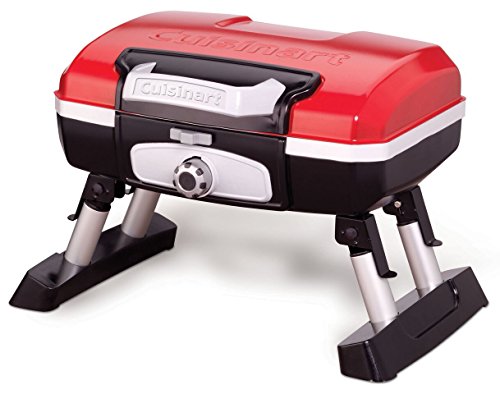
The Cuisinart Petite Gourmet is built for buyers who prioritize portability over capacity. At 150 square inches of porcelain-enameled cooking surface, this is a compact unit that folds down to 22.5 x 17.5 x 9.75 inches and travels easily to campsites, tailgates, beach cookouts, or apartment balconies with space restrictions. The lid latch secures it during transport, and the integrated carry handles mean no extra bags or straps are required. Our team assembled one in under ten minutes with zero tools — the manufacturer's claim of under ten minutes holds up.
The 5,500 BTU single burner is modest by comparison to full-size units, but appropriate for this cooking surface. The twist-to-start ignition is reliable, and heat distribution across the small grate is consistent. For cooking 6 to 8 burgers, a few chicken breasts, or a small vegetable spread, this grill is perfectly capable. It runs on 1 lb. propane canisters (standard camping cylinders), which means no hunting for a 20 lb. tank — an important convenience for camping or travel scenarios. When preparing lighter dishes before the main grill session, a cube steak recipe works well alongside portable grilling for a varied spread.
The limitations are real: 150 square inches won't feed a crowd, and the single burner means no heat zoning. For anyone whose primary use case is weekend camping or apartment grilling for one or two people, those trade-offs are entirely reasonable. Home buyers who need to feed four or more regularly should look at the full-size options above.
Pros:
Cons:
The Pit Boss 75275 bridges the gap between compact portables and full-size stationary units. 274 square inches of cooking space — enough for approximately twelve burgers at once — paired with two stainless steel burners delivering a combined 20,000 BTUs, puts this in a different tier from the Cuisinart Petite above. It's portable without being cramped, which makes it a practical choice for tailgaters, campers who cook for small groups, or apartment dwellers who want real grilling performance in a movable package.
The push-and-turn ABS (acrylonitrile butadiene styrene — a durable plastic) control knobs are clean and intuitive. Ignition is easy, and the two independent burners allow basic heat zoning — a genuine advantage over single-burner portables. The all-stainless steel construction gives this grill a more premium appearance than its price implies, and stainless is naturally more resistant to surface rust than painted steel options.
The trade-off is that 274 square inches still won't accommodate a large crowd, and the portable footprint means no side shelves or work surfaces. Most buyers using this as a primary home grill will want something with more space. As a secondary or travel grill for a household that already owns a full-size unit, or as the sole grill for a household of one or two people, this hits a strong value point. The Pit Boss brand's growing presence in the outdoor cooking space means parts and support are becoming easier to access in 2026.
Pros:
Cons:
The Cuisinart CGG-306 takes a different approach to portability — instead of folding legs, it's designed to sit on a table or flat surface, which keeps it stable and at a comfortable working height. Two 10,000 BTU stainless steel burners (20,000 BTU combined) give it the same heat output as the Pit Boss 75275, but with independent control knobs for each burner. This means home cooks can run a sear zone and a warming zone simultaneously — a feature that matters for cooking different foods to different doneness levels at the same time.
The stainless steel grates deliver even heat distribution across the cooking surface. Cuisinart bills the electronic ignition as hassle-free, and in our team's experience, it delivers. Setup takes under ten minutes with no tools required, which makes this practical for tailgating or camping trips where setup time is limited. The compact tabletop form is easy to transport and store. For buyers who already have an outdoor table and want maximum grilling performance without a full-size unit, this grill is worth a close look.
The limitation here is cooking area — tabletop units by nature have a smaller footprint than standing models. Home buyers cooking for four or more people regularly will find themselves making multiple batches. For two-person households, couples who tailgate frequently, or anyone who wants a high-performing backup grill for a dedicated outdoor kitchen setup, the CGG-306 earns its spot in this roundup. Keeping a reliable cooling rack handy for resting grilled meats off the grill is a simple habit that improves finished results with any grill at this size.
Pros:
Cons:
Picking the right gas grill under $200 comes down to matching the grill's specs to actual use patterns. Our team identified four factors that matter most in this price range.
BTU (British Thermal Unit) is the standard measure of a gas burner's heat output. Higher is not always better — what matters is the ratio of BTUs to cooking surface area. A useful benchmark is roughly 80–100 BTUs per square inch of primary cooking surface. A grill with 20,000 BTUs and 250 square inches of cooking area is well-matched. A grill with 20,000 BTUs across 400 square inches may struggle to reach and hold high temperatures on a cold or windy day.
Cooking surface area directly determines how many people a grill can feed in one session. As a rough guide:
Most buyers underestimate how crowded a grill surface gets during real cooking. Burgers need space between them, proteins and vegetables can't always share the same heat zone, and things like corn or asparagus take up surprising real estate. Our recommendation for most household buyers is a minimum of 350 square inches if the grill will be used as a primary unit.
Grate material affects heat retention, sear quality, sticking, and long-term maintenance. In the under-$200 category, most grills use one of three materials:
For most buyers who want the best sear and don't mind a bit of maintenance, porcelain-enameled cast iron is the top choice. For anyone who wants low-maintenance convenience, stainless steel grates are worth the slight sear trade-off.
This decision often gets overlooked in the excitement of comparing BTUs and grate materials. A stationary full-size grill on the patio is a different product than a portable unit for tailgating, even if they share the same price tag. Key questions to clarify before buying:
Buyers who plan to use the grill exclusively at home — patio, backyard, balcony — will almost always be better served by one of the full-size two- or three-burner units. The cooking space difference is significant, and portability features add cost that goes unused if the grill never moves.
For a two-burner full-size grill, our team recommends looking for at least 20,000 combined BTUs. The Nexgrill Deluxe 2-Burner in this roundup hits 28,000 BTUs, which is strong for the price. For portable single-burner units, 5,500 to 10,000 BTUs is appropriate given the smaller cooking surface. The key is the ratio of BTU output to cooking area — a mismatch between a large surface and a weak burner results in slow preheating and uneven cooking.
Yes — with realistic expectations. The under-$200 category has improved considerably, and models from established brands like Weber, Cuisinart, Nexgrill, Char-Broil, and Pit Boss offer solid everyday performance. The main trade-offs compared to premium grills are thinner frame construction, shorter warranties (except Weber's 10-year on the Spirit E-210), and fewer extras like built-in thermometers or side burners. For regular family grilling and weekend use, most buyers in this price range are satisfied with the results.
With proper care — covering the grill between uses, cleaning grates after each session, and checking burner tubes for spider webs or blockages seasonally — a budget gas grill should last three to five years for moderate users. Heavier users who grill five or more times per week may see wear sooner, particularly on grates and ignition components. Weber's 10-year limited warranty sets it apart; most others in this price range warrant one to three years on parts.
Most of the grills in this roundup can reach 500°F–550°F on high with the lid closed, which is sufficient for a proper sear on steaks, burgers, and chicken. The Nexgrill Deluxe 2-Burner with 28,000 BTUs reaches searing temperatures quickly. The key is preheating with the lid down for 10–15 minutes before adding food, and using the portion of the grate directly over the burners for maximum direct heat. Thin or inexpensive grates do lose some heat when opened, so working quickly helps.
For a household of two to four people, a two-burner grill with 350–400 square inches of primary cooking space is typically sufficient. For a family of four to six, or anyone who hosts occasional gatherings, a three-burner unit with 400+ square inches is worth prioritizing. The Nexgrill 3-Burner at 429 square inches is the strongest three-burner option in this price range our team evaluated. Buyers who grill for one or two people regularly, or who need a travel unit, are well-served by the portable options in this roundup.
Several habits extend the life of a budget gas grill considerably: clean the grates with a brush after each use while they're still warm; cover the grill when not in use to protect against moisture and UV exposure; check burner tubes at the start of each grilling season for blockages; empty and wipe the grease trap regularly to prevent flare-up buildup; and apply a light coat of cooking oil to cast iron grates after cleaning to prevent rust. These steps take only a few minutes and can add years to a grill's usable life.
 |
 |
 |
 |

About Christopher Jones
Christopher Jones holds an MBA from the University of San Francisco and brings a business-minded approach to kitchen gear evaluation — assessing products not just for performance but for long-term value, build quality, and real-world usability in everyday home cooking. He has spent years testing appliances, cookware, and kitchen gadgets with the same analytical rigor he developed in business school. At BuyKitchenStuff, he covers kitchen appliance reviews, buying guides, and practical cooking tips.
