Kitchen Gadgets & Equipment Reviews ›
by Daisy Dao
According to a 2025 NPD Group report, griddle sales in the United States surged by 18% year-over-year, making flat griddle pans one of the fastest-growing cookware segments in American kitchens. That growth makes sense. A quality flat griddle pan transforms your stovetop into a short-order station capable of handling everything from weekend pancake stacks to seared steaks on a Tuesday night.
But not all griddles are created equal. You'll find cast iron behemoths that weigh 12 pounds, featherweight aluminum models with ceramic coatings, and electric options that bypass the stove entirely. The right choice depends on your cooking style, your stovetop type, and how much cleanup you're willing to tolerate. We've spent weeks testing seven of the top-rated flat griddle pans on the market in 2026, pushing each one through rounds of pancakes, bacon, smash burgers, and eggs to find the best options at every price point.
Whether you're upgrading from a warped nonstick pan or investing in your first serious griddle, this guide covers everything you need. Below you'll find detailed hands-on reviews, a side-by-side comparison, and a buying guide to help you zero in on the perfect flat griddle pan for your kitchen. If you're also outfitting your kitchen with other essentials, check out our picks for the best bakeware sets and turbo convection ovens while you're at it.
Contents
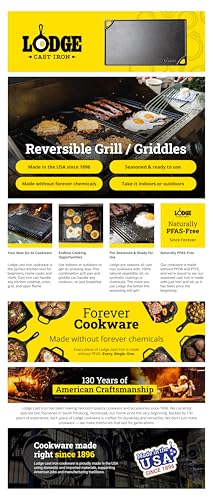


The Lodge Double Play earns our top spot for one simple reason: it does two jobs exceptionally well. Flip it one way and you get a perfectly flat griddle surface for pancakes, eggs, and tortillas. Flip it over and raised grill ridges give you steakhouse-quality sear marks on burgers and vegetables. That dual functionality across two burners makes it the most versatile griddle we tested.
Lodge's factory seasoning impressed us right out of the box. We cooked eggs on the flat side during our first test and they released cleanly with just a thin coat of oil. The cast iron construction weighs in at roughly 12 pounds, which means it stays planted on your burners and distributes heat with rock-solid consistency. No hot spots, no cold zones — just even, reliable cooking across the entire surface.
This griddle is PFAS-free and non-toxic, which matters if you're moving away from chemical nonstick coatings. The seasoning improves over time, building a natural nonstick layer that outperforms any synthetic coating after a few months of regular use. It works on gas, electric, induction, campfires, and grills.
Pros:
Cons:
If the Lodge's weight is a dealbreaker, the Nordic Ware Two Burner Griddle is your answer. Built from formed aluminum, it weighs a fraction of cast iron alternatives while still spanning two burners at 10.3 x 17.4 inches. The ceramic nonstick coating delivered flawless pancake releases during testing — no butter needed, no sticking, no frustration.
The real sleeper feature here is portability. The uncoated backside means you can throw this griddle on a camp stove, an RV burner, or directly on a grill grate. We tested it on a Weber charcoal grill and it performed admirably for outdoor breakfast service. It heats up faster than cast iron too — about 3 minutes to reach pancake temperature compared to 6-7 minutes for heavy iron griddles.
The trade-off is durability. Ceramic nonstick coatings degrade over time, especially if you use metal utensils or abrasive scrubbers. Nordic Ware explicitly warns against metal scouring pads and sharp cooking tools. Treat the surface gently and you'll get solid performance for 2-3 years. Also note that this griddle is not compatible with induction cooktops — aluminum won't trigger the magnetic field.
Pros:
Cons:
All-Clad's reputation in professional kitchens isn't accidental. The HA1 Expert brings that same precision engineering to a compact 11x11-inch square griddle pan. The hard anodized aluminum body heats evenly and quickly, while the low walls make it remarkably easy to slide a spatula under pancakes, eggs, and grilled cheese sandwiches without fighting the pan's edges.
During our testing, we cooked four pancakes simultaneously with perfectly uniform browning across the entire surface. No rotating needed. The nonstick coating on this model is All-Clad's latest generation, and it handled sticky foods like French toast batter and melted cheese without any residue. Oven safety up to 500°F means you can start a frittata on the stovetop and finish it under the broiler — a genuinely useful capability that cheaper griddles can't match.
The one caveat is size. At 11 inches square, this is a single-burner griddle. It's perfect for daily cooking for one or two people, but you'll feel the space limitation when cooking for a family. If you need more real estate, look at the Lodge or Nordic Ware above. But for quality-over-quantity cooking, the All-Clad is unmatched in this lineup. It's also dishwasher-friendly, which is a rarity at this build quality.
Pros:
Cons:
GreenPan built its brand on one promise: healthy ceramic nonstick that won't release toxic fumes. The Lima 11" Square Griddle delivers on that promise convincingly. The Thermolon ceramic coating is free of PFAS, PFOA, lead, and cadmium. Even if you accidentally overheat it — and we tested this deliberately — it won't off-gas harmful chemicals. For families with birds, small children, or anyone who's simply done with chemical nonstick coatings, this griddle is the safest option we reviewed.
Performance-wise, the ceramic surface handled eggs, crepes, and quesadillas with impressive release. The hard anodized aluminum body resists scratches and held up well through our testing cycle. With oven and broiler safety up to 600°F, it actually outpaces the All-Clad on heat tolerance. The stainless steel handle stays cool on the stovetop and provides a secure grip.
Ceramic nonstick does have a shorter lifespan than traditional PTFE coatings. Expect peak performance for 1-2 years with daily use, then gradual decline in nonstick properties. Avoid cooking sprays (they leave a residue that degrades the coating) and stick with oils or butter. At its price point though, replacing it every couple of years still costs less than a single premium PTFE pan.
Pros:
Cons:
The Staub Plancha is what happens when French manufacturing precision meets cast iron tradition. At 18.5 x 9.8 inches, it spans two burners and provides a generous cooking surface finished in Staub's signature textured black matte enamel. That enamel changes the game compared to bare cast iron — it delivers exceptional browning without requiring any seasoning, ever. No flaxseed oil rituals. No rust anxiety. Just cook and clean.
We tested this griddle with smash burgers and the results were outstanding. The textured enamel surface created a deep, crispy crust that rivaled our best bare cast iron results. Heat retention is phenomenal — once this griddle reaches temperature, it holds steady even when you load it with cold food. The enameled surface also means you can deglaze with wine or broth without worrying about stripping seasoning, which opens up technique options that bare cast iron can't handle.
The Staub's "Made in France" pedigree comes with a premium price. This is comfortably the most expensive griddle in our roundup. But if you want cast iron performance without the maintenance commitment, the enameled approach is worth every dollar. It also cleans up easier than any other cast iron option — warm water, mild soap, done. For more on keeping your kitchen essentials in top shape, browse our full cookware reviews.
Pros:
Cons:
Sometimes you don't want to deal with stovetop griddles at all. The Presto Tilt 'n Drain takes a completely different approach — plug it in, set your temperature, and cook on a massive surface that holds up to 12 slices of French toast simultaneously. For families who do big weekend breakfasts or anyone who wants to free up their stovetop burners, this electric griddle is a revelation.
The tilt-and-drain feature is genuinely clever. When you're cooking pancakes or eggs, lock the griddle flat for even cooking. Switch to burgers, bacon, or sausages, and tilt the surface so grease channels to the built-in drip tray. We tested both modes and the drainage angle is steep enough to keep grease moving without food sliding off. Cool-touch edges and handles mean you can use it safely around kids — something stovetop cast iron griddles absolutely cannot claim.
The nonstick surface is easy to clean but won't deliver the searing power of cast iron or hard anodized aluminum. If you want deeply caramelized smash burgers or hard-seared steaks, an electric griddle isn't your tool. But for everyday breakfast cooking, sandwiches, and meal prep at volume, the Presto delivers the best surface-area-per-dollar ratio in this roundup. It also works brilliantly as a buffet warmer for gatherings, similar to how a good utensil holder keeps your cooking tools organized and accessible.
Pros:
Cons:
The Victoria Rectangular Cast Iron Griddle punches well above its price point. Made in Colombia using European cast iron machinery, it delivers commercial-grade heat retention at a fraction of the Staub's price. The 18.5 x 10-inch cooking surface spans two burners and the reversible design gives you both flat and grill surfaces — directly competing with the Lodge Double Play at a lower cost.
Victoria's seasoning approach is notable. They use 100% kosher-certified non-GMO flaxseed oil, which creates one of the hardest, most durable natural seasoning layers available. During testing, the flaxseed seasoning outperformed the Lodge's factory seasoning in initial nonstick performance. Food released cleaner during the first few uses without additional seasoning buildup. The seasoning is also PTFE and PFOA-free for health-conscious cooks.
The handles on the Victoria are wider than most competitors, which makes a real difference when you're gripping with thick potholders or oven mitts. It's a small design detail that shows thoughtful engineering. This griddle works on induction, ceramic, campfires, grills, broilers, and ovens. For the price, it's the best value in cast iron griddles in 2026, and the lifetime durability of cast iron means your cost-per-use approaches zero over the years. According to the history of cast iron cookware, these pieces have been kitchen staples for centuries — and for good reason.
Pros:
Cons:
The material of your griddle determines almost everything about its performance, maintenance, and lifespan. Here's the breakdown:
Your cooking priorities should drive this decision. If you sear meats frequently, cast iron wins. If you cook eggs and pancakes daily and want easy cleanup, hard anodized nonstick is your best bet.
Griddle pans fall into two categories: single-burner and double-burner. Double-burner griddles (17-19 inches) give you roughly twice the cooking surface, which is transformative for batch cooking. You can cook pancakes and bacon simultaneously, or line up eight burger patties in a single batch.
Single-burner griddles (10-12 inches) are easier to store, lighter to handle, and heat more evenly since they sit on one heat source. They're the right call if you typically cook for one or two people. Consider your cabinet space too — a 19-inch cast iron griddle needs serious storage real estate.
If you're choosing a coated griddle, understand the coating technology:
None of these options is objectively "best." Your choice depends on whether you prioritize health concerns, convenience, or long-term value.
This is the gotcha that catches many buyers. Not every griddle works on every stovetop. Induction cooktops require magnetic materials — cast iron and some stainless steel work, but aluminum does not. If you have an induction range, verify compatibility before purchasing. The Nordic Ware, for example, explicitly states it won't work on induction.
If you cook outdoors regularly, look for griddles rated for open flame, campfire, and grill use. Cast iron handles all of these. Nonstick-coated aluminum griddles vary — check the manufacturer's guidance. Electric griddles bypass this question entirely since they generate their own heat.
A griddle has a flat, open surface with very low or no walls, designed for foods that need flipping — pancakes, eggs, burgers, and tortillas. A skillet has raised sides (typically 2-3 inches) to contain liquids and sauces. Griddles give you easier spatula access and more cooking surface area. Skillets are better for sautéing, braising, and anything that produces liquid. For flat cooking, a griddle outperforms a skillet every time.
Most modern cast iron griddles ship pre-seasoned and are ready to cook out of the box. Both Lodge and Victoria come with factory seasoning that works well for initial cooking. However, you'll get better nonstick performance by applying 2-3 additional thin layers of oil (flaxseed, grapeseed, or canola) baked at 450°F. The seasoning builds and improves naturally with every use. Enameled cast iron like the Staub requires no seasoning at all.
Only if the griddle is made from a magnetic material. Cast iron griddles (Lodge, Staub, Victoria) all work on induction. Hard anodized aluminum griddles (All-Clad, GreenPan) work on induction only if they have a magnetic base layer — check the product specs. Plain aluminum griddles like the Nordic Ware are not induction-compatible. Electric griddles don't use your cooktop at all, so compatibility isn't a concern.
For cast iron: scrub with hot water and a stiff brush or chain mail scrubber while still warm. Avoid soap on bare cast iron (it can strip seasoning). Dry completely and apply a thin coat of oil. For nonstick griddles: let the pan cool, then wash with warm soapy water and a soft sponge. Never use metal scouring pads on nonstick surfaces. For enameled cast iron: warm water with mild dish soap is fine — the enamel protects the iron underneath.
If you regularly cook for three or more people, absolutely yes. A double-burner griddle lets you cook an entire breakfast spread — pancakes, eggs, and bacon — in a single batch instead of three rounds. The time savings add up fast. If you mostly cook for one or two people, a quality 11-inch single-burner griddle gives you plenty of room and is easier to store, clean, and handle. The decision comes down to household size and cooking frequency.
Medium heat (350°F) handles most griddle cooking: pancakes, eggs, French toast, and quesadillas. For searing burgers or steaks, crank to medium-high (400-450°F). For delicate foods like crepes, go lower at around 300°F. The number one griddle mistake is cooking too hot. Preheat your griddle for 4-5 minutes at your target temperature before adding food. Test by flicking a few drops of water on the surface — they should sizzle and evaporate within 2-3 seconds at medium heat.
Buy cast iron if you want a griddle that outlasts you, nonstick if you want one that never frustrates you — and whichever you choose, preheat it properly before a single drop of batter hits the surface.
 |
 |
 |
 |

About Daisy Dao
Daisy Dao grew up in Honolulu, Hawaii, where coastal living and access to fresh local ingredients shaped her approach to home cooking from an early age. She has spent years experimenting with seafood preparation, healthy cooking methods, and ingredient substitutions — developing hands-on familiarity with a wide range of kitchen tools, techniques, and produce. At BuyKitchenStuff, she covers healthy recipes, cooking techniques, and ingredient substitution guides.
