Kitchen Gadgets & Equipment Reviews ›
by Daisy Dao
Which chef jacket actually holds up through a double shift without looking like you slept in it? If you've been cycling through cheap coats that pill after three washes, you already know the answer matters. After evaluating seven of the top-rated chef jackets on the market in 2026, the Chef Works Men's Montreal Cool Vent Chef Coat stands out as our top overall pick for its blend of breathability, durability, and freedom of movement.
A quality chef jacket does more than complete your uniform. It protects you from splashes, burns, and steam while keeping you cool enough to stay focused during a relentless dinner rush. The best options balance professional appearance with functional design — moisture-wicking fabrics, reinforced seams, and cuts that let you move without restriction. Whether you're running a professional kitchen or building your culinary career, the right coat makes a measurable difference in your comfort and confidence on the line.

We've tested and compared jackets across a range of price points, from workhouse basics to premium European craftsmanship. This guide covers each jacket's strengths and weaknesses, a detailed buying guide to help you zero in on the right features, and answers to the most common questions chefs ask before buying. If you're also upgrading the rest of your kitchen wardrobe, check out our roundup of the best chef aprons for restaurants to complete the look. Let's get into it.
Contents


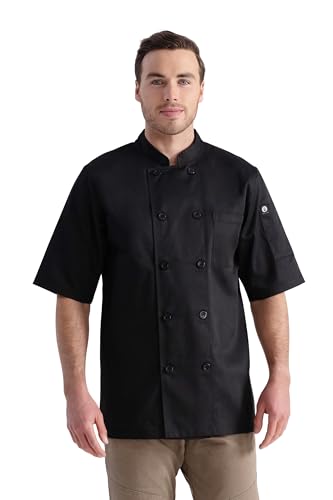

The Chef Works Montreal Cool Vent has earned its reputation as one of the most reliable chef coats on the market, and that reputation is well-deserved heading into 2026. This jacket is built on a poly-cotton blend that's been pre-tested for strength and durability — meaning the fabric won't thin out or lose its shape after repeated industrial laundering cycles. If you need a coat that looks sharp on week one and still looks sharp on week fifty, this is where you start.
What sets the Montreal apart is its wider cut through the chest and sleeves. This isn't a fashion-forward slim fit — it's engineered for movement. You can reach overhead for plates, bend to check oven temperatures, and work the sauté station without feeling like you're fighting your own clothing. The reinforced stress points at the seams add genuine longevity, which is a detail you'll appreciate when cheaper jackets start unraveling at the shoulder after a few months of heavy use.
The Cool Vent panel system deserves special mention. Mesh panels are strategically placed to channel heat away from your body, and they work. During extended service in a hot kitchen, the difference between a vented coat and a standard one is immediately noticeable. You'll still sweat — that's unavoidable — but you won't feel like you're wearing a blanket while doing it.
Pros:
Cons:
Mercer Culinary has built a solid following among professional chefs, and the Genesis jacket shows exactly why. Constructed from a poly-cotton twill fabric, it strikes a balance between comfort, breathability, and easy cleaning that's hard to beat at this price point. The twill weave gives the jacket a slightly more polished appearance than plain weaves, which matters if you're working in an open kitchen or doing any front-of-house interaction.
The thoughtful design details are where the Genesis really earns its keep. You get a utility shoulder pocket that's perfect for a thermometer or pen, two inside collar buttons to keep your neckline clean, and side slits that improve your range of motion. The drop shoulder and yoke design distributes fabric weight more evenly across your upper body, reducing that bunching sensation you get with cheaper jackets when you raise your arms. The cloth knot buttons are a classic touch that adds visual appeal while being easy to fasten and unfasten quickly — important when you need to strip your coat in a hurry.
Mercer also deserves credit for their extended sizing. The Genesis runs from XS all the way to 5X, making it one of the more inclusive options on this list. If you've struggled to find a professional-grade jacket in your size, this one is worth trying. The fit is generous without being boxy, and it drapes well across a variety of body types.
Pros:
Cons:
The Mercer Millennia is the jacket you buy when you need something tough, reliable, and affordable enough to stock your entire kitchen team without breaking the budget. Built from the same poly-cotton twill fabric as the Genesis, it shares that foundation of comfort, easy cleaning, and wrinkle resistance. The wrinkle resistance is a genuine standout here — this coat comes out of the dryer looking presentable, which saves you ironing time you simply don't have.
This is a traditional double-breasted chef jacket in every sense. The fold-back cuffs are a practical feature that lets you adjust your sleeve length on the fly, and the shoulder pocket gives you a convenient spot for your instant-read thermometer. The double-breasted front means you can reverse the jacket to hide stains mid-shift — a classic trick that every working chef relies on sooner or later. The traditional button closure is straightforward and reliable, with no zippers or snaps to jam when your hands are greasy.
Where the Millennia truly shines is in its size range. Mercer offers this jacket from XS all the way up to 8X, which is the widest size range on this entire list. That kind of inclusivity is rare in professional culinary apparel, and it makes the Millennia an excellent choice for equipping a diverse kitchen brigade. The black colorway is forgiving on stains and gives a modern, clean look that many contemporary kitchens prefer over traditional white.
Pros:
Cons:
If you work in an open kitchen, do cooking demonstrations, or simply want to look sharp while you work, the Chef Works Hartford is the jacket that'll turn heads. This coat features a slim, tailored cut through the chest and body that looks polished without sacrificing functionality. It's not restrictive — Chef Works describes it as "slightly relaxed but more form-fitting," and that's accurate. You still have room to move, but you won't look like you're swimming in fabric.
The Hartford is built from a lightweight fine-twill fabric that feels noticeably different from the heavier poly-cotton blends on this list. It drapes well and moves with you, making it an excellent choice for all-day wear when you need to stay comfortable through hours of continuous work. But the real selling point is the Cool Vent side panels — the same award-winning moisture-wicking technology found in Chef Works' premium line. These panels actively draw heat and moisture away from your torso, keeping your core temperature regulated even when you're standing over a 500-degree flattop.
The blue colorway is a welcome departure from the standard black-or-white options that dominate the market. It's professional, distinctive, and easier to keep looking clean than pure white. If your kitchen allows color variety, or if you're looking for something that photographs well for media appearances or your restaurant's social channels, the Hartford delivers on aesthetics without compromising on the features that matter during service. For more on outfitting a professional kitchen, our reviews section covers a wide range of essential kitchen gear.
Pros:
Cons:
The Gramercy breaks every rule in the traditional chef coat playbook — and that's exactly why it works. This is a denim chef jacket with a zipper closure, and it looks nothing like the standard double-breasted white coats that have defined professional kitchens for over a century. Chef Works designed this for the modern culinary scene where personality, branding, and visual identity matter as much as what's on the plate. If you're running a food truck, heading a farm-to-table concept, or working any kitchen where creativity extends to what you wear, the Gramercy is made for you.
The tailored fit gives you a clean, contemporary silhouette, while the zipper closure offers a level of convenience that traditional button or knot closures can't match. You can zip up or down in a second, which is a small luxury that adds up over hundreds of shifts. The long sleeves feature a roll-up button tab, letting you convert to short sleeves when the kitchen heats up — a versatile detail that eliminates the need to own separate short-sleeve coats for warmer months.
Perhaps the most forward-thinking feature is the rounded cell phone and notebook pocket on the right sleeve, complete with a hidden earphone hole. In 2026, chefs rely on their phones for recipe references, timers, supplier communication, and playlist management. Having a dedicated, secure pocket that keeps your phone accessible without it sliding around in a chest pocket is genuinely useful. The indigo blue denim develops a natural patina over time, giving each jacket a unique character that only improves with wear.
Pros:
Cons:
The Volnay is Chef Works' answer to the growing demand for truly unisex culinary apparel, and they've nailed it. Rather than just slapping a "unisex" label on a men's jacket pattern, Chef Works designed the Volnay with a wider cut through the chest and sleeves that accommodates a broad range of body shapes without looking oversized on anyone. It's an inclusive approach that makes uniform management vastly simpler if you're outfitting a mixed-gender kitchen team with a single style.
Under the hood, the Volnay shares its DNA with the Montreal. You get the same pre-tested poly-cotton blend that balances comfort against durability, the same reinforced stress points at high-wear areas, and the same quality craftsmanship that Chef Works is known for. The wider sleeve design ensures that both men and women can work through a full range of motion — reaching, lifting, plating — without the sleeves binding or riding up. It's the kind of practical engineering that sounds simple but makes a meaningful difference when you're wearing the coat for ten hours straight.
The black colorway is universally flattering and practical, hiding most stains effectively throughout a shift. If you're a kitchen manager or owner looking to standardize your team's appearance without maintaining separate men's and women's inventory, the Volnay eliminates that headache entirely. It's also a strong individual choice for any chef who prefers a roomier, more relaxed fit regardless of the unisex designation. You might also want to pair it with one of the top-rated chef aprons we've reviewed for complete kitchen protection.
Pros:
Cons:
Bragard is the name that Michelin-starred chefs and culinary school instructors reach for when quality is non-negotiable. The Julius short sleeve jacket represents everything the French brand stands for: clean lines, superior construction, and an unmistakable sense of refined professionalism. If you've ever wondered what separates a premium chef jacket from a standard one, wearing a Bragard will answer that question in about five seconds. The fabric feels different. The seams lay flatter. The overall fit and finish are simply on another level.
The Julius keeps things deliberately simple. Short sleeves for maximum airflow and arm freedom. One chest pocket positioned for a pen or thermometer. Press stud fastening for quick on-and-off changes. There are no gimmicks here — Bragard has stripped the design down to essentials and executed each element with precision. The press stud closures are especially well-done, offering a clean, unbroken front line that buttons and knots can't achieve. They're also faster to fasten and unfasten than any other closure type on this list.
The sizing uses European numeric sizing (40, 42, 44, etc.) rather than standard S/M/L, so you'll want to consult Bragard's size chart before ordering. The price point is notably higher than everything else on this list, and that's by design — Bragard is a luxury culinary apparel brand with a heritage stretching back to 1933. According to Wikipedia's overview of chef's uniforms, the traditional white double-breasted jacket dates back to the mid-19th century, and Bragard has been refining that tradition for nearly a century. You're paying for materials, craftsmanship, and a brand that top chefs trust worldwide.
Pros:
Cons:
The fabric is the single most important factor in a chef jacket, and in 2026 the market gives you more options than ever. Most professional jackets use a poly-cotton blend, typically around 65% polyester and 35% cotton, which delivers a good balance of durability, wrinkle resistance, and comfort. Pure cotton jackets breathe slightly better but wrinkle more and wear out faster. For high-heat kitchens — grill stations, pizza ovens, wok lines — look specifically for jackets with ventilation panels like the Cool Vent technology in the Chef Works Montreal and Hartford. These mesh panels create active airflow channels that make a real difference when ambient kitchen temperatures climb above 100°F.
If you're working in a climate-controlled pastry kitchen or a teaching environment where temperatures are more moderate, standard poly-cotton without venting will serve you well. Denim, like the Gramercy, is the heaviest option and works best in cooler environments or for shorter shifts where style takes priority over temperature regulation.
Chef jackets broadly fall into three fit categories: traditional (wider, roomier), modern (slightly tapered), and tailored (slim through the chest and body). Your best choice depends on how you work. If you're constantly reaching, bending, and moving at high speed across a large kitchen, a traditional or modern fit gives you unrestricted range of motion. If you're working in front of guests — open kitchens, tasting menus, cooking shows — a tailored fit like the Hartford presents a more polished image.
Pay attention to sleeve design. Long sleeves offer protection from burns and splashes but can get in the way during fast-paced plating. Fold-back cuffs (like the Mercer Millennia) give you the best of both worlds. Roll-up button tabs (like the Gramercy) offer similar versatility. Short sleeves sacrifice protection for maximum airflow and freedom — a trade-off that makes sense in extremely hot kitchens. Whatever you choose, make sure you can fully extend your arms overhead without the jacket riding up past your waist. If you're investing in your kitchen setup more broadly, our guide to the best flat griddle pans covers another piece of essential equipment worth upgrading.
The three main closure types each have distinct advantages. Traditional cloth knot buttons are the classic choice — they look professional, won't melt near heat, and are easy to replace if one comes loose. Double-breasted designs with these buttons also let you reverse the front panel to cover stains, which is a lifesaver during long shifts. Press stud closures, like those on the Bragard Julius, offer the fastest on-and-off time and create the cleanest front line. Zippers, like the Gramercy's, are modern and convenient but can't be reversed and may conduct heat if they're made of metal (though most modern chef coat zippers use heat-resistant materials).
For most professional environments, cloth knot buttons remain the safest and most versatile choice. If speed is your priority, press studs are hard to beat. Zippers work well for casual or contemporary kitchen settings where the traditional double-breasted look isn't expected.
Always check the manufacturer's specific size chart rather than ordering based on your street clothes size. Chef jackets are designed to be worn over other clothing and typically run differently from casual shirts. If you fall between two sizes, order the larger one — you can always roll up sleeves or adjust, but a jacket that's too tight across the chest will restrict your breathing and movement during intense service periods.
Durability comes down to fabric weight, seam reinforcement, and construction quality. Look for reinforced stress points at the shoulders, underarms, and side seams — these are the areas that take the most abuse during a typical shift. Pre-shrunk fabrics are essential if you're using industrial laundering, which operates at higher temperatures than home machines. A well-made chef jacket from a reputable brand should last through 200+ industrial wash cycles before showing significant wear. Budget jackets often start deteriorating after 50-75 cycles, making the cost-per-wear argument strongly favor mid-range and premium options.
With proper care, a quality chef jacket should last 12 to 18 months of daily professional use. Signs it's time to replace include thinning fabric at the elbows or chest, stress holes at seam points, permanent discoloration that won't wash out, and buttons or closures that no longer fasten securely. If you're rotating between two or three jackets (which you should be), each one can last significantly longer since you're distributing wear across multiple garments.
White remains the standard in most traditional professional kitchens and is often required in fine dining, culinary schools, and institutional food service. White shows cleanliness and bleaches easily. However, colored jackets — especially black, blue, and gray — have gained significant acceptance in casual dining, food trucks, catering, and contemporary restaurants. Black and dark colors hide stains better during service. Choose based on your workplace requirements first, and personal preference second.
A lightweight poly-cotton blend with dedicated ventilation panels is the best combination for hot kitchen environments in 2026. Look specifically for jackets with mesh vent panels, like Chef Works' Cool Vent technology, which actively wicks moisture and channels heat away from your body. Avoid 100% polyester, which traps heat, and pure denim, which is too heavy for sustained high-temperature work. Short-sleeve jackets also help, though they sacrifice burn protection on your forearms.
Yes, most modern chef jackets are designed to withstand both home and commercial laundering. Wash in warm water (not hot) with a standard detergent, and avoid fabric softener, which can reduce the fabric's moisture-wicking properties over time. For white jackets, you can add bleach sparingly to remove stubborn stains. Always check the care label — some premium jackets like Bragard may have specific washing instructions. Tumble dry on medium heat or hang to dry for maximum fabric longevity.
Always order the larger size. Chef jackets are meant to be worn over an undershirt or T-shirt, and you need room to move freely. A jacket that's too tight will restrict your arm movement, ride up when you reach overhead, and feel increasingly uncomfortable as your body heats up during service. Most jackets feature adjustable elements like fold-back cuffs or roll-up tabs that let you customize the fit. It's far easier to work with a slightly loose jacket than one that's too snug.
It depends on your usage. For daily professional use in a high-volume kitchen, a mid-range jacket from Chef Works or Mercer Culinary offers the best value — strong durability, functional features, and reasonable replacement costs when the jacket eventually wears out. Premium jackets like the Bragard Julius are worth the investment for executive chefs, culinary instructors, or anyone who needs to project a higher level of professionalism. The superior fabric and construction genuinely last longer and feel better, but the diminishing returns make them harder to justify for line cook positions where jackets take heavy abuse.
The right chef jacket is a tool, not just a uniform — and like any tool, it works best when it matches the job. Whether you go with the all-around excellence of the Chef Works Montreal, the inclusive sizing of the Mercer Millennia, or the premium craftsmanship of the Bragard Julius, you now have the information to make a confident choice. Pick the jacket that fits your kitchen, your body, and your style, then get back to doing what you do best: cooking great food.
 |
 |
 |
 |

About Daisy Dao
Daisy Dao grew up in Honolulu, Hawaii, where coastal living and access to fresh local ingredients shaped her approach to home cooking from an early age. She has spent years experimenting with seafood preparation, healthy cooking methods, and ingredient substitutions — developing hands-on familiarity with a wide range of kitchen tools, techniques, and produce. At BuyKitchenStuff, she covers healthy recipes, cooking techniques, and ingredient substitution guides.
