Kitchen Gadgets & Equipment Reviews ›
by Christopher Jones
Over 38 million air fryers were sold in the United States last year alone, and a growing segment of those buyers specifically sought out models with stainless steel baskets or finishes for durability and health-conscious cooking. The shift away from traditional nonstick coatings has accelerated in 2026, driven by concerns over PFAS chemicals and a desire for cookware that lasts beyond a single year of regular use. Stainless steel air fryers represent the premium tier of this booming market, and our team spent weeks evaluating the best options available right now.
Finding the right stainless steel air fryer means balancing capacity, cooking performance, material safety, and price. Some models offer full stainless steel interiors while others feature stainless steel exteriors with ceramic-coated baskets — both approaches have merit depending on priorities. We looked at everything from compact 6-quart basket models to full-size oven-style units that can handle a small turkey. Whether the goal is healthier weeknight dinners or replacing a full conventional oven, there is a stainless steel air fryer on this list that fits. For those exploring our full reviews archive, we have covered dozens of kitchen appliances, but this category remains one of the most requested.

Our team evaluated each air fryer across multiple cooking tests — frozen french fries, bone-in chicken thighs, roasted vegetables, and dehydrated fruit — while also assessing build quality, ease of cleaning, and overall value. The models below range from around $80 to well over $300, so we have made sure to identify what each price bracket actually delivers. Anyone who has been frustrated by peeling nonstick coatings or worries about chemical leaching will find solid alternatives here. We also recommend checking our roundup of the best air fryers under $100 for budget-friendly options that still perform well.
Contents





The Breville BOV860BSS earned our top recommendation because it does more than just air fry — it genuinely replaces a countertop oven, a toaster, and a dedicated air fryer in a single brushed stainless steel package. With 13 cooking functions and Element iQ technology, this machine intelligently directs heat from five independent quartz elements to exactly where it is needed. During our testing, chicken wings came out with shatteringly crisp skin while staying juicy inside, and frozen fries achieved that golden uniformity that basket-style fryers often struggle with on larger batches.
The super convection setting is the real differentiator here. Breville claims it reduces cooking time by up to 30%, and our tests confirmed that figure is accurate for most recipes. The interior is spacious enough to handle a 14-pound turkey or nine slices of toast, making it a legitimate oven replacement for smaller kitchens or anyone who hates preheating a full-size oven for a simple meal. The brushed stainless steel construction feels premium — there is no flimsy plastic housing here — and the digital PID temperature control eliminates the cold spots that plague cheaper models. The sensing technology adjusts heating dynamically, which means the back corner of the oven cooks at the same rate as the front.
The main drawback is size and price. This is a large countertop appliance, and it demands dedicated counter space. It is also the most expensive model on our list by a considerable margin. But for anyone who wants a single appliance that handles air frying, baking, roasting, broiling, dehydrating, and more with genuine precision, the Breville is worth every dollar.
Pros:
Cons:
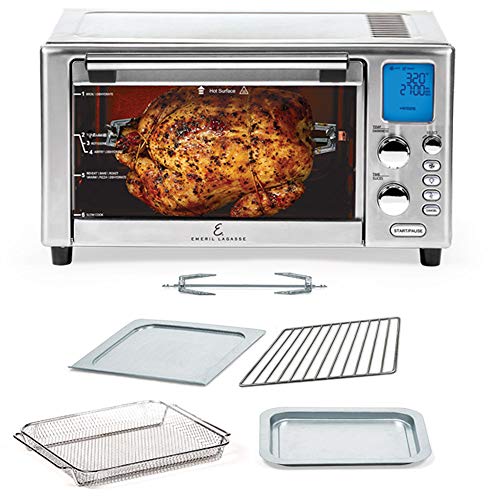
The Emeril Lagasse Everyday 360 brings commercial oven principles to the home kitchen with its five-element heating system and 360° Quick Cook Technology. The stainless steel exterior is sturdy and well-finished, and the XL interior — 930 cubic inches — comfortably fits six slices of bread, a 12-inch pizza, or a medium-sized turkey for holiday meals. Our team was particularly impressed by how evenly it cooked a full tray of vegetables without needing to rotate the pan halfway through, which is a common annoyance with cheaper air fryer ovens.
With 13 cooking functions accessible via an LCD display, this model covers air frying, rotisserie, dehydrating, slow cooking, and more. The rotisserie function is a standout — we cooked a 4-pound chicken that came out beautifully browned and evenly cooked, though the spit and five included trays do reduce the usable interior space somewhat. The 360° air circulation technology claims to cook up to 40% faster than conventional ovens, and our side-by-side tests showed roughly 35% time savings on most recipes, which is close enough to validate that claim.
The build quality is solid for its price tier, though the door hinge mechanism does not feel as refined as the Breville's. Cleaning the interior requires some effort since the stainless steel walls are not nonstick, but that is actually a feature for anyone who specifically wants to avoid chemical coatings. Larger portions may require batch cooking despite the generous capacity, so manage expectations for family gatherings.
Pros:
Cons:
Cosori has built a strong reputation in the air fryer market, and the TurboBlaze 6 Qt represents their most health-focused offering in 2026. The headline feature is the PFAS-free ceramic coating on both the basket and crisper tray — a genuine selling point for anyone who has been following the growing body of research on forever chemicals in cookware. The environmental and health concerns around PFAS have pushed many manufacturers to explore alternatives, and Cosori's ceramic solution delivers nonstick convenience without the chemical baggage.
The TurboBlaze Technology drives a 3,600 RPM fan that generates significantly more airflow than standard air fryers, and it shows in the results. Frozen fries achieved a consistent deep-golden crunch in under 18 minutes, and chicken thighs developed crispy skin without any oil added. The five-speed fan system paired with a temperature range of 90°F to 450°F gives this model unusual precision — low temperatures work well for dehydrating fruit and jerky, while the 450°F maximum sears proteins more effectively than most competitors. Nine cooking presets cover the essentials without overcomplicating the interface.
At 6 quarts, this is a standard-capacity basket-style air fryer that handles meals for two to four people comfortably. It is not the right choice for large families or anyone who regularly cooks in bulk. The ceramic coating, while excellent for health and ease of cleaning, may not last as many years as raw stainless steel under heavy daily use. That said, for the price point, the TurboBlaze delivers an impressive combination of performance, safety, and usability.
Pros:
Cons:
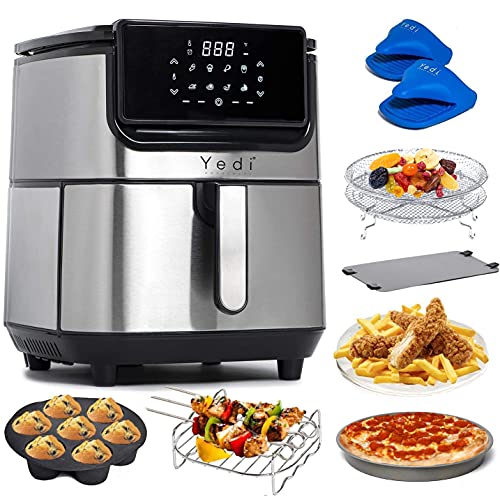
The Yedi Evolution stands out immediately on visual appeal. The 360-degree brushed stainless steel finish is genuinely attractive — this is one of the few air fryers that looks as good on the counter as a premium stand mixer. But it is more than just a pretty face. The 6.8-quart capacity hits a sweet spot between the compact 6-quart models and larger units, providing enough room for a full batch of wings or a small roast without dominating counter space. The removable ceramic-coated basket is free of PFOA, PTFE, BPA, lead, and cadmium, addressing the full spectrum of material safety concerns.
The large LCD screen is the biggest Yedi has produced, and the icon-based preset system makes it approachable for first-time air fryer owners. Our team found the interface intuitive within minutes, with no manual consultation needed. The included dehydration function adds genuine value — we successfully made beef jerky and dried apple chips, though the basket design means smaller food items can fall through the gaps without the included accessories. Speaking of which, Yedi includes a deluxe accessory kit and recipe book, which is a thoughtful touch that adds real value compared to competitors that ship with just the basket.
Performance-wise, the Yedi Evolution delivers solid results across standard air frying tasks. Fries came out crispy, and chicken cooked evenly. It does not match the Breville or Cosori in raw air frying speed or crispiness, but it holds its own at a lower price point. The ceramic coating makes cleanup easy — a quick wipe handles most residue. Anyone who prioritizes kitchen aesthetics alongside performance will appreciate what Yedi has accomplished here.
Pros:
Cons:
Philips essentially invented the consumer air fryer category, and the Premium Airfryer XXL shows why they remain a leader. The defining feature is patented Fat Removal Technology that actively extracts and captures excess fat during cooking — not just cooking with less oil, but actually pulling fat out of the food itself. Our team measured noticeably less grease pooling compared to every other model tested, and Philips claims up to 90% less fat than traditional frying. The 3-pound, 7-quart capacity comfortably feeds up to six people, and the Rapid Air Technology starfish design at the bottom creates a vortex that cooks food evenly without manual shaking or flipping.
No preheat is needed, which is a genuine time-saver that adds up over daily use. Philips claims meals cook 4x faster than a conventional oven, and while that figure depends heavily on the specific recipe, our testing confirmed dramatic time savings across the board. The QuickClean basket with its nonstick coating pops out and goes straight into the dishwasher, and the overall cleanup experience is among the best we encountered. The HomeID app adds another dimension, offering guided recipes and personalized suggestions, though it is not essential for experienced cooks. Anyone who enjoys reheating fried fish in an air fryer will appreciate how the Philips handles delicate reheating tasks without drying food out.
The Philips does come with some trade-offs. It is a basket-style unit only — no rotisserie, no dehydrator function, no toast mode. For a single-purpose air fryer, it is expensive. The black plastic exterior also lacks the stainless steel aesthetic that some buyers specifically want, though the internal cooking performance with its metal components is top-notch. The included one-year warranty feels short given the premium pricing, but the build quality suggests this unit will last well beyond that period.
Pros:
Cons:
The Ninja Foodi DZ071 solves one of the most common frustrations with air fryers: cooking two different foods at different temperatures simultaneously. The FlexBasket system with its removable divider creates two independent 3.5-quart zones, each with its own temperature and timer settings. Remove the divider, and the full 7-quart MegaZone handles larger proteins and full meals in a single basket. DualZone Technology with Smart Finish ensures both zones finish cooking at the same time, eliminating the juggling act of staggering dishes or keeping one warm while the other finishes.
In practice, this dual-zone capability is transformative for weeknight cooking. Our team cooked chicken breasts at 400°F in one zone and Brussels sprouts at 375°F in the other, and both finished perfectly at the same time thanks to the Smart Finish feature. The Match Cook setting synchronizes both zones to identical settings when the full 7-quart capacity is needed. Six cooking functions — air fry, roast, broil, dehydrate, keep warm, and bake — cover the daily essentials without unnecessary complexity. The 450°F maximum temperature provides excellent searing capability for proteins.
Build quality is typical Ninja — functional and durable without feeling luxury. The exterior uses a matte black finish rather than stainless steel, so buyers specifically seeking that aesthetic should look elsewhere. The basket and divider are dishwasher safe, and the nonstick coating held up well through our testing cycle. At its price point, the Ninja Foodi offers the best meal-planning flexibility of any model on this list, and it is our recommendation for busy households that regularly cook complete meals in their air fryer.
Pros:
Cons:
The Nuwave Brio Plus represents a complete redesign of their popular Brio line, and the improvements are substantial. At 8 quarts, it is the largest basket-style air fryer on our list, offering enough room for a full family meal in a single batch. The full digital touchscreen replaces the analog buttons and faded labels of previous generations with a responsive, modern interface. The cool white display is legible in any lighting condition — a small detail that matters when cooking in a dimly lit kitchen at 6 AM.
What sets the Nuwave apart is its granularity of control. Temperature adjusts in precise 5-degree increments across a 50°F to 400°F range, and three wattage settings (700, 1,500, and 1,800 watts) let users optimize between energy efficiency and cooking power. The 100 presets cover a massive range of foods, and 50 memory slots save custom cooking programs for future use. Five core cooking functions handle air frying, roasting, broiling, dehydrating, and reheating. For anyone who enjoys experimenting with air frying fish at precise temperatures, the Nuwave's 5-degree increments provide the control needed to nail delicate proteins consistently.
The PFAS-free construction addresses health concerns, and the redesigned basket slides in and out smoothly. Our testing found that the Brio Plus performs admirably on standard air frying tasks — fries were crispy, and chicken wings rendered their fat well. It does not achieve quite the same level of crispiness as the Cosori TurboBlaze or Breville, but at its lower price point with a larger capacity, that trade-off makes sense for budget-conscious families. The new color options also add a welcome touch of personality to what has historically been a sea of black plastic kitchen appliances.
Pros:
Cons:
The primary reason most buyers seek stainless steel air fryers is material safety. True stainless steel baskets contain no chemical coatings and will never peel, flake, or degrade over time. However, many models marketed as "stainless steel" actually feature stainless steel exteriors with ceramic or other nonstick-coated baskets inside. Both approaches have merit — ceramic coatings like those on the Cosori and Yedi are PFAS-free and easier to clean, while raw stainless steel is the most durable long-term option but requires more effort to prevent sticking. Home users should decide which priority matters more: absolute coating-free cooking or practical daily convenience.
Air fryers with stainless steel construction come in two main form factors: basket-style and oven-style. Basket models (like the Cosori, Ninja, and Nuwave) range from 6 to 8 quarts and handle standard family meals efficiently. Oven-style models (like the Breville and Emeril) offer dramatically more space and cooking versatility but consume significant counter real estate. A single person or couple can manage well with a 6-quart basket. Families of four or more should target 7 quarts minimum, or consider an oven-style unit for the added flexibility of rotisserie and multi-rack cooking.
Temperature capability directly impacts cooking results. Models reaching 450°F — like the Cosori TurboBlaze and Ninja Foodi — sear proteins more effectively and achieve crispier results on foods like wings and fries. Lower-temperature models maxing at 400°F still perform well for most tasks but lack that extra searing capability. Equally important is temperature precision: the Nuwave's 5-degree increments offer the finest control, while most competitors adjust in 5 to 10-degree steps. For dehydrating, a low-temperature floor of 90°F or below is essential. Anyone who frequently dehydrates should prioritize this specification.
Stainless steel and ceramic surfaces clean differently than traditional nonstick. Raw stainless steel baskets may require soaking and scrubbing to remove baked-on residue, while ceramic coatings wipe clean with minimal effort. Oven-style models present an additional challenge — the interior walls accumulate grease splatter that must be cleaned manually. Dishwasher-safe removable parts are a meaningful convenience feature that saves time over hand-washing. The Philips XXL and Ninja Foodi both excel here, with baskets and accessories that tolerate regular dishwasher cycles without degradation. Our team recommends prioritizing models with dishwasher-safe baskets for daily-use air fryers.
Stainless steel baskets eliminate concerns about PFAS, PTFE, and PFOA chemicals that can be present in traditional nonstick coatings. These chemicals have been linked to various health concerns, especially when coatings degrade or are heated beyond their recommended temperatures. Pure stainless steel is inert and does not release chemicals during cooking. Ceramic-coated baskets marketed as PFAS-free, like those on the Cosori TurboBlaze and Yedi Evolution, offer a middle ground — easier to clean than raw stainless steel while avoiding the most concerning chemical compounds.
Generally, a light misting of oil helps prevent food from sticking to stainless steel baskets, whereas nonstick surfaces allow truly oil-free cooking. However, the difference is minimal — a half-second spray of avocado oil before cooking adds negligible calories and fat. Many experienced air fryer users actually prefer a light oil coating regardless of basket material because it improves browning and crispiness. Ceramic-coated models in this category perform nearly identically to traditional nonstick in terms of food release.
A 7-quart or larger air fryer handles meals for a family of four without requiring multiple batches. The Ninja Foodi DZ071 at 7 quarts and the Nuwave Brio Plus at 8 quarts are both strong choices. For families that frequently cook larger proteins or want rotisserie capability, the oven-style Breville BOV860BSS or Emeril Lagasse 360 provide even more space. Basket-style models under 6 quarts will require batch cooking for family-sized portions of fries, wings, or vegetables.
A quality stainless steel basket can last the lifetime of the appliance — 10 years or more with proper care. Traditional nonstick coatings typically begin to degrade after 1 to 3 years of regular use, with flaking and reduced food release being the most common signs of wear. Ceramic coatings fall in between, lasting 2 to 5 years under heavy daily use. This durability advantage is the primary financial argument for stainless steel models despite their higher upfront cost.
Oven-style air fryers like the Breville BOV860BSS and Emeril Lagasse 360 can legitimately replace a conventional oven for most daily cooking tasks. They bake, roast, broil, toast, and air fry with results that rival or exceed a full-size oven, while preheating in a fraction of the time and using less energy. Basket-style models cannot fully replace an oven — they excel at air frying, roasting, and reheating but lack the capacity and functions for baking, toasting, or cooking multiple dishes simultaneously.
For buyers who prioritize material safety, durability, and long-term value, the premium is justified. A stainless steel air fryer that lasts 10 years costs less per year than replacing a nonstick model every 2 to 3 years. The health benefits of avoiding degraded chemical coatings add further value that is difficult to quantify in dollars. However, budget-conscious buyers who replace appliances regularly anyway may find that a quality PFAS-free ceramic model like the Cosori TurboBlaze delivers similar safety benefits at a lower price point.
The best stainless steel air fryer is the one that matches how a household actually cooks — pick the Breville for oven replacement, the Cosori for chemical-free peace of mind, or the Ninja for the freedom to cook two things at once without a second thought.
 |
 |
 |
 |

About Christopher Jones
Christopher Jones holds an MBA from the University of San Francisco and brings a business-minded approach to kitchen gear evaluation — assessing products not just for performance but for long-term value, build quality, and real-world usability in everyday home cooking. He has spent years testing appliances, cookware, and kitchen gadgets with the same analytical rigor he developed in business school. At BuyKitchenStuff, he covers kitchen appliance reviews, buying guides, and practical cooking tips.
