Kitchen Gadgets & Equipment Reviews ›
by Daisy Dao
What's the single best way to guarantee a juicy, flavor-packed brisket or Thanksgiving turkey every single time? If you've been relying on surface rubs and overnight brines alone, you're leaving a lot of flavor on the table. A quality meat injector puts marinade directly into the muscle, where it actually matters — and the difference in your next cook will be obvious from the very first bite. After testing dozens of models across price points and use cases, the Ofargo Stainless Steel Meat Injector stands out as the top pick for most home cooks in 2026.
Meat injection (pushing liquid marinade deep into cuts using a syringe-style tool) has been a staple of competition BBQ pits for decades. Now it's completely mainstream, and the market is flooded with options ranging from basic budget syringes to professional-grade guns with multiple needle attachments. Choosing the wrong one means leaky seals, bent needles, or marinade that spurts out the entry point instead of distributing evenly. Choosing the right one means fall-apart brisket and turkey that your guests will talk about for weeks.
In this guide, Christopher Jones reviews seven of the best meat injectors available on Amazon in 2026 — breaking down build quality, needle selection, capacity, and real-world usability so you can pick the one that fits your cooking style and budget. Whether you're a weekend griller or a serious pitmaster, there's a pick here for you. And if you want to sharpen the rest of your kitchen game too, check out our guide on how to sharpen a kitchen knife for skills that pair perfectly with precision cooking.
Contents
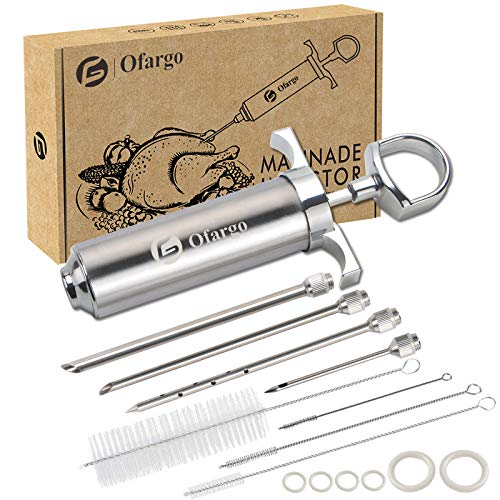




The Ofargo kit earns its top spot by nailing every fundamental. The barrel and plunger are both full stainless steel — not plastic with a chrome finish, actual culinary-grade metal — which means no cracking, no peeling, and no mystery materials touching your marinade. The silicone O-ring seals keep everything leak-free under pressure, which anyone who's dealt with a syringe that squirts marinade all over the counter will immediately appreciate. At 2 oz capacity, it's the right size for most home cooks: large enough to inject a full turkey or brisket without constantly refilling, compact enough to control precisely.
The four included needles cover almost every scenario you'll encounter. There's a standard liquid-injection needle, a needle with side holes for even distribution in dense cuts like pork shoulder, a fine needle for thinner liquids, and a basting brush attachment made from silicone rated for high cooking temperatures. This is the kind of thoughtful kit design that saves you from hunting down accessories later. The included paper user manual and e-book recipe collection are genuinely useful additions — especially if you're new to injection cooking and want proven marinade formulas for turkey, beef brisket, or even dessert applications like injecting rum into strawberries.
Build quality is heavy by design. The metal barrel has real weight in hand, which translates to confidence during use. Piercing through a frozen-surface chicken thigh or a tough-skinned turkey breast takes no real effort with the sharp stainless needles. Cleanup is straightforward — disassemble, run the cleaning brush through each needle, and either hand-wash or rack the components. This is the injector we'd hand to a first-time buyer without a second thought.
Pros:
Cons:
Premiala made a smart call that most competitors missed entirely: they included a marinade straw for filling the syringe. Instead of submerging the needle tip in a bowl of marinade and pulling back the plunger (which is slow, messy, and frustrating), you attach the 12-hole filling needle to a straw and draw up your liquid cleanly in seconds. Premiala claims it's 60% quicker and 100% less messy than the standard method, and that's genuinely accurate. If you cook frequently, that quality-of-life improvement alone justifies choosing this kit.
The 304-grade stainless steel (also called food-grade or surgical-grade stainless) is a meaningful differentiator. Premiala explicitly avoids aluminum components — a smart move since aluminum can leach into acidic marinades over time. Every part that touches your marinade is 304 stainless, and they back that claim clearly in the product description. The kit includes four precision needles covering liquid marinades, thicker pureed sauces, and a steak needle for thinner cuts like minute steaks or kebabs. You also get four cleaning brushes (one per needle) and eight spare O-rings, which means you have replacements ready before the originals wear out.
The 2 oz barrel is standard, but between the straw-fill system and the four-needle selection, this kit handles more cooking situations than most similarly-priced competitors. If you ever find yourself prepping thick BBQ sauces to inject alongside thinner liquid marinades, the jumbo needle handles pureed consistency without clogging. Long-term owners report the O-rings hold up well, and with eight spares in the box you're covered for years of heavy use.
Pros:
Cons:
The SpitJack injector is a different category of tool. This thing is made in the USA, assembled in American workshops with local labor, and it's adapted from veterinary instruments used to inject entire herds of animals. That's not marketing fluff — that lineage means the engineering tolerances are built for continuous, heavy-duty use, not one-off holiday cooking. If you're catering events, running a BBQ competition circuit, or just cooking for large groups regularly, the SpitJack is the one to reach for.
The gun-style grip design is the most ergonomically thoughtful format for injecting large quantities of marinade. Rather than pushing a plunger with your palm, you squeeze a trigger, which distributes the effort across your hand and lets you inject precisely without hand fatigue. On a 20-pound competition brisket where you're making dozens of injection points, that ergonomic advantage is significant. Four stainless steel needles cover the full range of injection scenarios, and the 50ml (roughly 1.7 oz) capacity barrel handles most cuts without excessive refilling.
SpitJack's guarantee is unusually direct: if it breaks, they fix it or replace it. For a tool built on the engineering heritage it claims, that confidence is well-placed. Users report that needles don't bend, barrels don't crack, and the trigger mechanism stays tight even after years of use. The one trade-off is price — this is the premium option in this roundup, and it's priced accordingly. But if you need a meat injector that treats professional use as a baseline rather than an aspiration, the SpitJack delivers.
Pros:
Cons:
The Bayou Classic 5030 proves that a meat injector doesn't have to be complicated to be effective. This is a stripped-down, no-nonsense syringe with a single stainless steel needle and a 2 oz barrel. That's the whole product — and for casual home cooks who inject a turkey a few times per year, it's genuinely all you need. The stainless steel needle is sharp, durable, and easy to clean, handling poultry, beef, pork, and wild game without any drama.
Bayou Classic has been making outdoor cooking equipment for decades, and the 5030 reflects that heritage. It's a workhorse built to last without fancy features. The simplicity is a feature in itself — fewer components means fewer things that can fail, leak, or lose a piece during cleanup. Assembly and disassembly take seconds. If you've ever bought a fancy multi-piece kit only to lose one of the seven needle attachments, the appeal of a single-needle design makes a lot of sense.
The limitation is obvious: one needle means one injection style. You can't handle thick chunky marinades or switch to a steak needle for thin cuts. This is a liquid-marinade injector, full stop. But for its intended purpose — marinating poultry, pork, and beef with thin to medium-consistency seasoning liquids — the Bayou Classic 5030 delivers consistent results at a price that makes it the easiest recommendation for budget-conscious buyers. It's the right first injector for someone who wants to try the technique without a big investment.
Pros:
Cons:
When you're injecting a whole brisket or a large turkey before a big gathering, stopping every 2 oz to refill is genuinely annoying. The HICOOK injector solves that problem directly with a 4 oz (½ cup) barrel — double the capacity of most competitors. That larger reservoir means fewer interruptions to your workflow, and on large cuts where you're making 20+ injection points, that time and efficiency savings adds up fast.
The three-ring handle design deserves mention because grip matters more than most buyers realize. Controlling an injector requires steady hand pressure, especially when working with thick marinades or resistant muscle tissue. The three-ring grip distributes your fingers properly and gives you leverage without hand strain. The sturdy plunger offers improved pressure control — you can modulate injection speed precisely rather than forcing marinade in unevenly. Three specialized needles cover liquid, solid/chunky, and precision applications: a 6-inch side-hole needle for liquids, a large-end-hole needle for solid or thicker marinades, and a 3-inch shorter needle for smaller cuts or precision work.
Dishwasher-safe construction is a real convenience bonus that the competitors at this price point don't always offer. After a big BBQ session, you can rack everything in the dishwasher and move on with your evening instead of scrubbing needles by hand. Build quality is solid commercial grade throughout — high-grade stainless steel on all food-contact components, sharp needles that pierce tough cuts without bending. According to Wikipedia's overview of marination, injecting marinades directly into meat tissue achieves deeper flavor penetration than surface brining alone — and the HICOOK's capacity and precision make that process significantly more efficient.
Pros:
Cons:
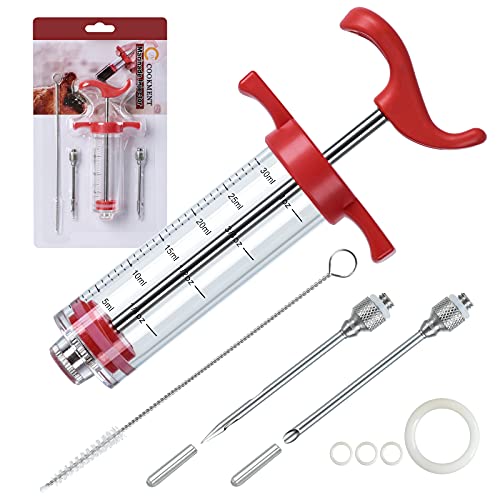
The JY COOKMENT is the most compact option in this roundup, with a 1 oz barrel that makes it exceptionally easy to control for precise, small-volume injections. If you're regularly cooking chicken breasts, pork tenderloins, or smaller roasts rather than whole turkeys and briskets, that reduced capacity is actually an advantage — you waste less marinade, refill less often for smaller cuts, and have finer control over exactly how much liquid goes into each injection point. The two professional needles included are sharp enough to pierce any cut without bending.
JY COOKMENT keeps the design focused. Food-contact-safe materials throughout, quick disassembly for cleaning, and a cleaning brush included in the kit so you can actually clean the needles properly without a separate purchase. The recommendation for hand washing over dishwasher is honest and worth following — the small size means pieces are easier to lose in a dishwasher and the hand-wash process takes under two minutes anyway.
Where the JY COOKMENT earns its place in this lineup is accessibility. It's approachable for someone who's never used a meat injector before, lightweight enough to feel confident with, and priced to make the purchase a no-risk experiment. Once you've developed the technique on smaller cuts, you'll know whether you want to invest in a higher-capacity or multi-needle kit. Think of it as the best starting point for home cooks who are new to injection cooking but don't want to commit to a full professional kit on day one. It's also compact enough to tuck into a drawer without taking up real estate — always a practical consideration in a busy kitchen. If you're the kind of cook who thinks carefully about food storage too, our guide on how to store food in the freezer pairs well with the marinate-then-freeze workflow many injection cooks use.
Pros:
Cons:
Most meat injectors work fine with thin liquid marinades — butter-based blends, citrus brines, apple juice mixes. But what about pesto? Jerk seasoning paste? Garlic-herb blends with real texture? Most syringes clog immediately with anything thicker than a smooth liquid. The BBQ Dragon kit solves that with its angled chunky-marinade needle, which is specifically engineered for thicker, textured marinades that would jam a standard side-hole needle. If you cook with complex, restaurant-style marinade blends, this is the injector built for you.
The kit includes three needles total: a 6-inch twelve-hole needle for liquid marinades (the twelve holes mean even distribution throughout the injection path), the angled chunky needle for thicker blends, and a 3-inch steak needle for thin cuts where precision matters. The 2 oz barrel hits the standard capacity mark, and the stainless steel construction throughout keeps everything food-safe and durable. BBQ Dragon is an established brand in the outdoor cooking space, and their quality control on this kit reflects that reputation.
The twelve-hole liquid needle deserves extra attention because it's the detail that separates good injection from great injection. Twelve holes along the needle shaft means marinade exits at multiple points simultaneously, creating a wider distribution pattern inside the meat with each insertion. That translates to more even flavor throughout the cut versus the uneven pockets you sometimes get with single-hole designs. Whether you're injecting a Thanksgiving turkey or a competition-level BBQ brisket, that even distribution makes a real difference in the final result. And when your brisket comes out perfect, you'll want your sides to match — our tips on how to thicken BBQ sauce help you nail the accompaniment too.
Pros:
Cons:
This is the first decision you should make, and the answer is almost always stainless steel. Food-contact surfaces should be either 304-grade stainless steel or food-safe silicone — never aluminum (which can react with acidic marinades) and never unlabeled plastic. Most budget injectors use a plastic barrel with a stainless needle, which is a reasonable compromise if the plastic is explicitly labeled food-safe. But full stainless steel construction like the Ofargo or Premiala means no chemical leaching concerns at all, and it holds up to repeated dishwasher cycles or high-temperature use without cracking.
Check specifically for 304-grade stainless on all components that touch marinade: the barrel interior, the plunger, the needles, and the O-rings (which should be silicone, not rubber). Premiala explicitly advertises 304-grade and aluminum-free construction. If a listing doesn't specify the grade of stainless, that's a yellow flag.
A single-needle injector works fine for thin liquid marinades. But if you want versatility, look for at least two or three needles covering different functions. The main types you'll encounter are:
The more variety in your needle kit, the more cooking situations you can handle without buying add-ons. For most home cooks, a kit with two to four needles covers everything you'll actually cook.
Standard meat injectors hold 1–2 oz. Larger options like the HICOOK reach 4 oz. The right capacity depends on what you're cooking most often. For whole turkeys, large briskets, or pork shoulders — a larger barrel means fewer refills and a faster overall injection process. For smaller cuts like chicken thighs, pork tenderloins, or individual steaks, a 1–2 oz barrel gives you better control and wastes less marinade. Consider your most common use case when choosing.
Meat injectors that aren't cleaned properly are a food safety hazard — residual marinade in narrow needle channels can harbor bacteria between uses. Look for kits that include dedicated needle-cleaning brushes (the Premiala kit includes four brushes, one per needle). Dishwasher-safe construction like the HICOOK is a real convenience bonus. If you're hand-washing, the process should take no more than a few minutes per needle with a cleaning brush and warm soapy water. Avoid any injector that's advertised as "easy clean" but doesn't include a cleaning brush — that's usually an empty claim.
A meat injector is a syringe-style kitchen tool that pushes liquid marinades, butter blends, brines, or seasoning mixtures directly into the interior of meat cuts. Unlike surface rubs or brines that only penetrate the outer layer, injection delivers flavor deep into the muscle tissue — resulting in juicier, more evenly seasoned results throughout the entire cut. It's especially popular for large cuts like brisket, pork shoulder, and whole turkeys.
They accomplish different things, and the best approach is often both. Brining (soaking meat in a saltwater solution) seasons the outer layers and helps retain moisture during cooking. Injection delivers concentrated flavor directly into the center of the cut, where brining liquid takes much longer to penetrate. For large cuts like a whole turkey or a 12-pound brisket, injection ensures that the interior is just as flavorful as the surface. Using both techniques together gives you the best of both worlds.
Any liquid or semi-liquid mixture works well. Common choices include melted butter with garlic and herbs, apple juice or apple cider vinegar blends for pork, Cajun butter mixtures for poultry, beef broth with Worcestershire sauce for brisket, and citrus-based marinades for chicken. Thinner liquids work with standard side-hole needles; thicker blends like pureed garlic butter or jerk seasoning paste need a wide-bore or end-hole needle to avoid clogging. Avoid very chunky marinades with large solid pieces — those will clog most needles regardless of design.
Disassemble the injector completely immediately after use — don't let marinade dry inside the needle channels. Run a dedicated cleaning brush through each needle from both ends under warm running water. Wash the barrel, plunger, and O-rings with dish soap and warm water, then rinse thoroughly. If your injector is dishwasher-safe, the top rack is safe for all components. Air-dry fully before reassembly and storage. Replace O-rings if you see cracking or leaking — most quality kits like the Premiala include spare O-rings for exactly this reason.
A general guideline is about 1 oz of marinade per pound of meat, though this varies by the intensity of your marinade and personal preference. For a 12-pound turkey, that's roughly 12 oz total — distributed across multiple injection points spaced about 1–2 inches apart across the entire surface of the cut. Inject slowly and steadily rather than forcing the plunger quickly, which causes marinade to squirt back out the entry point rather than distributing into the tissue. Moving the needle slightly during injection helps spread the marinade over a wider area with each insertion.
Plastic injectors can be food-safe if the plastic is specifically rated for food contact (look for BPA-free, FDA-approved material labeling). However, plastic barrels can crack over time, especially with high-temperature liquids like melted butter. They're also harder to fully sanitize than stainless steel and can absorb flavors or odors from marinades over repeated use. For anyone using their injector regularly, a full stainless steel barrel and needle kit is worth the modest additional investment for long-term safety and durability.
The best meat injector is the one you'll actually use — buy for the cuts you cook most often, and flavor will follow every time.
 |
 |
 |
 |

About Daisy Dao
Daisy Dao grew up in Honolulu, Hawaii, where coastal living and access to fresh local ingredients shaped her approach to home cooking from an early age. She has spent years experimenting with seafood preparation, healthy cooking methods, and ingredient substitutions — developing hands-on familiarity with a wide range of kitchen tools, techniques, and produce. At BuyKitchenStuff, she covers healthy recipes, cooking techniques, and ingredient substitution guides.
