Kitchen Gadgets & Equipment Reviews ›
by Rick Goldman
Picture this: you pack a fresh salad, some grapes, and a yogurt for lunch — then open your bag at noon to find everything lukewarm and sad. If that sounds familiar, you already know why a freezable lunch bag is worth the upgrade. The right bag keeps your food genuinely cold without relying on bulky ice packs that leak and take up space.
We tested and researched the best options on the market in 2026 so you don't have to guess. Whether you're meal-prepping for the office, packing lunch for school, or just want your food to stay fresh on a long commute, this guide covers every top pick. Browse all of our kitchen product reviews for more help building the perfect lunch setup.
From PackIt's innovative built-in gel technology to YETI's premium insulation, there's a freezable lunch bag for every lifestyle and budget. Here's what we found.
Contents



PackIt's Classic Lunch Box earns the top spot because it completely eliminates the ice pack problem. Freezable gel is built directly into the walls of the bag — just collapse it flat, toss it in the freezer overnight (12 hours), and by morning the whole bag is frozen and ready to go. No separate packs to freeze, no extra parts to forget, no messy leaks inside your lunch.
The large zip opening makes packing fast. You can fit a full lunch — a sandwich, fruit, yogurt, and a drink — without playing Tetris. The buckle handle clips onto a backpack or gym bag so your hands stay free. The exterior mesh side pocket holds a small water bottle or utensils, and a front zip pocket stores cards or wipes. It's a complete, thoughtful design that covers the basics and then some.
Performance-wise, this bag holds cold temperatures for hours, making it ideal for anyone who packs fresh fruits, vegetables, cheese, or allergy-sensitive foods. If you're particular about keeping food at safe temperatures — the FDA recommends keeping perishables below 40°F — this bag takes the guesswork out of the equation. It's also perfect if you like to store fresh pasta and bring it for lunch, since pasta and dairy need reliable cold protection.
Pros:
Cons:
This is the original PackIt formula in a softer, more flexible bag format. It uses the same patented EcoFreeze Technology — gel permanently embedded in the bag's lining — so you still just fold it flat and freeze it the night before. In the morning it's completely frozen and ready to keep food and drinks cold all day long.
The dimensions open to 10"H × 8.5"W × 5"D, giving you solid space for a full day's worth of food. It's lighter and more pliable than the Classic Box version, which makes it easier to stuff into a crowded backpack or locker. If your priority is something simple and no-fuss, this is exactly that. No straps, no clips — just fold, freeze, fill, and go.
Pros:
Cons:
The Hampton is PackIt's most polished, commuter-ready bag. It keeps the same EcoFreeze Technology at its core — nontoxic gel built into the lining so you never need ice or ice packs — but adds shoulder straps for hands-free carrying, a front pocket for extras, and a more structured shape that looks at home in any office or on any transit ride.
Open dimensions are 7.5"L × 10"W × 8.5"H. Collapsed, it packs down to just 2.5"L × 10.5"W × 9"H. That's genuinely compact for a freezer. The food-safe BPA-free liner means everything that touches your lunch is clean and non-toxic. The zip closure locks in cold dry air effectively. If you take public transit, bike to work, or carry a tote alongside a laptop bag, the Hampton's shoulder strap setup is a real practical upgrade over a handle-only bag.
Pros:
Cons:
If your workday runs long or you need your lunch to stay cold through a full 8-hour shift, the Arctic Zone Titan Deep Freeze is built for that. It uses SuperFoam insulation combined with a Therma-Flect radiant barrier (a reflective interior lining that bounces heat away from your food) plus two included reusable Ice Walls. Together, this system keeps contents fridge cold for up to 6 hours and chilled for up to 12.
The Ice Walls are smart: they slide into exterior pockets, so you insert them from the outside without opening the main compartment. That keeps the cold air locked inside where it belongs. The interior has an ultra-safe leak-proof lining with Microban antimicrobial protection — meaning it actively resists the buildup of odors and stains, which makes cleanup much easier after a long day. The bag also expands when you need more room, making it genuinely versatile.
This is the bag to grab if you're packing leftovers from last night's grilled dinner — check our guide to the best non-stick grill pan if you're cooking the food going into this bag. The Titan is also a solid pick for construction workers, nurses, teachers, or anyone who can't just pop food in a fridge during their shift.
Pros:
Cons:
This is essentially the same powerhouse cooling system as the Deep Freeze model above — SuperFoam insulation, Therma-Flect radiant barrier, two Ice Walls, Microban-protected leak-proof lining — but wrapped in the eye-catching Jungle Hunt print. Same performance, bolder personality. If you want your lunch bag to stand out in a sea of plain black bags at the office, this delivers.
Performance specs match its sibling: fridge cold for up to 6 hours, chilled for up to 12, with Ice Walls that slot into exterior pockets so you don't break the cold seal to load them. The leak-proof lining is easy to wipe down and resists odor and stain buildup over time, which is a bigger deal than most people realize — lunch bag funk is real, and Microban protection actually prevents it rather than just masking it.
Pros:
Cons:
YETI doesn't make cheap products — and the Daytrip 6L isn't trying to compete on price. What it offers instead is class-leading build quality and ColdCell Flex Insulation that keeps your meal at the right temperature for hours without you having to think about it. The magnetic MagSnap closure is the real standout feature: it opens with one hand instantly and snaps shut just as fast, locking in cold air without a zipper to fumble with.
The 6-liter capacity is sized for a real adult lunch — not a snack pouch. The Classic Navy colorway is clean and professional enough for any workplace. YETI's design philosophy is "fold and go" — the bag is flexible and lightweight for its performance level. If you've invested in quality kitchen tools (we love pairing YETI gear with a proper setup — see our picks for the best meat injectors for serious home cooks), the Daytrip fits that same mindset: buy once, buy right.
You do need ice packs or ice with this one — ColdCell is exceptional insulation, but it's not self-chilling like PackIt's gel. That's the only real trade-off. For premium performance with a bag that will last years, it's hard to beat.
Pros:
Cons:
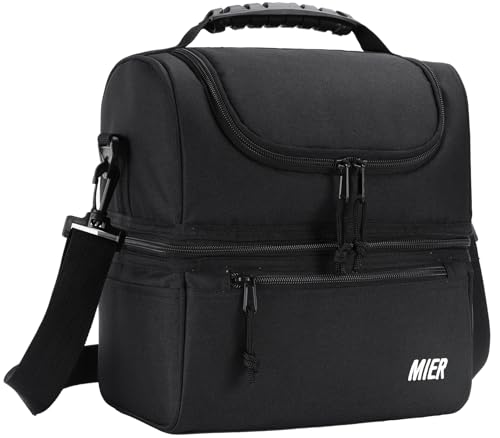
The MIER Double-Deck is the only bag on this list that completely separates your dry food from your cold drinks — and that single design choice makes it incredibly practical. The top compartment is designed for "dry" items: fruits, snacks, sandwiches, sliced veggies. It has a wide U-shaped opening with dual zipper pulls for fast access. The bottom compartment is fully insulated with a food-grade PEVA liner and heat-welded seams that prevent leaks, making it the safe zone for drinks, water bottles, and anything liquid.
Top compartment interior: 9.45"L × 7"W × 5.5"H. Bottom compartment interior: 9.45"L × 7"W × 4.7"H. Together you get substantial total storage — more than most single-compartment bags. The detachable and adjustable shoulder strap (31.5" to 55.5" range) handles most body types, and the MIER-design 2.0 silicone handle gives you a comfortable grip when you're hand-carrying it. This is a great bag for someone who brings both a full meal and multiple drinks to work every day.
You'll need ice packs for the insulated bottom section. But the separation system means your snacks never get soggy from condensation, and your lunch stays organized even when the bag gets stuffed. If you're the type who meal-preps seriously and wants everything in its place, the MIER Double-Deck earns its spot.
Pros:
Cons:
Not every freezable lunch bag works the same way, and the wrong choice can leave you with lukewarm food by noon. Here's what actually matters when you're comparing options.
This is the biggest fork in the road. You have two main approaches:
If you're a consistent planner who preps lunches the night before, built-in gel is more convenient. If your mornings are unpredictable, removable ice packs give you more flexibility.
Marketing numbers are often best-case scenarios. Here's a realistic breakdown:
If your lunch break is at noon and you leave home at 7am, you need at minimum 5 hours of reliable cold. Most bags here hit that target comfortably under normal conditions.
Think about exactly what you pack every day before picking a size:
Also consider extra pockets. The PackIt Classic has a mesh side pocket and front zip pocket. The Hampton adds a front pocket. The YETI and basic PackIt Lunch Bag keep it minimal. More pockets mean more to clean, but also more organization options.
You'll use this bag every weekday, so durability matters more than it might seem:
PackIt bags have nontoxic freezable gel permanently built into the bag's walls or lining. You collapse the bag flat, put it in your freezer for at least 12 hours, and by morning the walls are completely frozen. When you pack your lunch in the morning, the frozen walls chill the contents from all sides — no separate ice packs needed. The gel stays cold for several hours depending on ambient temperature and how often you open the bag.
It depends on the bag and conditions. PackIt bags typically maintain cold temperatures for 4–6 hours under normal conditions. The Arctic Zone Titan with its two Ice Walls keeps food fridge cold for up to 6 hours and chilled for up to 12 hours. YETI's ColdCell insulation with ice packs can push 6–8 hours or more. Factors like ambient temperature, how often you open the bag, and how full it is all affect performance. On a hot summer day, expect numbers on the lower end of the range.
It depends on which bag you choose. PackIt bags have built-in gel — you freeze the entire bag, so you never need separate ice packs. The Arctic Zone Titan bags come with two reusable Ice Walls included in the box. The YETI Daytrip and MIER Double-Deck do not include ice packs — you'll need to add your own. If you want a zero-extras setup, PackIt or the Arctic Zone Titan are your best options.
Yes, all the bags on this list use food-safe, BPA-free liner materials — typically PEVA. PackIt specifically markets their EcoFreeze gel as nontoxic. The Arctic Zone Titan uses Microban antimicrobial protection in the lining to prevent odor and bacteria buildup. For food safety, the key rule is keeping perishables below 40°F. A quality freezable lunch bag with a fully frozen gel system or freshly frozen ice packs will maintain that temperature for several hours under normal conditions.
Most freezable lunch bags are not machine washable — especially PackIt bags, since machine washing can damage the built-in gel system. For PackIt bags, hand wipe the interior with a damp cloth and mild soap, then air dry fully before freezing again. The Arctic Zone Titan's Microban lining wipes clean easily. The MIER's PEVA interior is also wipe-clean. YETI products are generally wipeable and very easy to maintain. Always check the manufacturer's care instructions before washing.
Both use the same EcoFreeze built-in gel technology and require 12 hours of freezing. The Classic Box has a more structured, boxy shape with a large top-load zip opening, a buckle handle that clips to backpacks, a mesh side pocket, and a front zip pocket. The Lunch Bag is a softer, more flexible format — simpler design with fewer exterior pockets but easier to squeeze into tight spaces. The Classic Box is better if you want extra organization and attachment points; the Lunch Bag is better if you want something lightweight and minimalist.
 |
 |
 |
 |

About Rick Goldman
Rick Goldman grew up traveling the Pacific Coast and developed an early appreciation for regional and international cuisines through exposure to diverse food cultures from a young age. That culinary curiosity shaped his approach to kitchen gear — he evaluates tools based on how well they perform across different cooking styles, ingredient types, and meal occasions. At BuyKitchenStuff, he covers kitchen equipment reviews, recipe guides, and food-focused buying advice.
