Kitchen Gadgets & Equipment Reviews ›
by Rick Goldman
Over 240 million crepes are consumed in France each year, and the demand for quality crepe pans has surged by 18% in North American kitchenware sales since 2023. Whether you're flipping paper-thin French crêpes or hearty buckwheat galettes, the pan you use determines the difference between a golden, lacy result and a torn, unevenly cooked mess. The best crepe pans in 2026 span carbon steel, cast iron, nonstick, and ceramic — each material bringing distinct advantages depending on your skill level and cooking style.
After evaluating dozens of options across material types, weight classes, and price ranges, we narrowed the field to seven standout crepe pans that represent the best of what's available right now. Our picks include options from heritage French manufacturers like Mauviel and de Buyer alongside modern contenders from OXO and GreenPan. We looked at heat distribution, surface seasoning, handle comfort, and long-term durability to arrive at these recommendations. If you're also outfitting your kitchen with other essentials, check out our guide to the best cookware for more curated picks.

The crepe pan market breaks into two camps. Nonstick and ceramic pans offer immediate ease of use — no seasoning, no sticking, minimal learning curve. Carbon steel and cast iron pans require upfront investment in seasoning but reward you with a naturally nonstick surface that improves over years of use. According to Wikipedia's overview of crêpe cooking traditions, the traditional Breton billig (crepe griddle) was always iron, and carbon steel remains the preferred material among professional crêperies worldwide. Your ideal pan depends on how often you cook crepes, whether you want a pan that lasts decades, and how much maintenance you're willing to perform.
Contents




Le Creuset built its reputation on enameled cast iron, but the Toughened Nonstick PRO line proves the company can excel with modern coatings too. This 11-inch crepe pan features a triple-reinforced nonstick surface that Le Creuset claims is four times stronger than previous generations. The coating sits atop a hard-anodized aluminum body that delivers fast, even heat distribution across the entire cooking surface. You get the responsiveness of aluminum without hotspots — a critical factor when you're trying to produce a uniformly thin crepe.
The included rateau (the T-shaped wooden spreader used in traditional French crêperies) sets this pan apart from competitors at similar price points. Having a properly sized spreader matched to the pan's diameter means you can achieve consistent batter thickness from day one. The pan's textured interior promotes browning while still releasing crepes effortlessly. It's a smart design choice that bridges the gap between the crisp results you'd get from carbon steel and the easy-release convenience of nonstick.
The stay-cool ergonomic handle deserves mention. At 11 inches, this pan has real weight to it when loaded with batter, and the handle's shape lets you tilt and swirl with one hand without strain. For cooks who want professional-quality crepes without the seasoning ritual, this is the pan to own. The main trade-off is price — you're paying Le Creuset's premium — and the nonstick coating, however reinforced, will eventually wear out in ways that carbon steel never does.
Pros:
Cons:
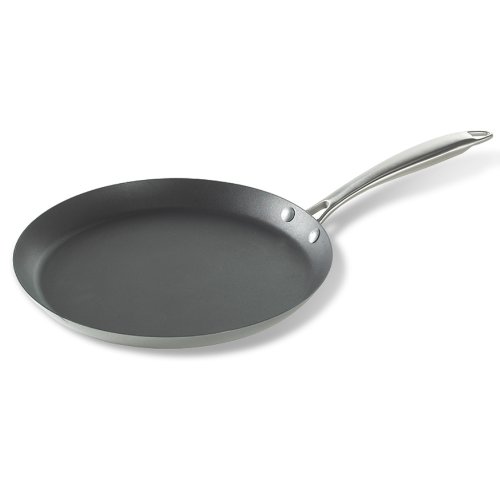
Nordic Ware's French Steel Crepe Pan delivers remarkable performance at a fraction of what premium brands charge. Built from aluminized steel — a material that combines aluminum's heat responsiveness with steel's durability — this pan offers a larger cooking surface than most traditional crepe pans in the 10-inch class. The shallow, gently sloped sides make flipping and sliding crepes effortless once you've built up a proper seasoning layer.
The nonstick interior coating gives beginners immediate confidence. Your first crepe won't stick, and you won't need to go through the seasoning process that carbon steel demands. That said, this is a different category of nonstick than what you'll find on the Le Creuset. It's functional and reliable, but it won't stand up to metal utensils or aggressive scrubbing. Use wooden or silicone tools exclusively. Nordic Ware manufactures this pan in the United States, and the build quality reflects their decades of experience in producing dependable kitchen tools at accessible prices.
Where the Nordic Ware truly excels is as an entry point. If you're making crepes for the first time or you want a dedicated pan for weekend brunches without committing to a $100+ investment, this is the logical choice. The 10-inch diameter is ideal for standard dessert crepes, and the lightweight construction means less fatigue during longer cooking sessions. Pair it with a good cooling rack to stack and cool your finished crepes efficiently.
Pros:
Cons:
Mauviel has been crafting cookware in Villedieu-les-Poêles, France since 1830, and the M'Steel crepe pan carries nearly two centuries of metalworking expertise. This pan is made from extra-thick black carbon steel with riveted iron handles — the same construction used in professional French crêperies. The extra thickness matters. Thicker steel means better heat retention and more consistent temperature across the cooking surface, which translates directly to evenly browned crepes without pale spots.
Carbon steel is a superb conductor of heat. It rises to temperature quickly and responds immediately when you adjust the burner — a quality that stainless steel and cast iron simply cannot match. After proper seasoning, the surface develops a natural nonstick patina that improves with every use. Professional chefs prize this quality because a well-seasoned carbon steel pan eventually outperforms any synthetic nonstick coating. The stainless steel 18/10 rivets securing the iron handle are commercial-grade, built to withstand the demands of restaurant service.
The 9.4-inch cooking surface is slightly smaller than some competitors on this list, which may matter if you prefer larger galette-style crepes. But for classic French dessert crepes, this size is traditional and practical. The iron handle does get hot during cooking — there's no silicone sleeve or stay-cool technology here. This is an uncompromising, professional-grade tool. You'll need a kitchen towel or handle cover, but you'll own a pan that can genuinely last your entire lifetime.

Pros:
Cons:
The de Buyer MINERAL B is the pan serious home cooks graduate to when they want the full crêperie experience. At 12 inches in diameter with a 10-inch cooking surface, it provides the largest working area on this list — enough room for full-sized galettes, tortillas, and oversized dessert crepes. de Buyer manufactures this pan in France from 99% iron with a beeswax coating applied at the factory. That beeswax isn't decorative; it protects the raw steel during shipping and provides the foundation for your first seasoning.
Carbon steel occupies a sweet spot between cast iron and stainless steel. It's lighter and more heat-responsive than cast iron, so you get faster temperature adjustments. It tolerates higher heat than stainless steel, making it ideal for achieving the slight caramelization (called the Maillard reaction — the browning that creates flavor) that separates great crepes from mediocre ones. After seasoning, the surface becomes naturally nonstick without any artificial coatings — an important consideration if you're concerned about PFAS or PTFE in your cookware.
The seasoning process is straightforward. de Buyer provides clear instructions: wash off the beeswax, heat gradually to medium-high, apply a thin oil layer, heat for 10 minutes until it smokes, cool, wipe dry, and reheat briefly. The pan will look patchy and uneven at first. This is normal. After 10 to 15 uses, the patina darkens and becomes uniformly slick. Many owners report that their de Buyer crepe pans become more nonstick than any coating after six months of regular use. The pan also doubles effectively as a tortilla press and pancake griddle, making it a versatile addition to your kitchen. If you're building out a well-equipped cooking station, you might also want to explore our roundup of the best cast iron griddles for complementary flat-surface cooking.
Pros:
Cons:
Staub brings the heft and heat retention of cast iron to the crepe pan category, and the results are distinctive. This 11-inch pan is made in France and comes bundled with a wooden spatula and spreader — everything you need to start making crepes immediately. Cast iron's defining characteristic is its ability to hold temperature. Once this pan is properly preheated, it maintains consistent heat even when cold batter hits the surface. That thermal stability produces crepes with exceptionally even browning from edge to edge.
The matte black enamel interior is Staub's signature. Unlike raw cast iron, the enameled surface doesn't require seasoning and won't react with acidic ingredients. You can make lemon-butter crepes or savory tomato-filled galettes without worrying about metallic flavors leaching into your food. The enamel also simplifies cleanup — a quick wash with warm soapy water is sufficient. The pan is oven-safe to 500°F, which opens up possibilities for gratinéed crepe dishes that start on the stovetop and finish under the broiler.
Weight is the primary consideration with cast iron. This pan is substantially heavier than carbon steel or nonstick alternatives, and the one-handed swirling technique used in classic crêpe-making requires more wrist strength. If you have joint concerns or plan to make large batches, you'll feel the difference after 20 minutes. That said, the weight provides its own advantage: the pan sits flat and stable on any burner without sliding. For cooks who value unmatched heat retention and the convenience of an enamel-coated surface, the Staub is the strongest choice in cast iron. It pairs well with the right tools — a quality set of heat-resistant cooking gloves will protect your hands when maneuvering this heavy pan.

Pros:
Cons:
GreenPan's Valencia Pro line has earned recognition from both America's Test Kitchen and Good Housekeeping, and this 9.5-inch crepe pan brings their award-winning ceramic nonstick technology to a dedicated crepe format. The headline feature is Thermolon 9G — GreenPan's latest ceramic coating that is completely PFAS-free and NSF Certified. In 2026, concerns about PFAS (per- and polyfluoroalkyl substances — sometimes called "forever chemicals") in cookware coatings have made ceramic nonstick a rapidly growing category. GreenPan is the market leader in this space.
The Valencia Pro's diamond-reinforced surface adds genuine durability to the ceramic coating. Earlier generations of ceramic nonstick had a reputation for losing their nonstick properties within a year or two. GreenPan claims the Thermolon 9G formulation lasts 10 times longer than previous versions, and independent testing supports meaningful improvement. The hard-anodized aluminum body provides excellent heat conduction, and the pan is compatible with all cooktops including induction — a feature that carbon steel and nonstick aluminum pans don't always offer.
This pan is dishwasher-safe and oven-safe to 600°F, giving it the highest oven rating on this list. The 9.5-inch diameter is modest but well-suited to standard crepes. For health-conscious cooks who want zero chemical risk from their cookware, the GreenPan Valencia Pro delivers the strongest combination of safety credentials and cooking performance. The ceramic surface releases crepes cleanly with minimal butter or oil, which also makes it a good fit if you're watching fat intake.
Pros:
Cons:
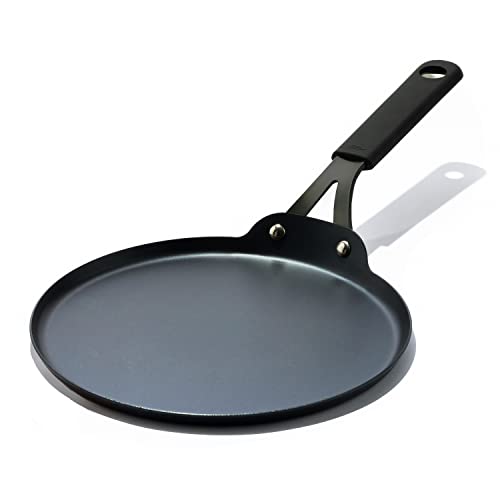
The OXO Obsidian earned Wirecutter's 2025 Best Pick designation, and the reasons are immediately apparent when you hold it. This is a pre-seasoned carbon steel pan that's ready to cook on right out of the box — eliminating the biggest barrier that keeps home cooks away from carbon steel. OXO applies a factory seasoning that provides functional nonstick performance from your very first crepe. The seasoning naturally deepens and improves with continued use, meaning the pan gets better over time rather than wearing out.
At 10 inches in diameter, the Obsidian hits the practical sweet spot for home crepe-making. It heats quickly and distributes heat evenly, two qualities that carbon steel delivers more effectively than cast iron. The pan is noticeably lighter than the Staub cast iron option on this list, making one-handed swirling and tilting much more comfortable during extended cooking sessions. OXO's removable silicone handle holder is a thoughtful addition — it provides a secure, heat-resistant grip during cooking and slides off for oven use or compact storage.
What makes the Obsidian stand out is how effectively it lowers the entry barrier to carbon steel cooking. You don't need to wash off beeswax, gradually heat oil until it smokes, or nurse the pan through its awkward first dozen uses. You unwrap it, heat it up, and cook. The pre-seasoning isn't as deep or resilient as a well-used pan's patina will eventually become, but it's genuinely functional from day one. For cooks who want the long-term benefits of carbon steel — natural nonstick, extreme durability, no synthetic coatings — without the initial learning curve, the OXO Obsidian is the pan to buy in 2026.
Pros:
Cons:
Your choice of material is the single most important decision when buying a crepe pan. Carbon steel (used in the Mauviel, de Buyer, and OXO models) is the material preferred by professional crêperies. It heats quickly, responds fast to temperature changes, and develops a natural nonstick surface that improves with every use. The trade-off is maintenance — you must hand-wash, dry immediately, and occasionally re-season.
Nonstick pans like the Le Creuset and Nordic Ware offer immediate ease of use. No seasoning, easy cleanup, and reliable release from the first use. The downside is longevity — even reinforced nonstick coatings degrade over time and must eventually be replaced. Cast iron (the Staub) provides unmatched heat retention but adds significant weight. Ceramic nonstick (GreenPan) eliminates PFAS concerns while offering good nonstick performance, though ceramic coatings historically haven't matched the longevity of either carbon steel or traditional nonstick.
Crepe pans on this list range from 9.4 inches (Mauviel) to 12 inches (de Buyer). The right size depends on what you're making. Standard French dessert crepes work well on 9 to 10-inch surfaces. Savory buckwheat galettes and large-format crepes benefit from 11 to 12-inch pans. Keep in mind that the stated pan diameter includes the rim — the actual flat cooking surface is typically 1 to 2 inches smaller. The de Buyer explicitly lists a 10-inch cooking surface on its 12-inch body, which is the kind of transparency you want from a manufacturer.
Larger pans require more batter per crepe and take slightly longer to preheat. They're also heavier, which matters during the swirling motion used to distribute batter. If you're new to crepe-making, a 10-inch pan is the most forgiving size to learn on.
Crepe-making involves constant tilting, lifting, and swirling — handle comfort directly affects your results. Stay-cool handles (Le Creuset, GreenPan) let you work barehanded. Removable silicone covers (OXO) offer versatility. Iron handles (Mauviel) get hot and require protection. Cast iron handles (Staub) retain heat throughout cooking. Consider how many crepes you plan to make in a single session. If your typical batch is 20 or more crepes, handle ergonomics matter significantly.
If you cook on an induction cooktop, verify compatibility before purchasing. Carbon steel and cast iron pans are inherently induction-compatible because they contain ferromagnetic material. The GreenPan Valencia Pro is also induction-ready thanks to its magnetized base. Standard aluminum nonstick pans — including some in the budget category — may not work on induction without an adapter disc. All seven pans on this list are compatible with gas and electric cooktops.
It depends on the material. Carbon steel pans (Mauviel, de Buyer) require seasoning before first use — you heat oil in the pan until it polymerizes into a protective layer. The OXO Obsidian comes pre-seasoned and is ready to use immediately. Nonstick pans (Le Creuset, Nordic Ware), ceramic pans (GreenPan), and enameled cast iron pans (Staub) do not require seasoning. Simply wash with warm soapy water before your first use.
Carbon steel is the preferred material among professional crêpe makers and serious home cooks. It provides the best combination of heat responsiveness, longevity, and natural nonstick performance once properly seasoned. For convenience-oriented cooks, reinforced nonstick (like Le Creuset's triple-reinforced coating) or ceramic nonstick (like GreenPan's Thermolon 9G) offer excellent nonstick release without any maintenance. Cast iron excels at heat retention but adds considerable weight.
You can, but the results will be noticeably different. Crepe pans have ultra-low, gently sloped sides that make it easy to spread batter thin, flip crepes, and slide finished crepes onto a plate. Regular frying pans have higher, steeper sides that trap steam, making it harder to achieve the crisp, lacy edges that define a well-made crepe. A dedicated crepe pan is a worthwhile investment if you plan to make crepes regularly.
Three factors prevent sticking: proper preheating, adequate fat, and correct batter consistency. Heat your pan over medium to medium-high heat for 2 to 3 minutes before adding a thin layer of butter or oil. Your batter should be thin and pourable — roughly the consistency of heavy cream. Pour the batter and immediately tilt the pan in a circular motion to spread it evenly. On carbon steel, a well-developed seasoning layer provides additional nonstick protection.
A quality nonstick crepe pan typically lasts 3 to 5 years with proper care. Reinforced coatings like Le Creuset's triple-reinforced surface may extend this to 5 to 7 years. Avoid metal utensils, high heat above medium, and dishwasher cleaning to maximize coating lifespan. By comparison, a well-maintained carbon steel or cast iron crepe pan can last decades — many users report using the same pan for 20 or more years.
A budget option like the Nordic Ware French Steel Crepe Pan makes financial sense even for occasional use — it costs roughly the same as two restaurant crepe orders. Crepe pans also work well for heating tortillas, making thin omelets, toasting flatbreads, and cooking blintzes. If you invest in a carbon steel or cast iron model, the pan will last indefinitely regardless of how frequently you use it, making the per-use cost negligible over time.
 |
 |
 |
 |

About Rick Goldman
Rick Goldman grew up traveling the Pacific Coast and developed an early appreciation for regional and international cuisines through exposure to diverse food cultures from a young age. That culinary curiosity shaped his approach to kitchen gear — he evaluates tools based on how well they perform across different cooking styles, ingredient types, and meal occasions. At BuyKitchenStuff, he covers kitchen equipment reviews, recipe guides, and food-focused buying advice.
