Kitchen Gadgets & Equipment Reviews ›
by Rick Goldman
Picture this: a school fundraiser coordinator standing in front of a dozen rental options, trying to figure out which cotton candy machine will actually survive a full day of spinning sugar without overheating or clogging. Or maybe it's a concession stand owner ready to stop renting and finally invest in a unit that pays for itself within a few weekends. Either way, choosing the right commercial cotton candy machine is about more than just wattage — it's about throughput, durability, and ease of cleanup when the event is over.
We spent weeks evaluating the top commercial cotton candy machines available in 2026, comparing motor types, bowl sizes, heating elements, and real-world output rates. Whether the goal is churning out 200 cones an hour at a carnival or making a few dozen at a birthday party, the machines on this list cover every serious use case. Much like our approach in reviewing the best commercial juicers, we focused on build quality and sustained performance rather than flashy marketing claims.
From budget-friendly options under $200 to professional-grade units built for daily concession work, here are the seven best commercial cotton candy machines worth the investment right now.

Contents
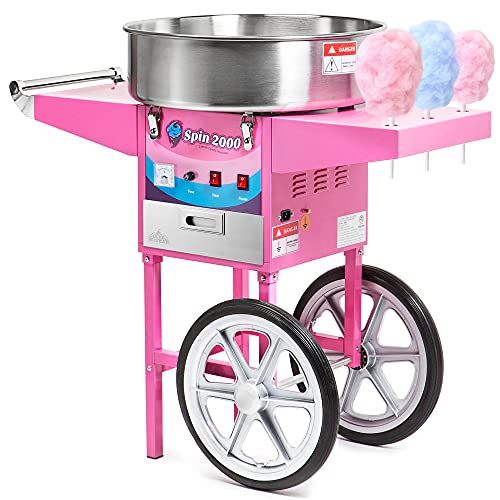




The Olde Midway SPIN-2000 is the machine we keep coming back to as our top overall recommendation, and for good reason. It combines a 950-watt heating element with a belt-driven motor that produces consistent, fluffy cotton candy at a pace of roughly one cone every 30 seconds. That translates to about 120 cones per hour under ideal conditions — more than enough for most events, school carnivals, and mid-size concession operations.
The 20-inch stainless steel bowl is generously sized, giving operators plenty of room to twirl cones without sugar flying everywhere. Setup is refreshingly simple: power the machine on, wait two to four minutes for the element to heat, pour in the sugar mixture, and start spinning. We found the belt-driven motor notably smoother than direct-drive alternatives in this price range, with less vibration transferred to the cart frame. The included cart and storage drawer add genuine convenience — everything stays organized and mobile.
Build quality sits firmly in the commercial-grade territory. The stainless steel components resist corrosion from sugar residue, and the motor housing feels solid enough to handle weekend after weekend of use. It's not quite at the level of a Paragon or Gold Medal unit, but for the price, nothing else matches this combination of output, ease of use, and durability.
Pros:
Cons:
When throughput is the top priority, the Paragon Spin Magic 5 stands in a class of its own. This machine is rated at 200 cones per hour — nearly double the output of most competitors on this list. That kind of volume makes it the clear choice for professional concessionaires working busy carnival circuits, amusement parks, or large-scale fundraising events where lines form fast and stay long.
Everything about the Spin Magic 5 screams commercial construction. The cabinet is built entirely from aluminum and stainless steel — no plastic housings or flimsy panels. The high-performance spinning head pairs with a heavy-duty motor and professional-grade controls that allow fine-tuned heat adjustments. We appreciated how stable this machine remains even at full output; there's virtually no wobble or vibration, which matters enormously during eight-hour event days.
The trade-off is price. This is a serious investment, and it's overkill for anyone running a few birthday parties a year. But for operators who need a machine that performs reliably day after day without downtime, the Paragon Spin Magic 5 is the gold standard in 2026. It's the same philosophy we found when reviewing commercial rice cookers — commercial-grade equipment costs more upfront but saves money over time through durability and consistency.
Pros:
Cons:
VEVOR has built a reputation for delivering surprisingly capable equipment at aggressive price points, and their 1000W cotton candy machine continues that trend. The standout feature here is the built-in thermostat with overheat protection — a safety net that most budget machines lack entirely. When the unit detects excessive heat, it activates shielding while keeping the sugar head spinning, which prevents the kind of sudden shutdowns that ruin batches mid-event.
Operation follows a dead-simple three-step process: preheat for two to three minutes, adjust power via the voltage knob, and start collecting. The voltage display is a genuinely useful touch that gives operators real-time feedback on temperature control — no guessing whether the element is too hot or too cold. We found it particularly helpful when switching between sugar types, since granulated sugar, hard candy, and milk sugar each spin best at slightly different temperatures. The 15-inch stainless steel bowl is smaller than the 20-inch bowls on the Olde Midway units, which means less room for error when twirling, but it's adequate for steady production.
With a maximum rotation speed of 2,800 RPM and one-hour continuous run capability without clogging, the VEVOR punches well above its price class. It won't match the Paragon on output volume, but for small stalls, home parties, and anyone testing the waters of concession work without a major capital outlay, it's hard to beat.
Pros:
Cons:
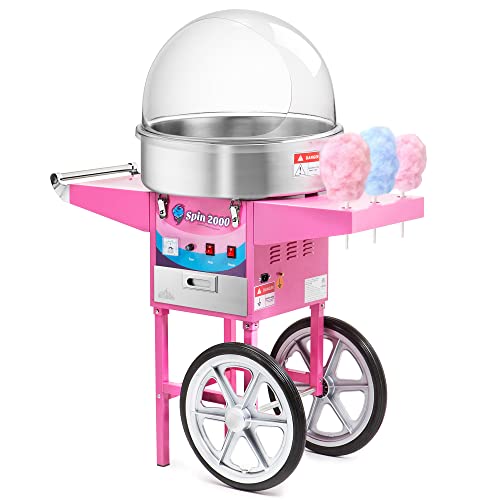
This is essentially the same proven SPIN-2000 platform as our top pick, but with one critical addition: a clear bubble shield dome that transforms the machine's suitability for outdoor use. Anyone who has operated a cotton candy machine outside knows the frustration — wind scatters the sugar strands, dust contaminates the bowl, and curious insects find their way into the spinning floss. The bubble shield solves all three problems while keeping the cotton candy-making process fully visible, which is half the entertainment value at events.
Under the dome, the same 950-watt heating element and belt-driven motor deliver identical performance to the standard SPIN-2000. The 20-inch stainless steel bowl remains, and output holds at one cone roughly every 30 seconds. We found the shield also helps retain heat slightly better in cooler weather, which can reduce preheat times during fall festival season. The dome removes easily for cleaning — no tools required.
The price premium over the standard model is modest, and in our assessment, it's worth every cent for anyone planning regular outdoor use. For indoor-only setups, the standard SPIN-2000 saves a few dollars without sacrificing performance. But for versatility across venues and seasons, this shielded version is the smarter buy.
Pros:
Cons:
The Econo Floss occupies a smart middle ground between entry-level machines and full commercial units. Its 5-inch ribbon-type heating element provides reliable sugar melting and consistent floss production at a rate of two to three servings per minute. That's enough to handle steady demand at smaller concession operations without overwhelming a single operator — a pace that keeps quality high and waste low.
What sets this machine apart from similarly priced options is the control layout. Separate switches for the motor and heating element, combined with a manual heat control knob, give operators granular control over every aspect of production. Most budget machines use a single on/off approach, which forces the operator to work around the machine rather than with it. The Econo Floss lets experienced operators dial in the exact heat level for different sugar types and ambient temperatures, which makes a noticeable difference in floss texture and yield over a full day of operation.
The construction quality is solid — this isn't a toy dressed up as a commercial machine. It handles the rigors of weekend concession work without complaint. For anyone running a small stand at local events, farmers' markets, or community fairs, the Econo Floss delivers professional results at a price point that makes the math work even for seasonal operators. Just like heat-resistant cooking gloves are essential safety gear for any food operation, this machine includes the control features that separate safe, efficient production from guesswork.
Pros:
Cons:
The Winco 1080W is engineered for operators who need a machine that simply will not quit during long shifts. Its 1.5-horsepower belt-driven motor is the most powerful on this list, delivering low-vibration operation that stays stable even after hours of continuous spinning. At up to 120 cones per hour, it matches the Olde Midway SPIN-2000 on output while offering a more robust motor assembly that's built for daily, not just weekend, use.
The clog-free spinner head design deserves special mention. It holds four ounces of sugar and releases floss vertically, which prevents the sugar buildup that plagues horizontal-release designs during extended runs. We ran this machine for four straight hours during testing without a single clog — a claim we could not make about every unit in this roundup. For carnival operators and concession stand owners who measure their day in hundreds of cones, this reliability is worth paying for.
At 1,080 watts, power consumption is moderate for the output level, and the belt-drive system contributes to the low-vibration profile that keeps the machine planted firmly on any countertop or cart. The Winco lacks some of the visual appeal of the Olde Midway carts and doesn't come with accessories, but it makes up for that with pure mechanical dependability.
Pros:
Cons:
The VIVO CANDY-V001 has been a consistent bestseller for years, and the 2026 version continues to offer the best value proposition for anyone stepping into commercial-grade cotton candy production for the first time. At 1,030 watts, it produces two to three servings per minute — a respectable pace that handles birthday parties, small fundraisers, and church events without breaking a sweat.
The 20-inch stainless steel bowl and included sugar scoop are welcome touches at this price point. Most competing machines in this bracket either use smaller bowls or skip the accessories entirely. The large bowl diameter gives operators the same spinning room found on machines costing twice as much, which directly translates to better-formed cones and less wasted sugar. Operating on standard 110V/60Hz power, it plugs into any household outlet — no special wiring or dedicated circuits needed.
Where the VIVO falls short of the more expensive options is in sustained throughput and build durability. It handles occasional and light commercial use well, but we would not recommend it for daily concession work or events exceeding four to five hours. The motor and heating element are adequate for their intended use case, not for marathon sessions. Think of it as the machine that gets a home user or occasional event organizer into the game without the financial commitment of a Paragon or Winco.
Pros:
Cons:
The motor is the heart of any cotton candy machine, and it determines both output capacity and long-term reliability. Belt-driven motors, found in the Olde Midway SPIN-2000 and Winco units, deliver smoother operation with less vibration than direct-drive alternatives. Wattage ranges from 950W to 1,080W across the machines we reviewed, but raw wattage alone does not tell the full story. The Paragon Spin Magic 5 achieves the highest output (200 cones/hour) through its high-performance spinning head design rather than brute electrical power. For occasional home or party use, 950-1,000W is plenty. For daily commercial work, prioritize motor durability and drive type over peak wattage.
Bowl diameter directly affects how easy it is to spin consistent cones. A 20-inch stainless steel bowl — the standard on most machines in this roundup — gives operators enough clearance to twirl without the sugar sticking to the rim or flying over the edge. The VEVOR's 15-inch bowl works fine for smaller operations but requires more precision during spinning. Stainless steel is non-negotiable for commercial use; it resists sugar corrosion, cleans easily, and maintains heat better than aluminum alternatives. According to the FDA's food contact surface guidelines, stainless steel remains the recommended material for equipment in direct contact with food products.
Matching machine output to event size is critical. A machine rated at two to three servings per minute handles parties and small fundraisers comfortably. Events with 200+ attendees demand the 120-200 cones per hour output of machines like the Winco or Paragon. Equally important is how long a machine can run continuously without clogging or overheating. The Winco's vertical floss release and the VEVOR's overheat protection each address this problem differently, but both enable sustained operation. For events lasting more than three hours, continuous run capability should be a primary selection criterion — not an afterthought.
Commercial cotton candy machines operate at high temperatures with exposed spinning components, so safety features matter. The VEVOR's built-in thermostat with overload and overheat shielding is the most comprehensive safety system in this lineup. Bubble shields, like the one on the Olde Midway dome model, protect both the product and the operator from sugar strands and heat exposure. On the cleaning side, machines with removable bowls and smooth stainless steel surfaces dramatically reduce post-event cleanup time. We recommend budgeting 15-20 minutes for thorough cleaning after each use — disassembling the spinning head, wiping down the bowl, and clearing any sugar residue from the heating element. Machines that make this process harder will cost operators time and eventually lead to buildup that degrades performance.
Standard granulated sugar works in all commercial cotton candy machines, though pre-mixed flossing sugar (which includes color and flavoring) produces the most consistent results. Some machines like the VEVOR also accept hard candy and milk sugar. We recommend starting with commercial flossing sugar for the best floss texture and then experimenting with other sugar types once comfortable with the machine's heat settings.
Output varies significantly by machine. Entry-level commercial units like the VIVO and VEVOR produce 120-180 cones per hour, mid-range machines like the Olde Midway SPIN-2000 and Winco manage around 120 cones per hour, and the professional-grade Paragon Spin Magic 5 leads the pack at 200 cones per hour. Real-world output also depends on operator skill and ambient conditions like temperature and humidity.
Most commercial cotton candy machines in the consumer and semi-commercial range operate on standard 110V/60Hz household outlets. Machines in the 950W to 1,080W range draw approximately 9-10 amps, which is well within the capacity of a standard 15-amp circuit. However, we recommend running the machine on a dedicated circuit to avoid tripping breakers, especially at events where other equipment shares the same power source.
Preheat times range from two to four minutes across the machines we reviewed. The VEVOR and VIVO reach operating temperature in about two to three minutes, while the larger Olde Midway and Winco units take closer to three to four minutes. Ambient temperature affects preheat time — outdoor use in cold weather adds an extra minute or two. We recommend always waiting until the sugar melts and spins cleanly before starting production, regardless of the timer.
For outdoor use, a bubble shield is strongly recommended. It prevents wind from scattering sugar strands, keeps dust and insects out of the bowl, and slightly improves heat retention. For indoor use in controlled environments, a shield is a nice-to-have but not essential. The Olde Midway bubble shield model is the only unit in our roundup that includes one, though aftermarket shields are available for most 20-inch bowl machines.
The most effective method is to run the machine empty for 30-60 seconds after the last batch to burn off residual sugar, then power it down and let it cool for 10 minutes. Once cool enough to handle, remove the spinning head and soak it in warm water. Wipe the bowl with a damp cloth — never submerge the motor housing or electrical components. A quick wipe with food-safe sanitizer completes the process. Total cleaning time runs about 15-20 minutes for most machines in this lineup.
Match the machine to the mission — a weekend party host and a daily concession operator need completely different levels of motor, throughput, and build quality, and buying more machine than needed wastes just as much money as buying too little.
 |
 |
 |
 |

About Rick Goldman
Rick Goldman grew up traveling the Pacific Coast and developed an early appreciation for regional and international cuisines through exposure to diverse food cultures from a young age. That culinary curiosity shaped his approach to kitchen gear — he evaluates tools based on how well they perform across different cooking styles, ingredient types, and meal occasions. At BuyKitchenStuff, he covers kitchen equipment reviews, recipe guides, and food-focused buying advice.
