Kitchen Gadgets & Equipment Reviews ›
by Rick Goldman
The Breville Juice Fountain Elite 800JEXL earns our top pick for best commercial juicer in 2026, thanks to its 1000-watt motor that extracts up to 30% more juice than traditional centrifugal models. Whether you run a busy juice bar, a restaurant with a fresh-pressed menu, or a health-focused café, investing in the right commercial juicer directly impacts your output quality and operational efficiency.
Commercial juicers differ from home units in virtually every measurable way — motor power, extraction speed, continuous-run durability, and ease of cleaning during high-volume service. The machines on this list range from dedicated citrus presses built for single-purpose speed to versatile centrifugal and masticating models that handle everything from leafy greens to dense root vegetables. If you're already exploring ways to incorporate fresh juice into your menu alongside recipes like a lemon water for weight loss program, a capable commercial juicer becomes an essential piece of your kitchen infrastructure.
We evaluated seven of the best commercial juicers available in 2026 across criteria that matter most in a professional setting: extraction yield, motor longevity, noise output, cleaning time, and overall value. Below you'll find our detailed reviews, a comparison table, a comprehensive buying guide, and answers to the most common questions buyers ask before committing to a commercial-grade machine.

Contents
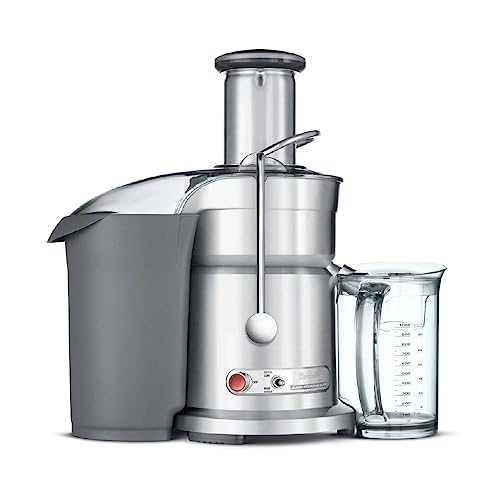


The Breville Juice Fountain Elite 800JEXL remains one of the most trusted names in high-performance juicing, and the 2026 model continues to deliver on that reputation. Powered by a 1000-watt motor spinning at up to 13,000 RPM, this machine generates the kind of extraction force that pulls up to 30% more juice from fruits and vegetables compared to standard centrifugal juicers. The titanium-reinforced cutting disc paired with an Italian-made micro mesh filter basket creates a two-stage system specifically engineered for maximum nutrient and juice yield from every piece of produce you feed through it.
What sets the 800JEXL apart in a commercial or semi-commercial environment is the combination of speed and refinement in its output. Over 40,000 filtering pores in the mesh basket produce remarkably smooth juice with minimal foam, which means you spend less time straining and more time serving. The 3-inch extra-wide feed chute accepts whole apples, carrots, and oranges without pre-cutting, which dramatically reduces your prep time during morning rushes or high-demand service windows.
Build quality is excellent across the board, with a die-cast steel housing that absorbs vibration and keeps noise levels manageable for a machine running at this speed. The dual-speed control lets you drop down to lower RPMs for softer fruits like berries and citrus, then ramp back up for harder produce like beets and ginger root, giving you the flexibility to handle a diverse juice menu from a single unit.
Pros:
Cons:
If you operate a dedicated juice bar or high-traffic restaurant where juicing happens continuously throughout service, the Robot Coupe J80 Ultra is the professional-grade workhorse you need. Built around a 1.25 HP motor running at 3,000 RPM, this machine is engineered for sustained commercial use where downtime simply isn't an option. The automatic feed system with integrated pulp ejection means you can process large batches of produce without stopping to empty containers, which keeps your line moving during peak hours.
Robot Coupe has a well-earned reputation in the commercial kitchen equipment space, and the J80 Ultra reflects that pedigree in every design decision. The centrifugal extraction system is paired with an automatic feed mechanism that handles continuous loading, so your staff can maintain a steady workflow rather than babysitting the machine through each batch. The stainless steel motor base isn't just an aesthetic choice — it provides the structural rigidity and corrosion resistance demanded by commercial kitchen environments where equipment gets washed down multiple times daily.
The anti-drip spout is a small but meaningful detail for service settings, keeping your countertops and juice station clean between pours without the mess that cheaper commercial units often leave behind. At this price point, you're investing in a machine that's built to run for years under heavy daily use, and the J80 Ultra delivers on that promise with the kind of build quality that justifies the premium over consumer-grade alternatives.
Pros:
Cons:
For operations that focus primarily on citrus — fresh-squeezed orange juice service at a hotel breakfast buffet, a lemonade stand at a farmers market, or a bar program that demands consistent fresh citrus for cocktails — the Waring Commercial JC4000 is purpose-built to excel. This is a dedicated citrus press with a heavy-duty direct-drive motor that delivers quiet operation alongside powerful, consistent extraction. The direct-drive design eliminates belt wear, which is one of the most common failure points in commercial juicers that see daily use.
The polycarbonate motor housing keeps the unit lightweight relative to its output capacity while the vibration-dampening feet ensure stable operation even during extended juicing sessions. Waring designed the stainless steel juice collector with an oversized spout specifically for high-volume production, allowing continuous pouring into pitchers or dispensers without the backup and overflow issues that plague smaller citrus units. If your fresh juice program centers on oranges, grapefruits, lemons, and limes, this machine handles them with the kind of speed and consistency your staff needs during busy service periods.
The dome-style reamer accommodates various citrus sizes and applies consistent downward pressure for thorough extraction without the bitterness that comes from over-pressing the pith. It's a single-purpose machine that does that one job exceptionally well, and in a commercial environment, that kind of specialization translates directly into efficiency and reliability.
Pros:
Cons:
The Zumex Essential Basic takes commercial citrus juicing to a fully automated level, processing up to 22 fruits per minute with minimal operator involvement. Where the Waring JC4000 requires manual pressing, the Zumex loads, cuts, squeezes, and ejects rinds automatically, making it the superior choice for operations where speed and hands-free consistency are paramount. The 4-5 fruit feeding capacity means your staff can load a batch and step away to handle other prep tasks while the machine works through the queue.
Zumex is a Spanish manufacturer with deep expertise in commercial citrus solutions, and the Essential Basic reflects that heritage with thoughtful engineering throughout. The 300-watt motor running on standard 115V power delivers reliable extraction without the electrical demands of larger commercial units, keeping your energy costs reasonable even during continuous morning service. The machine accommodates citrus diameters between 65mm and 81mm, which covers the range from standard limes through large navel oranges, giving you flexibility across your citrus menu without swapping reamers or adjusting settings.
The professional design aesthetic also deserves mention — Zumex machines are built to operate front-of-house, and the Essential Basic looks sharp on a buffet line or juice counter where customers can watch their fresh juice being made. That visual presentation adds value to your juice program beyond the functional extraction quality, turning a kitchen task into a customer-facing experience.
Pros:
Cons:
For juice bars, health clubs, spas, and smaller restaurant operations looking to add fresh juice without a massive capital investment, this 370W stainless steel commercial juice extractor offers genuine commercial capability at an entry-level price. The full stainless steel construction provides the corrosion resistance and easy cleaning that commercial environments demand, and the centrifugal extraction system handles a wide range of fruits and vegetables with respectable efficiency for its power class.
The standout feature for day-to-day commercial use is the adjustable juice outlet with eight different positions, which lets you direct the juice stream to exactly where your collection vessel sits without repositioning the machine. This sounds like a minor convenience until you're running a busy juice station and realize that every small efficiency adds up across hundreds of servings. The stainless steel body also wipes down quickly between different juice types, preventing flavor cross-contamination when you're switching from carrot-ginger to a green blend.
You should set realistic expectations with a 370W motor — this unit handles moderate volume well but isn't built for the continuous all-day operation that the Robot Coupe J80 delivers. For operations that produce dozens of juices per day rather than hundreds, however, this machine strikes an attractive balance between commercial-grade construction and accessible pricing that makes fresh juice service financially viable for smaller businesses. If you're building out a full commercial kitchen, you might also want to explore our guide to the best commercial juicers for additional options across different price tiers.
Pros:
Cons:
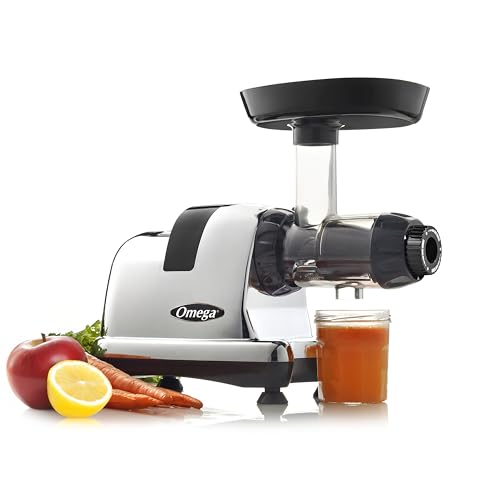
The Omega Cold Press Juicer takes a fundamentally different approach to extraction than every other machine on this list, and for health-focused operations, that difference matters enormously. Operating at just 80 RPM with triple-stage masticating technology, this machine crushes produce slowly and deliberately to minimize the heat buildup and oxidation that destroy enzymes and vitamins during high-speed centrifugal extraction. According to research on juicing methods, cold press extraction preserves significantly more nutrients than centrifugal juicing, and the Omega's design maximizes that advantage with its three-stage process.
Beyond pure juicing, the Omega functions as a complete nutrition system that extends your menu possibilities well beyond juice alone. You can extrude fresh pasta, grind coffee beans, make nut butters, prepare baby food, create frozen sorbets, and produce fresh soy milk — all from the same machine with different attachment configurations. For a small café or health food store where kitchen space and equipment budgets are limited, that versatility transforms a single countertop appliance into a multi-function production station. If you're incorporating fresh juice into wellness-oriented menu items like an oats smoothie for weight loss, the Omega's superior nutrient retention makes your health claims more substantive.
The trade-off with masticating technology is speed — you won't match the throughput of a centrifugal juicer running at 13,000 RPM, and the feed chute requires more pre-cutting. For operations where juice quality and nutritional density are the primary selling points rather than raw volume, the Omega delivers a measurably superior product that justifies longer preparation times and supports premium pricing on your menu.
Pros:
Cons:
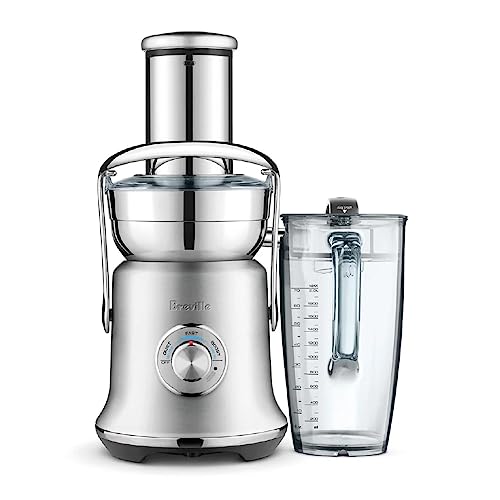
The Breville Juice Fountain Cold XL bridges the gap between traditional centrifugal speed and cold press nutrient preservation through its proprietary Cold Spin Technology. This system manages heat transfer during extraction so that you get the speed advantage of centrifugal juicing — up to five times faster than dedicated cold press machines — while preserving more vitamins and minerals than conventional high-speed juicers. The 70-fluid-ounce jug capacity means you can produce large batches without stopping to empty and restart, which is valuable for catering prep, meal-prep services, or busy breakfast operations.
The 3.5-inch feed chute is the widest in Breville's lineup and accepts even larger whole produce than the 800JEXL, further reducing your prep time and knife work. Paired with the Italian-made precision mesh filter, the Cold XL produces clean, well-filtered juice with good clarity and minimal foam, and the integrated Noise Reduction Technology makes it noticeably quieter than other centrifugal juicers at comparable power levels. That noise reduction is particularly valuable if you're operating in an open kitchen or front-of-house juice station where customer experience matters.
For operations that want the speed of centrifugal extraction without fully sacrificing the nutrient benefits associated with slower methods, the Cold XL represents Breville's most thoughtful compromise in their 2026 lineup. The brushed stainless steel finish gives it a professional appearance, and the overall build quality reflects Breville's consistent reputation for producing durable, well-engineered kitchen equipment that performs reliably through years of commercial and heavy home use. If you're outfitting a complete professional kitchen alongside your juicing station, our guide to the best chef aprons for restaurants covers another essential piece of your equipment list.
Pros:
Cons:
Your choice between centrifugal and masticating extraction should be driven primarily by your volume requirements and the type of produce you'll juice most frequently. Centrifugal juicers like the Breville 800JEXL and Robot Coupe J80 use high-speed spinning blades to separate juice from pulp rapidly, making them ideal for high-volume operations where speed directly impacts revenue. They excel with hard fruits and vegetables — apples, carrots, beets, cucumbers — and can process large quantities in short timeframes.
Masticating juicers like the Omega operate at low RPMs to crush and press produce, which yields more juice from leafy greens, wheatgrass, and soft fruits while preserving heat-sensitive nutrients and enzymes. The trade-off is throughput: masticating juicers produce higher-quality juice but at significantly lower volume, making them better suited for health-focused establishments where customers pay a premium for nutrient-dense, cold-pressed juice rather than quick-service juice bars prioritizing speed.
Motor wattage tells you how much power is available, but duty cycle tells you how long you can actually run the machine before it needs to rest. Consumer juicers typically have intermittent duty cycles — run for a few minutes, rest, repeat — while true commercial units like the Robot Coupe J80 are rated for continuous operation. If your operation serves juice throughout the day rather than in concentrated bursts, you need a machine specifically rated for extended continuous use, regardless of its wattage.
Look at the full power specification rather than just the headline number when comparing models on our commercial juicer category page. A 370W motor rated for continuous duty can outperform a 1000W motor with a 15-minute duty cycle in a sustained service environment, because consistent availability matters more than peak extraction speed when customers are waiting in line.
In a commercial environment, cleaning time is production time lost, so the speed and ease of disassembly directly impact your operational efficiency. The best commercial juicers break down into a handful of dishwasher-safe components that your staff can clean in under five minutes between batches. Stainless steel components resist staining from deeply pigmented produce like beets and turmeric, while plastic parts tend to absorb colors and odors over time, requiring more aggressive cleaning or eventual replacement.
Consider how many separate pieces each juicer disassembles into and whether those pieces are intuitive to reassemble correctly, since a machine assembled incorrectly after cleaning can produce inconsistent results or even pose safety risks. The models with the fewest removable parts and clearest reassembly points — like the Waring JC4000 and the Robot Coupe J80 — tend to see the highest compliance with cleaning protocols from kitchen staff, which matters more than the theoretical ease of cleaning.
Match your juicer selection to your actual peak demand rather than your average daily output, because the bottleneck during your busiest hour determines customer wait times and potential lost sales. A hotel breakfast buffet that serves 200 guests between 7 and 9 AM needs a different machine than a smoothie shop that processes 50 orders spread evenly across a 10-hour day, even if both operations produce similar total daily volumes.
For concentrated high-volume windows, prioritize extraction speed and large collection containers — the Breville Cold XL's 70-ounce jug and the Robot Coupe J80's continuous pulp ejection are specifically designed for this scenario. For steady all-day service with moderate peaks, a versatile mid-range centrifugal juicer handles the workload without the premium price tag of true continuous-duty commercial equipment. If your service model allows advance preparation, cold-pressed juice from a masticating juicer can be stored for 24-48 hours with minimal nutrient degradation, letting you batch-produce during off-peak hours.
Commercial juicers are built with more powerful motors rated for extended continuous operation, heavier-gauge materials that withstand daily use and frequent cleaning, and larger feed chutes and collection containers designed for high-volume production. Home juicers typically have intermittent duty cycles that require rest periods between batches and use lighter construction materials that wear faster under heavy use. The motor power, build quality, and extraction efficiency in commercial models justify their higher price when you're producing juice for customers rather than occasional personal use.
Neither type is universally better — the right choice depends entirely on your operation's priorities. Centrifugal juicers process produce five to ten times faster, making them essential for high-volume juice bars and fast-service environments. Masticating juicers extract more nutrients and handle leafy greens far better, making them ideal for health-focused businesses where juice quality commands premium pricing. Many successful juice operations use both types: a centrifugal model for high-demand items and a masticating unit for specialty cold-pressed offerings.
You should disassemble and thoroughly clean your commercial juicer at minimum after every service period, and ideally between different juice types to prevent flavor cross-contamination. Most health department regulations require cleaning food contact surfaces every four hours during continuous use, though best practice is more frequent cleaning to maintain juice quality and prevent pulp buildup from reducing extraction efficiency. A quick rinse between batches of the same juice type keeps performance consistent, while a full breakdown cleaning at the end of each shift prevents residue buildup.
You can juice leafy greens in a centrifugal juicer, but the yield will be significantly lower than what a masticating juicer produces from the same quantity of greens. The technique that helps most is wrapping leafy greens tightly into a compact ball and feeding them through with a harder produce item like an apple or carrot immediately after, which pushes the greens through the blade more effectively. For operations where green juices represent a significant portion of your menu, a masticating juicer like the Omega will extract measurably more juice and nutrients from kale, spinach, and wheatgrass.
For centrifugal juicers handling hard produce in a commercial setting, look for at least 700 watts to ensure consistent extraction speed without bogging down on dense items like beets and ginger root. The sweet spot for most commercial operations falls between 1000 and 1500 watts, which provides enough power for continuous processing without excessive energy consumption. Masticating juicers operate effectively at much lower wattages — 150 to 400 watts — because they rely on torque and slow compression rather than high-speed cutting, so wattage comparisons across different juicer types are not meaningful.
Fresh centrifugal juice should be served within 15 to 30 minutes for optimal flavor, color, and nutrient content, as the high-speed extraction introduces more oxygen that accelerates oxidation and separation. Cold-pressed juice from masticating juicers retains its quality for 24 to 48 hours when stored in airtight containers under refrigeration at 35-38°F, which is why many cold-pressed juice businesses batch-produce and bottle their products for grab-and-go retail. If you plan to offer bottled juice alongside fresh-made options, a masticating juicer gives you the shelf life flexibility to support that business model.
 |
 |
 |
 |

About Rick Goldman
Rick Goldman grew up traveling the Pacific Coast and developed an early appreciation for regional and international cuisines through exposure to diverse food cultures from a young age. That culinary curiosity shaped his approach to kitchen gear — he evaluates tools based on how well they perform across different cooking styles, ingredient types, and meal occasions. At BuyKitchenStuff, he covers kitchen equipment reviews, recipe guides, and food-focused buying advice.
