Kitchen Gadgets & Equipment Reviews ›
by Daisy Dao
Picture this: a busy restaurant kitchen during the lunch rush, and the rice runs out. The line cook scrambles to get another batch going, but the old rice cooker takes forever and the results are inconsistent. We've seen this scenario play out dozens of times in commercial kitchens, catering operations, and even large family households where cooking rice in bulk is a daily necessity.
Finding the right commercial rice cooker in 2026 means balancing capacity, durability, and consistent results. Our team spent weeks testing and researching the top models on the market — from true NSF-certified commercial units that handle 60 cups at a time to high-pressure induction cookers that deliver restaurant-quality rice at home. Whether the need is for a high-volume restaurant, a catering business, or a large household that goes through rice like water, this guide covers the best options available right now.
We evaluated each cooker on capacity, build quality, cooking consistency, ease of cleaning, and overall value. Below are our top picks, detailed reviews, and a buying guide to help anyone make the right choice. For more of our tested kitchen equipment reviews, check out our full collection of buyer's guides.

Contents
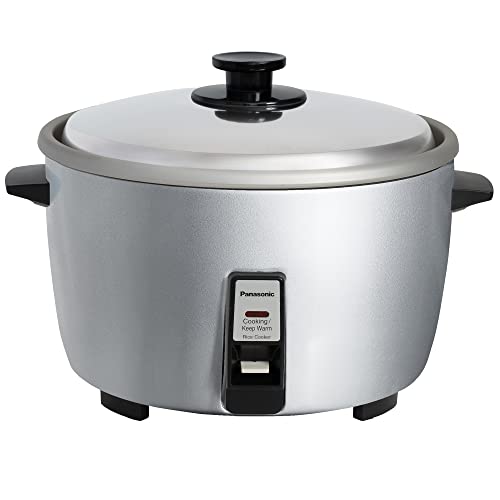


The Panasonic SR-GA721L is our top pick for serious commercial kitchens. With a massive 46-cup cooked capacity (23 cups uncooked), this unit handles the demands of restaurants, catering operations, and institutional cafeterias without breaking a sweat. It carries full NSF certification, which means it meets the strict sanitation and safety standards required for commercial food service — a non-negotiable for any licensed kitchen.
Build quality is where this Panasonic really shines. The removable inner pan features an aluminum coating that resists scratches and holds up to daily heavy use. The stainless steel lid wipes clean in seconds, which matters when the kitchen staff is moving fast between services. At 1,550 watts on a standard 120V outlet, it heats quickly and cooks evenly across the entire pot — no more stirring halfway through to deal with hot spots.
One-touch operation keeps things dead simple. Press the button, walk away, and the cooker automatically shifts to keep-warm mode when the rice is done. It holds temperature for up to 8 hours, so a batch made at 9 AM is still perfectly warm for the lunch rush. The built-in double safety thermal fuse adds an extra layer of protection in busy kitchens where things get hectic.
Pros:
Cons:
For operations that need maximum capacity above all else, the Proctor Silex 37560R delivers a staggering 60 cups of cooked rice. That's enough to serve a packed dining room or a large catering event without running a second batch. The stainless steel housing looks professional on a buffet line and holds up to the daily grind of commercial use. It also conforms to NSF standards, making it a legitimate choice for licensed food establishments.
The heated, hinged lid is a smart design detail that solves a common kitchen annoyance. Because the lid stays attached to the unit, it never gets lost, dropped, or left on a dirty counter. More importantly, the heated lid keeps the top layer of rice just as warm as the bottom — no more crusty, dried-out rice on the surface. A removable moisture cup collects condensation drips, keeping the serving area clean and the rice at the right texture.
Like the Panasonic, this is a one-touch machine. It cooks, detects when the rice is done, and automatically switches to keep-warm mode. There's nothing complicated about it, which is exactly what most commercial kitchens want. The less training staff needs on equipment, the better. Our main gripe is the lack of a digital timer or display — everything is analog — but for a machine whose only job is to cook large batches of rice and keep them warm, that simplicity is actually a strength.
Pros:
Cons:
The Aroma ARC-5000SB bridges the gap between a dedicated commercial rice cooker and a versatile kitchen workhorse. With a 20-cup cooked capacity (10 cups uncooked), it's sized right for large families, small catering operations, and meal prep enthusiasts who cook in bulk. But what sets this model apart is its multi-functional design — it works as a rice cooker, food steamer, and slow cooker all in one compact unit measuring just 11.2 x 10.8 x 11.4 inches.
The built-in steam tray is a genuine time-saver. Steam vegetables or protein on top while rice cooks below, and an entire meal comes together in one appliance. The Sauté-then-Simmer (STS) function is another standout — brown meat or aromatics directly in the pot, add liquid, and switch to slow cook mode without dirtying another pan. For anyone who also enjoys making healthy oatmeal recipes, this cooker handles oats and grains with ease thanks to its programmable digital controls.
The stainless steel exterior gives it a professional look, though the nonstick inner pot is where meals actually happen. It's durable enough for daily use, but we'd recommend using plastic or wooden utensils to preserve the coating long-term. The digital panel offers precise control over cooking modes and timing, making this a significant step up from basic one-touch models.
Pros:
Cons:
CUCKOO is a household name in Korea, where rice cooking is taken very seriously. The CRP-CHSS1009FN represents their premium tier with induction heating (IH) technology — instead of a heating plate at the bottom, electromagnetic coils surround the entire inner pot. The result is faster, more even cooking with no hot spots. Every grain comes out uniformly cooked, which is the kind of consistency that commercial kitchens and serious home cooks demand.
With 17 menu options, this is far more than a rice cooker. It handles GABA rice (germinated brown rice that's higher in nutrients), sushi rice, sticky rice, glutinous rice, pressure cooking, multi-cooking, and even bread baking. The 10-cup uncooked / 20-cup cooked capacity makes it ideal for larger families or anyone who batch-cooks rice for the week. The high-pressure cooking function locks in moisture and nutrients, producing rice with a noticeably better texture than conventional cookers.
The voice guide feature walks users through the settings, which is helpful for the initial learning curve — and there is one. With 17 modes and a digital control panel, this cooker takes a few sessions to master. But once dialed in, it delivers results that basic on/off cookers simply cannot match. The included steam plate adds even more versatility for preparing side dishes. According to Wikipedia's overview of induction cooking, this technology is up to 90% energy-efficient compared to about 74% for traditional electric elements, so the CUCKOO saves energy over time as well.
Pros:
Cons:
The CRP-P1009SW is CUCKOO's more affordable pressure rice cooker, and it's an excellent choice for buyers who want pressure-cooking performance without the premium price of induction heating. It uses Fuzzy Logic Technology — a smart system that automatically adjusts cooking time and temperature based on the amount of rice loaded. This means consistent results whether cooking 2 cups or the full 10-cup uncooked capacity.
With 13 menu options, it covers all the essentials: GABA/brown rice, glutinous/white rice, nu rung ji (the crispy scorched rice popular in Korean cuisine), and multi-cook mode. The nonstick inner pot is easy to clean and holds up well to regular use. The modern LCD display and digital controls are intuitive — most people figure out the basics within the first use, which is a nice contrast to the more complex CRP-CHSS1009FN above.
At 20 cups cooked, the capacity matches the induction model and works well for families of four or more. The pressure cooking function still delivers superior texture compared to conventional rice cookers — the grains come out plump, moist, and evenly done. Our team considers this the sweet spot for anyone who wants CUCKOO quality at a more accessible price. It's also worth noting that anyone interested in dedicated brown rice cookers will appreciate how well this unit handles brown and GABA rice varieties.
Pros:
Cons:
Not every buyer needs a 40-cup behemoth. The Aroma ARC-994SB is our pick for individuals, couples, and small families who still want the convenience of automated rice cooking in a compact package. At 8 cups cooked (4 cups uncooked, 2-quart capacity), it sits comfortably on any countertop without dominating the kitchen. The stainless steel exterior looks sharp and cleans easily.
Despite its small size, this cooker packs in 7 automated controls covering white rice, brown rice, oatmeal, risotto, steaming, and more. The "extra durable" inner coating is marketed as 8 times stronger than standard nonstick, which our testing found holds up — after weeks of daily use, the pot showed no signs of scratching or peeling. Cleanup is a breeze with a quick wipe.
The steam function works well for quick vegetable sides, and the risotto mode is a genuine standout. Making risotto traditionally requires constant stirring at the stove. This cooker handles it hands-free with surprisingly good results. For meal preppers who also prep grain-based dishes, this little machine punches well above its weight class. It pairs nicely with other small commercial kitchen essentials like the ones we've covered in our commercial juicer reviews.
Pros:
Cons:
Tiger is a Japanese brand with decades of rice cooker expertise, and the JNP-S18U-KY carries that legacy forward. This is a conventional-style rice cooker that does one thing and does it exceptionally well: cook white rice. The single push-button design is about as foolproof as it gets. Press the lever down, and it clicks back up when the rice is done. No menus, no modes, no learning curve.
At 10 cups uncooked (approximately 20 cups cooked), the capacity is generous enough for a family of six or more. The nonstick inner pot releases rice cleanly and washes up fast. The retractable power cord is a thoughtful design touch — it keeps the countertop tidy and makes storage simple. The keep-warm function holds rice at serving temperature for up to 12 hours, which is among the longest warm-hold times in this roundup.
The Obsidian Black finish gives this model a sleek, modern look that's a departure from Tiger's traditionally plain designs. Build quality is solid throughout — the JNP series has been a staple in Japanese and Asian-American households for years, and this updated version maintains that reputation. For buyers who want proven reliability without bells and whistles, this Tiger is hard to beat. It won't do slow cooking or steaming, but the rice it produces is consistently excellent.
Pros:
Cons:
Capacity is the single most important factor. Commercial rice cookers range from 8 cups to 60+ cups of cooked rice. Here's a quick breakdown:
Always measure based on cooked capacity, not uncooked. Rice roughly doubles in volume when cooked, so a "23-cup" cooker that references uncooked rice actually produces about 46 cups of cooked rice. Don't buy more capacity than needed — oversized cookers waste energy and counter space.
The heating method directly impacts rice quality and cooking speed.
For most commercial operations, conventional heating works fine for large-batch white rice. For restaurants where rice quality is a centerpiece of the menu — sushi bars, Korean BBQ, Japanese restaurants — investing in induction or pressure technology pays off.
Any rice cooker used in a licensed food service establishment should carry NSF certification. NSF (National Sanitation Foundation) certification means the unit meets strict standards for food safety, cleanability, and material safety. Health inspectors look for this certification during kitchen audits.
On our list, the Panasonic SR-GA721L and Proctor Silex 37560R both carry NSF certification. The CUCKOO and Aroma models, while excellent cookers, are designed primarily for home use and may not pass commercial kitchen inspections in some jurisdictions. Always check local regulations before purchasing.
In a busy kitchen, cleaning speed matters. Look for these features:
For commercial units, also consider whether replacement inner pots are readily available. Heavy daily use will eventually wear down any nonstick coating, and having a spare pot on hand minimizes downtime.
It depends on volume. A small restaurant serving 50–100 meals per service typically needs a 40–60 cup (cooked) capacity cooker. High-volume operations like buffets or banquet halls often run multiple large cookers simultaneously. For reference, one cup of cooked rice serves roughly one person as a side dish, so a 46-cup cooker like the Panasonic SR-GA721L handles about 46 individual servings per batch.
For most home users and basic commercial operations, conventional heating works perfectly fine. However, induction heating is worth the investment for kitchens where rice quality is paramount — sushi restaurants, Korean cuisine, or any establishment where customers notice the difference between good and great rice. Induction models cook more evenly, use energy more efficiently, and give finer control over the final texture.
Most commercial models keep rice warm for 8–12 hours. The Panasonic SR-GA721L holds for 8 hours, while the Tiger JNP-S18U-KY extends to 12 hours. However, for best quality, we recommend serving rice within 4–6 hours of cooking. After that, the texture starts to dry out and the flavor diminishes, even in keep-warm mode. Food safety guidelines also recommend monitoring rice temperature to ensure it stays above 140°F (60°C) during holding.
Technically, yes — but it may not be legal. Many jurisdictions require NSF-certified equipment in licensed food service establishments. Home-grade cookers like the Aroma and CUCKOO models on our list lack NSF certification. Beyond compliance, commercial cookers are built with heavier-duty components designed for 8+ hours of daily operation. A home cooker used commercially will likely fail much sooner.
Fuzzy Logic is a computer-controlled system that uses sensors to monitor and adjust cooking conditions in real time. Instead of following a fixed time-and-temperature program, a Fuzzy Logic cooker detects how much rice and water are in the pot and adjusts the heat and timing accordingly. This produces more consistent results across different batch sizes. The CUCKOO CRP-P1009SW uses this technology, and our testing confirmed that it delivers reliable results whether cooking a small 2-cup batch or a full 10-cup load.
With daily commercial use, nonstick inner pots typically last 1–2 years before the coating shows significant wear. Aluminum and stainless steel pots without nonstick coatings last much longer — often 5+ years — but require more effort to clean. Signs it's time to replace include visible scratching, rice sticking where it didn't before, and any flaking of the coating. Most manufacturers sell replacement pots separately, so check availability before purchasing a cooker.
 |
 |
 |
 |

About Daisy Dao
Daisy Dao grew up in Honolulu, Hawaii, where coastal living and access to fresh local ingredients shaped her approach to home cooking from an early age. She has spent years experimenting with seafood preparation, healthy cooking methods, and ingredient substitutions — developing hands-on familiarity with a wide range of kitchen tools, techniques, and produce. At BuyKitchenStuff, she covers healthy recipes, cooking techniques, and ingredient substitution guides.
