Kitchen Gadgets & Equipment Reviews ›
by Daisy Dao
What's the single best butcher knife on the market right now — and is it actually worth the price tag? We've tested seven top-rated blades across a range of price points, and our answer is clear: the Victorinox Fibrox Pro earns our top spot for 2026, delivering professional-grade performance at a price that doesn't require a second mortgage. Whether we're breaking down a whole hog or trimming a brisket for competition day, a quality butcher knife is the one tool that can't be swapped out for something else.
A butcher knife is purpose-built for heavy-duty meat work — splitting, portioning, and trimming large cuts where a chef's knife would buckle under the pressure. According to Wikipedia's overview of butcher knives, these blades trace their lineage back centuries and are designed with a distinctive curve and heft that standard kitchen cutlery simply can't replicate. In 2026, the category spans everything from ultra-affordable carbon steel workhorses to high-end Japanese super-steel showpieces, and knowing which type fits the job is half the battle.
We've spent considerable time researching and evaluating every option in our butcher knife reviews guide to bring this list down to the seven that genuinely stand out. We considered blade steel, handle ergonomics, edge geometry, weight balance, and real-world cutting performance. If anyone is shopping for a knife that'll handle serious meat work without letting them down mid-task, this guide has the answers.

Contents




The Victorinox Fibrox Pro is, in our assessment, the definitive butcher knife for 2026 — and it's been the benchmark in this category for years for very good reason. The 10-inch blade is crafted from high-carbon stainless steel, conical ground and ice-tempered to maintain a razor edge through the kind of extended butchering sessions that would destroy a lesser knife. The hollow-ground, straight-edge geometry gives it the heft to power through thick cuts while keeping enough precision for trimming work.
What really sets this knife apart in daily use is the Fibrox Pro handle. It's NSF-certified, genuinely non-slip even when covered in fat and moisture, and ergonomically weighted so the blade does most of the work. The built-in finger guard is a practical safety feature that professionals appreciate — and home butchers will too, especially during long cutting sessions. The laser-tested edge comes sharp out of the box and holds well between sharpenings. For anyone who also uses a whetstone for knife maintenance, this steel responds beautifully to regular honing.
We've used this knife on everything from whole chickens to full pork loins and large beef roasts. It performs consistently across all of them. At its price point, nothing else on this list comes close to matching the overall package of build quality, performance, and longevity. This is our unambiguous #1 pick.
Pros:
Cons:
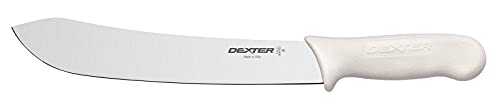
Dexter-Russell has been supplying professional butchers and meat processing facilities for well over a century, and the S112-10PCP is exactly the kind of no-nonsense workhorse that reputation is built on. The 10-inch blade with a pointed tip is purpose-built for the demands of commercial environments — it's lean, functional, and designed to keep performing through shifts that would humble most consumer knives. At just 0.58 lbs, it's lighter than it looks, which makes a real difference during repetitive cutting tasks.
What we appreciate most about this knife is how unapologetically utilitarian it is. There's no marketing language about exotic steel or artisan finishing — Dexter-Russell makes knives for people who use them hard, every day. The pointed blade tip gives it more versatility than a rounded butcher knife, allowing for more precise trimming and scoring work alongside the heavy-duty portioning tasks. The blade geometry suits both freehand cuts and board work equally well.
Anyone who prioritizes pure function over aesthetics will find this knife deeply satisfying. It's the kind of blade that quietly becomes indispensable. Pairing it with a quality meat injector — we've reviewed the best meat injectors here — completes a solid meat preparation toolkit.
Pros:
Cons:
The Mercer Culinary BPX is a precision-forged German steel knife that punches well above its price class. Ice hardening during the forging process increases blade strength and wear resistance, and the mirror-finished blade isn't just aesthetically pleasing — it actually reduces drag during cutting, helping the knife glide through large cuts of meat more smoothly. This is the kind of detail that separates a thoughtfully engineered knife from a commodity product.
The handle is glass-reinforced nylon with a textured grip pattern, and it performs exactly as advertised — comfortable, non-slip, and durable enough to handle serious use. The balance point is well-placed for a breaking knife, favoring the blade slightly to give more momentum through heavier cuts. We found it especially effective for splitting and stripping large primal cuts, trimming silverskin, and slicing through roasts cleanly. The mirror finish really does make a difference — food releases from the blade readily, which keeps cuts cleaner and technique sharper.
For anyone who wants a meaningful upgrade from entry-level options without committing to a premium price, the BPX is the most sensible recommendation we can make. It's versatile, well-built, and comfortable for extended use sessions.
Pros:
Cons:
If budget isn't the primary concern, the DALSTRONG Shogun Series ELITE is the most technically impressive butcher knife on this list — and it's not particularly close. The blade is precision-forged from a single piece of Japanese AUS-10V super steel with 66 layers of folded steel, enhanced with vacuum treatment and nitrogen cooling. That process yields a blade sharpened to 8-10 degrees per side, which is an ultra-acute angle that produces a cutting edge most kitchen knives simply can't match. This knife glides through brisket fat like it isn't there.
The curved blade geometry is engineered specifically for a single-motion cutting stroke — no sawing required. We found it especially effective for breaking down large game and working through cartilage, where the leverage created by the curve transfers force efficiently into the cut. The G10 handle is mil-spec rated and virtually indestructible, offering a secure grip across a wide range of hand sizes. The Shogun Series ELITE is as close to a professional competition-grade butcher knife as the consumer market offers in 2026.
It comes with a sheath included, which is a meaningful addition for storage and transport. This is the knife we'd recommend to serious BBQ competitors, professional chefs, or home butchers who process significant quantities of meat and want the absolute best tool available.
Pros:
Cons:
Global occupies a unique position in the knife market — a Japanese brand that specifically engineered a heavier knife for those who want Japanese metallurgy with Western-style heft. The GF series is their answer to that demand, and the GF-27 is a genuinely distinctive blade. At 7 inches, it's the shortest knife on this list, but the added weight in the GF series compensates by delivering more cutting authority than the blade length alone would suggest. The CROMOVA 18 stainless steel is face-ground with a long taper, which means the edge geometry stays sharp for longer between maintenance sessions.
The all-stainless construction — blade and handle in one seamless design — is immediately recognizable as Global's signature. There are no seams, no handle joints, no spots where bacteria can accumulate. That makes it exceptionally easy to sanitize, which is an underappreciated advantage in any serious meat-processing environment. The handle is dimpled for grip, and while it takes some getting used to compared to traditional handle shapes, most users adapt quickly.
The GF-27 is our top pick for anyone specifically seeking a Japanese-style blade that still delivers the weight and authority of a traditional butcher knife. It's a niche recommendation, but the right niche absolutely loves this knife.
Pros:
Cons:
The Old Hickory is a throwback in the best possible sense — a no-frills American-made carbon steel butcher knife that does exactly what the category was invented to do. The 7-inch blade is forged from 1095 carbon steel, which is a high-carbon alloy prized among traditionalist knife enthusiasts for its ability to take and hold an exceptionally keen edge. It sharpens faster than stainless steel and, for many users, feels more responsive on a whetstone. The trade-off is maintenance: 1095 carbon steel will rust if neglected, and it requires drying and occasional oiling to stay in top condition.
The handle is a classic hardwood design — simple, functional, and comfortable. There's nothing ergonomic-committee-designed about it, and that's exactly the point. Old Hickory has been making knives this way since 1889, and the approach hasn't needed updating because it works. For traditionalists, hunters, and homesteaders who process their own game and appreciate old-school craftsmanship, this knife is genuinely irreplaceable. After a session on the grill, cleaning up with a quality non-stick grill pan — like the options in our best non-stick grill pan guide — and then tending to this blade is a satisfying routine.
The price is remarkably low for the quality of steel involved. Anyone willing to commit to basic carbon steel maintenance will own a capable, lifetime-quality knife at a budget price.
Pros:
Cons:
The Cangshan HELENA is the newest entry on our list and one of the most visually striking. Handcrafted from German X50CrMoV15 steel — the same alloy found on many premium European knives — it's full-tang forged construction, sharpened to a precise 16-degree angle, and finished with an elegant black aesthetic that makes it stand out in any kitchen setup. The tight-grained German steel offers excellent stain resistance and strong edge retention, which suits home butchers who process meat occasionally rather than daily.
The slim, ergonomic handle is genuinely one of the better-feeling designs we've tested this year. It fits the hand naturally without requiring adjustment, and the weight distribution between blade and handle is well-calibrated for the 10-inch length. The HELENA handles carving, trimming, skinning, and portioning with equal confidence. Cangshan's claim that it also handles large fruits and vegetables holds up — the blade geometry and weight make it a versatile all-rounder that earns its counter space beyond pure butchery tasks. As a gift or kitchen upgrade in 2026, the HELENA presents exceptionally well.
Our one reservation is that it's the newest product on this list, so long-term durability data is still limited. What we've seen so far is very promising, but buyers should know they're investing in a newer product with a shorter track record than the Victorinox or Dexter-Russell options.
Pros:
Cons:
The steel type is the most consequential decision in any butcher knife purchase. Here's how we break it down:
Our recommendation for most buyers: start with a high-carbon stainless option. Upgrade to Japanese steel only when the performance ceiling of stainless steel becomes a real limitation.
Butcher knife sizing follows the task, not personal preference alone.
Handle performance in a butcher knife matters more than in most other kitchen knives because the work involves significant force and often wet, fatty hands. Key considerations:
Edge angle determines how a knife performs and how it's maintained. Broader angles are more durable; acute angles are sharper but more demanding to maintain correctly.
For anyone new to maintaining fine-edged knives, learning how to use a whetstone properly before investing in a premium blade is genuinely worthwhile. Maintaining the correct angle is the single biggest factor in long-term edge retention.
A butcher knife is specifically designed for heavy-duty meat work — splitting large primal cuts, portioning whole animals, and trimming thick fat and silverskin. It has more mass, a wider blade, and a more robust edge geometry than a chef's knife. A chef's knife is designed for general kitchen tasks including vegetables, herbs, and lighter protein work. They serve different purposes, and neither one is a replacement for the other in a fully equipped kitchen.
That depends entirely on the steel type, how it's used, and how it's stored. High-carbon stainless options like the Victorinox typically need honing before each use session and full sharpening every few months for home butchers. Japanese super steels like the DALSTRONG AUS-10V hold their edge longer but require more careful sharpening technique when the time comes. Carbon steel blades like the Old Hickory 1095 sharpen quickly and easily but may need touching up more frequently during heavy use sessions.
The short answer is yes, but it's not optimized for it. Butcher knives handle large vegetables, melons, and squash very effectively given their size and weight. The Cangshan HELENA is explicitly designed to handle this dual-purpose use. For everyday chopping, mincing, and precision work, a standard chef's knife remains more practical. Most serious cooks keep both in rotation and reach for the butcher knife when the task demands it.
For most home butchers and serious home cooks, high-carbon stainless steel is the more practical choice. It delivers strong performance without demanding the active rust-prevention maintenance that pure carbon steel requires. Pure carbon steel — like the Old Hickory's 1095 — is the right call for traditionalists, hunters, and users who understand and enjoy that maintenance routine. Japanese super steels represent the performance ceiling but carry both a higher price and a steeper maintenance learning curve.
A 10-inch blade is the most versatile length for home butchery — long enough to handle large roasts, briskets, and primal cuts efficiently, while still manageable in a home kitchen environment. Seven-inch options like the Global GF-27 and Old Hickory are better for users focused on detailed trimming and smaller cuts, or those with smaller hands. Our team defaults to the 10-inch format when recommending a single knife for general home butchery use.
A magnetic knife strip or a wooden knife block are the two best storage options for a quality butcher knife. Drawer storage — even with a blade guard — causes edge degradation from contact with other utensils over time. A sheath (included with the DALSTRONG Shogun Series) is the right solution for transport. Carbon steel knives like the Old Hickory should always be stored dry and may benefit from a light coat of food-safe mineral oil on the blade to prevent oxidation.
 |
 |
 |
 |

About Daisy Dao
Daisy Dao grew up in Honolulu, Hawaii, where coastal living and access to fresh local ingredients shaped her approach to home cooking from an early age. She has spent years experimenting with seafood preparation, healthy cooking methods, and ingredient substitutions — developing hands-on familiarity with a wide range of kitchen tools, techniques, and produce. At BuyKitchenStuff, she covers healthy recipes, cooking techniques, and ingredient substitution guides.
